
Camera red flags in this category are unusually easy to spot, and the reason is not that suppliers here are dishonest. It is that the published specification is so thin that a claim has nowhere to hide. Across our whole camera range there is no published sensor model, no field of view, no video resolution, no frame rate, no aperture, no stabilisation figure, no low-light behaviour and no storage format. What is published is the resolution tier and the electrical rows around it: cell configurations from 220 mAh to 290 mAh, a charge time of two hours or less on every camera platform, runtimes from roughly five to eight hours, magnetic or Type-C charging, and case capacities from 900 mAh to 1400 mAh where a case exists.
Against that background, a supplier claiming camera sophistication is claiming it against a very short list of facts, and smart glasses camera technology smart glasses red flags is best understood as a list of the things a supplier does when the camera data is thin.
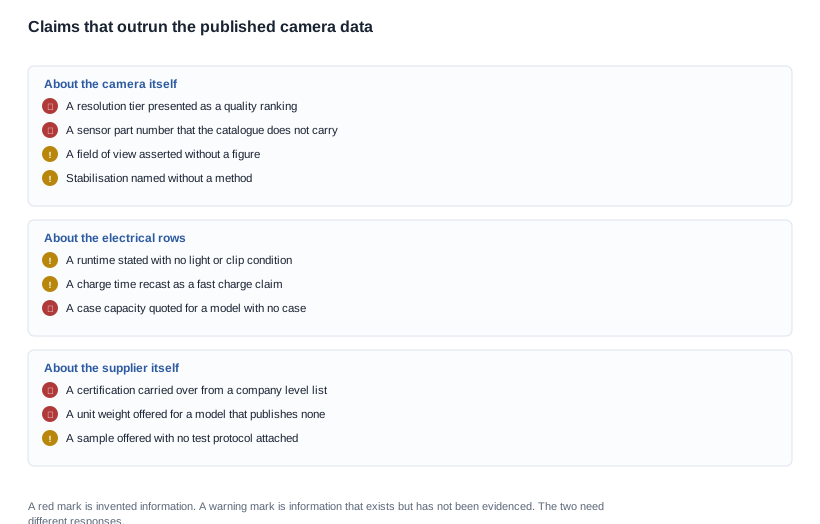
The distinction that makes the list usable is between information that is missing and information that has been invented. A missing row is a question. An invented row is a claim, and a claim that cannot be reproduced becomes a customer complaint, a review, or a regulatory problem in the market you are selling into. Most of the red flags below sit on the second side of that line.
Smart glasses camera technology: six claims that outrun the published rows
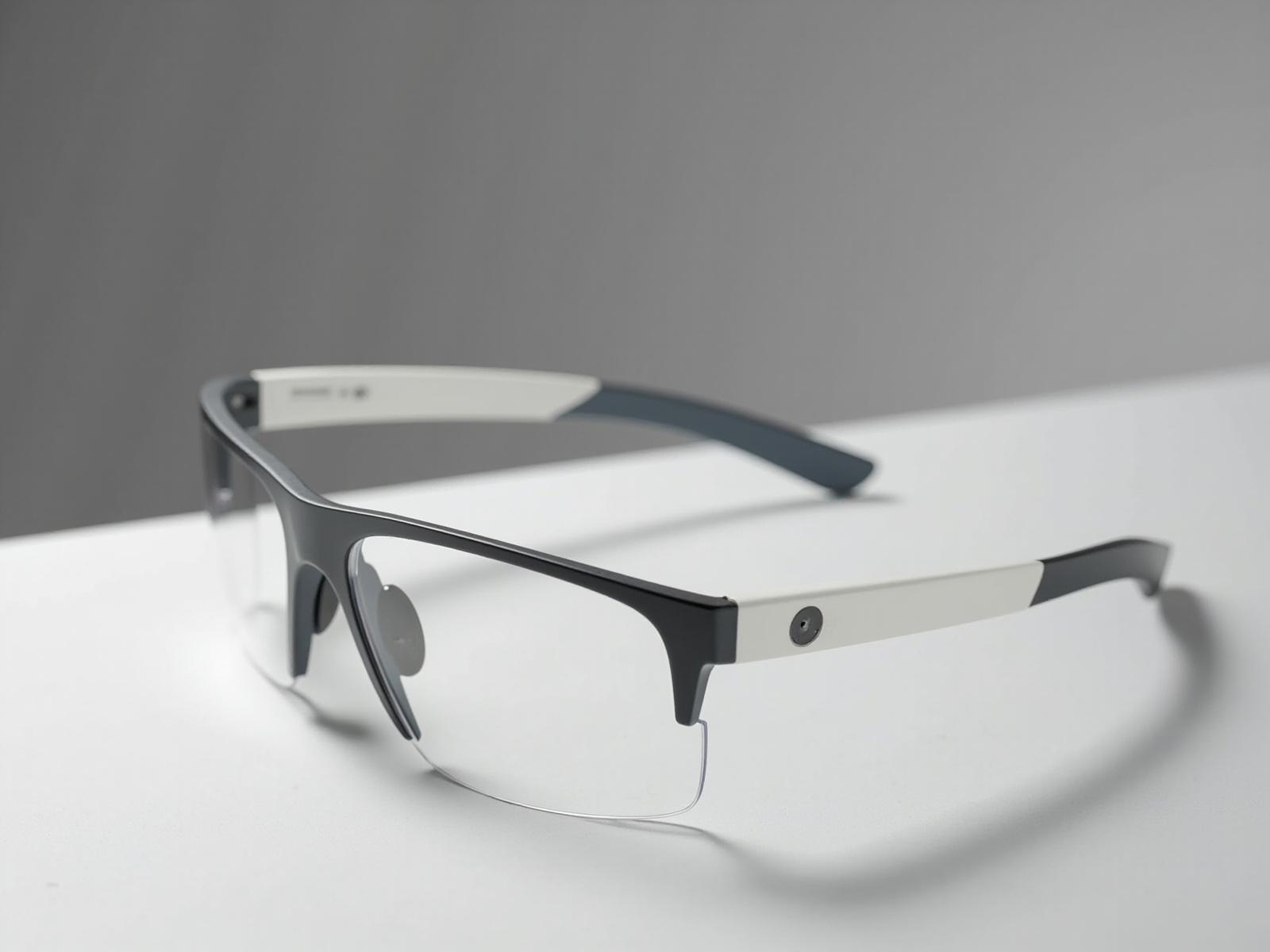
These are the claims that recur across supplier listings and quotation responses, and in each case the problem is not that the claim might be false. The problem is that the claim is unfalsifiable as written.
The resolution tier presented as a quality ranking. "13 MP" says how many pixels the sensor records. It does not say how large those pixels are, how much light they gather, or how the camera behaves at dusk. A listing that uses a megapixel count as though it were an image quality statement is making an inference the data does not support — and the inference happens to favour the more expensive product, which is what makes it worth flagging.
A sensor part number that nobody can trace. Naming a specific sensor is informative, because a part number implies a pixel size and an age. But a part number that does not appear in any of the supplier's own documents, offered verbally on a call, is worse than no part number at all: it is a detail that will appear in your copy and cannot be defended.
A field of view asserted without a figure. "Wide angle" settles nothing, because the question is not whether the lens is wide but how wide in degrees, measured at what distance from the eye, and whether that figure is horizontal, vertical or diagonal. A field of view quoted without a distance is not a number.
Stabilisation named as a method. Optical, electronic, hybrid and software stabilisation produce visibly different results, and only one of them is a hardware fact about the camera. A listing that says "stabilised" is making a claim about the footage, and the buyer who repeats it in the copy is responsible for it.
A runtime stated with no light or clip condition. Our published runtimes — five to eight hours on the V03 and the S7, and the V06 and the V03 Pro, six to eight hours on the KY06 and the MT5, and about seven hours on the L1 Pro and the MT6, and the L2 Utral and the CY05, and the CY03 — carry no statement about how the recording was made. "Up to eight hours" is a range compressed into a single number, and it is the number that ends up on the product page.
A case capacity quoted for a model that has no case. Case capacities are published for five platforms: 1400 mAh on the CY03 and the L1 Pro, and the CY05, 900 or 1400 mAh on the L2 Utral depending on configuration, and a foldable 1200 mAh on the MT6. The KY06 and the MT5 have a charging case with no published capacity. A figure for either of those is not in the catalogue, and it should be asked for rather than assumed.
The one that appears on almost every listing
If a supplier's camera copy is identical across every model in the range, that copy is describing the category and not the product. The reason is practical: the same sentence copied across a product family is cheaper to produce, and a supplier who has done it is telling you that the camera was not configured per model.
A genuine per-model camera configuration produces visible differences between models, because the module, the lens and the housing differ. Our own range shows this: the V03 Pro is distinguished by photochromic lenses and a flexible temple, the V06 and the S7 by the detachable inner frame and the IP54 marking, the MT6 by its folding case and the only published unit weight in the catalogue at 158 g for the glasses themselves. A supplier whose copy does not distinguish any of that is writing for the category.
Two claims that only look like red flags
Two things that read as warnings are actually legitimate, and misreading them costs a supplier that is behaving properly.
The first is a runtime quoted as a range. "Five to eight hours" is more honest than "up to eight hours", and a supplier who publishes the range and explains what moves inside it is describing a measurement rather than writing a marketing line. Our own catalogue does exactly this: the V03 and the V06, and the S7 and the V03 Pro publish five to eight hours, the KY06 and the MT5 publish six to eight hours, and the 290 mAh platforms publish a single figure of about seven hours. A range is not a weak claim. A range with no explanation of what varies inside it is.
The second is a claim scoped to a configuration. The L2 Utral publishes two case capacities, 900 mAh and 1400 mAh, so any statement about that platform has to name which configuration it describes. A supplier who says the case holds 1400 mAh is not wrong, because the 1400 mAh case exists; they are incomplete. The red flag is never specificity — it is ambiguity that a customer cannot resolve after the goods have arrived.
Both errors are expensive, and they pull in opposite directions. A supplier wrongly suspected of over-claiming is a supplier who stops publishing ranges, and the next quotation you receive will carry a single optimistic number instead. A supplier wrongly accepted because the claim was scoped produces a page that does not match the configuration the customer received, and those returns get attributed to the product rather than to the page.
Three structural signals that the specification was never built
Some red flags are not about a sentence in a listing. They are about the shape of the business behind it, and they are visible before any sample is tested.
There is no engineering answer to a technical question. Ask which sensor is fitted and the answer is a description of what a sensor does. Ask for the part number and the answer becomes a discussion of the company's product planning. A supplier who has a defined configuration can name it; one who has a platform assembled from whatever is available that month cannot.
The same answer comes for every model in the range. Ask for the field of view on the 8 MP group and the 13 MP group and get the same figure, or get a figure for one model and a gesture for the others. Real configurations differ by model, and a supplier who has not configured them differently is not going to have measured them differently either.
Certification is offered at company level for a model-level need. Our catalogue presents export certification as a company capability on its front page, and it does not carry a per-model certification row. A supplier who answers "we have export certification, our customers use it for the whole range" has answered a different question from the one you asked. Whether a particular model designation holds a particular certificate is a per-model question and has to be answered per model, with a reference.
Four questions that separate a measured supplier from an adjective supplier
The point of asking a question in writing is that the form of the answer tells you as much as its content. A supplier who has measured something answers with a figure and a condition. A supplier who has read the same datasheet you have answers with a figure and no condition. A supplier who has neither answers with an adjective.
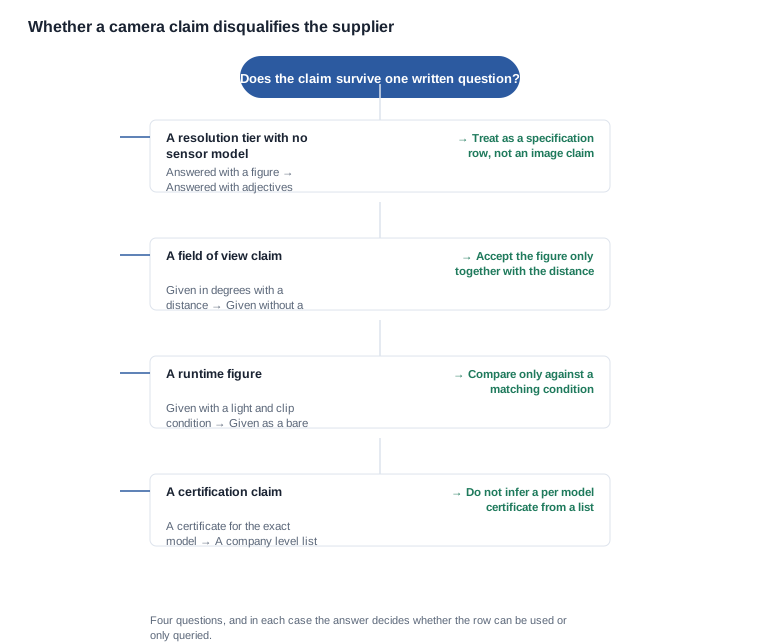
- What is the sensor part number, and can you send the document it appears in? A part number with a document is an answer. A part number on its own is a rumour. No answer is a red flag about the configuration, not about the honesty.
- What angle does the lens cover, measured from where? The distance matters as much as the angle, because a horizontal field of view quoted from the lens centre and the same figure quoted from the eye position are different numbers, and only one of them describes what a customer sees.
- What format and rate does it record, and can a recording be played back? Asking for a recording rather than a specification tests two things at once: whether the platform records video rather than stills, and whether the supplier is willing to let you examine the output.
- How long does the battery last, under what condition? The answer that matters is the condition. A runtime with a light level, a clip length and a recording mode attached is a measurement; the same number without them is a copy of the same catalogue row everyone else copied.
The cheapest disqualifying question is the first one, because it costs a paragraph and can be asked before the sample is even ordered. The most revealing is the third, because a supplier who is confident about the hardware will usually send a recording without being pressed.
Where the red flags appear, and in which document
Three documents carry them, and each one carries a different kind. The product page or listing carries the claims, and it is where a red flag is most visible because the page is written for persuasion. The quotation and the specification sheet carries the configuration, and it is where a red flag does the most damage, because the sheet is what the factory builds to and what a contract is written against. The sample report or inspection note carries the evidence, and it is where a red flag is most likely to sit quietly, because a supplier who has written more than it can show on the sample has an obvious reason not to foreground the difference.
Reading the three against each other is far more informative than reading any one of them, and the comparison costs nothing because all three normally arrive together. Where the page claims more than the sheet supports, the page is the problem and it is the cheapest one to fix. Where the sheet states more than the sample report confirms, the sheet is the problem and it is the expensive one, because a build specification is a commitment. Where the sheet and the page agree with each other and both disagree with the sample report, the supplier is not describing one product and building another — it is describing a product that may not exist, and that is the most serious of the three outcomes and the one that most often ends a supplier relationship before the first order.

How the answer changes the commercial risk
The useful thing about a written answer is that it changes what you may do with the row afterwards. An answer with a condition can be quoted as a specification and, with the condition attached, can support a claim. An answer without a condition can still be used internally for planning, but it cannot be printed on a product page. An answer that conflicts with the catalogue can be used for nothing at all until the conflict is resolved.
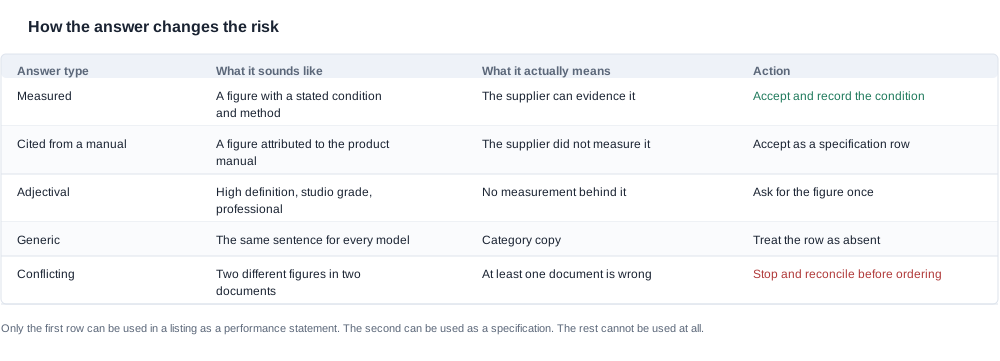
The fifth row in that table is the one that stops a buyer rather than merely slowing them down. Two figures that contradict each other, one in the product documentation and one in an email, mean that at least one document is wrong, and neither can be used until the supplier has said which. If the two figures are for the same measurement under the same conditions, the disagreement is close to the worst case a buyer can meet in this category, because it means nobody in the chain has looked at both.
A useful discipline for a procurement team is to keep a single answer sheet per supplier rather than a folder of documents, with the date, the source and the condition attached to every figure. The sheet makes two things visible that a folder hides: which figures have never been confirmed, and which figures were confirmed against a different condition from the one now being discussed.
What the red flags protect you from in money
The commercial argument for doing this work is straightforward and it is not about the reputational risk. It is about the three costs that arrive later and are attributed to other causes.
The reprint. A product page that claims a sensor, a field of view or a runtime condition the hardware does not support has to be corrected after publication, and a correction on a live listing costs traffic and generates a thread on the page itself.
The return. A camera product bought for its imagery returns when the imagery does not match the page. Returns on a camera product are disproportionately expensive because the diagnosis has to happen at the customer's end, and the customer usually sends a description rather than a measurement.
The market finding. In a regulated market, an unsupported claim on a product page is not a marketing problem, it is a compliance problem, and it is found by someone other than the brand. A camera device carried on a person also raises a privacy dimension that a plain audio product does not, and a listing that overstates what the camera records invites exactly the attention that a buyer would rather not attract.
None of the three is large enough to justify a slow evaluation, and all three are cheap to avoid at the quotation stage, which is the only stage where avoidance is cheap. The red flags are therefore worth checking before the sample rather than after the launch, even though the people best placed to spot them are usually the ones who are not in the room.
There is a fourth cost that does not appear on any ledger, and it is the one that decides whether the check is made at all. A red flag that is found during evaluation costs a paragraph and a delay. The same red flag found after launch costs a reprint, a returns cluster and a supplier relationship, and by that point the person who could have asked the question has usually moved on to another project. The commercial value of the check is therefore concentrated almost entirely in the weeks before the order, which is why a red flag list belongs in the evaluation stage rather than in a document written afterwards.
The practical form of that is a short standing checklist, attached to the evaluation file, with the same items for every supplier in the category. A checklist that changes between suppliers tests the supplier rather than the category, and a category that keeps producing the same red flags is a category where every buyer is paying for the same discovery separately.
Where the empty rows sit in our own catalogue
We will not quote a field of view, a video specification, a stabilisation claim or a storage behaviour for any model in this range, and we will tell you plainly that those have to go to the engineering team rather than be estimated.
What our catalogue does publish, for every one of the eleven camera platforms, is the resolution tier, the cell capacity, the runtime and the charge time, and for seven of the eleven the charging interface as well. Eight models state 8 MP — the V03 Pro and the CY03, the MT5 and the V06, and the KY06 and the V03, and the CY05 and the MT6 — and three state 13 MP: the L1 Pro and the S7, and the L2 Utral. The unit weight is published for one model in the entire catalogue, the MT6 at 158 g for the glasses themselves, with its 1200 mAh folding case capacity listed separately and the case weight not published at all.
What we do not publish for any camera platform is the sensor model, the field of view, the video resolution and frame rate, the aperture, the stabilisation method, the low-light behaviour, the storage capacity and format, and the capture latency. We also publish no per-model certification row, and we would not let a company-level export certification be turned into a model-level claim by anyone.
That is the same rule we hold other suppliers to. A row that is filled is one we can source. A row that is empty is one we would rather mark open than fill with a typical value from the industry, because a listing built on a typical value produces exactly the kind of review that says the footage is not what the page promised.
Send us the model and the use case and we will say which of these red flags are likely to matter for your programme and which are noise for it.
Related reading
- The claims to cross-check before ordering — camera manufacturer claims
- The verification sequence for a supplier — camera supplier verification
- Where the camera platforms sit — AI camera glasses range
- The background on the published rows — camera imaging
Send the model and the use case and we will say which of these red flags are likely to matter for you.


