
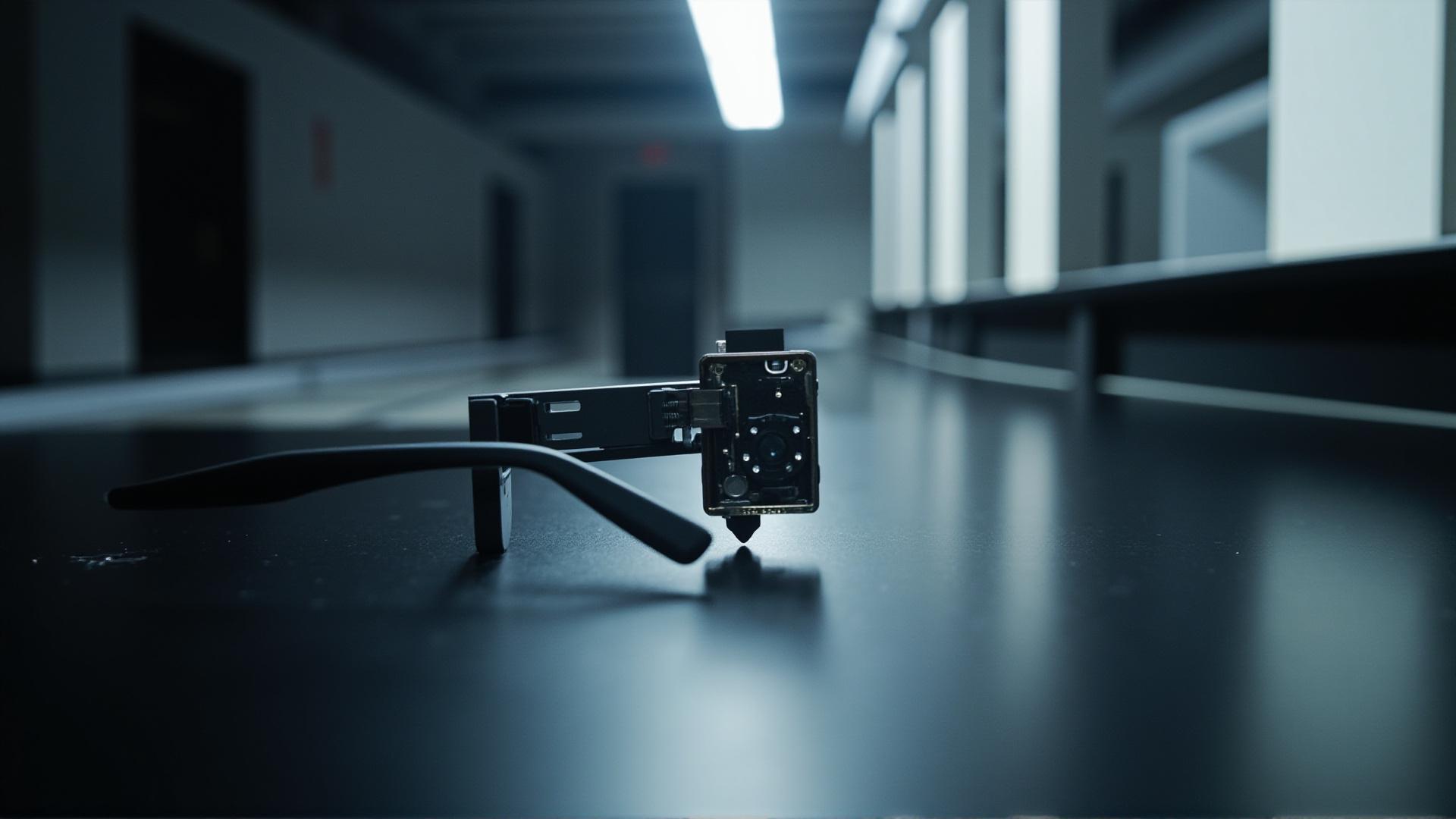
Camera cost in smart glasses is dominated by a set of decisions that are all made in the frame and the temple, and none of which is the sensor. A buyer who negotiates on the sensor price will negotiate the smallest number in the programme, and will do it at the point where the supplier has the least room to move.
Our published data in the camera tier shows the configuration space a cost conversation happens in: two resolution tiers, 8 MP and 13 MP, cell configurations from 220 mAh to 290 mAh, charge times of two hours or less, rated runtimes of roughly five to eight hours, magnetic charging on five of the eleven platforms with a Type-C port on the V03 Pro and the L2 Utral, four camera platforms that publish no interface row at all, and case capacities published at 1400 mAh, 900 or 1400 mAh, and a foldable 1200 mAh. The 13 MP tier appears on the L1 Pro and the S7, and the L2 Utral. The sensor model, the field of view, the video specification, the stabilisation, the low-light behaviour and the storage format are all Not published.
So smart glasses camera technology smart glasses cost factors is a question about which decisions actually move the cost, where each one appears in a quotation, and which of them are still open when the unit price is agreed.
Smart glasses camera technology: where the money sits
The cost is mostly not in the electronics line
A camera glasses quotation usually presents as a unit price with a handful of one-off lines above it, and the natural reading is that the unit price is the electronics and the one-off lines are the setup. That reading is wrong for a camera product, and it is wrong in a specific way: the camera's largest cost consequences are not in the electronics line at all.
The reason is geometric. A camera module sits in the front of a temple, and putting it there changes the section thickness of that temple, the mass distribution across the front of the frame, the geometry of the front, the tooling that produces them, and the assembly steps on the line. The cost of a camera therefore lands in the frame and in the tooling, and it lands there because of the electronics, which is why it does not appear next to the electronics in a quotation.
This is the practical reason two camera quotations can differ by a wide margin while looking nearly identical on a spreadsheet. A supplier who itemises the camera module at one line and the frame tooling at another has shown you the smaller part of the difference.
The seven drivers, and where each one lands
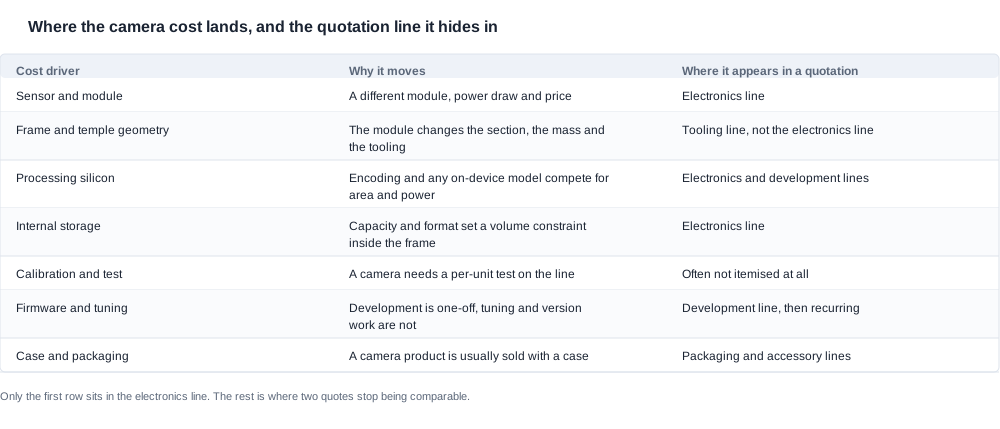
| Cost driver | Why it moves | Where it appears in a quotation |
|---|---|---|
| Sensor and module | A different module, power draw and price | Electronics line |
| Frame and temple geometry | The module changes the section, the mass and the tooling | Tooling line, not the electronics line |
| Processing silicon | Encoding and any on-device model compete for area and power | Electronics and development lines |
| Internal storage | Capacity and format set a volume constraint inside the frame | Electronics line |
| Calibration and test | A camera needs a per-unit test on the line | Often not itemised at all |
| Firmware and tuning | Development is one-off; tuning and version work are not | Development line, then recurring |
| Case and packaging | A camera product is usually sold with a case | Packaging and accessory lines |
Only the first row sits in the electronics line. The remaining six are where two quotes stop being comparable, and a buyer who compares a quote that itemises all seven against a quote that itemises two is not comparing two products.
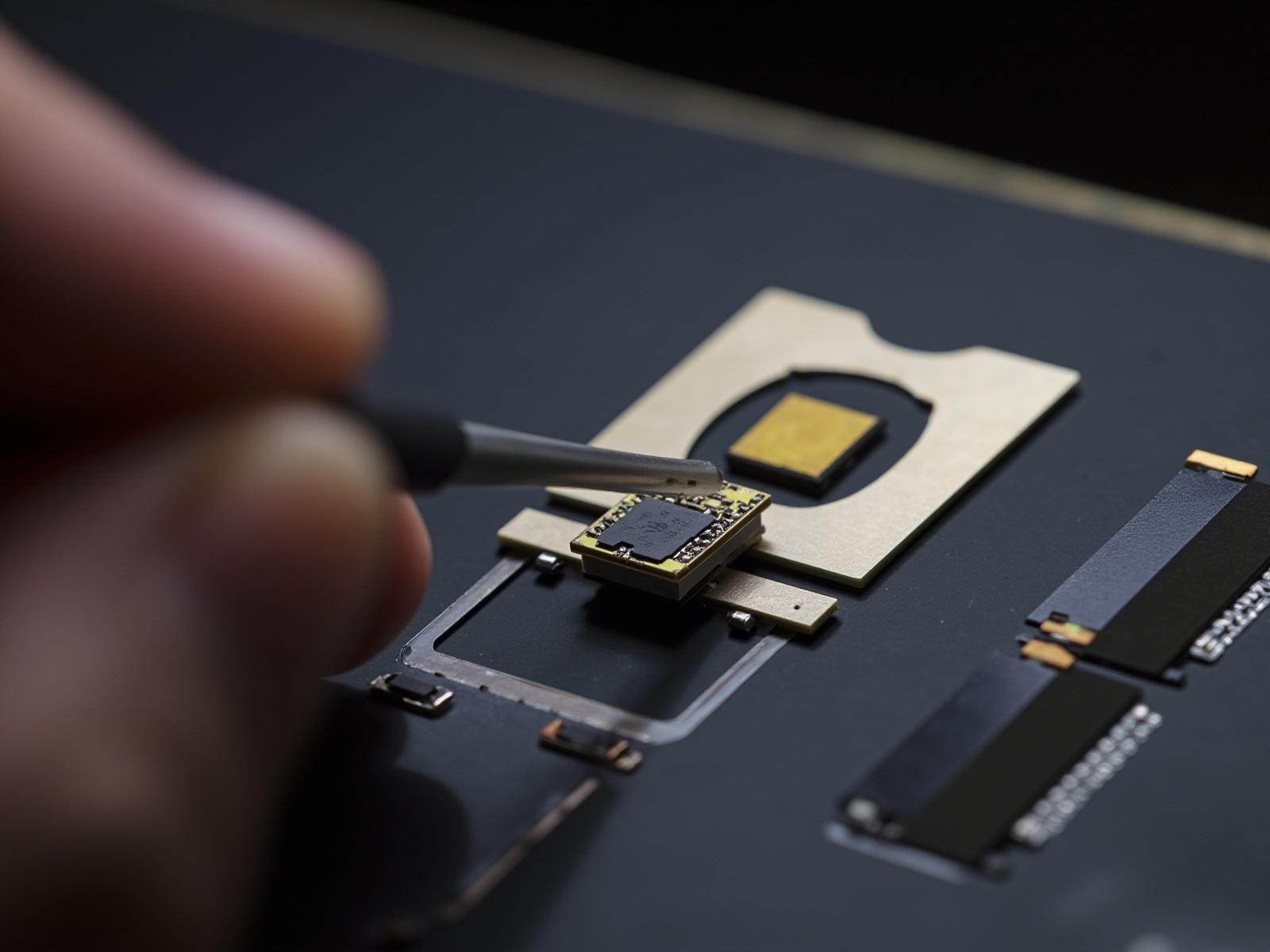
The five cost drivers that a quotation rarely itemises
The five recurring costs that are quoted as one-off
The camera calibration and the test fixture. This is a recurring cost per unit and a recurring time on the line, not a setup charge. A supplier who quotes the fixture as a one-off and then leaves the per-unit test time out of the line rate has moved the cost somewhere invisible, and at volume it is the item that determines the true unit cost.
The mounting and alignment tooling. Also recurring per unit, inside the assembly operation. Alignment is the step where the module is positioned relative to the frame, and it is the step whose cycle time grows when the frame gets heavier and the module has to be held in a fixed position.
The firmware and the image processing work. The development is a one-off. The tuning data, the per-market configuration and the version maintenance are not, and for a camera product they recur every time a new host device or a new application version appears in the field.
The evaluation units. A camera programme needs more sample units than an audio programme, because the reference unit and the comparison unit have to sit alongside the production units. That is a line in the quotation, and it is usually an order of magnitude larger than a buyer expects because it is usually counted as a unit count rather than as a comparison requirement.
The end-of-line test time. A per-unit time cost in a production line, often invisible in a quotation because the supplier considers it part of the process. On a high-volume line it is a real cost, and it is one of the few lines that scales with volume in a way the buyer can calculate.
The cost stack, from the channel down to the silicon
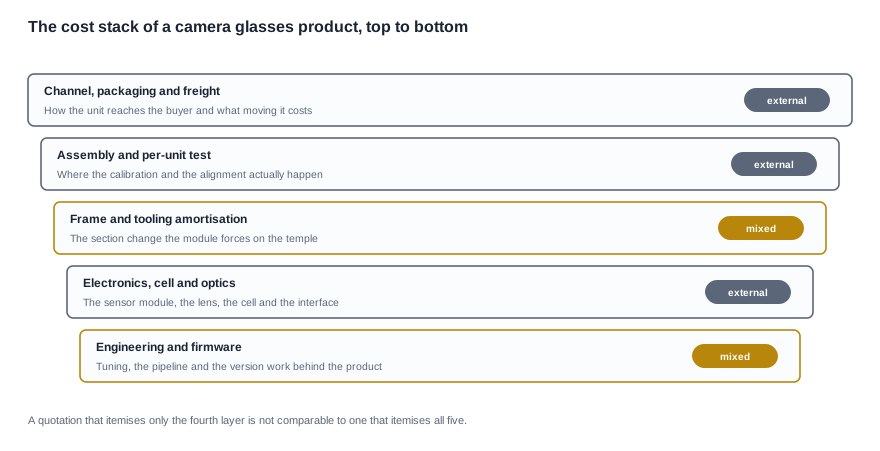
Read the stack from the top and the picture is clear: the costs closest to the buyer are the ones hardest to negotiate, because they are freight, packaging and the labour content of the line, while the costs nearest the silicon are the ones the supplier treats as fixed and the buyer treats as variable. That mismatch is where a cost conversation usually goes wrong.
What the published cell figures tell you about the cost structure
The cell is the one published cost input with a value attached
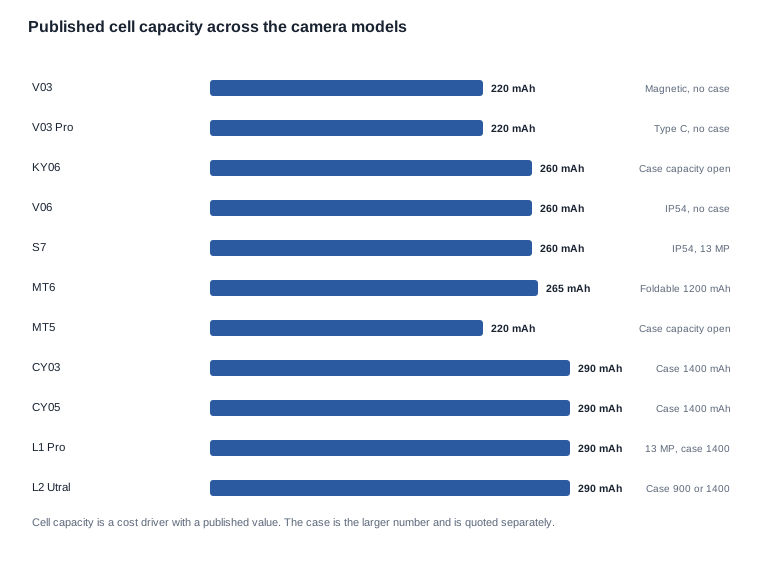
Cell capacity is unusual in this catalogue because it is both published and a direct cost input. Eleven camera models, four capacity values. The MT5 and the V03 Pro, and the V03 sit at 220 mAh. The S7 and the V06, and the KY06 sit at 260 mAh. The MT6 sits at 265 mAh. The L1 Pro and the CY03, and the L2 Utral and the CY05 sit at 290 mAh. The differences between them are not cosmetic: a 290 mAh cell and a 220 mAh cell are different parts with different tooling implications, different certification implications and a different pack volume inside a temple that a camera module has already made thicker.
What the chart also shows is the second, larger number. Seven of the eleven camera models ship with a charging case, and the case is where the real energy cost sits: 1400 mAh on the CY03 and the CY05, and the L1 Pro, 900 or 1400 mAh on the L2 Utral, and a foldable 1200 mAh on the MT6. The KY06 and the MT5 are shown with a case whose capacity the catalogue does not publish, which means a buyer comparing those two against the rest is comparing a known figure with an unknown one and should ask rather than assume.
Four camera models publish no charging-case row at all — the S7 and the V06, and the V03 and the V03 Pro — which makes the case an open configuration question rather than a documented accessory, and therefore a negotiation object.
Why the runtime band matters commercially even though it is not a cost line
The published runtimes are about seven hours on the 290 mAh configurations, five to eight hours on the 220 mAh ones, six to eight hours on the KY06 and the MT5, and five to eight hours on the V06 and the S7, with no test condition attached to any of them. A runtime figure without a test condition does not price the product, but it does set the customer's expectation, and the expectation determines the return rate. A buyer who sells a five-to-eight-hour product into a shift-based use case has bought a support cost into the unit price.
The same applies to the charging interface. Magnetic charging on five of the eleven camera models — the KY06 and the V03, and the S7 and the V06, and the MT5 — a Type-C port on the V03 Pro, a Type-C interface badge on the L2 Utral catalogue page, and no interface row at all on the CY05 and the MT6, and the L1 Pro and the CY03. An interface choice is a packaging choice, a cable choice in the box, and a charging-cycle choice for the customer, and all three of those are costed somewhere, which is what makes an interface the catalogue does not state an unpriced line rather than a free one.
Making two camera quotations comparable line by line
Six questions that turn two quotes into one comparison
- Which sensor is used, and what is the module? One part number, and it tells you the module cost, the power draw and the plausible low-light performance.
- What is the field of view, and how does the frame's own geometry occlude the scene? The usable view is a product property, and the frame's contribution to it is a cost driver as well as a specification.
- What are the video resolutions and frame rates, and what storage does that require? The storage requirement follows from the video requirement, and both are volume constraints inside a frame.
- Is there stabilisation, and of what type? Optical, electronic and software are three different implementations with three different costs, and the software version depends on the processor.
- What is the end-of-line test, and how long does it take per unit? A per-unit time cost in a production line.
- What does the camera add to the frame's tooling and to the assembly steps? The question that exposes the largest single difference between two quotes.
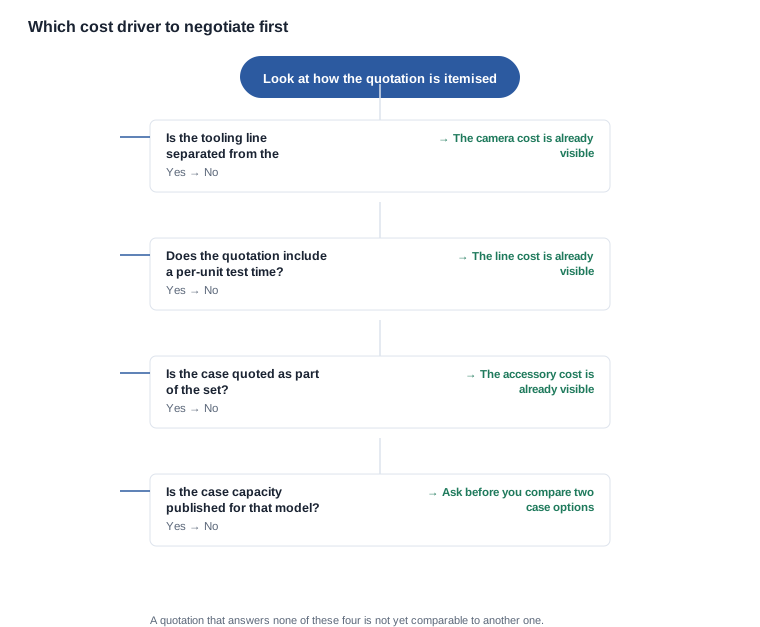
The four questions that expose an incomplete quotation
The decision chart above is a read of the quotation rather than of the product. If the tooling line is separated from the electronics line, the camera cost is already visible and the buyer can negotiate against it. If the quotation includes a per-unit test time, the line cost is already visible. If the case is quoted as part of the set rather than as an accessory, the accessory cost is already visible. And if the case capacity is published for the model in question, two case options can be compared without a request.
A quotation that answers none of these four is not yet comparable to another quotation, and the correct response is not to negotiate but to ask for the four answers. It is worth saying plainly that this is common, and that it is not a sign of a bad supplier. It is a sign that the supplier quotes the way their internal cost model works, and the buyer has to translate between the two models.
The five mistakes that turn a cost comparison into a wrong decision
Negotiating the sensor. It is a small part of the cost and a fixed part of the design once the platform is chosen. Comparing quotes on the camera tier without comparing the frame. The camera's cost is substantially in the frame, and a quote that itemises the electronics and not the tooling is not comparable. Treating the AI features as free. An on-device model is silicon, power and development, and our published position is that these details are Not published in our range. Forgetting the test cycle. On a high-volume line, a per-unit test time is a real cost and it is often invisible. Pricing a content product on the camera alone. The case, the storage and the endurance are what make it a sellable product, and in our range the case options are 1400 mAh, 900 or 1400 mAh, a foldable 1200 mAh and two camera models whose case capacity is not published at all.

Total cost beyond the unit price: what a camera programme actually costs
The seven cost elements that sit outside the unit price
A camera programme's total cost is the unit price plus seven other elements, and in this category the other seven are routinely larger than the negotiation a buyer spends their attention on. Listing them is the first step to evaluating a quotation.
- The minimum order quantity and the per-configuration minimum. A camera programme has more combinations than an audio programme because the camera tier interacts with the case, the colour and the interface. A supplier's minimum is usually expressed per configuration, so four colours with two case options is eight minimums, not one. This is where the negotiating capital sits, because a committed combination count is worth more to a supplier than a committed unit count.
- NRE and tooling. One-off engineering and tooling charges. The useful questions are what volume the tooling is amortised over, whether it is owned by the buyer or the supplier, and what happens to it if the programme is discontinued or transferred to a second channel. A camera product's tooling line is larger than an audio product's, because the module changes the temple section.
- Sample and evaluation unit cost. A camera programme needs more sample units than an audio one, because a reference unit and a comparison unit have to sit alongside the production units. This is a real line and it is usually underestimated.
- Documentation and testing cost per configuration. Certification cost and time are fixed per product family, but the re-validation triggered by a configuration change is per configuration, and it compounds. A brand that adds a lens option or a colour later pays again.
- Packaging, freight and duty. A camera unit is heavier than an audio unit and a case adds volume again, so the freight cost per unit moves with the configuration. This is also where the battery transport rules bite, because the cell configuration and the case affect how a shipment can be packed.
- Defect, return and warranty cost. The published runtimes have no test condition attached, and the published camera tiers carry no published imaging performance, so a mismatch between the listing and the delivered behaviour shows up here rather than in the factory. This is the cost line that a missing acceptance criteria ultimately lands in.
- Payment terms and the deposit structure. A first order in a new camera platform is a higher-risk order for a supplier than a repeat audio order, and the deposit, the balance milestone and the inspection point are all negotiable in a way that rarely gets negotiated.
How the total cost changes with configuration
The three configurations that most often move the total cost are the case, the charging interface and the lens or colour variant. The case is a published, sizeable and sometimes optional cost, and in this tier the camera models divide cleanly into seven that carry one and four that do not, with two of the seven not publishing the capacity at all. The interface is nearly as consequential: magnetic on five camera models, a Type-C port on the V03 Pro, a Type-C badge on the L2 Utral catalogue page, and four camera models that publish no interface row at all, and each choice changes the packaging and the cable in the box.
The variant is the one that compounds, because a variant is a combination rather than a specification. The 8 MP group runs across the MT6 and the KY06, the V06 and the V03 Pro, and the V03 and the CY03, and the MT5 and the CY05, and the 13 MP group across the L2 Utral and the L1 Pro, and the S7, and each of those can carry a case state, a colour and an interface state. A buyer who prices the range as one product with eleven colour options has not counted the combinations at all.
The landed-cost view a procurement team should build
Before comparing two quotations, build the landed cost per unit for each: the unit price at the committed volume, plus the amortised NRE and tooling per unit, plus the case and packaging, plus the freight and duty for the destination market, plus the expected defect and warranty allowance based on the acceptance criteria that were written. Doing this on paper also exposes the gap between two quotes that look close on unit price and are far apart on landed cost.
The gap between the two numbers is usually the camera's effect on the frame and the line, and it is exactly the part of the cost that a unit-price comparison hides. Where our catalogue publishes a row, it is a number you can use in this calculation: the cell capacities from 220 mAh to 290 mAh, the case capacities at 1400 mAh, 900 or 1400 mAh and a foldable 1200 mAh, the charge time of two hours or less, the runtime band, and the single published weight of 158 g for the MT6 glasses unit excluding its case. Everything else in this calculation is a figure the buyer has to request.
Where the negotiating capital is, and where it is wasted
The lines that move and the lines that do not
The negotiating capital a buyer has is concentrated in four places: the per-configuration minimum, which moves when a combination count is committed rather than a unit count; the artwork round count, where each round is a week and the number of rounds is decided before the first proof; the number of markets entered, because a channel served from markets where approvals already exist is worth a better price than one that requires new testing; and the case and packaging configuration, because in this tier the case is a real cost line rather than a free accessory.
The lines that do not move are the sensor, once the platform is chosen, and the certification cost and time, which are a fixed cost per product family and a queue at the test laboratory. Pressing on either produces a longer schedule rather than a shorter one.
What we publish, and what we will not put on a quotation
Stated plainly: we will publish the resolution tiers and the electrical rows accurately, and we will not convert an 8 MP or 13 MP figure into a statement about image quality, because resolution is not a quality metric and the sensor data that would support one is Not published to us.
We will also be direct that a camera quotation should be itemised across the electronics, the frame and the tooling rather than as a single number, because the cost is spread across all three.
Minimum order quantities, unit prices and production lead times are Not published on this site and confirmed per enquiry, because each depends on configuration, quantity, documentation and the current schedule. The unit weight is published for one model in the entire catalogue, the MT6 at 158 g for the glasses unit including its battery and camera and excluding the foldable charging case, and the weight of that case is not published.
If you tell us the use case and the target price band, we will tell you which configuration in our range is closest and what its cost drivers are.
Related reading
- Camera imaging technology
- Camera key specifications
- Camera advanced considerations
- AI camera glasses range
Tell us the use case and the target price band and we will tell you which configuration is closest.


