
The conclusion on smart glasses camera technology smart glasses cost vs performance is uncomfortable but clear: in this category you cannot yet buy measured camera performance, because almost none of it is published — by us or, on the evidence available, by most suppliers. What you can do is separate the cost lines that buy a capability from the ones that buy a number, and then decide which capabilities your product actually needs.
The distinction is the whole argument. A capability can be tested, and a test can be written into a purchase order as an acceptance criterion. A number cannot be tested, because a number without a method is not a measurement; it is a position. Paying more for a number is the most common way a camera glasses programme ends up with a higher price and no better product, and it is entirely avoidable.
Smart glasses camera technology: trade-offs on published data
Two kinds of spend, and only one of them is defensible
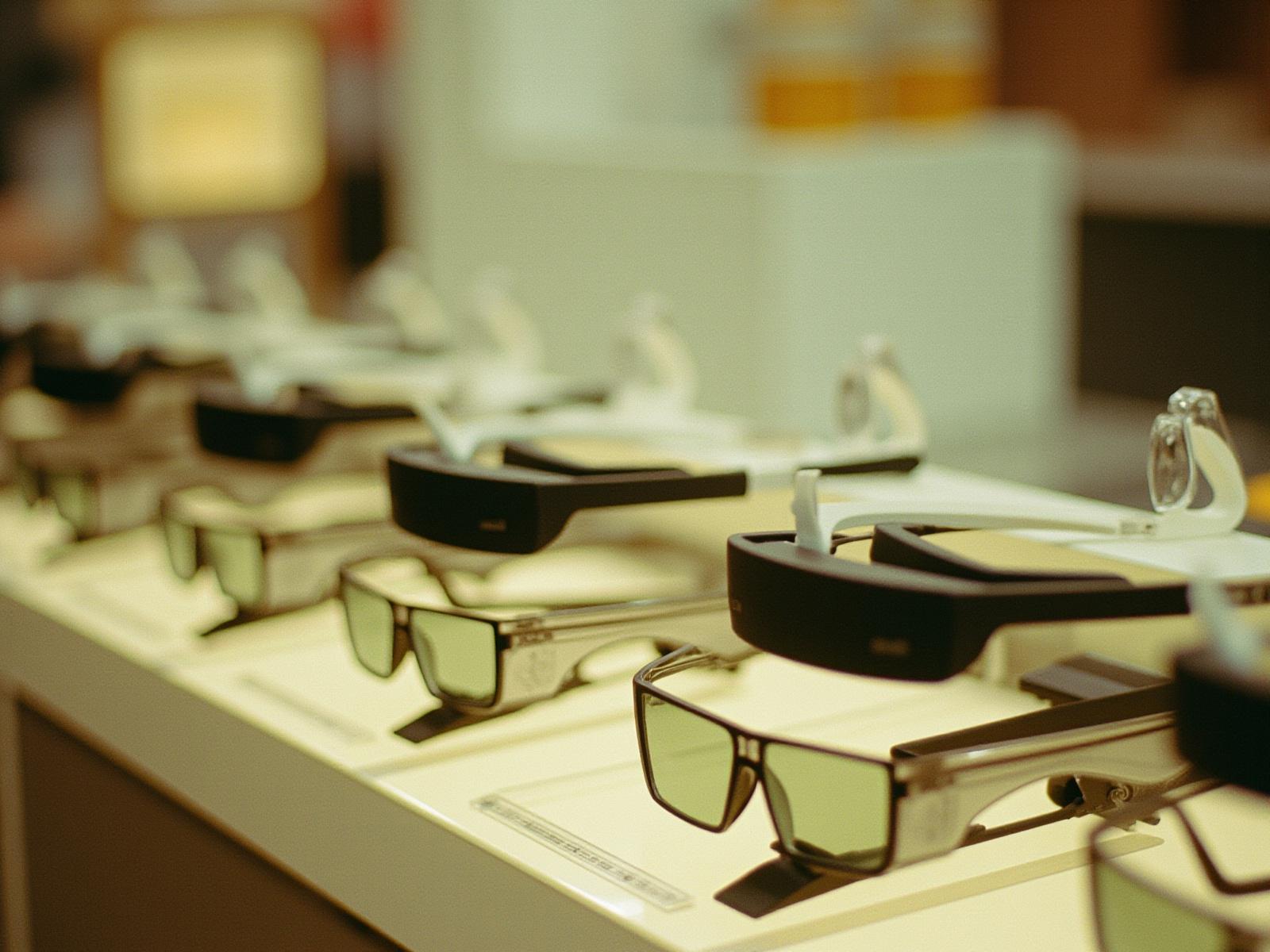
Read any camera quotation and the line items divide into two groups. The first group buys a capability: a sensor tier, a set of optics, a thermal design, a firmware pipeline, a storage configuration. The second group buys a number: a cell capacity, a rated runtime, a case capacity. The first group can be verified because somebody can measure it. The second group cannot be verified because nobody publishes the condition the number was measured under.
That distinction has a commercial consequence that is easy to miss. A buyer who pays for a capability gets something defensible, because the test protocol is written before the order and the result is enforceable. A buyer who pays for a number gets a figure that cannot be compared against a competitor using the same reasoning, because the two figures were measured under different conditions and neither supplier will disclose theirs.
Why the published rows sit on the wrong side of the line
Almost every row our catalogue publishes for the camera tier is on the number side. The resolution tier, the charge time, the cell capacity, the rated runtime, the case capacity and the single published weight are all figures without conditions. The imaging rows that would sit on the capability side — the sensor model, the field of view, the video specification, the stabilisation status, the low-light behaviour and the storage behaviour — are Not published for every camera model in the range.
So the honest reading of our own catalogue is that a buyer can compare cost but cannot yet compare performance from published data, and the only way to close the gap is a sample measured against criteria the buyer writes. That is not a complaint about the catalogue; it is a description of what a category with no published performance baseline resembles, and it determines where a procurement team's effort should go.
What that changes about the buying sequence
If performance cannot be bought, the decision sequence inverts. Instead of evaluating a supplier's product and then negotiating its price, a buyer defines the acceptance criteria first, asks what a supplier can evidence against them, and treats the price as the consequence of the scope. Two suppliers that answer the same question are comparable. Two suppliers that answer different questions are not, whatever their unit prices say.
What each cost line buys, and what it only appears to buy
The lines that buy a capability
The sensor tier buys resolution on paper: 8 MP across the V03 Pro and the KY06, the V03 and the V06, and the MT6 and the CY05, and the CY03 and the MT5, and 13 MP on the L1 Pro and the L2 Utral, and the S7. What it actually buys depends on a sensor model we do not publish, and a higher pixel count on a small pixel performs worse in low light than a lower count on a large one.
The optics buy the field of view, which determines whether the product is usable for first-person video at all. Not published for any model in our range.
The thermal design buys sustained capture — the ability to record without the image degrading or the unit throttling as it warms. Not published for any model. On a camera platform this is the line that most affects whether continuous capture works as advertised.
The storage buys capacity and determines retention behaviour. Not published.
The firmware buys image pipeline quality — processing rather than capture. This is the single most under-discussed line in the category, and the one that most often separates two products with identical published specifications.
The lines that buy a number
The cell capacity, published at 220 mAh on the V03 and the V03 Pro, and the MT5, 260 mAh on the KY06 and the V06, and the S7, 265 mAh on the MT6 and 290 mAh on the CY03 and the CY05, and the L2 Utral and the L1 Pro. This buys runtime under continuous load, which our catalogue states at roughly five to eight hours with no test condition attached.
The rated runtime, which is the number most often used as if it were a capability. A runtime of about seven hours with no stated load, no stated temperature and no stated recording mode cannot be compared with a runtime of five to eight hours from another supplier, because the two are describing different experiments.
The charging case, published at 1400 mAh on the CY05 and the L1 Pro, and the CY03, at 900 or 1400 mAh on the L2 Utral, and as a foldable 1200 mAh on the MT6. This is the clearest case in our range of a cost that buys a retail proposition more than an engineering one, and it is also a configuration choice rather than a fixed cost, because four camera models publish no charging-case row at all.
The two lines that sit in between
The calibration and test and the per-unit alignment time sit between the two groups. They buy a capability — consistent output across units — but they buy it in the factory rather than in the product, which means the buyer has to ask about them rather than see them on a datasheet. A supplier with a real calibration process and a supplier with a visual check produce units that appear identical on a shelf and behave differently in a thousand-unit order, and only one of those suppliers can tell you the difference in advance.
The published rows on the two camera tiers, side by side
Reading the table without reading a conclusion into it
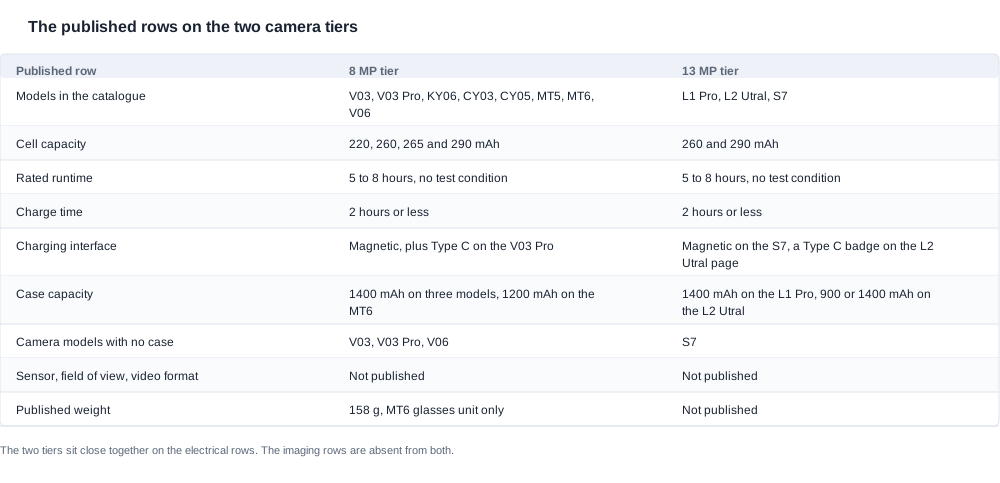
The two tiers sit close together on the electrical rows, and that is the first useful finding. The 8 MP group runs from 220 mAh to 290 mAh across eight models and the 13 MP group from 260 mAh to 290 mAh across three, and the rated runtime bands overlap almost entirely. The charge time is two hours or less for every model in both tiers. In other words, the tier choice is an image decision and not a power decision, which is convenient for a buyer because it means the upgrade question reduces to a single question about the downstream pipeline.
The second useful finding is in the rows that are identical. The sensor model, the field of view, the video specification, the stabilisation status and the storage behaviour are absent from both tiers, and so is the frame weight for two of the three 13 MP models. Whatever the buyer is paying for when choosing between the tiers, it is not access to better published data.
Where the tiers genuinely differ
They differ in three visible ways. The 13 MP group is smaller, three models against eight, which matters for a brand committing a per-configuration minimum across a range. The L2 Utral publishes two case options and carries a Type-C charging interface badge on its catalogue page, where its tier sibling the L1 Pro publishes one case option and no charging interface at all. And the 13 MP group includes the S7, one of only two camera models in the entire catalogue published with an IP54 rating, alongside the V06 in the 8 MP group.
For a buyer whose channel compares resolution on the listing page, the tier difference is the only difference the customer will ever see. For a buyer whose channel sells the footage rather than the specification, the tier difference is the least of the differences that matter.

Whether the 13 MP tier earns its place in your channel
Four questions that decide it, none of which is a technical one
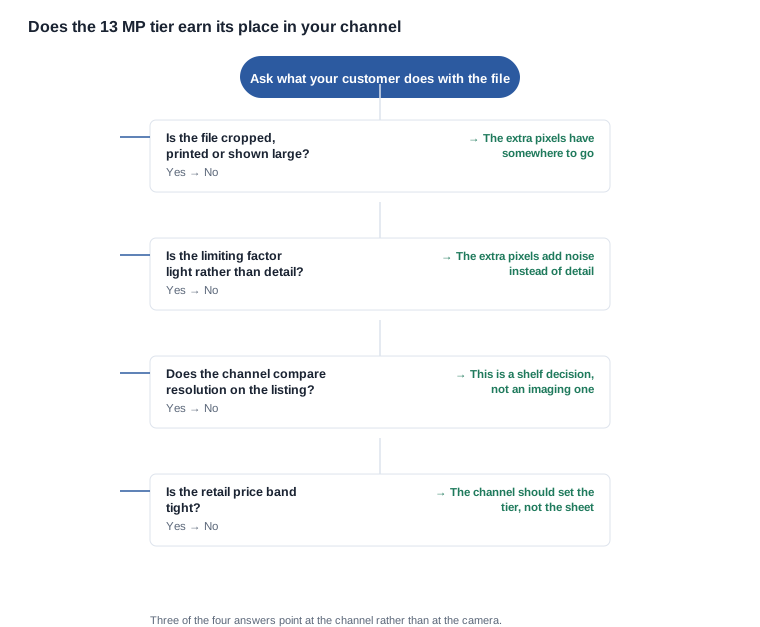
The extra pixels have somewhere to go only if the customer crops, prints large, or serves a client that specifies resolution. If the limiting factor in the image is light rather than detail, the extra pixels add noise rather than detail, and a buyer paying for them has bought a worse image at a higher price. If the channel compares resolution on the listing, the tier is a shelf decision rather than an imaging one, and it should be made on price and on how the comparison reads to a customer. And if the retail price band is tight, the channel should set the tier rather than the sheet.
None of these four questions is answered by a sensor model, because there is no sensor model. They are answered by what the customer does with the file, which is information the buyer already holds and the datasheet does not.
The trade-off to negotiate rather than the tier to pick
The tier is largely a price-tier decision once the workload is known. The trade-off worth negotiating is different: the camera programme costs more than an audio programme because of the frame, the tooling and the line, and those are the lines where a committed configuration count and a committed volume buy real movement. A buyer who has decided that the workload needs the tier can then negotiate the case configuration, the artwork rounds, the number of markets and the per-configuration minimum, and leave the sensor alone, because the sensor is a fixed part of the design once the platform is chosen.
A worked comparison: the same channel, two tiers, one decision
This is a hypothetical scenario rather than a client project, and it is written to show the decision sequence rather than to report an outcome.
Assume a European brand already selling a Bluetooth audio glasses product into four markets, with an existing camera platform in its range that it has not yet taken to market. The product manager wants a first camera order, the channel wants a listing that compares the product against the audio model, and the retail price band is fixed. The internal question is which tier to open with, and the honest answer is that the tier question is the last one to answer.
Step one, the workload. The channel's customers are field service technicians who record short clips to attach to a job record, and a smaller group of retail buyers who want stills for a listing. The clips are short, they are taken indoors, and they are reviewed by a colleague rather than published. Two implications follow immediately. The decisive parameter is not resolution but the field of view and the transfer behaviour, because a technician who cannot see the panel or cannot get the clip off the device has no use for the product at all. And the second tier's extra pixels have nowhere to go.
Step two, the data. The brand's shortlist is built on the published rows, which narrows eleven camera models down to the case configurations and charging interfaces it is willing to support commercially. It then requests the six imaging rows in writing, from two suppliers, in the same format. The answers diverge sharply. One supplier returns a sensor part number and a field of view with a stated convention. The other returns a description of the field of view without a convention and no sensor part number at all. That divergence is more informative than any unit price, because it tells the brand which supplier can be tested and which can only be described.
Step three, the criteria. Before the samples arrive, the brand writes five acceptance criteria: a field-of-view minimum in the named convention, a minimum usable frame rate while walking, a maximum capture latency, an image comparison against a reference unit, and a storage exhaustion behaviour observed on the unit. The criteria are attached to the purchase order draft before either supplier's price is discussed, which is what keeps the conversation about the product rather than about the price.
Step four, the price comparison. The two quotations are now comparable, because both are answering the same criteria and both are itemised across electronics, tooling and the line. The gap that remains is explained rather than mysterious: it is the frame and tooling consequence of the camera module, which the brand can now see because the supplier separated it. The brand moves the negotiating capital to the per-configuration minimum and the artwork rounds, and leaves the sensor alone.
Step five, the tier. With the workload established, the tier decision falls out. The extra pixels have nowhere to go in a short indoor clip for a colleague's review, so the 8 MP tier is opened with, and the 13 MP models are held for a channel that will eventually publish large stills. The brand has not chosen a tier because of a comparison table; it has chosen a tier because the workload made one of them pointless.
Step six, the copy. The listing claims what the brand can evidence: the published resolution tier, the runtime band, the case configuration, the interface. It does not claim a field of view in degrees, because that figure is not published in the catalogue the buyer is working from, and it does not claim a low-light performance, because no measurement is available. The buyer writes the listing with the evidence it actually holds, which is the position a compliance reviewer will accept and a customer will not be disappointed by.
The result of this walk-through is a cheaper first order than the 13 MP opening would have produced, a narrower set of claims, and a decision record that explains itself. The point worth carrying to the next programme is that the tier was never the decision. The workload was.
Writing acceptance criteria when there is no performance figure to buy
The five criteria that substitute for a performance claim
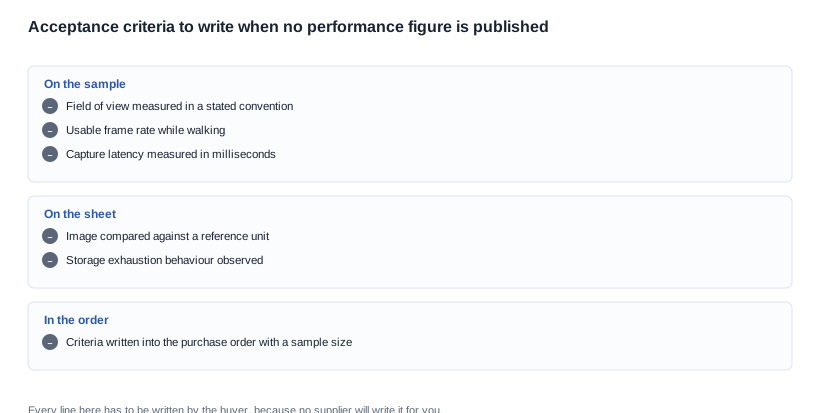
Each of the five closes a row the catalogue leaves open, and each is stated so that a measurement can settle it.
- A field-of-view minimum, in a named convention, measured on the received units. Without the convention, the measurement is not comparable to anything.
- A minimum usable frame rate while the person is walking. This is the criterion that separates a camera product from a stills product, and it is a test rather than an opinion.
- A maximum capture latency, in milliseconds, from the control press to the written file.
- An image compared against a reference unit rather than against a claim. A like-for-like comparison on the same scene, at the same moment, in the same light, judged by someone who will use the output.
- A storage exhaustion behaviour observed, not described. Fill the storage deliberately and record what happens, because silent stopping is the most common avoidable return reason in this category.
Why the criteria have to outrank the supplier's own figures
The reason is a pattern that recurs in this category. A supplier's own datasheet figure and the buyer's own measurement disagree more often than they agree, because the datasheet figure is a laboratory condition and the buyer's measurement is a field condition. When that happens, the disagreement has to be settled by something written down in advance, and the only document in the room that can settle it is the purchase order.
Writing the criteria is also what makes the quotation comparable. A supplier who answers five specific questions with five specific measurements is describing a product whose behaviour is knowable, and a supplier who cannot is describing a product whose behaviour will be discovered in the channel, at the buyer's expense, in the market the buyer paid to enter.
One practical detail matters more than buyers expect: the criteria have to name the units they apply to. A measurement taken on a sample unit describes that unit, and a procurement team that never states the sample size will find that the result cannot be applied to the delivery it was supposed to protect.
The boundary between a measured claim and a plausible one
We publish resolution, capacity, runtime, charge time, interface and case capacity exactly as our documentation states them. We do not attach a sensor model, a field of view or a video specification to either camera tier, because attaching those without measured data would produce a comparison that appears decisive and is not.
Across the twenty-eight models in our catalogue, the camera family accounts for eleven. No sensor model, no field of view, no video resolution or frame rate, no stabilisation, no low-light figure, no storage capacity, no overwrite behaviour and no export method is published for any of them, and the unit weight is published for one model in the entire range — the MT6 at 158 g for the glasses unit including its battery and camera, excluding its foldable charging case.
Anyone who can tell you which tier is better for your use case, without a sensor model and a sample, is describing a preference rather than a measurement. We would rather help you design the sample that settles it. The imaging background is under camera and imaging, the tier selection logic is in camera technology upgrade considerations, and the platforms are on the ai camera glasses range page.
Related reading
- Choosing between the two tiers — camera technology upgrade considerations
- Claims made without evidence — camera technology myths
- Settling it on a sample — sample evaluation
Tell us what you are shooting and we will tell you which rows we can confirm and which need a sample.


