
The vocabulary of camera technology is the one area where a buyer's existing knowledge actively works against them, because almost every term in it was defined for a camera in a phone — a device with a fixed sensor, a fixed lens, a known sensor size and a dedicated image processor doing the work downstream.
A camera in a pair of glasses has none of those fixed points. The frame flexes, the person moves, the scene is whatever they turn towards, and the field of view has to work around a frame that is physically in the shot. Some terms transfer. Several do not, and the ones that do not are the ones that decide the product.
Our published position for the camera tier in this range is two resolution tiers — 8 MP and 13 MP — and no sensor model, no field of view, no video resolution or frame rate, no stabilisation, no low-light figure and no storage format. So smart glasses camera technology smart glasses glossary is a glossary with a purpose: each entry exists because a buyer has made a wrong assumption with it.
Smart glasses camera technology: a glossary is procurement, not a photography lesson
Every term on a sheet carries a claim
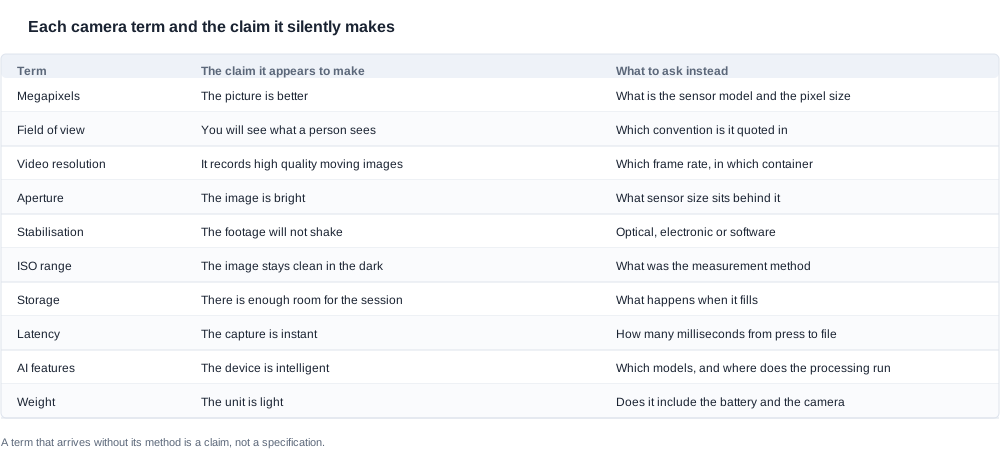
A datasheet term is not a definition, it is a promise. "13 MP" promises a better picture than "8 MP". "Stabilised" promises footage that will not shake. "8 GB storage" promises that a session will not run out. Each of those promises is made by the word and not by the product behind it, and each is defeasible by the absence of the method that would make it true.
That is what makes a glossary a procurement document. A photography glossary tells you what a term means. A procurement glossary tells you what a term is claiming, what it leaves out, and what to ask the supplier to make the claim checkable. The entries below are written for the second purpose, and the test each one passes is: a buyer who knows only the definition is worse off than a buyer who knows the claim.
The four families the vocabulary falls into
Terms that count. Resolution, frame rate, storage capacity, runtime, cell capacity, weight. They answer how much and how long, and the danger is not that they are wrong but that they are unconditioned: a count without a method is a number, and two numbers in the same row are frequently two different measurements.
Terms that describe behaviour. Field of view, aperture, stabilisation, auto exposure, white balance, shutter speed, low-light performance. They describe what the camera does, and the danger here is that the behaviour is assumed rather than specified, because the terms sound descriptive and are usually promotional.
Terms that describe an implementation. Sensor model, module, pipeline, codec, container, thermal design. They name what is inside, and the danger is that naming an implementation implies the behaviour without stating it.
Terms that describe a service. AI features, assistant, cloud, subscription, data location. They describe what happens away from the device, and in this category they are the terms most often used to imply a capability the camera itself does not provide.
A buyer who sorts a supplier's vocabulary into these four families before reading the numbers can tell in a few minutes which parts of a sheet are measurement and which parts are narrative. That distinction then drives the request: the counting terms need conditions, the behaviour terms need measurements, the implementation terms need part numbers, and the service terms need a written description of where the data goes.
How to use the vocabulary in a request and in a shortlist
A glossary is only useful to a buyer if it changes what they write down. The way to make it do that is to use the term families as the structure of the request, because the families determine what kind of answer you need and therefore how long the answer will take.
When you ask for a counting term, ask for its condition at the same time. What load produced the runtime, what light level produced the low-light figure, at what temperature was the charge time measured, how many units were in the sample for the weight. A supplier who cannot add the condition in the same sentence is quoting a number from somewhere else, and a number from somewhere else cannot be compared with the other supplier's number from somewhere else.
When you ask for a behaviour term, ask for the measurement method. Which instrument, in what environment, compared against what. A low-light figure described as "much better than the previous generation" is a marketing comparison between a product and a product that no longer exists, and it settles nothing.
When you ask for an implementation term, ask for the part number. A part number is checkable, portable between suppliers, and it lets a buyer compare two quotations on the same component rather than on the same word. Asking for the sensor module part number rather than the sensor family is the single highest-value habit a buyer can develop in this category.
When you ask for a service term, ask where the processing runs and where the data is held, in which jurisdiction, and for how long. If the answer is that a service is involved, the service has to be available in every market the buyer sells into, and its recurring cost belongs in the total cost of the programme rather than in the product page.
The shortlist follows from this. Rather than comparing two suppliers on the terms their sheets happen to share, build the criteria list from the workload, then read both sheets against those criteria and count how many each one actually answers. The supplier that answers four of your six criteria with a method attached is the one to sample, even if the other sheet is longer. Before you order, the criteria and the answers belong in the purchase order with the method attached, because a criterion without a method is an opinion that arrives at the moment of dispute.
The three words that are not a specification at all
Sensor size is frequently presented as a quality metric. It is a physical dimension, and it matters because it determines the pixel size, which determines how much light each pixel gathers. But "a larger sensor" on its own settles nothing about the image.
Low-light performance is the term most often used without a method anywhere in the industry. A low-light claim without a light level, an aperture, a comparison and a judgement criterion is a phrase, not a specification.
AI features names a category rather than a capability. Our catalogue names an AI voice assistant among the camera family's technologies, and the details that would distinguish one implementation from another — which models are supported, whether processing runs on the device or in a service, what the processing does — are Not published in our range.
The terms that transfer from a phone camera, and the ones that quietly do not
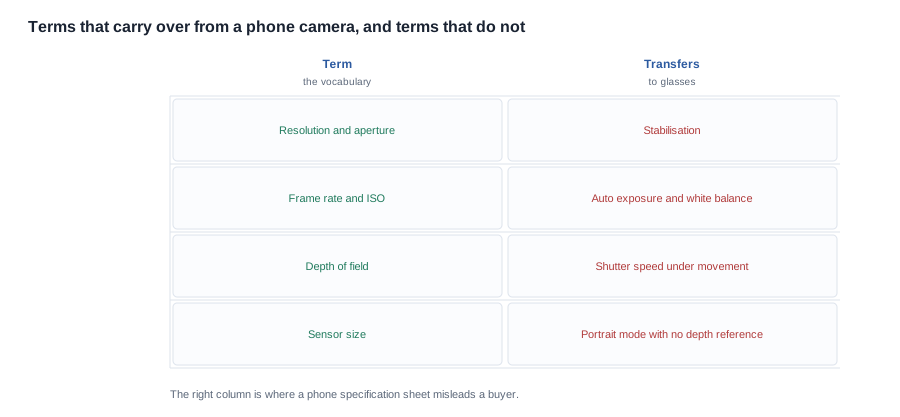
The terms that carry over safely
Resolution, or megapixels. The pixel count the sensor can record. Eight and thirteen megapixels are the two published tiers in our range, on the MT6 and the KY06, the CY03 and the V03, and the MT5 and the V06, and the CY05 and the V03 Pro at the lower tier, and on the S7 and the L2 Utral, and the L1 Pro at the upper one. Resolution says nothing about image quality: not the pixel size, not the light-gathering behaviour, not the low-light result. A pixel count is a quantity, not a quality.
Field of view, or FOV. The angle the lens sees. Not published for any model in our range. The critical detail is that it is quoted in one of three conventions — diagonal, horizontal or vertical — and they are not interchangeable. A horizontal 90 degrees is a diagonal of roughly 110 degrees. A buyer comparing two FOV figures quoted on different conventions will reach the wrong conclusion, and a supplier who omits the convention is telling you something.
Aperture, as an f-number. How much light reaches the sensor. A lower f-number means more light and a shallower depth of field, and the depth of field matters here because the camera is pointed at unpredictable distances, so a shallow one turns a background into an unusable blur. Not published.
Sensor size, in inches or millimetres. The physical size of the sensor and therefore of each pixel. This is the row that determines low-light capability, and it is the row most often absent. Not published.
Frame rate, in frames per second. How many images per second are recorded. Thirty is a baseline for casual capture and sixty is for movement. It is a separate number from resolution, and a supplier who publishes only the resolution has published half the specification.
The terms that quietly do not transfer
Stabilisation. A phone camera is stabilised by a fixed body and a computational pipeline that knows the scene. A glasses camera moves with the person's head in ways the frame's own motion does not predict, so the stabilisation problem is fundamentally different. Optical, electronic and software stabilisation are three different implementations with three different artefacts, and "stabilised" without a type tells you nothing.
Auto exposure and auto white balance. These assume a subject at a known distance in a known light. Here the subject is whatever the person happens to be looking at, and the light is whatever they walk into. A camera that behaves well in a test and badly in a street is doing exactly what its algorithm was built to do.
Depth of field and portrait mode. A phone uses several cameras or a depth sensor to separate a subject. A glasses camera has one sensor and no published depth reference in our range, so background separation is a processing artefact rather than a measurement.
Shutter speed against frames per second. A camera in glasses is frequently moving, and a fast shutter is what stops motion from smearing. Shutter speed is not published in this range, and it is often the difference between usable footage and unusable footage.
The vocabulary of a camera glasses product, layer by layer
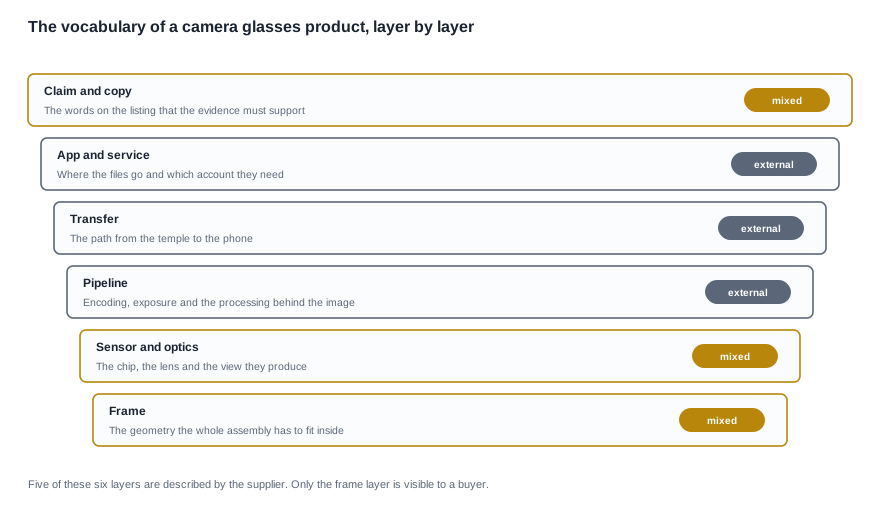
Six layers, six different vocabularies
The claim and copy layer speaks in superlatives: sharper, clearer, immersive, intelligent. It is the layer where evidence is thinnest and where a buyer should be most suspicious, because the copy is written to sell rather than to describe.
The application and service layer speaks in account, subscription, sync and cloud. It is where the data question lives, and it is the layer a buyer must understand before the copy is written, because the data flow determines what the user information can say.
The transfer layer speaks in speed, latency, pairing and range. It is where a camera product's exposure is greatest, because the output is a file rather than a sound.
The pipeline layer speaks in processing, tuning, HDR and noise reduction. It is the layer that most often separates two products with identical published specifications, and it is almost never published.
The sensor and optics layer speaks in the vocabulary of the count and the angle: megapixels, aperture, sensor size, field of view. It is the layer where a buyer is most confident and least informed.
The frame layer speaks in section, weight, balance, materials and ingress rating. It is the only layer where the buyer can see the physical consequence of the camera, and it is where the cost of the camera mostly lands.
The four terms about the product rather than the camera
Storage and overwrite behaviour. Where the footage goes, in which format, whether it overwrites oldest-first, and what happens when it fills. Not published. This determines whether a product can be the customer's primary capture device or only a secondary one.
Latency, or the preview-to-capture delay. A wearable camera has a control and a processing pipeline, and the delay between pressing and capturing is what a content customer notices. Not published.
The lens itself. A lens in a glasses frame is a different optical proposition from a phone lens, and the frame's own geometry occludes part of the scene. No published figure in our range addresses the interaction between the frame and the field of view.
Frame weight. The only published weight in the entire catalogue is the MT6 at 158 g, and it is the glasses unit including its battery and camera, excluding the foldable charging case. No bare frame weight is published for any model in the range, and the weight of that case is not published either. A sheet that quotes 158 g without saying what it includes is making a claim the buyer cannot use.

The question each term raises when you meet it on a sheet
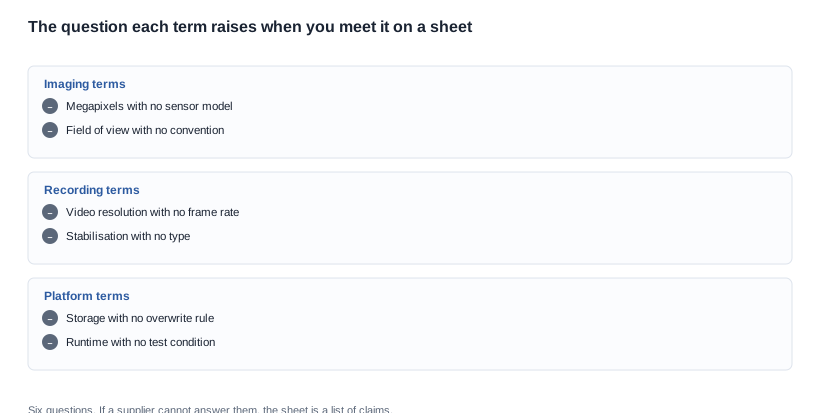
Six questions, and they are the questions to put to a supplier rather than the questions to answer from the sheet. If a supplier cannot answer them, the sheet is a list of claims.
- Megapixels with no sensor model. Which imaging chip is fitted, and what is the pixel size?
- Field of view with no convention. Is the figure diagonal, horizontal or vertical, and how much of it does the frame itself occupy?
- Video resolution with no frame rate. Which frame rates are recorded, in which container, and is audio recorded with the video?
- Stabilisation with no type. Optical, electronic or software, and what artefact does each produce?
- Storage with no overwrite rule. What is the capacity, in which format, and what happens when it fills during a session?
- Runtime with no test condition. What load, what ambient temperature and what recording mode produced the figure?
The two questions a supplier will find harder than the rest
The frame geometry against the field of view question is harder than it sounds, because it requires someone to have measured the assembled product rather than the lens. A supplier who can answer it has done that measurement. The latency question is harder still, because latency is a property of a pipeline that includes the control, the encoder and the write, and a supplier who quotes a single number without saying where the measurement starts and ends has quoted a partial result.
The terms that hide a commercial claim rather than a technical one
Four terms that are really about the business
The charging case. In our range the case is published at 1400 mAh on the L1 Pro and the CY05, and the CY03, at 900 or 1400 mAh on the L2 Utral, and as a foldable 1200 mAh on the MT6, while the KY06 and the MT5 ship with a case whose capacity is not published and four camera models publish no charging-case row at all. When a sheet describes the case as included, it is describing a packaging decision, a second cell in the transport paperwork and a per-configuration minimum.
AI features. As described above, this is a category label. Commercially it is often the difference between a product that has a recurring service cost attached and one that does not, and the buyer needs to know which.
Ingress rating. IP54 is published on the V06 and the S7 and on no other camera model in the range. An ingress claim is a statement about a sealed assembly and it is not transferable from one model to another, so it cannot be inherited by a variant.
The charging interface. Magnetic on five of the eleven camera models, a Type-C port on the V03 Pro, a Type-C interface badge on the L2 Utral catalogue page, and no interface row at all on the MT6 and the L1 Pro, and the CY05 and the CY03. The interface is a packaging choice, a cable choice and a customer routine, and each of those is costed somewhere.
The question these terms raise for a buyer
For each of the four, the buyer needs to know whether the term is describing a fixed fact about the product or a configuration that can be changed at the next order. The interface, the case and the ingress rating can all vary between configurations of the same platform, and each variation carries a per-configuration minimum and a documentation consequence. A supplier who describes them as fixed has described the sample rather than the range.
The rows we publish, and what we will not define for you
We publish the 8 MP and 13 MP resolution tiers and the electrical rows as the catalogue states them, and we will not define resolution as a stand-in for image quality, because the sensor measurements behind such a definition are Not published to us. A buyer who learns what megapixels actually count, and what they leave out, stops reading a number as a verdict on the product — which is the whole reason a glossary page exists.
We will not quote a field of view, a video specification, a stabilisation claim or a storage behaviour for any model in this range. Across the twenty-eight models in our catalogue, eleven carry a camera, and for those eleven the published rows are the charge time, the cell capacity, the resolution tier, the rated runtime, the charging interface on the seven of them that publish one, the case capacity where it is published, the ingress rating on the V06 and the S7, and the weight on the MT6. Everything else in this article's vocabulary is a question to put to the supplier.
What we can do is tell you which of these terms are decisive for a given workload, so that you know which questions to put to the engineering team and which you can let go. The imaging background is under camera and imaging, the claims made without evidence are collected in camera technology myths, the models are on the AI camera glasses range page, and the field behaviour is covered in camera real world performance.
Tell us the model and what the camera has to do, and we will say which of these terms actually matter for that.


