
Four conditions decide whether a camera platform performs in practice, and none of them is visible on a bench. The movement of the person carrying the device, the light available where the content is actually produced, the length of a working session, and the heat generated by continuous recording. A demonstration shows the platform at rest, in good light, for a short time, and the buyer's customer will use it in none of those conditions. That gap is not a supplier failing to impress; it is the normal shape of this category, and the only reliable way to close it is a written trial in the target environment.
Smart glasses camera technology smart glasses real world performance is therefore not a question about a published figure. Our catalogue publishes the resolution tier, the cell, the runtime, the charge time and the interface for every camera platform, and it publishes no sensor model, no field of view, no video format, no frame rate and no low-light data for any of them. The published rows cannot answer the four conditions above, so they have to be established on samples and written into the incoming inspection criteria before an order is signed.
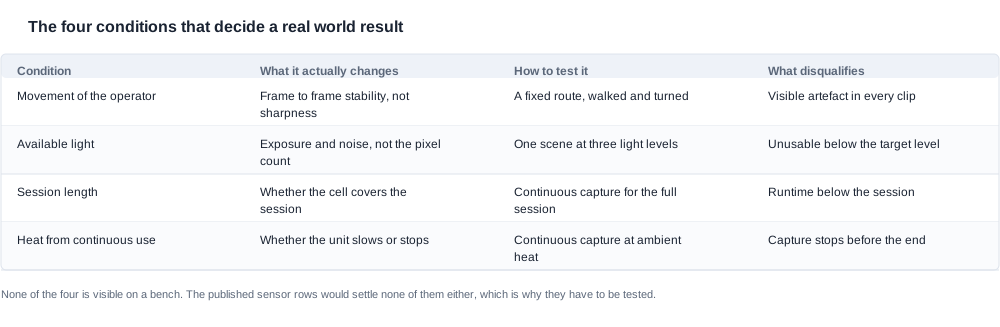
Smart glasses camera technology: four conditions a bench test cannot reproduce
Each of the four conditions acts on a different part of the chain, and each of them produces a different symptom. Confusing them is what makes a trial inconclusive, because a buyer who does not know which condition produced a failure cannot decide whether the failure is a product problem, a usage problem or a scene problem.
Movement, and why it changes the footage
The camera is mounted on a head, and a head is never still. Every handheld comparison a buyer performs — a camera on a desk against a camera on a stand — removes exactly the variable that matters. The failure modes that follow are well known to anybody who has edited footage captured on a moving platform: judder that no amount of post-processing removes cleanly, a horizon that drifts, and a rolling-shutter artefact that bends vertical lines in a way that makes an ordinary room look wrong.
Whether a given platform handles this well depends on the sensor, the stabilisation method and the processing pipeline, and we publish none of the three for any model in our range. The published resolution tier tells a buyer nothing about it. That is precisely why a platform that is described as "stabilised" in a listing without a stated method is a claim that has to be tested rather than a feature that can be relied upon.
The practical test is cheap. Fix the route — the same corridor, the same stairs, the same turn — and record the same sequence on every candidate in turn. The comparison becomes controlled, because the operator, the path and the light are all held constant and the only variable is the platform. What the buyer is looking for is not a judgement about which one is smoother in the abstract, but whether any candidate shows the artefacts badly enough that a customer would describe the footage as broken.
Available light, and where the demonstration is always made
Office lighting is the condition in which every camera demonstration is recorded, and it is the condition least like the one the product will be used in. A platform that behaves well under a ceiling panel can behave badly under a single low lamp, and the gap between the two is where the complaints live.
The published rows again do not help. A megapixel count says nothing about how much light the sensor gathers, because gathering light is a function of pixel size and lens speed, and neither of those is published for any of our models. A buyer who assumes that a higher resolution tier means better performance in low light is making an inference the catalogue does not support in either direction.
The trial design that answers the question uses one scene and three light levels rather than three scenes and one light level. Holding the scene constant removes the variables of subject matter and framing, and lets the buyer attribute every change to the light. The three levels that matter are the one the customer will use routinely, the weakest one that still has to produce usable footage, and the level at which the platform stops being usable at all. That third one is the most valuable number in the whole exercise, because it is the boundary that decides whether the product can be sold into a particular market at all.
Session length measured against the published runtime
The published runtimes for our camera platforms run from roughly five to eight hours, and every one of the eleven camera models publishes one. That number is the floor of a range in most cases rather than a point, and it carries no statement about light level, clip length, recording mode or thermal conditions.
It is also, for this reason, the runtime figure most likely to be quoted in a listing in a way it cannot support. A buyer who publishes "up to 8 hours" for a platform whose published range starts at five hours has turned a range into a single number, and the customer who records at the lower end will experience a difference that no amount of explanation will fix.
This is where the trial earns its keep, because the session test is the one measurement that closes the gap between the published row and the customer experience. Run a continuous recording for the full length of a real working session — not a clip test, a continuous capture — and record what happens at the point where the runtime ends: whether the unit stops recording, whether it warns, whether it drops the oldest files, or whether it simply keeps going longer than the row said. All four behaviours are acceptable. Silence about them is not, because silence in a listing becomes a complaint.
Writing a trial that produces a decision rather than a demonstration
A trial fails for a structural reason more often than for a technical one: nobody wrote down what result would end the evaluation. The team runs the sample, forms an impression, and then argues about the impression, and the argument is usually settled by whoever is most confident rather than by the evidence. The fix is procedural and it costs nothing.
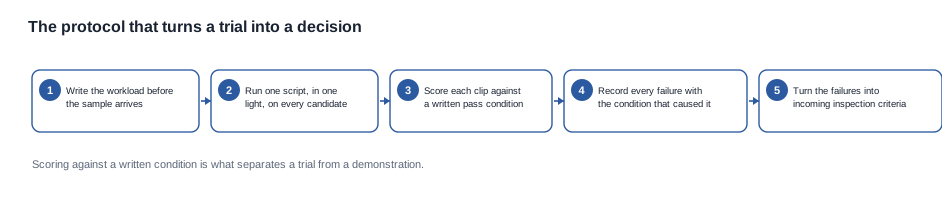
The four-step protocol and why each step is cheap
The protocol has four steps, and each of them is cheap in a way that is worth stating explicitly, because a buyer often assumes a proper trial means a laboratory engagement.
- Write the workload before the sample arrives. Where the content is produced, how long a session runs, what the light is like, and what the platform has to deliver. This is a paragraph, and it is the step that makes everything after it legible.
- Run one script, in one light, on every candidate. A single script removes the temptation to compare a studio clip of one platform with a field clip of another, which is the comparison that produces confident conclusions and no evidence.
- Score each recording against a written pass condition. Not an impression, and not a preference. "The chart is resolved across the full width of the frame at the working distance" is a pass condition. "The video looks good" is a preference, and a preference is not a basis for a purchase order.
- Record every failure together with the condition that caused it. This is what converts a trial into a specification. A failure list that says the platform stopped recording after four hours is worth less than one that says it stopped after four hours of continuous recording in a warm environment, because only the second version can be written into an acceptance criterion.
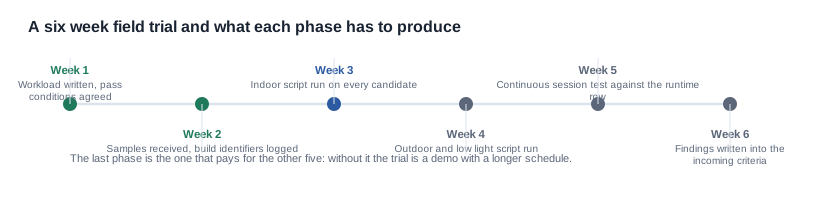
The six-week shape in the chart is not a schedule, it is a dependency. The workload and the pass conditions have to be written first, because everything downstream is a comparison against them, and the results have to be written into the incoming criteria before the order, because criteria agreed after the first rejection are criteria the buyer will lose.
The session test, and why the published runtime cannot answer it
The published runtime rows across our camera range are worth printing together, because they show two things at once: that every platform publishes a figure, and that the figures overlap so heavily that they cannot rank anything.
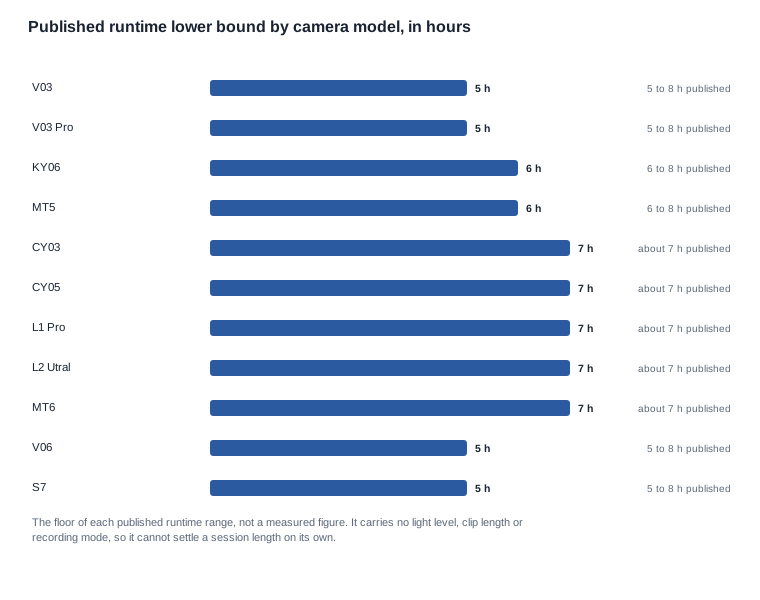
The eight models at the lower end of the chart publish a range beginning at five hours — the V06 and the V03 Pro, and the S7 and the V03. The KY06 and the MT5 publish ranges beginning at six hours. The five platforms on 290 mAh cells — the L1 Pro and the L2 Utral, and the CY05 and the MT6, and the CY03 — publish a single figure of about seven hours. Between them, these are the same order of magnitude, and no buyer can pick a platform on runtime.
What a buyer can do is pick a platform on a session requirement. If the working session is three hours and the platform is used in a cool environment, the published figures are consistent with the requirement, and the trial confirms it. If the session is eight hours, no published camera figure in our range covers it, and the platform is the wrong choice regardless of how the trial goes. That test — session length against the published row — is available before any sample arrives, and it removes more candidates than anything a supplier can demonstrate.
The second thing the chart shows is that the runtime does not sort with anything else a buyer cares about. The V06 and the S7 publish the shortest ranges and are also the two models in the catalogue carrying an IP54 ingress marking, so the two sport platforms with the best-protected housings are also the two with the least endurance in the range. A buyer choosing a platform for outdoor use is choosing between that and the 290 mAh group, and the trial has to be run in the environment that decides it.
What a programme goes wrong when the field result is assumed
The most expensive failure in this category is not a defective unit. It is a platform that performs acceptably in the office and disappoints in the field, and it is expensive because the discovery happens after the launch, after the listing copy is written, and after the customer reviews have been written about the footage.
Six patterns recur, and each has a prevention that costs nothing.
- The trial was run at the factory. Symptom: early production units behave differently from the samples that were approved. Root cause: the factory floor and the field differ in light, in vibration and in temperature. Prevention: run at least one session in the target environment before the order.
- The pass conditions were written after the results. Symptom: two suppliers produce different results and both are declared acceptable. Root cause: there was no criterion to differ against. Prevention: write the conditions in the first week, before the samples arrive.
- Only one unit was tested. Symptom: a defect appears at a rate that a single unit could never have shown. Root cause: a single-unit test cannot produce a rate. Prevention: two units of the same build at minimum, and preferably a unit from a second production lot.
- The night or low-light case was skipped. Symptom: the platform works in the office and fails in the evening. Root cause: the light condition was never in the script. Prevention: include the weakest usable light level and the failure boundary in the workload.
- The continuous session was never run. Symptom: a customer reports the platform stopping in the middle of a session. Root cause: only short clips were captured. Prevention: one continuous session at the full session length.
- The failures were recorded as impressions. Symptom: a second buyer, a second factory or a second year cannot reproduce the conclusion. Root cause: the finding was never written as a condition. Prevention: every finding becomes a line in the incoming criteria.
The failure record is the part that turns the six patterns above from a list into a control. A useful record has four fields: the platform and its build identifier, the condition that was present when the failure occurred, the observable symptom, and the criterion the failure would have breached. Written that way, a failure from a trial two years ago is still usable as an acceptance criterion, because it can be re-created on a line. Written as a sentence in a report, it is not, because the report does not say what condition to reproduce.
A buyer who receives such a record from a supplier learns more about that supplier than a sample ever shows. It tells the buyer whether the factory measures its own output, whether it writes down what it found, and whether it is willing to be judged against its own findings. Those three things are the foundation of every later argument about quality, and they are visible in the paperwork long before they are visible in the goods.
Where the commercial room is in a camera platform
The commercial negotiation for a camera platform is narrower than the one available on an audio product, because the camera rows are fixed at the specification stage. The sensor, the resolution class and the resulting ceiling on image quality are what they are before any commercial conversation starts, which means the price discussion cannot change the picture.
What can be negotiated is the support around it, and four items carry more value than the unit price does.
- The sample protocol. A supplier who will run your workload, on your script, on units from your order's build, has removed an entire category of risk at a cost that is small compared with the order. Ask for it as a condition of the quotation rather than as a favour.
- The acceptance criteria. Writing them before the order converts a quality argument into a contractual one. It is the cheapest form of leverage a buyer has, because it costs the factory nothing to accept a procedure it already runs.
- The pilot batch. A pilot at a fraction of the production volume, with the same build and the same criteria, moves the discovery of a systemic problem forward by weeks. It is a scheduling decision rather than a discount decision, and it is usually cheaper than the discount a buyer would ask for to compensate for the same risk.
- The returns and rework terms. A camera platform that produces photographs in complaints needs a disposition that is fast and specified. Agreeing who pays for a rework against a documented criterion before the first shipment is worth more than a small price concession.
What cannot be negotiated is the certification cost and the elapsed time of a certification programme, because those are set by the test laboratory and the review queue rather than by the price.
Two cost lines usually sit outside the product price altogether and are worth pricing separately before the order. The sample and pilot cost, which is set by how much of the trial the buyer asks for and is often negotiable against the order volume rather than charged at list. And the test and tooling cost, which for a platform in this category is where the first-order unit price actually sits. Both are in the pricing and sample evaluation material rather than in the product specification, and a buyer who has not opened them is pricing the visible half of the cost. Nor is the tooling cost in any real sense, since it is a one-off usually amortised across the first order. The useful questions about tooling are over what volume it is amortised across and what happens to it if the programme is discontinued.
What our documentation can and cannot evidence about field behaviour
Concretely, we publish the resolution tiers and the electrical rows accurately, and we will not infer an image quality claim from them, because the optical and sensor stages that would decide such a claim are not published to us. We will also be direct that real-world performance depends on conditions the customer chooses, and that the honest way to qualify a platform is behaviourally, in the environment it will be sold into.
What we publish for the camera range: the resolution tier — 8 MP on the V06 and the V03, the CY05 and the MT5, and the V03 Pro and the CY03, and the MT6 and the KY06, and 13 MP on the S7 and the L1 Pro, and the L2 Utral. The cell configurations, from 220 mAh on the V03 and the V03 Pro, and the MT5 through to 290 mAh on the L2 Utral and the CY03, and the L1 Pro and the CY05, with the MT6 at 265 mAh. The published runtimes. The charge time, which is two hours or less on every camera platform. The charging interface, magnetic on the KY06 and the V06, and the V03 and the S7, and the MT5, Type-C on the V03 Pro and the L2 Utral, and not published at all on the MT6 and the CY03, and the CY05 and the L1 Pro. The case capacity on the five platforms that publish one. The IP54 ingress marking on the V06 and the S7 only. And the unit weight, which is published for one model in the whole catalogue, the MT6 at 158 g for the glasses themselves.
What we do not publish for any camera platform: the sensor model, the field of view, the video resolution and frame rate, the aperture, the stabilisation method, the low-light behaviour, the storage format and capacity, and the capture latency. We also publish no test data of our own for field conditions, because we do not hold it, and we would rather flag the gap than let a buyer discover it from a returns report.
Send us the models, the environment the content is produced in, the session length and the price band, and we will tell you which published rows apply, which of the four conditions decides the purchase, and what has to be confirmed on a production unit before the order is signed. The background is at AI camera glasses imaging, the trade-offs are at camera advanced considerations, the content-creation context is at content creation camera performance, and the mechanism is at camera how it works.
Related reading
- The trial protocol in checklist form — how to test camera technology
- The specifications that have to be evidenced before a claim — certification checklist
- The commercial terms that go with a platform — contract terms
- Cell transport for a shipped device — battery transport
Tell us the environment, the session length and the price band, and we will say which of the four conditions decides the purchase.


