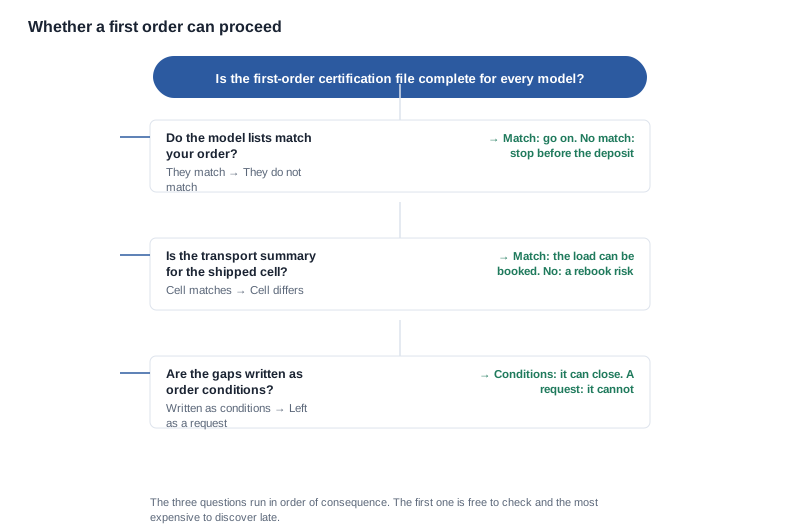
A certification file is not a single document, and the reason a first order gets held is usually that a buyer collected the right kind of document for the wrong model. The checklist below is therefore organised by document rather than by regulation, and for each one it names the fields to read and the single field that decides it. Read the deciding field and the rest of the document is context. Before the deposit moves, the file has to answer five questions: which models it covers, which markets it was written for, who holds each piece of evidence, what the shipping carton will actually contain, and which claims on your listing are backed by it. If any of those five is still open when the goods are packed, you have a delay coming, and the delay is charged to whoever's name is on the booking.
What a first smart glasses certification checklist has to settle before the deposit
Why first orders fail on documents rather than on hardware
The failure pattern in this category is unusually consistent, and it is worth stating plainly before anything else. The product is rarely the problem. The unit that leaves the line usually works, matches the drawing it was approved against, and passes the inspection that the factory runs on it. What fails is the paper that travels with the unit, and it fails because nobody established, before the order, which document covers which model in which market with which cell in the carton.
That sequence matters for a first order more than for a repeat one, because a first order is where the buyer has no history to fall back on. There is no previous shipment that cleared without incident, no broker who already knows how this factory's paperwork is worded, no importer who has seen the declaration before. Every assumption is being made for the first time, and the assumptions are the expensive part.
The practical consequence is that a first-order checklist is not really a compliance exercise. It is a scoping exercise. Its job is to establish, on paper and before money moves, what will be true about this order when the cartons are sealed.
The buyer, the order and the deadline behind this checklist
The reader here is someone buying on the brand side, a channel buyer or an importer. The common position is that one or more quotations are already in hand, the target market is decided, and the question is which supplier to sign and what to write into the order so that the shipment is not stopped at a border three weeks after the goods were paid for.
The things being managed at that moment are rarely the specification. They are the schedule and the exposure. A schedule, because a first order usually has a launch date attached to it that was set before any compliance work started. An exposure, because the buyer is the party that will eventually hold the marketing claims, the listing, the channel relationship and the regulatory obligation in their own market, whether or not the factory wrote a single line of the file.
The failure the buyer most wants to avoid is specific and common: the goods are produced, the cartons are printed, the consignment is offered to a carrier, and a document check stops it. At that point the choices are to re-label, to re-paper and re-offer, or to let the season go. All three are expensive, and none of them is recoverable by a better quotation.
The five things a first-order file has to establish
The first is model coverage. The file has to name the exact designations the buyer is ordering, not a product family, not a generic description. In our own catalogue this is not a hypothetical problem: the L2 Utral appears on one page of our own product material and the string "UtralPro Max" appears on the same page, and the A05 and the A06 are published with identical parameters, which makes them very easy to confuse in a file even though they are separate models.
The second is market scope. A conformity position is written against a market and a date, and it is not transferable between markets. The Radio Equipment Directive (EU) 2014/53/EU and the General Product Safety Regulation (EU) 2023/988, applicable since 13 December 2024, are European instruments; a United States launch runs through a different route, and a United Kingdom launch runs through UKCA and UK RoHS as a parallel path rather than a copy of the European one.
The third is holder. For every piece of evidence, the file has to say who owns it and whether it can be transferred to the party who will be responsible in the destination market. A file that sits with a factory and names a factory as the manufacturer does not carry your brand's obligations into your market.
The fourth is configuration. The configuration of a smart glasses model is not a single attribute. In our own published range the charging case alone varies: the L1 Pro and the CY05, and the CY03 are published with a 1400 mAh case, the L2 Utral is published with a 900 or 1400 mAh case, the MT6 with a 1200 mAh folding case, and the KY06 and the MT5 are published with a case whose capacity is not disclosed.
The fifth is claims. Every statement on the listing and the packaging has to trace back to a document. This is the item most often skipped on a first order, because it feels like a marketing problem rather than a procurement one, and it is the one that cannot be fixed after the product is on sale.

The six documents in a first-order file and the field that decides each one
Reading a document by its deciding field rather than by its title
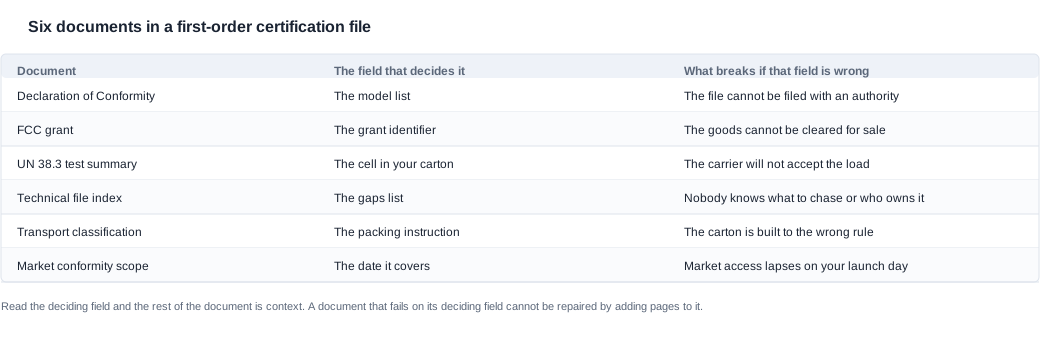
Documents arrive with titles, and titles are marketing. What matters is the single field inside each document that determines whether it can be used for this order. Six documents make up the working part of a first-order file for a rechargeable smart glasses product, and each one has a different deciding field.
| Document | The field that decides it | What breaks if that field is wrong |
|---|---|---|
| Declaration of Conformity | The model list | The file cannot be filed with an authority |
| FCC grant | The grant identifier | The goods cannot be cleared for sale |
| UN 38.3 test summary | The cell in your carton | The carrier will not accept the load |
| Technical file index | The gaps list | Nobody knows what to chase or who owns it |
| Transport classification | The packing instruction | The carton is built to the wrong rule |
| Market conformity scope | The date it covers | Market access lapses on your launch day |
The table is a criteria set rather than a specification, and the third column is the part worth reading twice. Each of those consequences is a different kind of event: one is a filing problem, one is a clearance problem, one is a freight problem, one is a management problem, one is a packaging problem and one is a date problem. A first-order review that treats them as one category of "paperwork" will not prioritise correctly.
The two documents that can stop the goods moving
The UN 38.3 test summary is not a conformity marking, and a buyer who has only dealt with market access documents sometimes treats it as one. It is a transport document, and every model in this catalogue runs on a rechargeable lithium cell, which means a forwarder will require the summary before the goods are offered for carriage. The deciding field is the cell, and it has to be the cell in the configuration that is actually in the carton.
The reason this is a recurring problem rather than an obvious one is that a configuration with a charging case and a configuration without one are different shipments. The case is a second cell, it changes the declared content of the consignment, and it changes the packing instruction that applies. A summary that covers the device and not the case is a summary for a different shipment.
The transport classification document is the second one, and its deciding field is the packing instruction, which has to match the carton that is actually going to be built. The state-of-charge rule in the same document is the item most often missed, because it is a condition on the dispatch rather than a line in the quotation, and the party that has to defend it is the broker rather than the factory.
The two documents that decide whether the product may be sold at all
The Declaration of Conformity is the document behind the CE mark, and it is the one most often received without the model list attached. The fields that matter are the models the declaration covers, the legislation it references, the harmonised standards relied on, the date, and the signatory. The deciding field is the model list, and the check is a line-by-line comparison against the purchase order rather than a general read.
The reason this catches people is naming, not substance. A declaration may cover a product family while the order is a specific configuration with a case, a colour or a firmware build. Whether that is a problem depends on the declaration and on the configuration, and it is a question to put in writing rather than a question to assume either way.
The FCC grant is the second, and for the United States it is the item with the least tolerance. The identifier is obtained through a laboratory recognised by the FCC, and it is marked permanently on the product and on the packaging. That last detail is what turns it into a schedule item rather than an administrative one, because the artwork has to carry it, so the artwork has to be settled before the test is started, and artwork that changes after the test is a reprint. The consequences of arriving without it are concrete rather than theoretical: the goods cannot be cleared, and major marketplaces will delist the product.
Verifying a first-order certification file step by step
The six steps and the completion test attached to each
Verification in this category is a document exercise with a physical check at the end, and it works in a fixed order. Each step below has a completion test, and a completion test is something with a date, a number or a named owner in it. A verbal assurance is not a completion test.
- Get the exact designation list in writing. Completion test: a written list from the supplier, containing every model and configuration on the order, matching your purchase order character for character. Not a marketing page, not a catalogue extract, not a sentence in an email.
- Ask which documents exist for those models. Completion test: a named list of documents, each with a holder and a date attached. A folder of files with no index is not an answer, because you cannot check an index you were not given.
- Request the document rather than the mark. Completion test: the document itself, with its model list visible. The moment the reply says "we are CE certified" and does not attach anything, the request has been declined in substance.
- Compare the model lists against your artwork. Completion test: a line-by-line comparison, with the artwork version number recorded. This is the check that most often finds a mismatch, because the declaration is usually written for an earlier build of the same product.
- Check the cell and the carton against the transport file. Completion test: the cell part number in your configuration matches the cell named on the summary, and the case is either in the file or confirmed as not shipping in the box.
- Write the outstanding items into the order as conditions. Completion test: a clause in the purchase order, with an owner and a date against each outstanding item. Not a request, not an email, a clause.
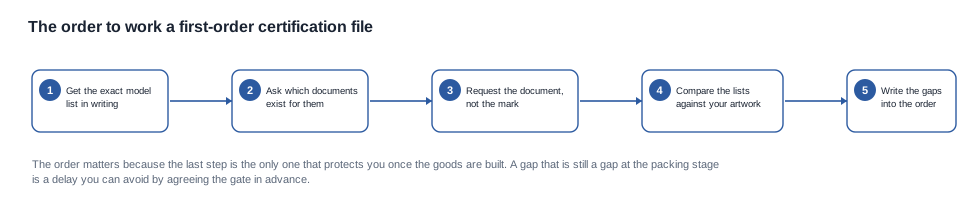
The sequence is in the order of consequence, not the order of convenience. Steps one and two cost a single email. Step six is the only one that changes what happens when something goes wrong, and it is the one that is skipped most often.
What to do when a document arrives with the wrong model on it
This happens, and the correct response is not to reject the document. A document naming a sibling model is still evidence about how the supplier documents itself, and it tells you the file index is not maintained at the level of granularity you need.
Three things are worth doing. First, ask for a reissue with the correct designation, and establish whether the reissue carries a cost; a reissue is a scope change, and scope changes are where the money goes. Second, establish whether the supplier's own document control is the cause, because a supplier with no model control will have the same problem on the next order with a different configuration. Third, record the gap in the purchase order as a condition with a date, so that the risk is shared rather than absorbed by the launch schedule.
None of this is a reason to change supplier. It is a reason to convert an assertion into a condition, which is exactly what a first-order file is for.
The questions to ask in writing
The following set is short on purpose, and every question on it has an answer that can be written down.
- Which model designations does each document in the file cover, and does the list include every configuration on our purchase order?
- Who is the holder of each piece of evidence, and can it be transferred to our importer in the destination market?
- What is the issue date and the expiry date of each document, and which market is each one valid in?
- Which cell is named on the transport summary, and does the carton as specified contain that cell and any case cell?
- What is the declared state of charge for the consignment, and how is it set?
- Which of the claims on our listing and packaging are supported by which document in the file?
That last question is the one that separates a compliance file from a marketing review, and it is the one that determines whether a listing can survive a challenge two years after launch. The certification checklist sets out the full framework, and the buyer's checklist for certification is the item-level version of the same work.

Where first-order certification goes wrong and what it costs to find out late
Four failures and the point in the programme where each appears
The failures are few, repeatable and mostly documentary. Each one is written here as what it looks like, what causes it, and what stops it before the goods move.
The declaration that names a different model. The report was written for an earlier build of the same product, and the designation changed during ordering because a suffix was added. The symptom appears at the document check, after the goods are already produced. The prevention is to fix the designation list before the sample goes anywhere, and to make a designation change a reissue trigger in the order.
The file that sits with the factory while the obligation sits with you. Where your brand is placing the product on the market, the obligations attach to your brand, and the labelling has to say so. A carton that carries your brand and a declaration that carries the factory's name is a mismatch that is discovered at the border. In the European Union this runs through the Radio Equipment Directive (EU) 2014/53/EU and the traceability requirements of the General Product Safety Regulation (Regulation (EU) 2023/988, applicable since 13 December 2024), which add manufacturer identification and a responsible economic operator in the market.
The case that was added to the box after the file was written. The device was cleared, the charging case was added later as an accessory decision, and nobody took the change back through the documentation. The symptom is a carrier that accepts the device and queries the second cell. The prevention is to freeze the box contents together with the cell configuration and require the transport file to name every cell that travels in the carton.
The packaging claim that runs ahead of the evidence. A product that says "waterproof" on the box, or names a Bluetooth qualification, or states a battery duration the file does not evidence, is a claim a market control authority can act on. The designation IP54 means protection against water spray, not immersion, so describing an IP54 model as waterproof is a claim the file cannot support even when the marking itself is accurate. In our own catalogue the IP54 marking appears on the V06 and the S7, and no third-party test report number is published behind it.
The two catalogue entries that make the risk concrete
Two entries in our published material are worth singling out on a first order, because both of them change what a buyer should ask for rather than only what a buyer should check.
The first is the children's line. The A05 and the A06 are published with a 40 mAh cell and about twenty hours of rated use, and the A07 with a 70 mAh cell and the same rated duration, and all three are magnetic charging. What is not published is a certification position of any kind for them, and the requirements for children's eyewear in Europe and the United States are additional to the radio and chemistry requirements rather than a substitute for them. On a first order this is not a document to request, it is a determination to make before the order.
The second is the bone conduction platform, which carries a published amplification figure of 35 dB. That is an assistive hearing level. No certificate answers the regulatory question that a published amplification figure raises, and a buyer who puts that model into a product line without a legal opinion is making a product decision rather than a procurement one. We will flag it, and we will not pretend the certification file resolves it.
The cost of a gap that is found at the dock
The cost of a gap found late is not the fee for the document that was missing. It is the demurrage on a container, a re-labeling run, a second freight booking, the delay to a launch, and the loss of a sales window that cannot be recovered. It is also the cost of the argument that follows, because a supplier who cannot produce a document on request tends not to produce it quickly either.
Against that, the cost of the checks in this article is an email and a clause. That asymmetry is the reason a first-order checklist exists in the form it does: it is not about paperwork for its own sake, it is about moving a cheap check to the front of a programme so that an expensive one is never reached.

What can be negotiated in a first-order certification scope and what cannot
The three commercial lines a supplier will move on
Negotiating a certification scope is different from negotiating a unit price, and it is worth separating the parts before you open the conversation.
The first movable line is the order of the work. Test scope, artwork finalisation and sample dispatch can often be sequenced so that the artwork is settled first and the sample is built for testing rather than for demonstration. This costs nothing and removes the most common reissue.
The second is the scope of the market file. A buyer who asks for a broad set of markets pays for a broad set of markets, and a buyer who narrows the list to the one market the first order is actually for often gets a shorter file and a shorter wait. The supplier's incentive is aligned here, which is why it is the easiest conversation to have.
The third is the commercial timing of the fees. Whether a test engagement is charged at the point of booking, at the point of approval or in stages tied to results changes the cash profile of the programme rather than its total, and it changes your exposure if the programme stops half way.
The two lines that look movable and are not
The testing and assessment of a model against a market are per model family and per market rather than per unit. They are close to fixed. Arguing about them is a poor use of a first order, because the scope is the thing that actually moves, and a buyer who wins a small argument on the fee and loses the scope argument has saved nothing.
The second is the certification of the children's models and of the bone conduction platform, and it is not a commercial question at all. Those are determinations about the product and the market that have to be made before a price means anything. We will not price a route we have not confirmed, and we would rather tell a buyer that the determination is outstanding than invoice a line called certification that describes work nobody has scoped.
The four clauses to put in the purchase order
Four clauses do most of the work, and they are short.
- A model designation clause. The documents delivered must name the exact designations on the order, and a change to a designation triggers a reissue at the supplier's cost.
- A document condition clause. Each outstanding document is listed with an owner, a date and a stated consequence, and the consequence is that the balance is not released until it is closed.
- A change-control clause. Named changes to the battery, the charging interface, the radio configuration, the enclosure material or the firmware trigger a scope review, and the re-assessment cost is allocated by whoever requested the change.
- A retention and transfer clause. The file is delivered in a form that can be handed to your importer, retained for a period that covers the market's record keeping expectation, and produced on request after the goods have moved.
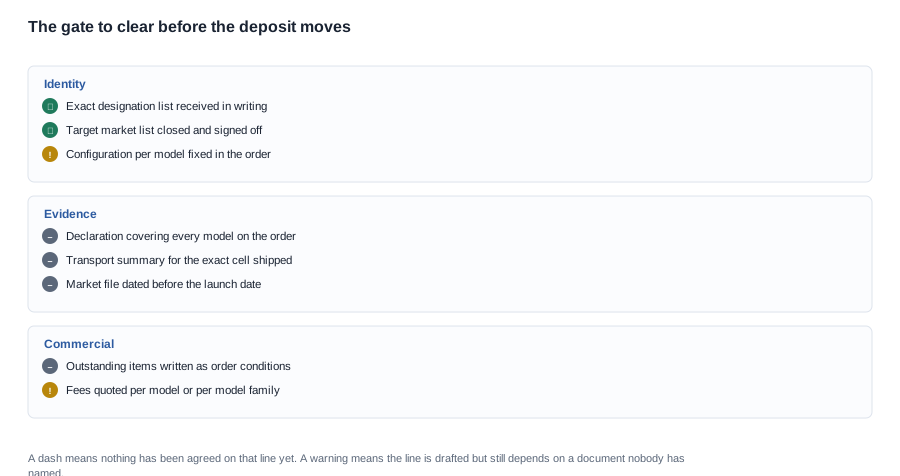
The third clause is the one that does the most work over the life of the relationship, because it converts a dispute about whether a change was material into a discussion about what the change touched. Everything in the certification checklist framework is easier to run when those four clauses are already in the order.
A first-order reasoning worked through, and the line we hold
A hypothetical first order for a camera model
The following is a reasoning exercise rather than a client story. No customer is described, no figures are claimed, and the model, the quantity and the market are assumed so that the order of the reasoning can be followed.
Suppose a brand is opening a first programme for a camera-equipped smart glasses model, for sale into one European market, with a first order in the low thousands of units and a charging case sold as a separate accessory rather than in the box. The decision to work through is which supplier to shortlist and what to require before a deposit.
The first move is identification. The buyer asks for the designation list in writing and finds that the supplier's own material carries two strings for one model. That is a five-minute finding and it changes the order of everything else, because a document that names a different string than the carton cannot be filed. The buyer writes the designation into the purchase order before anything else is agreed, which means the artwork, the declaration and the transport file will all be built from one string rather than reconciled from three.
The second move is the cell. The model ships with a 1400 mAh charging case, so the buyer asks for the transport summary for the device cell and separately for the case cell, and asks which of the two is actually travelling in the consignment. The supplier confirms that the case is an accessory, so the shipment contains one cell. That answer, in writing, is worth more than a general assurance that transport documentation exists.
The third move is the market file. The buyer asks what the declaration covers and when it was signed, and the answer establishes whether the file is current for the launch year or whether the market has moved since it was written. The buyer also asks for the position on the radio cybersecurity file, because a Bluetooth product has a radio file and a cybersecurity file and the second one is the one that is most often forgotten when the order is being placed.
The fourth move is the claims. The buyer sends the listing copy and the artwork and asks which lines are supported by which document. A protection marking, a battery duration, a resolution figure and a Bluetooth version are each either supported or they are not, and the answer is short.
The fifth move is the deposit. By this point the buyer has a designation, a cell configuration, a dated file position, a claims position and a list of outstanding items. The outstanding items are written into the order as conditions, and the deposit is released against a schedule. That is the whole method, and it costs a day of work rather than a week of delay.
What we will and will not put in writing about our own file
In our own documentation, the export-certification page carries ten patent certificates — eight appearance-design patents and two utility-model patents — and the content of that page is images rather than text. The catalogue names no CE, FCC or RoHS marking, no per-model certification row exists anywhere, and no model coverage, certificate number, issuing body or validity date is published for any model; the applicable scope for a model and a market is written material to be requested and filed before the order, and we will not present that page as though it were a model-level file. Where a document exists for a specific model, we will supply it. Where it does not, we will say so plainly and describe what has to be obtained and by whom.
We will also say that two entries in the catalogue need attention before a first order, and they are the two named above. The children's line has no conformity position recorded at all. The bone conduction platform carries a published 35 dB amplification figure, which raises a regulatory question that no certificate answers.
What we will not do is quote a reference from memory, describe a marking as a certified rating, or present a catalogue annotation as a test report. A plausible-looking identifier is worse than an open gap, because an open gap gets chased and a plausible identifier gets used.
What to send us to start the work
Send the model list with the configurations, the destination market, the packaging intention and the launch window. We will tell you which frameworks apply to each model in that market, which documents we hold for those models, which we do not, and what has to be obtained to complete the file before the goods are packed.
The camera and audio smart glasses range shows which models the claims apply to, and practical advice on the certification checklist covers how to run the same checks against a supplier who is not us.