

Smart glasses certification checklist: six stages and their pass conditions
The answer a buyer can act on
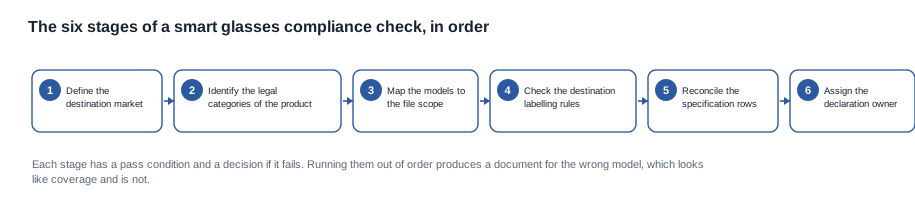
The order in which a buyer runs the compliance checks is what decides whether a gap is found in time to close it. A file collected in the wrong order produces a document for the wrong model, and a document for the wrong model is worse than no document at all, because it looks like coverage. The sequence below is the one to run, with a pass condition at each stage and a decision to make if it fails.
The sequence is: define the destination market, identify the legal categories the product falls into, map the models onto the file scope, check what the destination market demands on the goods themselves, reconcile the specification rows against the file, and assign the declaration owner. Each stage narrows the problem, and each one has a stage after it that is meaningless if the stage before it was skipped.
Why the order of the checks matters
The reason for the sequence is that each stage's output is the input to the next, and getting the input wrong produces a wrong answer that is still an answer. Run the model mapping before the market is defined and the buyer ends up with a file for a model, prepared for a market nobody is selling into. Run the labelling check before the scope is mapped and the buyer commissions artwork for a route the file does not support. Run the declaration question last and the buyer discovers at signing that nobody has been made responsible for the statement.
The sequence also has a property that matters commercially: each stage is cheaper than the one after it. Finding that the file does not cover the two-capacity case costs a question. Finding out at the port costs a hold. Finding out after the channel has taken the goods costs a recall, and the recall is the only one of the three that also damages the brand.

Stage one and two: the market and the legal category
Defining the market
The first question is where the goods are being sold, and in which configuration. It sounds trivial and it is the stage most often skipped, because a buyer who already knows the answer feels that stating it adds nothing. In practice the market question opens three things that are otherwise left implicit: which regulatory route applies, which labelling the artwork has to carry, and who ends up holding the declaration.
The European Union, the United Kingdom and the United States are three routes, not three versions of one route. The General Product Safety Regulation (EU) 2023/988 has applied since 13 December 2024 and also reaches products designed for professional use that later reach the consumer market, which catches a great many channel programmes that started in the trade and moved retail. The Radio Equipment Directive (EU) 2014/53/EU remains the framework for radio equipment, and the EN 18031 series of harmonised cybersecurity standards has been a mandatory part of the CE mark since 1 August 2025. The United Kingdom runs UKCA and UK RoHS as a parallel route. The United States requires an FCC ID under Part 15, obtained through a laboratory recognised by the FCC and permanently marked on the product and the packaging.
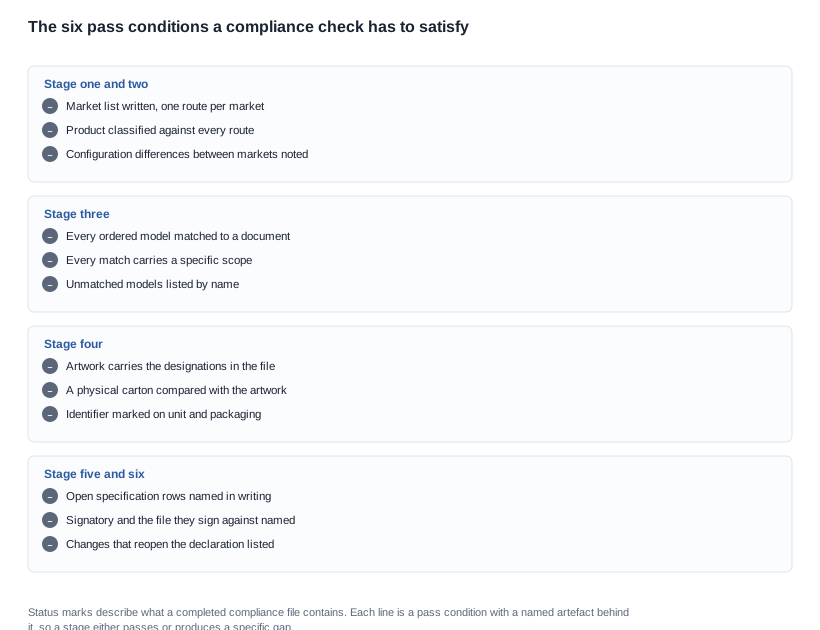
Pass condition for this stage: the market list is written down, each entry says which route it runs, and a configuration that is not the same in every market is identified as such.
Identifying the categories
A single product crosses several legal categories at once, and the categories are what determine which documents are needed. A model with a radio falls under the radio equipment framework. A model with a camera also carries requirements on how data is handled, which sit outside the radio framework and are a separate scope. A consumer product also sits under the general safety framework.
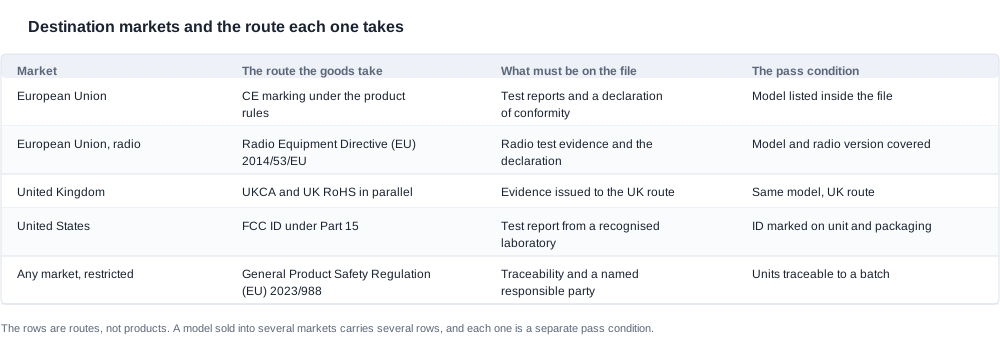
The table sets out the routes and the pass condition for each. The point of the middle column is that a file covering one row is not a file covering the order, and the right-hand column is the test that tells the two apart.
Pass condition for this stage: the product has been classified against every route in the market list, and the combination of categories for each model has been written down rather than assumed to be the same for all models.
Stage three: mapping the models onto the file scope
The mapping exercise
This is the stage that most often ends in a wrong answer, and it is the one worth doing properly. Take the configuration list from the purchase order and set it beside the model list inside each document. Then mark every model that appears in both, every model that appears in only one, and every model that appears in the document but not in the order.
The exercise sounds clerical and it is decisive, because it converts a vague impression into a short list. The list of models in the order but not in the file is the work. The list of models in the file but not in the order is not an error — it is scope the supplier holds and has not been asked to use, which is a useful asset at the next order.
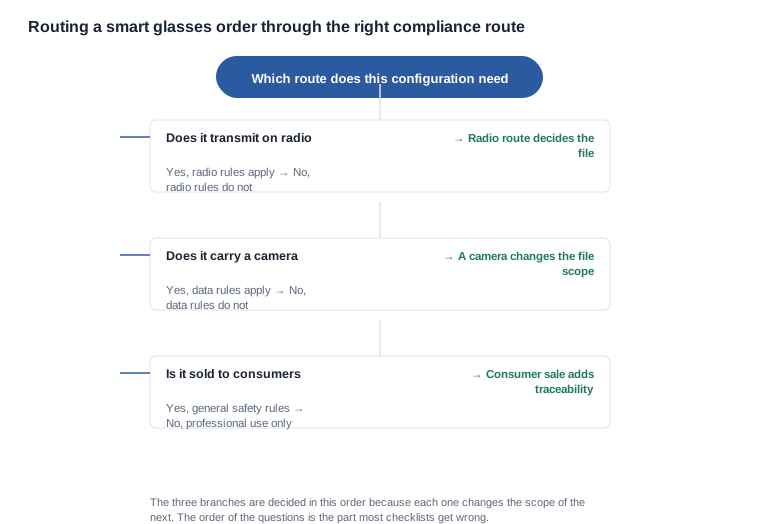
The routing tree is the tool for doing the mapping. The three branches are decided in this order because each one changes the scope of the next: whether the product transmits on radio, whether it carries a camera, and whether it is sold to consumers.
The three questions that resolve a mismatch
When a model in the order is not inside the file, three questions have to be answered before anything else happens, and each one has a different answer.
Is the model in the file under a different designation? Model codes get renamed between the catalogue, the test file and the purchase order, and the mapping exercise fails on a naming difference rather than on a scope difference. Ask for the internal designation behind each code in the file and check it against the designation in the order.
Is the model in the file under a broader scope that includes it? Some files cover a variant, a family or a platform rather than a single model code. If the file's scope includes the buyer's configuration, the answer is that it is covered and the mapping was too literal.
Is the file genuinely scoped elsewhere? If the file names a different configuration of the same model — a different case option, a different lens, a different radio version — then the order is not covered and the options are to extend the scope, to change the order to a covered configuration, or to move. This is the answer that changes the programme, and it is the one a buyer should insist on getting in writing.
Pass condition for this stage: every model in the order has been matched to a specific document and a specific scope, and the unmatched models are on a named list.

Stage four: what the destination market demands on the goods
Marking and labelling
The goods themselves carry requirements that are separate from the documents, and they are the part of the file that a buyer usually checks last and most casually. The mark and the labelling have to be right on the unit and on the carton, not only in the file, and they have to agree with the artwork and with the configuration that is actually in the box.
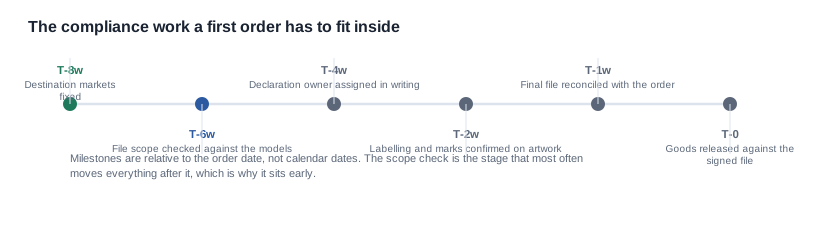
The timeline shows why this stage sits where it does. Artwork changes are slow once they are with a printer, and the artwork is the last thing in the chain that can still be corrected cheaply.
In the United States the FCC identifier is permanently marked on the product and on the packaging, which means it is a fixed element of the artwork rather than a label applied at the warehouse. In the European Union and the United Kingdom the marking follows the route and the model designation has to be the one the file names. Every market also has its own language and labelling requirements for the information that travels with the goods, and those requirements are the ones most likely to be caught by an inspection of the carton rather than of the file.
What a wrong label costs
An artwork error is expensive in a specific way: it is discovered at the worst possible time and it cannot be fixed by a document. A wrong model designation on the carton puts the buyer's goods outside the scope of a file they hold, so the file stops being evidence and becomes irrelevant to what is in the box. A wrong identifier on the unit is worse, because the unit is what an inspector handles first.
The mitigation is unglamorous. The artwork is checked against the configuration string and against the model list in the file before it goes to print, and a physical carton is checked against the artwork before the run is approved. Both of those are cheap checks performed early. Neither of them can be performed after the print run without scrapping the artwork.
Pass condition for this stage: the artwork carries the designations and identifiers that the file names, and a physical carton has been compared with it.

Stage five and six: the specification gaps and the declaration owner
The specification gaps that behave like certification questions
Some of the hardest gaps in this category are not compliance gaps at all. They are rows that the published specification does not carry, and they turn into compliance questions because the documentation has to be written against them.
The published catalogue leaves several such rows open. Four camera models — the CY03 and the CY05, and the L1 Pro and the MT6 — have no published charging-method row. The camera series has no published Bluetooth version. Twenty-seven of the 28 models have no published weight, and the MT6 is the single exception at 158 grams for the glasses themselves, excluding its folding charging case.
These gaps have to be closed in writing, because a documentation route cannot be written against a row that does not exist. The way to close them is to ask the supplier to state the value in the document for the configuration being ordered, which converts an open published row into a contractual one. That is a legitimate and common outcome: the buyer's own file becomes more precise than the catalogue.
There is a second class of gap that is not about a value at all. It is the gap between a file that covers the model and a declaration that covers the buyer's brand, packaging and configuration. The file supports the product; the declaration makes the statement about what is actually being sold.
Who signs the declaration
The final stage assigns ownership. In most programmes the importer is the party taking responsibility for the goods in the destination market, and the declaration is signed in the importer's name. But the signature is only meaningful if the signatory had the technical file in front of them, and this is where supplier relationships go wrong in a way that is hard to repair later.
The question to ask is who the signatory is, what they had access to when they signed, and which document they signed against. A declaration signed on the basis of a supplier's summary rather than on the file itself is a declaration with no evidential basis, and it is the arrangement that produces enforcement action rather than a customs query.
Pass condition for this stage: the party that will sign is named, the file they will sign against is identified by number and date, and the changes that would reopen the declaration are listed.
When the sequence stops, and what to do with the answer
The three cases where this sequence stops
There are three findings that end the sequence, and each of them ends it at a different stage.
The market cannot be defined. A buyer who cannot say where the goods will be sold cannot run the sequence, because every stage after the first depends on it. This is not a compliance problem, it is a commercial one, and it is settled at the level where the channel decision is made.
The file does not cover the configuration and cannot be extended in the time available. This is the commonest stop, and it is a planning problem rather than a technical one. The options are to change the order to a covered configuration, to extend the scope, or to move the launch. Which one is chosen depends on the launch date and not on the paperwork.
The specification rows the documentation depends on are open and will not be closed in writing. This is the stop that matters most, because a supplier who will not state a value in a document is telling the buyer that the documentation will have to be written without it. That is workable only if the buyer is prepared to sign the declaration without it.
What to do with the answer you get
The answers to the six stages are of three kinds, and each kind leads somewhere different. A pass at every stage means the order can proceed on the current documentation, with the open specification rows carried forward as named questions in the purchase order. A partial answer means the gap has to be written into the order as an obligation with a date attached, because a gap that is carried in the file and not in the contract is a gap that will be discovered at the worst moment.
A failure at a stage means the sequence stops there and the programme is redesigned around the answer. That is a legitimate outcome of a checklist. The purpose of a checklist is not to produce a pass, it is to find out which stage fails while there is still time to do something about it.
Running the sequence across two suppliers
The sequence is usually run against more than one supplier, and the way it is run across them determines whether the comparison is useful. The mistake is to run the stages at different depths for different suppliers — one gets the full file and the other gets a summary — and then to compare a complete answer with an incomplete one. The comparison then becomes a comparison of how much each supplier disclosed, which is a fact about the suppliers rather than about the configurations.
Run all six stages against all suppliers, in the same order, and record the answer in the same place. The record should have one row per stage and one column per supplier, with the answer and its artefact in the cell. That table is small enough to keep in a single document and it is the only version of the comparison that survives a question later.
The second question is where to stop. A supplier that fails stage three has told the buyer something different from a supplier that fails stage five, and the difference is about how much of the programme is at risk. Failing stage three means the file does not reach the goods, which is a structural problem. Failing stage five means the specification rows are open, which is a detail problem that can be closed by a written answer. A shortlist built by sorting suppliers by the stage where they first failed is therefore a shortlist built on the right variable.
There is a third discipline, and it is the one that costs the most if it is skipped. The stage where a supplier gave the weakest answer is often the stage where the buyer's own specification is weakest, and the two are connected. A supplier that cannot state the charging method for the configuration being ordered is frequently one that does not control that configuration either. Recording which stage failed for which supplier is therefore also a record of where the buyer's own specification needs work, and that is usually the more useful of the two readings.
Before you order, the criteria are the six pass conditions and nothing else. How to evaluate two suppliers is to run both through the same six stages and compare the stage where each one first failed, because a supplier that fails at stage three is a different proposition from one that fails at stage five.
What we can and cannot confirm
The short answer: the published catalogue is the part of our own position a buyer can check us against, and the company-level export certification statement covers the range rather than individual models. We publish the case capacities, the charging methods, the electrical rows, the pixel tiers and the charge times and the two IP54 markings on the V06 and the S7. We do not publish per-model certificate numbers, and we will not infer one for a model from a company-level claim.
We will also tell you where our own published data is open, because an open row that the buyer knows about is a question and an open row that the buyer does not know about is a surprise. The camera series' Bluetooth version, the charging method on four camera models, and the weight on twenty-seven models are all open on our side, and each one is a line to put in the enquiry.
- The practical version — certification checklist practical advice
- A worked audit — factory audit worked example
- The supplier side — sourcing risk documentation requirements
- The camera configuration — AI camera glasses
- The checklist pillar — procurement certification checklist
Send the models, the options and the markets, and we will tell you which published rows are settled, which are open, and which stage of the sequence will fail first.


