The certification checklist that matters is not a list of documents. It is a list of the places where a smart glasses product fails to clear, and those places are remarkably consistent: a certificate that covers the company rather than the model, a file assembled for a different market, a claim printed on artwork with no report behind it, and a product that is fine until it reaches a customs broker. This is a sequence rather than a list, because the order in which you collect things is what determines whether you find a gap in time to fix it. The two long-lead items in this category are the radio testing and the battery transport documentation, and both of them have to be opened before the short-lead items are even requested, because everything else depends on them. Everything below is written as an action with a completion test, so that you can tell whether a step is finished or merely attempted.

Smart glasses certification checklist: the order you request in decides the result
A buyer who requests everything in one email gets one answer, and the answer is the shortest thing that could plausibly be sent. A buyer who requests in the order the dependencies run gets several answers, each of which is specific, and each of which arrives while there is still time to act on it.
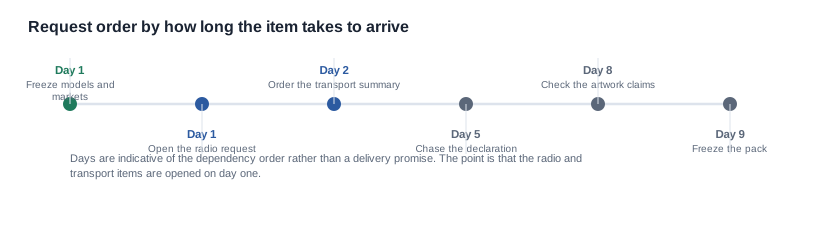
The reason is that two of the items in a smart glasses certification file are long-lead and the rest are not. The radio assessment takes longest, because it needs a sample, a laboratory and a scheduling slot, and a request that arrives after the programme has been specified is a request that cannot be met inside the launch window. The battery transport summary is second, because it is tied to the exact cell configuration in the carton and that configuration is not fixed until the box contents are decided. Everything else — the declaration, the technical file index, the marking artwork — is desk work once the two long-lead items exist, and it can be produced in days rather than weeks.
The commercial consequence is that the request order is a schedule decision disguised as an administrative one. Open the long-lead items on day one, even if the model list is not final, because the radio assessment can be scoped while the model list is still being narrowed and the battery summary can be scoped as soon as the cell configuration is known. Both requests are cheap to make and expensive to make late.
The same logic explains why a buyer who waits for a signed purchase order before asking for anything is usually waiting too long. A purchase order fixes the configuration but it does not open a laboratory slot, and the assessment is scheduled against a queue rather than against a contract. The practical instruction is unglamorous and it works: ask for the long-lead items against a draft configuration, then align the final order with the scope that comes back. A draft scope that turns out to be wrong costs a week; a scope requested after artwork approval costs a reprint and a date.

Step one: fix the market list and the model list in writing
The first action is not a request. It is a list, and it has to be written down before any supplier is asked for anything, because the shape of the request depends entirely on it. Two lists are needed: every destination market the goods will lawfully enter, and the exact model designations on the purchase order.
The market list has to be written as destinations, not as regions. The European Union, Great Britain and the United States are three separate routes with three separate frameworks, and a list that says "Europe" produces a file that covers one of them and a buyer who believes it covers two. Where the manufacturer is outside the destination market there is an importer obligation attached, and that obligation is attached to the buyer's side of the transaction rather than the supplier's.
The model list has to carry the exact designation strings, and it has to be checked rather than assumed. A model designation is not always a single string in the way a buyer expects: one model in this range appears in the catalogue under one designation and is also marked with a longer variant name, which is precisely the kind of difference that is invisible internally and fatal at a border. The same applies to designations that differ by a suffix rather than a version. Where a camera model and an audio model share a family name, they are different products and they need different evidence.
The completion test for this step is simple: the two lists exist as a document that the supplier, the logistics team and the brand's own compliance function have all read. A list that only the requester has seen is not a scope, and it will be re-interpreted by everyone downstream.
Three families, three different requests
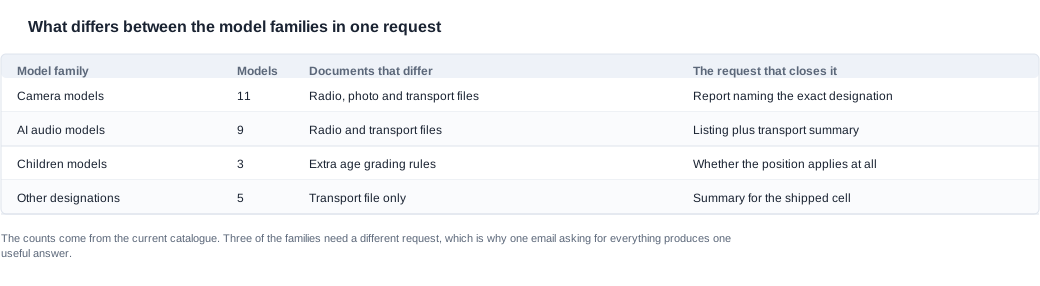
The current catalogue covers twenty-eight designations, and they fall into four groups that do not need the same request. The camera group is eleven models. The AI audio group is nine. The children's group is three. The remaining five are the AR platform, the electrochromic platform, the bone-conduction platform and two sports designations.
The camera group is the one that needs the most attention, and it is the one most often treated as a single request. It contains three models with a 1400 mAh charging case, one with a 900 mAh or 1400 mAh option, one with a 1200 mAh folding case, two with a case whose capacity is not published, and four camera configurations that publish no charging-case row at all. It also contains the two models that carry an IP54 marking, the V06 and the S7. The audio group publishes a Bluetooth version for every model in it and carries no ingress marking. The children's group has no published certification information at all, and the export certification page at the catalogue front page is a company-level page whose content is images rather than text, not a per-model row, so the three children's models need a question about applicability rather than a document request.
Sending one request for all twenty-eight produces one answer about the family. Sending three requests produces three answers that each close something.
Step two: split the models that share a radio configuration
Before the long-lead requests go out, the model list has to be grouped by radio configuration, because that grouping decides how many radio assessments are needed and it is the single largest lever on the cost of the file.
Models that share a radio module, an antenna path and a firmware radio stack can usually be covered by one assessment, with the per-model references held in the technical file. Models that differ in any of those three cannot, and a difference in the antenna is the one most often overlooked because it is a mechanical change rather than an electronic one. The grouping therefore has to be an engineering question answered by the supplier, not a guess made by the buyer from a product page.
There is a second axis that the radio grouping does not capture, and it is the one that catches buyers in the camera group. The transport summary is tied to the cell configuration in the carton, and the cell configuration varies across the range. Some models are published with a 220 mAh cell, several with 290 mAh, one with 265 mAh, others with 260 mAh, and the audio line publishes its capacity as a cell count times a cell value rather than a single number — for example the two 90 mAh cell models and the 55 mAh cell pairs in the audio range. Each of these is a different transport document, and none of them can be inferred from the device name.
The completion test for this step is a table with three columns: model designation, radio group, and cell configuration in the carton. If a model has no entry in the second or third column, the request has not been scoped yet.
One warning belongs here rather than later. The radio group is a technical grouping that the supplier has to confirm, and it is the grouping most likely to be wrong in the buyer's favour, because a supplier who is being asked for the cheapest scope will propose the widest grouping it can defend. The test that catches it is mechanical: the group has to be justified by an antenna and a firmware statement, not by a shared product name or a shared tooling set. Two camera models with the same case supplier and the same plastic are still two radio configurations if the radio module or the antenna differs, and in a range where eleven camera models share a product family, that distinction is the whole question.
What to request, and what to ask for instead
Once the two lists and the grouping exist, the requests themselves are short. What follows is the sequence, with the completion test for each line.
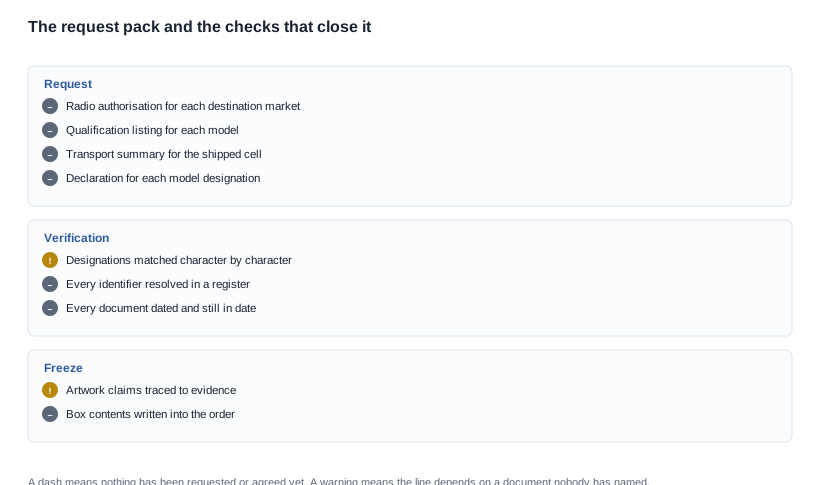
- The radio authorisation for each destination market. Ask for the identifier, the grantee name and the product code on the record. The completion test is that you can open the public register yourself and find it, rather than being told that it exists.
- The qualification listing for each model. A separate instrument from the radio authorisation, and the request should specify the model designation. Note that for the eleven camera models our catalogue publishes no Bluetooth version, so the radio configuration has to come from the supplier rather than from our own published rows.
- The battery transport summary for each cell configuration that ships. Ask for it against the cells in the carton, including the case where one is shipped, and state the case capacity in the request so that the supplier is answering the right question.
- The declaration for each model designation. One per model, with the designation printed on it exactly as it appears on the purchase order.
- The technical file index. The structure that holds the rest, and the document that tells you whether the file was assembled once or assembled from scratch each time.
- The evidence behind every claim intended for the artwork. Only the two ingress-marked models in this range carry such a claim, and the request should ask for a report number rather than for confirmation of the marking.
The certification red flags article covers what to do with a disappointing answer, and the documentation requirements article covers the sourcing-risk framing for the same documents.

Step three: verify what arrives rather than filing it
Collecting a document proves that a document was sent. It does not prove that the document covers the configuration being ordered, and the gap between those two things is where most of the cost in this category sits.
Four checks turn a received document into usable evidence, and each of them is mechanical.
Match the designation. Compare the designation printed on the document against the designation on the purchase order, character by character. Not the product name, not the family, not the marketing title. The string on the document.
Resolve the identifier. Where a document carries a number, open the issuing body's own register and confirm that the number exists and that the record says what you were told it says. A PDF with a number that does not resolve is decoration, and it is worth remembering that this check costs two minutes and can be done without the supplier's involvement at all.
Check the scope against the box. Confirm that the transport summary covers the cells that will actually be in the carton, including the charging case where one is shipped, and that the case capacity on the document matches the published capacity for that model.
Check the date against the programme. A document with an expiry carries a renewal obligation, and a renewal obligation that is not owned by a named person is a document that will quietly stop being valid in the middle of your second production year.
The completion test for the whole step is a single line per model in the request pack: the document, the identifier, the date, and the person who will chase the renewal. If a model has no line, the model is not ready to ship.
The four questions that close a request
Four questions settle the majority of requests, and they are worth sending as a standing set rather than one at a time, because the answers arrive together and the pack closes together.
- Which model designations does this document cover, exactly? Not which products, not which range — which designations, printed as they are printed. The answer either matches the purchase order line for line or it does not, and the comparison takes seconds.
- Which destination market does it apply to? The answer identifies a market, a territory or several, and it should be the same list you sent in the request. A document that comes back scoped to a market you did not ask about is a useful finding rather than a wasted request.
- What has to be requested to extend the scope to our configuration? This is the question that converts a no into a plan. A supplier who answers "the assessment covers the family, and your model needs to be listed, here is what that requires" has saved a launch window.
- Who owns the document after the shipment, and for how long? The retention question has to be answered before the order is signed rather than at the first audit, because a file that only exists on one machine is a file that will be unavailable at exactly the moment it is needed.
Send all four together. A supplier who answers three of them and leaves the fourth open has told you precisely where the risk sits, and that is a usable answer.

What a completed request pack looks like
A finished pack is not a folder of PDFs. It is a table with one row per model and per market, and in each row the framework that applies, the documents held against it, the identifiers, the dates, and the open items. Empty cells are marked empty. That distinction is the whole value of the exercise, because a table with blanks tells the buyer what to chase and who to chase it from, while a folder of documents tells the buyer only that a folder exists.
For our own range, the pack would show a specific shape. Twenty-eight designations, of which eleven are camera models and nine are AI audio models, three are positioned for children, and five carry no separate model designation. The certification position would read: an export-certification page of ten patent certificates — eight appearance-design patents and two utility-model patents — whose content is images rather than text, with no CE, FCC or RoHS marking named; model-level certificate numbers, issuing bodies and validity dates not published; an IP54 marking on the V06 and the S7 with no report number published behind it; a Bluetooth version published for fourteen designations and not for the eleven camera models; and a charging interface published as magnetic for seventeen models, Type C for seven, and not published for the CY05 and the MT6, and the CY03 and the L1 Pro.
Why the table beats the folder
A folder of documents and a table of documents look equally complete, and they are not equally useful. A folder answers the question "what have we been sent" and requires the buyer to assemble the answer to "what do we have, for which model, for which market, and until when" by reading each document and remembering what was in the previous one. The table answers the second question directly, and it is the only version of the answer that survives contact with a second market, a second model or a second year.
The practical difference shows up in three places. When a model drops out of the programme, the table loses a row and the folder loses a PDF nobody notices. When a renewal date arrives, the table surfaces it as a scheduled item and the folder surfaces it as a surprise. When an audit asks what evidence existed on the day of the shipment, the table answers in a minute and the folder answers in an afternoon, if it answers at all.
The table also makes the gaps legible in a way that a folder cannot. A row with a date and an identifier in every cell is a different statement from a row with a document name and nothing else, and the second kind of row is where a buyer gets surprised. Writing the pack as a table forces the distinction to be made, because a cell cannot hold both "a document" and "a verified document" at once.
Where the request pack meets our own published gaps
We publish the per-model specifications a compliance file is built around: the resolution class, the cell capacity and cell count, the charging interface where it is published, the case configuration where a case exists, the Bluetooth version where the catalogue states one, and the ingress marking where one is printed. We mark as not published the unit weight of every model except the MT6 glasses body, the sensor part numbers, the ingress test report numbers behind the IP54 marking on the V06 and the S7, the model-level certification numbers with their coverage, and the AI implementation detail.
That is the honest state of our own file, and we would rather state it than let a buyer find it at a customs broker's desk. Where we hold a document for a specific configuration and destination we will supply it. Where we do not, we will say so and tell you what needs to be obtained and by whom, and we will not present a company-level declaration as if it were model-level coverage.
The certification checklist section sets out the full document list, a worked factory audit shows where a gap like this appears in practice, and the camera and audio product range is where the model list behind the pack comes from. Send us the destination markets, the model list and what ships in the box, and we will tell you which documents apply and which we can produce today.