
Certification does not make a product better, but a weak certification position quietly lowers the quality of everything a buyer can verify about it, because the rows the evidence covers are the rows the evidence defines. Two consequences follow, and they pull in opposite directions. A complete file narrows the specification to what has actually been tested, which raises the quality of the product and lowers the quality of the paperwork. A file that covers only a company and not a model does the opposite: it lets a buyer write a specification by inference, and every inference in it will eventually be tested by a customer. The useful question is therefore not whether a supplier is certified. It is which rows on your specification sheet came out of the technical file and which rows you decided yourself, because that line is where the quality conversation actually happens. Below is how the evidence stacks, which rows we publish, which we deliberately leave open, and why the labelling and change-control obligations that come with the file are the most reusable part of the whole exercise.
Smart glasses certification checklist: the seam between evidence and buyer choice
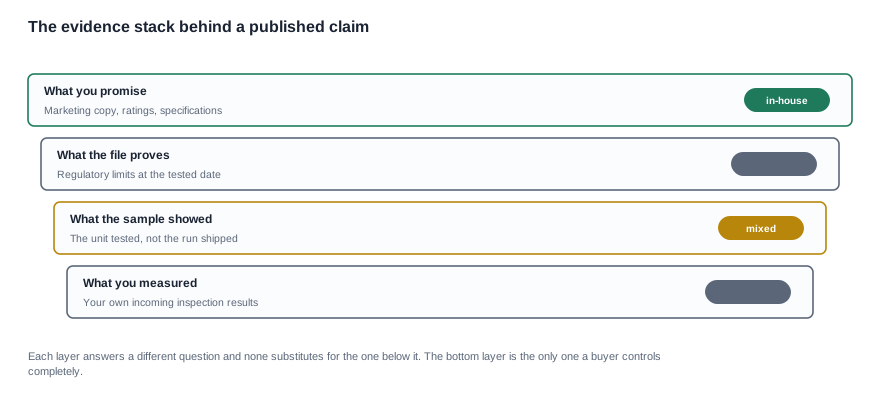
A report for a model designation establishes that the product was tested against a standard and passed. In practice that gives a buyer three things: that the radio, the safety and the electromagnetic behaviour were within limits when the sample was tested; that the model designation on the report is the one on the purchase order; and nothing else.
It does not establish image quality, storage behaviour, battery life under the customer's conditions, weight, or how the product behaves after six months of daily use. In this category the first two are not published in our documentation and the last two are largely unpublished. The rows that decide whether a buyer ships a good product are not the rows the evidence covers, and that is not a defect in the supplier. It is the shape of the discipline: conformity assessment is a regulatory instrument, and it was never designed to answer commercial questions.
The seam is the line between those two sets of rows, and a specification that does not show it is a specification with an invisible part. A buyer who builds a spec sheet entirely from what the certification covers ends up with a product that passes every test and disappoints every customer, and that is the more expensive outcome because it reaches the channel. A buyer who ignores certification entirely ends up with a product that cannot be shipped. Both failures come from the same mistake, which is treating one document as if it were the specification.
Three questions that expose the seam
- Which rows on your specification sheet came out of the technical file? If the answer is none, the specification was written by inference and the inference has to be tested another way.
- Which rows did your team choose, and what was the evidence for the choice? A chosen row is a legitimate thing to have, and it becomes dangerous only when it is presented as though it were evidenced.
- Which rows are neither chosen nor evidenced? These are the open items, and they are the ones that surface as returns rather than as questions during due diligence.
A supplier who can answer the first two questions produces a specification with a visible seam, and a buyer who can see the seam can decide what still needs measuring. A supplier who cannot answer has produced a specification by inference, and every inference in it is a risk that was accepted without knowing it was accepted.

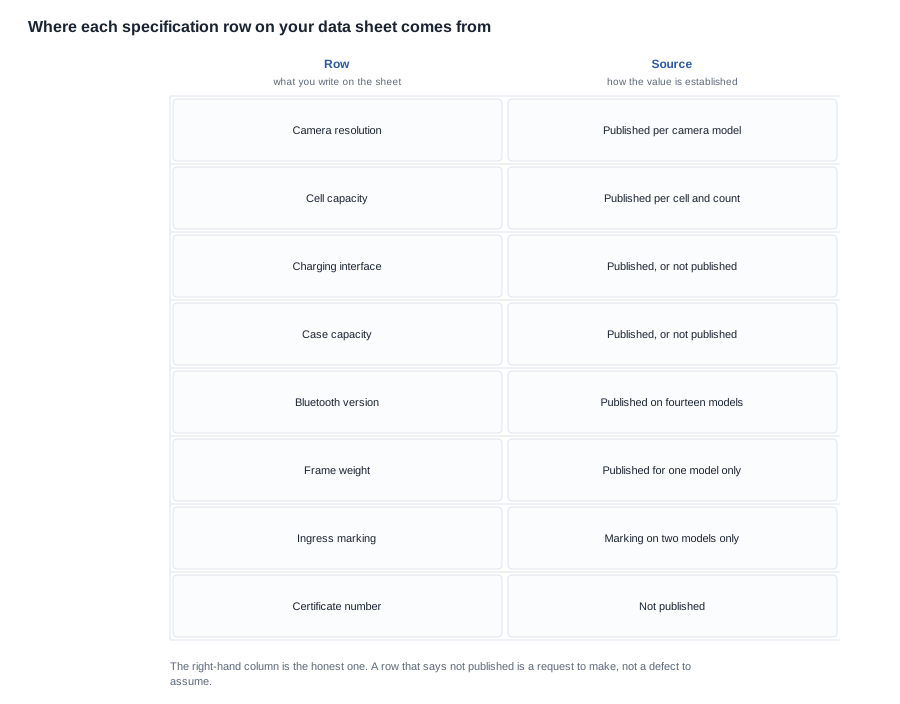
Which rows come from the file and which come from the catalogue
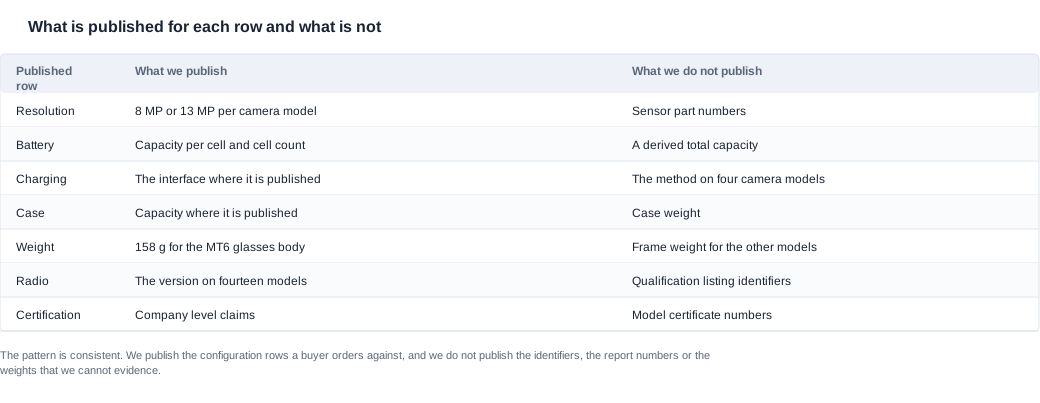
The catalogue publishes the configuration rows a buyer orders against, and the pattern of what is published and what is not is consistent enough to be worth stating plainly.
The resolution class is published. Eight of the eleven camera models in this range are published at 8 MP, and three at 13 MP. That is a published specification rather than an evidenced one, and it is exactly the kind of row a buyer chooses on commercial grounds and then has to test in practice.
The battery configuration is published as cells, not as a total. Several audio models publish their capacity as a cell count multiplied by a cell value — the two 90 mAh cell models, the 55 mAh cell pairs, the 70 mAh cell sports model — while the camera line publishes single values such as 290 mAh, 265 mAh, 260 mAh and 220 mAh. The published form is deliberate, and a buyer who wants a total has to derive it and label it as a derived figure.
The charging interface is published for twenty-four of the twenty-eight designations — magnetic for seventeen, Type C for seven — and is not published for the CY03 and the L1 Pro, and the MT6 and the CY05. The charge time is published for every model in the range, but it is published without a starting state of charge and without a termination criterion, which means it cannot be used to compare how long a mid-shift break has to be.
The case configuration is published where it exists. Three camera models are published with a 1400 mAh case, one with a 900 mAh or 1400 mAh option, one with a 1200 mAh folding case, two with a case whose capacity is not stated, and four camera configurations publish no charging-case row at all — the V03 and the V06, and the V03 Pro and the S7.
The weight is published for one model. The catalogue states 158 g for the MT6 glasses body, including its 265 mAh battery and camera and excluding the 1200 mAh folding charging case, whose own weight is not published. Every other model's weight has to be requested, and we would rather write that than quote a typical figure nobody can verify.
The rows we deliberately leave open
Four groups of information are not published, and each is open for a reason rather than by oversight.
Identifiers and report numbers. The model-level certificate numbers, the issuing bodies, the validity dates and the ingress test report numbers are not published, and the export certification page at the catalogue front page is a company-level page whose content is images rather than text, not a per-model row. We do not infer a per-model certification from a company-level claim, and we do not present a marking as a test result.
The radio version for the camera line. A Bluetooth version is published for fourteen of the twenty-eight designations and not for the eleven camera models, which means the radio configuration for the camera range has to come from the supplier rather than from our own published rows.
The specification detail behind the headline. Sensor part numbers, the AI implementation detail and the derived battery totals are not published, because a buyer who receives a derived total as though it were a catalogue figure ends up with a specification nobody can check against a future build.
The children's position. No certification information is published for the three children's models, and the requirements that apply to products positioned for children differ by market and are additional to the general ones. That is a blank to fill with a request, not a row to fill with an assumption.
What the camera line shows about specifying on published rows
The camera group is the clearest worked example of the distinction, because it contains eleven models with published configuration rows, two distinct resolution classes, six different case configurations and only one published weight.
Eight of the eleven camera models are published at 8 MP and three at 13 MP. A buyer choosing between those two classes is making a commercial decision on a published specification, and the compliance file says nothing whatsoever about the difference. The same is true of the camera's other commercial attributes — what it is worth in the channel, whether the channel can carry a case in the box, whether the buyer needs a variant with a different lens finish. None of that is a regulatory question, and none of it is answered by conformity assessment.
The consequence for a specification is that a camera line needs a row budget, and the budget has four categories rather than two. Published rows come from the catalogue and are the buyer's commercial choice: the resolution class, the case configuration, the Bluetooth version where the catalogue states one. Evidenced rows come out of a file and are the regulatory baseline. Measured rows are ones the buyer has tested on a sample and has a method for, which is where image quality under low light, continuous recording time and the behaviour of the charging interface belong. Open rows are neither published nor evidenced and are the ones that become a request.
Most buyer specifications in this category only have the first two categories, which is why the third and the fourth are where the quality of the product is actually decided. A specification that marks its open rows is a specification that says what it does not know, and that is a specification somebody can plan a test programme around.
Why one published weight is not a weight specification
The catalogue publishes 158 g for the MT6 glasses body, and that figure excludes the 1200 mAh folding charging case, whose own weight is not published. It is the only weight in the range. That single number is enough to be useful and not nearly enough to build a specification, because a buyer cannot calculate a shipping weight, a fit specification or a comfort brief for eleven camera models from one figure, and any attempt to do so would be an invented number wearing a published number's clothes.
The right use of it is as a marker of scale and as a test of the supplier's willingness to publish more. The right response to its absence elsewhere is a request with a protocol attached: state how the weight is to be measured, whether it is the glasses body alone, whether it includes the battery, and whether the case is measured separately. A supplier who answers that question precisely has a documentation habit worth relying on; a supplier who returns a single number has answered a different question and will leave the buyer to guess what it includes.

Why the rows that are hardest to publish are the ones a buyer needs most
There is an uncomfortable consistency in this category. The rows that are most commercially decisive are the rows that are least available, and the availability is not a matter of effort. The frame weights, the sensor part numbers, the ingress report numbers, the model-level certificate numbers and the Bluetooth version for the camera line are all absent, and they are absent for three different reasons that need three different responses.
Rows blocked by a third party. An ingress test report number belongs to the laboratory that ran the test, and a certification number belongs to the body that issued it. Where the underlying document exists and the supplier holds it, the row is retrievable on request. Where it does not exist for the configuration, the row is not retrievable at all, and the answer has to be a change of claim rather than a change of wording. In this range, that is the position on the IP54 marking for the V06 and the S7: either a report can be produced or the marking should not be printed as a tested result.
Rows blocked by build variation. A weight, a battery capacity and a radio configuration can all vary between builds of the same designation. Publishing a single value for a moving target is worse than publishing nothing, because the buyer cannot tell whether the value applies to the unit in the carton or to the unit in the last sample.
Rows blocked by ownership of the label. A Bluetooth version is a property of the module, and a module is chosen by the supplier, sometimes for reasons the buyer never sees. Where the version is published — for fourteen of the twenty-eight designations — it can be used. Where it is not, the radio configuration is not a published fact about our products and has to be requested against the configuration.
The buyer's answer is the same in all three cases and it is not to treat the blank as a defect. It is to send a written request that names the model, states the measurement basis, and asks for a document reference rather than a figure. A supplier can answer "here is the report" or "here is the specification" or "that is not published for this configuration" — and all three are usable answers. The only unusable answer is a number with no basis attached, and the reason to be careful about that one is that it is the answer most likely to be offered.

Why change control is the cheapest quality system a buyer can install
The most valuable thing a compliance file does for a quality system is not the testing. It is the naming. A technical file that identifies the radio module, the battery configuration and the enclosure by designation gives the buyer a change trigger for free, because any change to any of those three items now has an obvious question attached: does this need reassessment?
Most quality drift in this category is a change that nobody asked about. A second-source cell arrives with a different internal resistance. An antenna supplier changes the matching network. A firmware branch touches the radio stack. A housing is re-tooled for a cost reason. None of these is a decision anybody frames as a change, and each of them moves the product away from the configuration the file describes. The buyer who has a named change trigger has a mechanism; the buyer who does not finds out at the next audit, when the report and the product no longer describe the same thing.
The mechanism itself is simple and it is worth writing into the purchase order rather than into a quality manual. Name the items that trigger reassessment. Name the person who approves a change. Require the supplier to notify changes in writing. Require the sample that was tested to be traceable to the production run. None of that is expensive, and all of it is expensive to install retrospectively.
The labelling rules are reusable
The traceability obligations that come with the compliance framework have a second use that buyers rarely notice. In the European Union, the general product safety framework, Regulation (EU) 2023/988, applicable since 13 December 2024, requires the manufacturer to be identified, requires a responsible economic operator to be identified where the manufacturer is outside the market, and requires the labelling to carry them. That is a labelling discipline with a legal consequence, and it is also the beginning of a traceability discipline that a quality system can then reuse for batches, for complaints and for recalls.
The reuse works because the mechanics are identical. A unit that can be traced to a batch, to a production window and to a configuration is a unit that can be traced to a document. That is what makes a complaint investigation possible, a recall bounded, and a market surveillance enquiry answerable. A buyer who installs the labelling discipline for compliance reasons gets a large part of the quality traceability system with it, which is one of the few genuinely free gains in this category.
The same reuse applies to the retailer and the distributor relationship, which is where most quality cost actually lands. A channel partner who can identify the batch behind a defective unit can quarantine it, quantify it and credit it without a dispute. A channel partner who cannot identify the batch converts a contained quality issue into a commercial dispute, because the returns desk is left judging rather than investigating. The buyer who has the traceability discipline keeps the returns conversation short, and the returns conversation is where most of the money in this category disappears.
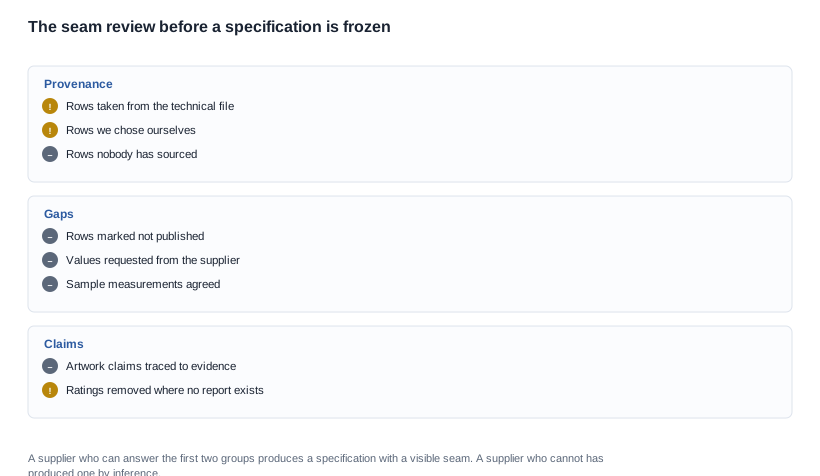
Smart glasses certification checklist: the limit of our published rows
The working rule we apply: we publish the configuration rows and mark the rest, because a buyer who is told where the line is can plan around it and a buyer who is not told will plan around an assumption. We publish the resolution class for every camera model, the cell capacity and cell count, the charging interface where it is stated, the case configuration where a case exists, the Bluetooth version where the catalogue states one, the ingress marking where one is printed, the charge time for every model, and the AI function entries across twenty of the twenty-eight models. We do not publish the unit weight of any model other than the MT6 glasses body, the sensor part numbers, the ingress test report numbers, the model-level certification numbers with their coverage, or the AI implementation detail.
We will not supply a certification claim we cannot evidence, and we will not fill a blank with an industry-typical figure. Where a buyer needs a number we have not published, the answer is that it has to be requested, and we will say which document would carry it.
There is one more limit worth stating, because it is the one that surprises people most often. Our published position is a position at the catalogue level, and it moves when the catalogue moves. A row that is published today is not a promise that it will be published for the next revision, and a row that is not published today is not a statement that the value does not exist. The durable facts are the structural ones — the designations, the case configurations, the resolution classes, the published weight on the MT6 — and a buyer who builds a programme on the structural facts and requests the moving ones has a specification that survives a revision.
The supplier verification process sets out how to ask for the moving rows, the certification cost calculation covers what the gaps cost, and the wider quality framework is on the quality consistency page. The full document list sits under the certification verification pillar. Send us your draft specification and we will mark, row by row, which lines came out of the file, which ones you chose and which ones are still open.


