

Almost every supplier in this category holds some certification evidence. The question is rarely whether they have any — it is whether what they hold covers the specific model, the specific labelled variant, the specific cell configuration in the carton and the specific market you are shipping into. Those four qualifiers are where the commercial risk sits, and the verification method that works is a short written request set plus a test for whether the answer is specific enough to act on. Below is the request set in the order it should be sent, the answer that closes each line, the answer that does not, and the record that turns a one-off verification into a repeat one.
Smart glasses certification checklist: ask for the document, not the confirmation
A supplier saying "yes, we are certified" has told you nothing. A supplier sending a report reference you can resolve has told you where the evidence is.
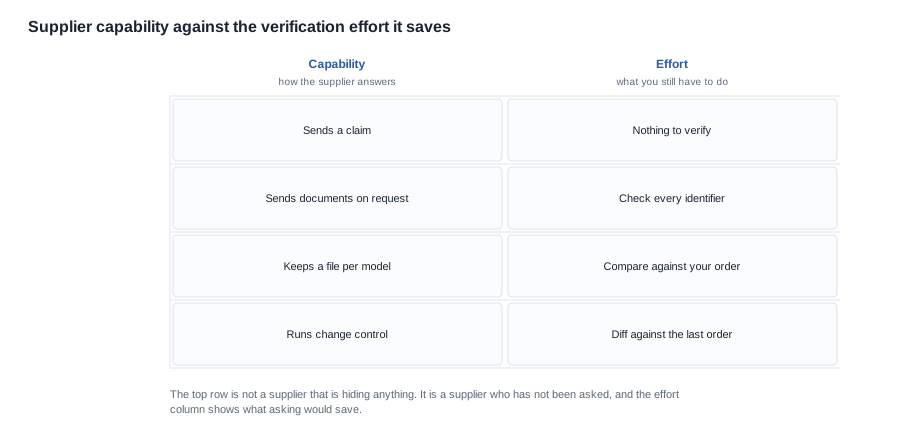
This is the first question and it is the one that most often ends the conversation, because some suppliers genuinely have evidence but have never been asked to produce it, and some have a claim they cannot document at all. Both are worth knowing before an order rather than after. A supplier who has evidence and has not been asked will answer in a day. A supplier who has a claim and no document will not answer at all, and the silence arrives in a form that is easy to mistake for busyness.
The instruction that makes the difference is to ask for a reference rather than for a confirmation. "Can you confirm you are CE certified?" is a yes-or-no question and it invites a yes. "Which model designations are printed on the declaration you hold for this market, and what is the document reference?" is a question with two answers, and a supplier with a document can give both in one line.
There is a second reason to ask for documents rather than confirmations, and it is about what happens later. A confirmation is a claim that has to be re-made at the next order. A document reference is a fixed point that can be re-checked, re-dated and compared against the previous order. The difference between the two is the difference between a programme that starts over annually and one that runs.

The five requests, and what closes each one
The request that gets a document rather than a confirmation
There is a form of wording that reliably separates a supplier who holds a file from a supplier who holds a claim, and it is worth keeping as a reusable sentence. Ask: "Which document covers this, and what is its reference?" The word "which" forces a document into the answer, because a reference can only be given for a document that exists, and the supplier who does not have one has to say so.
Three weaker forms are worth avoiding because they all collapse into the same answer. "Can you confirm you are certified for this model?" invites a yes. "Do you have CE and FCC for this range?" invites a description of the range. "Could you share your certification documents?" invites a folder, and a folder has to be read model by model before it can be checked, which puts the verification work back on the buyer.
The difference in effort is large enough to change the economics. A document reference takes one line and resolves in two minutes. A folder takes an afternoon per model, and in a range where twenty-eight designations have to be covered, the afternoon becomes the programme. Asking for the reference is not a more demanding question; it is a cheaper one.
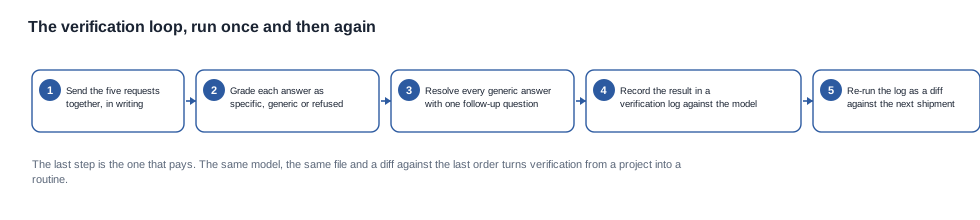
Send them together, in writing, with the model list attached. A request sent as one item invites a general reply; a request sent as five invites five specific answers, and the supplier's answers are the evidence.
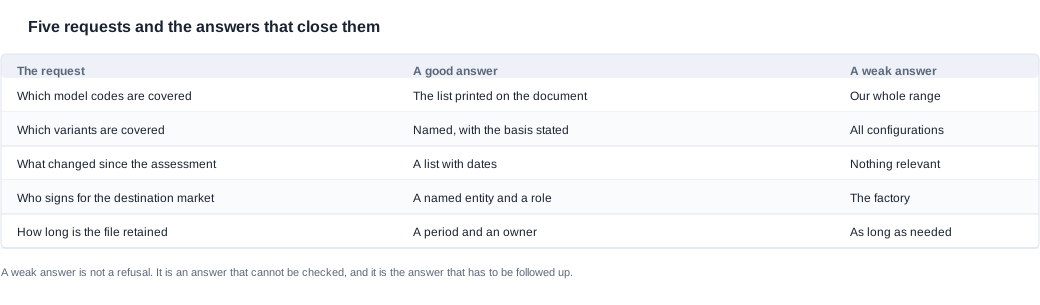
- Which model designations does this document cover? The closing answer is the list as printed on the document. The answer that closes nothing is "our whole range", because a range is not a scope and a document that names a range cannot be filed against a purchase order.
- Which labelled variants are covered, and how is that determined? The closing answer names the variants and states the basis — a shared radio configuration, a shared enclosure, a family assessment with per-model references. The answer that closes nothing is "all configurations", because it asserts rather than determines.
- What has changed since the assessment was carried out? The closing answer is a list with dates: the radio module, the antenna, the cell, the housing, the firmware that touches the radio. The answer that closes nothing is "nothing relevant", because it states a conclusion without the basis for it.
- Who signs the declaration for the destination market? The closing answer names a party and a role, and identifies the economic operator where the manufacturer sits outside the market. The answer that closes nothing is "the factory", because it does not distinguish the signatory for one market from the manufacturer for another.
- How long is the file retained, and who can produce it after shipment? The closing answer is a period and a named owner. The answer that closes nothing is "as long as needed", because it describes an intention rather than a control.
The pattern to notice is that a weak answer is almost never a refusal. A refusal is easy to handle — it is an answer, and it tells you the scope. A weak answer is the dangerous one, because it looks like a response and it cannot be checked. "All configurations" sounds like coverage. "Nothing relevant" sounds like stability. "As long as needed" sounds like a retention policy. Each of them is doing the work of a sentence without carrying any of the information.
The test an answer has to pass
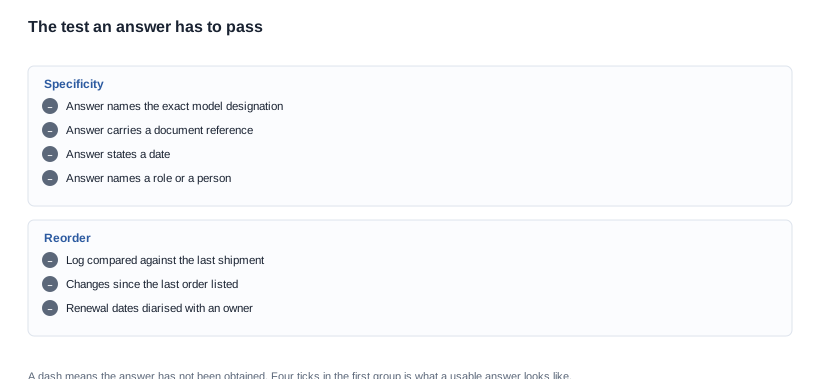
Four fields separate an answer you can file from an answer you have to follow up. The answer has to name the model designation, carry a document reference, carry a date, and name a role or a person. A missing field is not a stylistic problem; it is the specific piece of information you were trying to get.
This is where the effort goes, and the effort is not in chasing suppliers who are withholding. It is in converting a friendly, general answer into a specific one. The follow-up question is always the same shape: "Which model designations are listed on the document itself?" A supplier who answered "our whole range" can usually answer that question in one line, and the one line is either a list or it is not.
Where verification usually fails in this category
The model code. A report covers a model. A product page describes a family. In this category the gap between those two is where the risk sits, because a camera configuration and an audio-only configuration are not the same product even when they share a name. Ask for the exact model code on the report and compare it with the code in your quotation. If the report names a family or a range rather than a model, that is a material finding, and it is better discovered in a conversation than at a customs inspection.
The comparison has to be done on the string and not on the meaning. Our own catalogue prints one model as the L2 Utral, which appears to be a rendering of Ultra, and it publishes a Bluetooth version for fourteen of the twenty-eight designations while publishing none for the eleven camera models. A supplier who quotes you a version for a camera model is going beyond what our own catalogue states, and the extra confidence should be checked rather than banked.
The labelled variant. A report may cover a radio configuration that the labelled product does not match, because the label and the radio are decided in different places in the factory. Where a report covers several variants, ask which of them your configuration is and how that is determined — it is sometimes a simple match and sometimes a calculation that the report does not spell out.
The validity date. Validity matters because a report that has lapsed is not evidence for a launch next quarter, however sound it was at the time. The completion test is that you can state the expiry date without opening a second document, and that somebody owns the renewal.
The cell configuration in the carton. This is the one most often missed because it is not about the device. The transport document has to match the cells that actually ship, and the case is a second cell. Across this range the camera line carries a 1400 mAh case on three models, a 900 mAh or 1400 mAh option on one, a 1200 mAh folding case on another, a case of unstated capacity on two more and no case at all on one configuration — so "the device's battery" is never a sufficient answer to the transport question.
Where the catalogue itself limits what can be verified
Some of the verification work in this category is bounded by what a supplier publishes rather than by what they hold, and it is worth knowing which lines are bounded before a buyer spends a month on them.
The clearest example is the Bluetooth version. Our catalogue publishes a version for fourteen of the twenty-eight designations and none for the eleven camera models, for the two children's models where no version is shown, and for the bone-conduction platform. A buyer who wants to know which radio a camera model uses is asking a question our published documentation does not answer, and the answer has to come from the model-specific evidence rather than from the catalogue. The same applies to the charging interface, which is published as magnetic for seventeen models, Type C for seven, and not at all for the MT6 and the CY05, and the L1 Pro and the CY03 — a set of four camera models where the interface is not published and therefore has to be asked about rather than assumed.
The practical consequence for a verification programme is that some lines can be closed from a published catalogue in a minute, some can only be closed from a document, and some cannot be closed at all without a determination from the supplier or the buyer. Sorting the three in advance is what stops a buyer from re-verifying the same published row at every order, and what makes the remaining questions specific enough to be answered.

What has changed since the assessment
This is the step that distinguishes a first order from a repeat, and it is the one that a verification programme is judged on at the second order rather than the first.
If the radio module, the antenna path, the battery or the housing has changed since the report was issued, the report may no longer cover the product. Ask the supplier to state, in writing, whether anything in that list changed and when. A supplier who answers carefully is one whose process you can rely on later, because the same question then has a defined answer — and a supplier who cannot answer is telling you that their change control does not reach the evidence, which is a materially different thing from a supplier who has simply never been asked.
Keep the answers, not just the documents
Verification is a repeated activity rather than a one-off, because the configuration that is compliant today may not be the configuration you reorder in a year. A short file recording which model code was checked, against which report, for which market, converts the next check into a diff.
That file is also what you send to a new supplier at reorder, and it is a considerably more credible document than a list of questions. A supplier being asked to verify against a specification the buyer has already written is a supplier being asked to fill in gaps, rather than a supplier being asked to start again.
What the verification log is worth
The log is worth more than the verification it replaces, and it is worth more because of what it makes possible rather than what it records. Three things follow from having it.
First, the next check is a diff. Instead of re-verifying twenty-eight models, the buyer re-checks the three lines that changed and confirms the rest by date. That is the difference between a day and a month in the second year.
Second, the supplier relationship gets easier to maintain, because the question is already written down. "Your declaration for the European Union listed the L2 Utral as an Ultra Pro Max — has that changed?" is a question with a known answer, and it is answered in a sentence rather than in a round of requests.
Third, the programme becomes transferable. When the person who ran it leaves, the log is the handover, and the questions that were hard to formulate are the ones that stay hardest. The formulation of the question is the part of a verification programme that is genuinely irreplaceable, and a log is where it is kept.

What the five requests cannot establish
A request set is a filter, and it is worth being explicit about what passes through it, because the failure mode is not a supplier hiding something. It is a buyer reading a cleared line as a cleared programme.
The five requests establish what the supplier claims to hold and for which scope. They do not establish that the scope is right, that the underlying tests were carried out properly, that the product behind the documents is the product in the carton, that the production run matches the assessed sample, or that nothing changed afterwards. Each of those needs a different mechanism, and none of them is a document request.
Scope correctness is the buyer's own comparison, and it is the step that the string comparison protects: the designation on the document against the designation on the purchase order, character by character.
Test quality is a matter for the issuing body, and the buyer's lever is to require an accredited issuer rather than to inspect the laboratory's methodology. A document produced by an unrecognised body and a document produced by an accredited one can look identical on the page.
Sample identity is closed by a pre-shipment inspection against the approved sample, not by any document. It is the only one of these five gaps that has to be closed inside the factory.
Production consistency is closed by incoming inspection and by the change register, and neither of them is visible to a buyer who only ever sees the file.
Currency over time is closed by the expiry calendar and the change notifications, which is why a first verification and a repeated verification are different activities with different costs.
Stating this plainly is not a criticism of suppliers, because the overwhelming majority of suppliers in this category would fail the same five tests if the file were read critically — the position is normal for the industry. It is a statement about what a cleared line means. A cleared line means the supplier has told you what it holds and for which scope, in writing, with a reference. Everything after that is your own work.
The question that finds the rest of the programme
If the five requests produce five specific answers and you still want to know how the supplier actually works, ask which parameter is not published for the product and watch what happens. A supplier who answers "that one is not published, and here is what we can measure" is telling you something real about their documentation habit. A supplier who produces a confident figure immediately has either tested it or borrowed it, and the follow-up — which, and from where — resolves it.
That single question is the cheapest available probe of a supplier's process, and it is worth asking before the first order rather than at the first audit, because the answer tells you whether the verification effort you are about to build will be worth the hours you are about to spend on it.
Smart glasses certification checklist: the evidence we hold and the claims we will not make
We will supply the documents that exist for a given configuration and destination market, and we will tell you plainly which ones we do not hold rather than implying a complete file.
Certificate numbers, issuing bodies and validity dates are not published in our documentation, so nothing in this article should be read as a standing claim about our own status — each is confirmed against a specific model at enquiry. The export certification page at the catalogue front page is a company-level page whose content is images rather than text, and we do not infer a per-model certification from it; that in particular means we do not claim a children's certification for the A05, the A06 or the A07. We publish no ingress test report number behind the IP54 marking on the V06 and the S7, and we publish no Bluetooth version for the eleven camera models.
What we will not do is assert compliance for a market we have not assessed, or treat a report covering a comparable model as though it covered yours. If the evidence does not exist for the exact configuration, that is the answer, and it is a legitimate one to plan around. The certification checklist covers what to request when the answer is no, the checklist template is the form with status fields, when you can skip it covers the four gating questions, and the wider sourcing-risk process is set out in sourcing risk step by step.
Send us the model list, the destination market and what ships in the carton, and we will answer the five requests above against our own documentation — including the lines where the answer is that we hold nothing.


