

A standard operating procedure for smart glasses certification is worth having only if it produces an artefact at every stage, because the whole point of the procedure is to survive the person who wrote it. Most compliance processes in this category are inherited rather than designed: someone takes over the function in month four of a programme and finds a folder of reports, a shared drive and no process. The smart glasses certification checklist below is built from the five stages that turn that folder into something a second person can run without asking the first one. Each stage has an entry condition, a defined action, an exit condition and a named output, and the template below is the artefact set rather than a description of it. Copy it, fill in the columns, and the gaps in the programme become visible in the first week rather than at the first audit.
Smart glasses certification checklist: five stages, and the order is not arbitrary

The sequence is a dependency chain, and each stage reads what the previous one produced. Stage one produces the configuration matrix. Stage two produces the scope sheet, which reads the matrix. Stage three produces the evidence log, which reads the scope sheet and fills it with a status against every row. Stage four produces the change register, which is the only artefact that is alive for the life of the programme. Stage five produces the shipment file, which reads everything else and is the last thing signed before the cartons are sealed.
Running them out of order is the most common failure and it is expensive in a specific way. A programme that collects documents before it has fixed the scope collects the wrong documents, and discovering that at stage four means re-collecting them. A programme that skips the change register discovers at stage five that the product no longer matches the file, which is the worst moment to discover it because the goods are built and the cartons are waiting.
What each stage is for
Stage one, the configuration matrix, exists because the scope of a certificate is a model, and a model in this category is not always one configuration. The matrix has one row per model designation and one column per configuration attribute that changes the evidence: the cell capacity and cell count, the charging interface, the case configuration, the radio configuration, and the claims that will be printed. In our own range this matrix would immediately show twenty-eight rows, with the camera rows splitting on case configuration — three models with a 1400 mAh case, one with a 900 mAh or 1400 mAh option, one with a 1200 mAh folding case, two with a case whose capacity is not published, and one camera configuration with no case — and on charging interface, which is published as magnetic for seventeen models, Type C for seven, and not published at all for the L1 Pro and the CY05, and the MT6 and the CY03.
Stage two, the market and claim scope, exists because the same matrix has to be cut by destination and by what is printed. The scope sheet lists every market and, for each one, the framework, the holder, the marking and the claims that will appear on the artwork and packaging. Claims belong here rather than in stage five because a claim is a decision, and a decision made after the artwork is approved is a reprint.
Stage three, the evidence collection, exists because a request without a status column becomes a folder. Every row in the matrix gets a row in the evidence log with a status: held, requested, open, or not applicable. The status column is what converts an evidence request into a project that can be reported on.
Stage four, the change control, exists because the product moves and the file does not. This is the stage that most programmes skip and the one that produces most of the avoidable cost.
Stage five, the pre-shipment check, exists because everything upstream is a prediction and this is the last point at which it can be tested against the actual goods.
The reason the stages are numbered at all is that the numbering carries the argument about where a programme actually breaks. Stage one breaks by omission — a configuration nobody wrote down. Stage two breaks by deferral — a scope decision pushed to the week of the artwork. Stage three breaks by vagueness — a request that returns a folder rather than answers. Stage four breaks by silence — a change that nobody reported. Stage five breaks by scheduling — a check that gets run a day late or skipped because the shipment is waiting. Each break has a different owner and a different fix, and the numbering is what lets a team talk about which one they had.
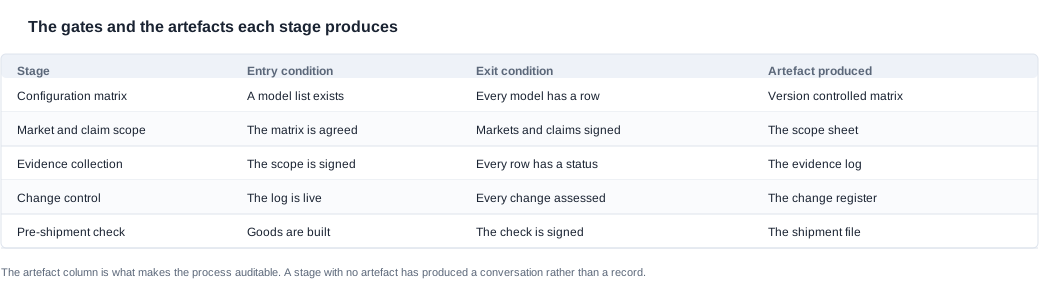

The stage gates and their exit conditions
A stage without an exit condition is a task rather than a control, and a programme made of tasks is what a team inherits when nobody designed the process. The exit conditions below are deliberately binary, because a condition that can be partly met cannot be reported.
| Stage | Entry condition | Exit condition | Artefact produced |
|---|---|---|---|
| 1 Configuration matrix | A model list exists | Every model has a configuration row | Version controlled matrix |
| 2 Market and claim scope | The matrix is agreed | Markets and claims signed off | The scope sheet |
| 3 Evidence collection | The scope is signed | Every row carries a status | The evidence log |
| 4 Change control | The log is live | Every change is assessed | The change register |
| 5 Pre-shipment check | The goods are built | The check is signed | The shipment file |
Two of these deserve a note on how they are actually run.
Stage three is run per configuration, not per document. A request that goes out for "the certification documents" comes back as a folder. A request that goes out row by row — this model, this market, this configuration — comes back as answers. The status column then carries a simple arithmetic that a manager can read in a minute: how many rows are held, how many are open, and which open rows are on the critical path to the launch date.
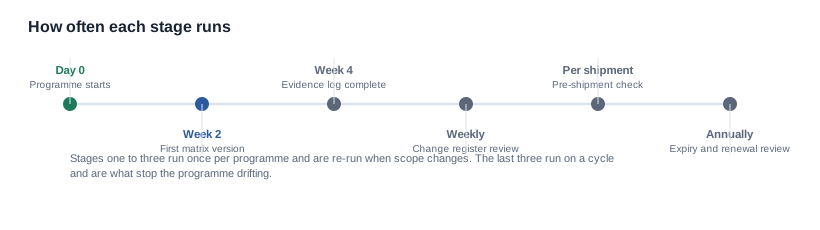
Stage four runs on a cycle rather than on a project. It is a weekly review of the controlled items, and the controlled items are the ones that move the evidence: the radio module, the antenna, the cell, the enclosure, the firmware that touches the radio, the case, and the artwork that carries the claims. A change to any of them triggers a question — does this need reassessment — and the register records the answer whether it is yes or no. Recording the no matters as much as the yes, because a no that was never written down is indistinguishable from a change nobody noticed.
The weekly review is short enough to survive a busy week, and that is the design constraint that matters. Fifteen minutes with the register open, three questions per change, and a decision on each: reassessment required, reassessment not required, or information still needed. A change that cannot be closed in that slot is escalated rather than carried forward, because a carried-forward change is a change that will be re-noted next week and then carried forward again. In our range the items most likely to trigger it are the ones a buyer cannot see: a second-source cell with different internal resistance, an antenna supplier changing the matching network, and a firmware branch that touches the radio stack. None of them looks like a change to a buyer who is not on the register.
The five-line pre-shipment check
The last stage is deliberately small, because a check that takes an afternoon gets skipped under pressure, and this is the check that has to run while the goods are built.
- The designation string on the report, the designation on the purchase order and the designation on the artwork: identical, character for character.
- The manufacturer and the responsible economic operator on the cartons: consistent with the documents, and reachable.
- The battery transport documentation: present, current, and covering the cells that are actually in the carton.
- Every claim printed on the packaging: traceable to something in the technical file.
- Every open row in the evidence log that touches this shipment: either closed or written into the order as an accepted condition with a named owner.
The exit condition is a signed pre-shipment checklist kept with the shipment file. Five lines and a signature is enough, and the value is entirely in the fact that it was done at that point rather than at the start of the programme.
How the first quarter of the programme actually runs
A template is easy to publish and harder to schedule, so it is worth setting out what the first weeks look like when the procedure is used for the first time on a range. The sequence below assumes a small team and a catalogue of twenty-eight designations, which is the shape of the range this procedure was written against.
Week one is the matrix. It is desk work rather than supplier work, and it is the week that produces the most surprising result, because the matrix almost always reveals more distinct configurations than anyone assumed. In our range it would show eleven camera models splitting on case configuration and on charging interface, eight audio models that publish their Bluetooth version and their charging method, three children's models with no certification position recorded at all, and five designations with no separate model code. The number of rows in the matrix is the number of units of work, and it is almost always larger than the number of model names on the quotation.
Week two is the scope sheet and the claim list. Both are decisions rather than requests, and both need a signature from someone accountable for the programme rather than from whoever happens to be running it. The claim list is the part that is usually skipped and it is the part that later determines whether a printed specification has to be withdrawn.
Week three is the evidence requests, issued per row. This is the slowest week, because it is the one that depends on the supplier and on laboratory scheduling for anything that was not already in the factory file. The requests that were opened late in stage three arrive after the launch date has been set, which is the single most common cause of a date that moves.
Week four is the first status review. At that point the evidence log has a number in every cell and the programme has a shape: rows held, rows open, rows requested, and the open rows that touch the launch date. From week four onward the procedure is a weekly twenty-minute review of the change register plus a monthly review of the expiry dates, and the two are what keep a programme honest after the initial effort is over.
Who owns what, and why that matters more than the stages
The stages are the easier half of the procedure. The ownership is the half that decides whether it runs at all.
The buyer owns the scope sheet and the claim list, because both are commercial decisions dressed as compliance documents. The supplier owns the evidence and the change notifications, because only the supplier knows what changed inside the factory. The programme owner owns the change register and the expiry calendar, because those are the two artefacts nobody else will maintain. The logistics team owns the carton contents and the artwork handover, because the box configuration is what determines the transport document and it is usually decided in a packaging meeting rather than in a compliance meeting.
When one of those four is missing, the procedure does not fail loudly. It fails quietly in a characteristic way: the buyer assumes the supplier owns the scope, the supplier assumes the buyer owns the claims, the register stops being updated because nobody owns it, and the carton contents change after the transport file was written. Those four failure modes account for most of the programmes that are still running on the same documents two years later.

Running the procedure again: a new model, a new market, a new revision
The second year of a programme is where a procedure either pays for itself or gets abandoned. What makes the difference is that a repeat run is not a repeat of the whole process — it is a partial re-run, and the partial run is cheap.
A new model is the lightest case. One row is added to the matrix, the scope sheet gains a line, the evidence request goes out for that row, and the change register gains a controlled item. If the new model shares a radio configuration with an existing row, the request is small; if it does not, the request is a new assessment and the cost has to be priced before the model is committed to a launch.
A new market is a column, not a row. The scope sheet gains a column, the framework and the holder and the marking for that market are recorded, the documents that are new for that market are requested, and the artwork is checked for the market marking. Nothing about the models changes, which is why a new market is the case a well-run programme handles in a week and a badly-run programme discovers at the border.
A new revision is the case that requires discipline, because it looks like the least disruptive and is the most expensive. The radio module, the antenna, the cell, the enclosure, the firmware that touches the radio, the case, or the artwork that carries a claim — any of them can change without a change request, and any of them can move the product away from the evidence. The procedure's answer is the controlled item list: a change to any listed item is assessed and the assessment is recorded, whether the outcome is that reassessment is required or that it is not.
The rule that keeps the repeat runs cheap is simple: stage one is run once and then amended, stage two is run per market and per claim set, stage three is run per new configuration, stage four runs continuously, and stage five runs per shipment without exception. A programme that follows that rule has a file that always matches what is shipping, and a programme that re-runs everything from scratch each time has a programme rather than a process.
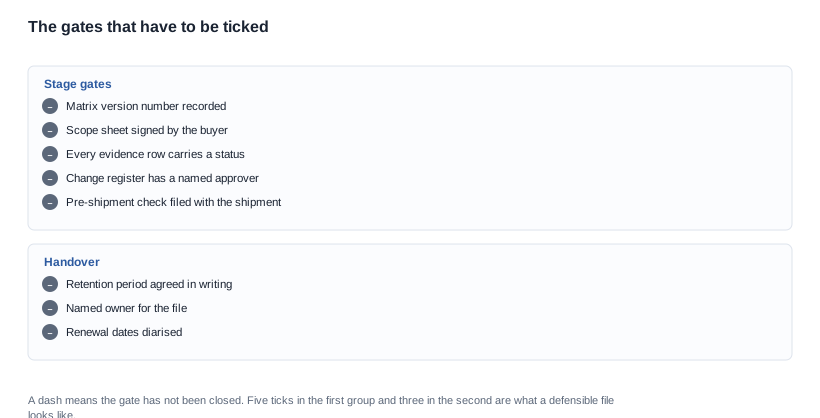

What the template cannot supply
Two things have to be said about a template of this kind, because a template that is trusted beyond its competence is worse than no template.
It cannot classify a product. The stage two scope sheet records the framework that applies to a model in a market, and it cannot tell you which framework applies to a product that has not been assessed. That is a legal determination, and for one product in our range it is a determination about something the catalogue publishes — the bone-conduction platform and its 35 dB amplification figure — that has to be made against the destination market before a listing is written. No form can answer it.
It cannot convert a company-level claim into model-level evidence. Our own position is the clearest illustration. The export-certification page in the catalogue carries ten patent certificates — eight appearance-design patents and two utility-model patents — and its content is images rather than text, so the catalogue names no CE, FCC or RoHS marking; the model-level certificate numbers, the issuing bodies and the validity dates are not published. The export certification page on the catalogue front page is a company-level page whose content is images rather than text, and we do not infer a per-model certification from it — which in particular means we do not claim a children's certification for the A05, the A06 or the A07. A template row can hold "held", "requested", "open" or "not applicable", and the honest status for a claim that exists only at company level is "open", because that is what it is from the perspective of a purchase order.
What the template does supply is the discipline. It makes the request a form rather than a series of one-off emails, it makes the gap visible instead of implicit, and it gives the person who inherits the programme in month four a starting point that does not depend on memory.
What we populate in the template, and what we leave open
The template exists so that an evidence request becomes a repeatable form rather than a series of one-off emails. We will populate it with the documents that genuinely exist for a given configuration and destination market, and we will mark the rows we hold nothing against with the status that says so. We will not write a placeholder that looks like a citation, and we will not fill a cell with a typical figure to make a column look complete.
Where a claim sits at the edge of what the evidence supports — a waterproofing descriptor on a unit whose designation is IP54, which addresses water spray and not immersion, and which in our range applies to the V06 and the S7 with no report number published behind it — the form records the designation and stops there. Any wording that would read more strongly than the test result has to be approved by someone who can see the report.
The same discipline applies to the two documentation habits that quietly fill a template with fiction. The first is writing a certificate number that has not been confirmed, which is easy to do because a cell looks empty otherwise and an empty cell invites a follow-up question. The second is writing a total battery capacity where the source publishes a cell count and a cell value, which is arithmetically correct and factually wrong as a quotation, because it presents a derived figure as a published one. Both are prevented by the same rule: the form carries the value in the form the source states it, and a derived value is written in the notes column with the arithmetic shown.
The certification checklist covers what to request at stage three, the beginner guide covers where the form first goes wrong, the supplier verification process covers checking a claim against the report, and the EU market entry article covers the frameworks by destination. Send us your model list and your destination markets and we will return the matrix and the scope sheet filled in, with the open rows marked as open.


