
Five variables move the certification cost of a smart glasses programme, and only one of them is the laboratory fee. Two of them are decisions you can still change at quotation stage; one is a consequence of a feature you probably wanted; two are consequences of how you intend to sell. Knowing which is which tells you where negotiating effort is worth spending.
The smart glasses certification checklist a buyer is given is usually a list of frameworks, and a list of frameworks answers the wrong question. Frameworks tell you what applies; they do not tell you what your programme will actually cost, because the cost is driven by scope, and scope is driven by five variables. Two of those variables are under your control at the point where the programme is being costed, and one of them — the number of model designations — is the one buyers most often misjudge, because they count models when what matters is how many of them are technically distinct.
Smart glasses certification checklist: variable one, the number of model designations
Why the count is not the number of models
This is the largest multiplier and the one buyers misjudge. Certification attaches to a specific product, and a case configuration, a colourway or a firmware branch can each require justification that it sits inside an existing technical file. The question is never "how many models" but "how many models with a documented technical relationship to each other".
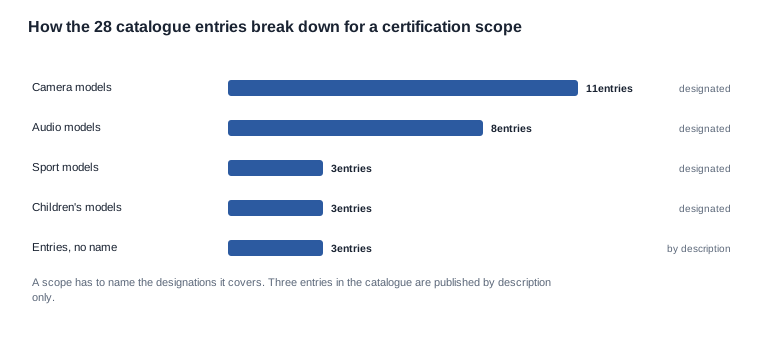
The published range makes the point better than an abstract example. Our catalogue carries 28 entries, and 25 of them carry a model designation — eleven camera models, eight audio models, three sport models and three children's models. The remaining three entries, an AR glasses entry, an AI electrochromic entry and a bone conduction entry, are published by description rather than by designation, and a scope has to name what it covers in both cases.
Now count the camera models the way a buyer would, and then count them the way a scope would. Eleven camera models is a manageable number. But the eleven include eight published at 8 MP and three published at 13 MP — two resolution tiers, which is a technical distinction with a technical consequence. They include four distinct cell capacities: 220 mAh on the MT5 and the V03, and the V03 Pro; 260 mAh on the KY06 and the S7, and the V06; 265 mAh on the MT6; and 290 mAh on the L1 Pro and the CY05, and the CY03 and the L2 Utral. They include a charging-case configuration that differs across the range — a 1400 mAh case, a case published in 900 or 1400 mAh, a 1200 mAh folding case, two models with a case whose capacity is not published, and four with no case row at all — the V03 and the V06, and the V03 Pro and the S7.
Whether those differences fall inside one technical file or across several is not something a buyer can assume in either direction, and the difference is the whole of variable one.
The question to ask, and what a good answer looks like
Ask the supplier to state, per model, whether it shares a file with an already-tested model and on what basis. A supplier who cannot answer that has not done the analysis, and their quote will move later.
A good answer names the technical relationship rather than the commercial one: the same radio module and the same firmware branch, the same cell with a different case assembly, a housing change that does not affect the radio or the antenna. A weak answer says that the models are "the same product" or "from the same platform" without saying in what respect, because that is a statement about the supplier's catalogue rather than about the file.
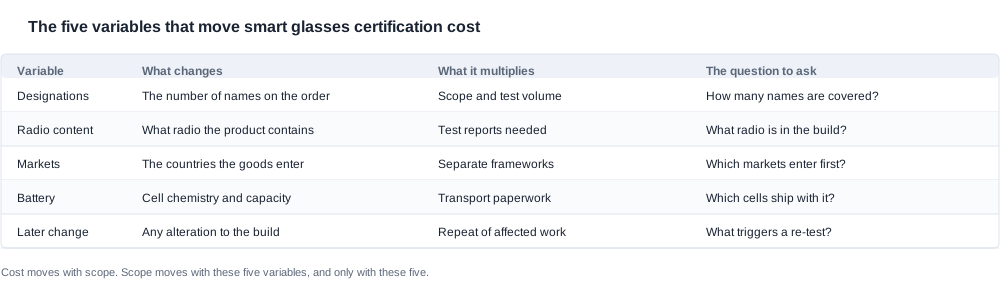
The table above sets the five variables side by side, and it is worth noting which of them are still open when a buyer first sees a quotation. The designation count and the destination markets are decided by the buyer and are usually still open. The radio content is usually decided already, because it is an engineering choice made before the product exists. The battery configuration is often open, because it depends on which case option is chosen. The change-after-testing variable is invisible until something changes — and that is the one that costs the most.
Variable two: the radio content inside the product
A product with radio is a different compliance object
A product with Bluetooth is radio equipment. A product without it is not, and its compliance position is materially simpler and cheaper in every market. This is a genuine engineering choice rather than a cost-cutting one, and it should be made deliberately: a camera product with no connectivity at all is a real product with real limits, but it is also a product that skips an entire framework.
In the European Union, radio equipment sits under the Radio Equipment Directive, Directive (EU) 2014/53/EU, with the EN 301 489 series as the EMC harmonised standards referenced alongside it, and Bluetooth SIG qualification is a separate question from the directive — a membership and product-qualification question that a radio directive declaration does not answer on its own.
The published range spans Bluetooth 5.3 and 5.4 configurations alongside camera and audio functions, so the choice is available at the platform level rather than after the fact. Two things are worth noticing about where the published information stops. Bluetooth version is published for 14 of the 28 entries, and the camera models publish none — so for a camera programme, the radio content of the ordered build is something that has to be established in writing rather than read off a specification sheet. And nothing in the catalogue publishes the radio module itself, the firmware branch, or the antenna configuration, which are the three things that actually determine whether two models sit in one technical file.
Why a radio module change is the expensive kind
Variable two is not just about whether there is radio; it is about whether the radio content is stable. A radio module change alters the radio characteristics that the assessment was performed against, and it is one of the few changes in this category that reliably requires reassessment rather than a piece of paperwork.
That is worth writing into the agreement in plain words. If a supplier proposes an equivalent module "for availability reasons" mid-programme, the question is not whether it is equivalent — it is whether the supplier is willing to state that the change does not affect the assessed radio characteristics, in writing, on their letterhead. A supplier who answers that question directly has a controlled module supply. A supplier who answers it with a marketing sentence has a procurement policy, and the cost of finding out which one it is arrives later than it should.
The four radio questions that actually settle the variable
The radio content is settled by four questions, and asking all four costs nothing. Which radio modules are in the ordered build, and whether the same module is used across the model range? Which firmware branch ships, and does the assessed version match it? What is the antenna configuration, and is it the same on every variant? And is there any variant in the range that ships without radio at all?
The fourth question catches more programmes than the first three, because a product line that includes both a connected and an unconnected variant is two compliance objects with one product name, and the file has to cover whichever variant you order. It is also the question that exposes a range where the camera models and the audio models have genuinely different radio positions — and where the catalogue publishes no Bluetooth version for the camera models at all, so the answer has to come from a request rather than from a specification sheet.
Variable three: the destination markets, counted properly
Each market carries its own framework
For the European Union, radio equipment sits under Directive (EU) 2014/53/EU, and GPSR, Regulation (EU) 2023/988, applies from 13 December 2024, adding manufacturer identification, a responsible economic operator in the EU, and traceability labelling. The UK runs through the UKCA route, which is a separate conformity framework rather than an extension of the EU one, so a UK launch is a second market in the full sense rather than a paper exercise. North America adds FCC. Australia, Japan and the Gulf markets each add their own.
The cost is roughly proportional to the number of markets, but not linearly: the first market is the expensive one because it establishes the technical file, and subsequent markets are cheaper if the standards overlap. That non-linearity is the most useful fact on this page, because it means the decision about which markets to certify into first is a decision about how much of the programme you want to carry at once.
The first run does not have to carry every market
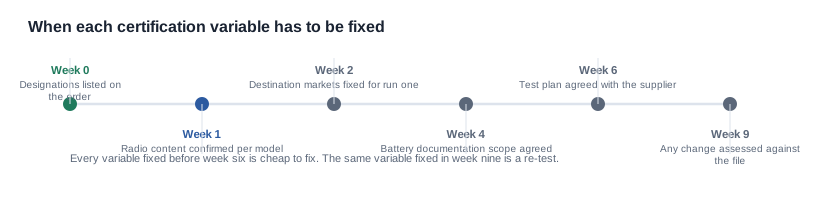
The sequencing in the timeline is the commercial argument. Designations, radio content, markets and battery scope all get fixed in the first four to six weeks, because those are the weeks in which they are free to fix. The test plan follows, and after that a change is a re-test rather than an adjustment.
A buyer who launches into three markets at once is carrying three frameworks from the first shipment, and the cost of that decision shows up not in the certification budget but in the working capital and the schedule risk of three parallel document sets. A buyer who launches into one market, builds a reusable file, and adds the second market afterwards pays a higher headline figure per market and a lower total, and has one documentation route to manage rather than three.
The counter-argument is real and should be stated: if the channel opportunity is genuinely perishable, waiting for the second market to be certified costs a sales window that may not come back. That is a commercial decision, not a technical one, and the right way to take it is to put a date on the market expansion and cost the second market against that date rather than leaving both markets open indefinitely.
The per-market cost that is not a laboratory cost
One part of entering a market is routinely costed as zero and is not. Under GPSR, Regulation (EU) 2023/988, a product placed on the market needs manufacturer identification, a responsible economic operator established in the market, and traceability that survives the supply chain. The laboratory work is the part that appears on an invoice; the responsible economic operator, the marking artwork, the label rules and the traceability records are operating costs that recur on every shipment and every production run, and they are frequently discovered after the packaging artwork has been printed.
That last point is what makes this worth deciding early rather than merely budgeting. Traceability information sits on the product, the packaging or the accompanying documentation, and artwork changes late are expensive changes. A buyer who discovers in month four that the labelling format has to change is buying a reprint of the packaging for the entire first run; a buyer who discovers it in week one pays for a print run. The GPSR section covers the traceability items themselves, and the commercial point is that they belong in the week-one list alongside the model designations rather than in the week-four list alongside the test plan.

Variables four and five: the battery, and the change made after testing
The battery configuration is priced per configuration, not per order
The battery configuration drives transport documentation — the test summary and the packaging arrangement that lets a lithium-powered product move. That is priced per battery configuration, not per order, and it is reusable across runs, which means it belongs in the fixed-cost column of your plan rather than in the per-shipment column.
The published range is unusually wide in this respect, which is why the variable is worth attention on a camera programme. The catalogue's cell configurations include 40 mAh single cells on the two children's models, 55 mAh doubled on the audio models, 70 mAh and 70 mAh doubled, 90 mAh doubled, 100 mAh, 115 mAh, 200 mAh, and then the camera spread of 220, 260, 265 and 290 mAh. Each distinct cell configuration is a distinct transport document, and each distinct charging-case configuration is part of what actually ships.
So the count that matters is not "how many camera models are in the order" but "how many distinct cell and case configurations are in the order". A buyer who orders four camera models that happen to share the 290 mAh cell and the 1400 mAh case has one battery configuration to document. A buyer who orders four camera models with four different cells and two different case options has considerably more, and this is invisible on a product list. The battery transport section covers the documentation that travels with the goods, and the GPSR section covers the traceability items that sit alongside it.
Establishing the configuration rather than assuming it
The cell capacity for a given model is published, so that half of the battery question is already answered for any model you have chosen. The case is the half that is not, because on several camera models the catalogue publishes more than one case capacity or no case capacity at all, and on some it publishes no charging-case row whatsoever. Those are three different states and they carry three different consequences: a case you have chosen, a case you have to specify, and a configuration nobody has described.
The practical step is to write the cell and the case onto the order as two separate lines, with the case capacity named and the alternative rejected by name. That single line of paperwork is what stops a battery configuration from being renegotiated in month three, when the case is already tooled, the artwork is printed and the transport documentation has been issued for a configuration that is no longer the one shipping.
The change made after testing
What changes after testing is the variable that costs the most, and not because the change is expensive. Firmware updates after the technical file is closed can trigger reassessment, and so can a change of supplier for a component the file names, a housing change, or a radio module substitution. The expensive outcome is a change made without asking anyone.
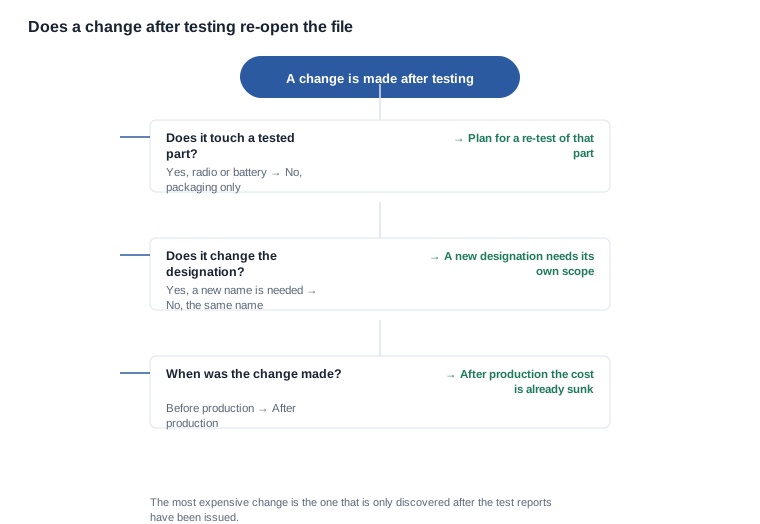
The three questions in that diagram are the ones to write into the change-control step of the programme. Does the change touch a part that was assessed? Does it change the model designation? And when was it made — before production or after? The third question is the one that converts a manageable question into a sunk one, because a change made after production has already been paid for whether or not it triggers reassessment.
The control is unglamorous and it works. Build a change-control step into the programme for anything that touches the radio, the battery or the enclosure, and make it a condition of the purchase order rather than a procedure that sits in a quality manual. A change that has been assessed against the file costs nothing. A change that has not been assessed costs whatever it costs, and the buyer finds out which one they are dealing with only when the assessment is done.

The question that gets asked last, and what it actually settles
"Is there a cheaper route to the same compliance position?" The answer is almost always that the cost is driven by what you are placing on the market, not by how you get there. Cutting the model count, dropping a market, or removing the radio function all genuinely reduce cost. Cutting the laboratory, using a different laboratory, or reusing a file across a change you should have declared all reduce cost on paper and move the risk into the first shipment that gets held.

That is the trade-off, and it is worth being explicit about it: the variables on this page are the only legitimate levers. Everything else is a way of spending the same money more quietly.
The flow above is the sequence that makes the legitimate levers available. Each step fixes a variable while it is still cheap to fix, and the last step writes the answers into the agreement with an owner and a date against each one. The reason this order matters is that each step is a precondition for the next: designations before radio content, radio content before the test plan, the test plan before production, and production before the point at which a change becomes expensive.
One point of vocabulary, because it is the source of most confusion in this category: a scope is a statement of what has been assessed, and a certificate or a declaration is a statement about a scope. Buying the second without knowing the first gives you a document that looks like evidence and settles nothing, which is the failure the certification verification checklist is built to catch.
The boundary of what we publish about certification cost
We do not publish certification costs, laboratory fees, certificate identifiers or validity dates. What we will tell you is which frameworks a configuration falls under, which models in our catalogue share technical characteristics and on what basis, and — the one that matters most commercially — we will say plainly when a proposed change would need reassessment rather than reassuring you that it would not.
It is worth being equally plain about the limits of the published catalogue on this specific point, because it is where buyers are most often given a false impression. Our catalogue carries one company-level export certification page and does not publish a per-model certification row for any entry in the range, and it contains no CE, FCC or RoHS document references in its text at all. So there is no published certification position to read for a specific model, and any statement about model scope has to be requested in writing and answered. That is not a weakness in the documentation; it is the correct description of where the evidence sits, and it is the reason the model-scoped question belongs at the top of a certification checklist rather than at the bottom.
Send us the models, the quantities, the destination markets and the date that is fixed, and we will tell you which frameworks each configuration falls under, which of the five variables are still open for you, and which of them are already settled by the published specification. The how to calculate certification cost article turns the same five variables into a number, and it is worth reading before the quotation arrives rather than after.
Related reading
- How to calculate certification cost — turning the variables into a number
- Battery transport — the reusable documentation
- GPSR compliance — the traceability items