

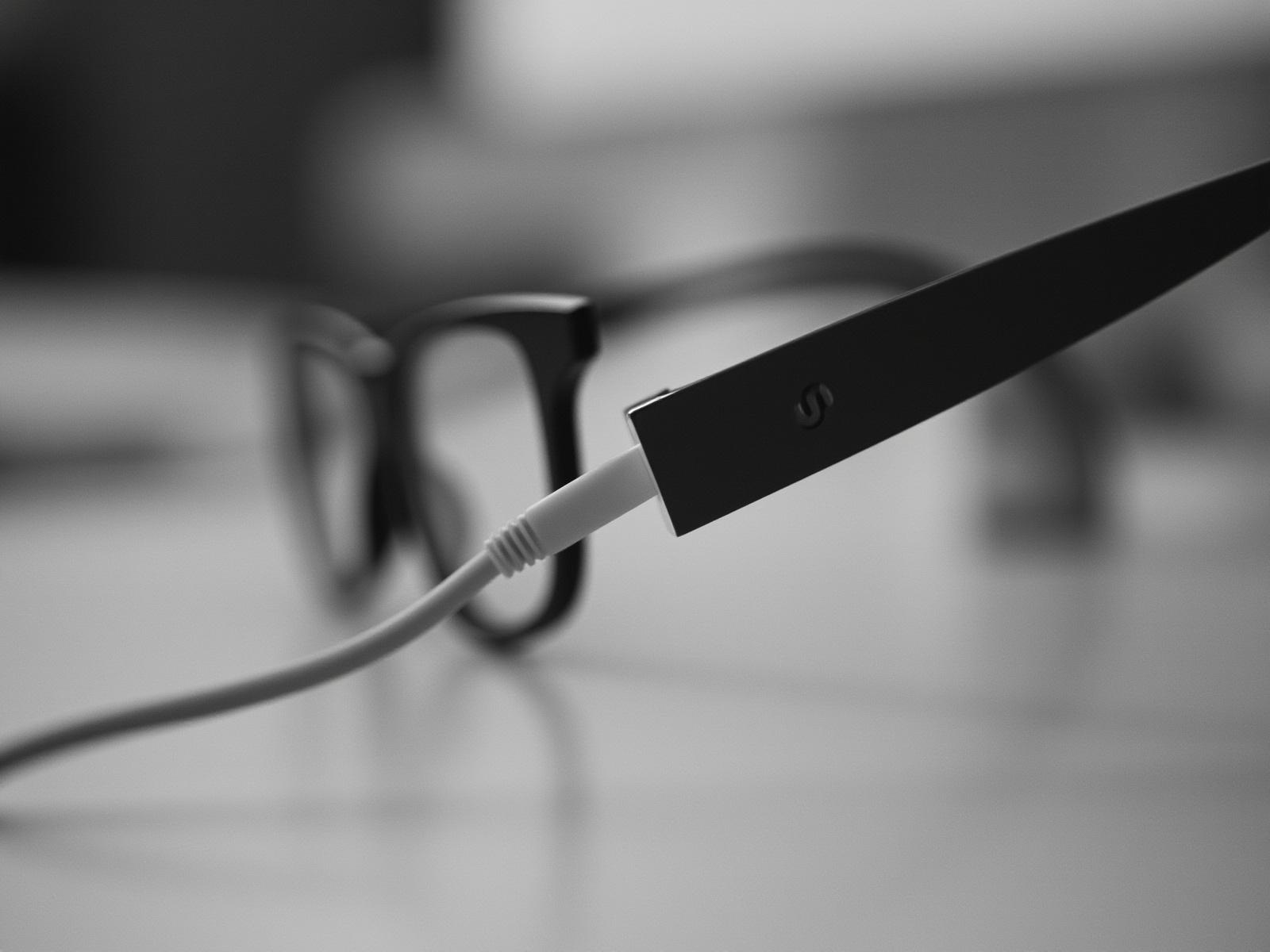
Charging mistakes are cheap to prevent and expensive to discover, and they cluster in a predictable set. Most are specification errors rather than technical failures — a model named where a configuration was needed, a case capacity left ambiguous, a runtime figure extrapolated beyond what it describes. The seven below account for the overwhelming majority of the charging problems that reach a procurement team, and each one is written the same way: the symptom you will actually see, the root cause underneath it, and the correction that prevents it rather than documents it. None of them requires a different product. Every one of them is a decision taken earlier or later than it should have been.
Smart glasses charging: the paperwork, not the circuit
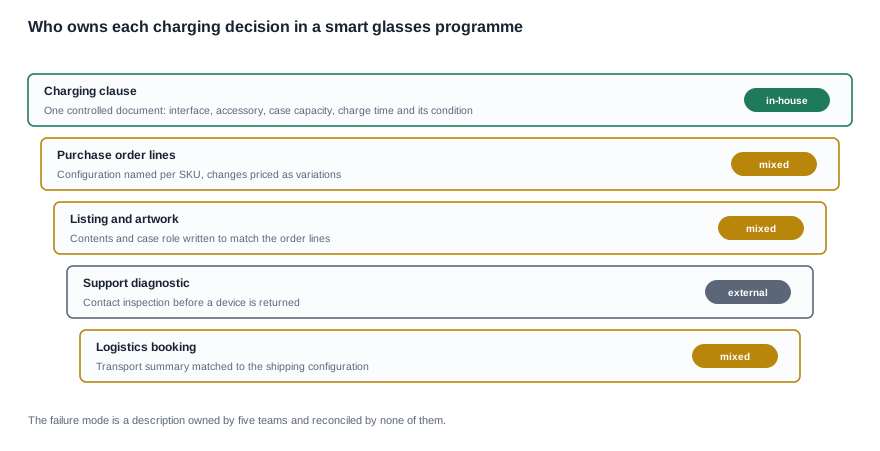
It is worth saying up front why charging attracts more specification mistakes than any other block on a smart glasses data sheet. The electrical rows — battery capacity, rated runtime, charge time — describe a single object. The charging rows describe a system: the device, an accessory that may or may not be in the box, a cable, a customer who has to bring their own adapter, a carrier who checks the paperwork and a channel that returns defective units. Each of those six can move independently, and the product does not change when any of them does.
That is the structural reason a charging specification fails. It is not that the engineering is wrong. It is that six parties are describing one arrangement in five different documents, and nobody owns the reconciliation.
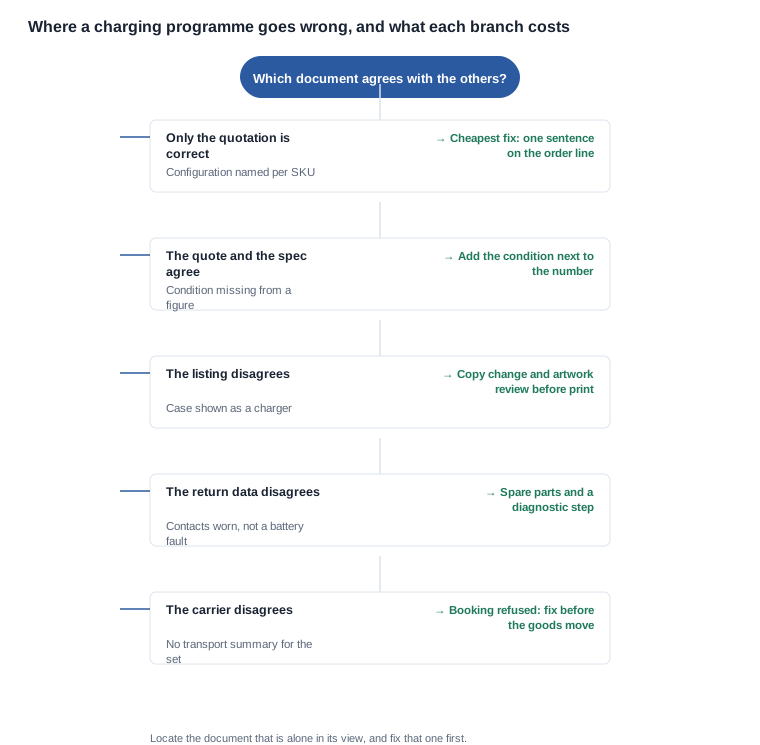
The practical consequence for a procurement manager is that the mistakes below are cheap to detect at the quotation stage and expensive to detect after the artwork is printed, the container is booked or the units are in the channel. A configuration ambiguity caught before the purchase order is a sentence. The same ambiguity caught after the print run is an inventory write-off; caught after the first container is refused it is a schedule; caught after the first batch of returns it is a support cost that runs for the life of the product.
So the way to use this list is not as a warning but as a pre-flight check on your own specification. Read each mistake, find out whether your programme contains it, and if it does, identify which of the five documents is currently the only one that agrees with the others. That document is usually a quote, and the quote is usually the one nobody re-reads after the purchase order is issued.
The five documents that disagree are worth naming, because a pre-flight review is much faster when you know what you are comparing. They are: the supplier's specification page, the quotation, the purchase order, the product listing, and the printed manual or artwork brief. In most programmes the specification page and the quotation agree with each other and with nothing else. The listing is written later, by a different team, from the marketing angle rather than the engineering angle. The artwork brief is written earliest, because it is usually the document that drives the production schedule.
So the review itself is short: put all five side by side, in a single column per attribute — interface, accessory in the box, case capacity, charge time, charge time condition — and mark every cell where the five do not agree. The disagreements are the mistakes below, in the order they will happen. A buyer who wants to know how to evaluate a quotation on this point is looking for whether the supplier's own documents agree with each other, and a supplier whose five documents contradict each other will not give you a clean answer to a direct question either.
There is a second reason these mistakes cluster in charging rather than elsewhere. Almost every one of them is a substitution of a plausible number for the real one — a charge time without a condition, a capacity without a unit of ownership, a runtime without a workload. The substituted number is not invented. It is published. It is just published with less precision than the decision needs, and the gap is invisible on a specification page.

Mistakes one and two: naming a model where a configuration was required
Mistake one: specifying the interface by model name instead of by SKU
Our catalogue uses magnetic charging across most of the range. Type-C appears on the V03 Pro and the ZH12, the D12 and the D11, and the D17 and the bone conduction entry, and the L2 Utral carries a Type-C charging port alongside its charging case. The V03 itself is magnetic with no case; the KY06 and the MT5 are magnetic with a charging case.
A model name is therefore not always enough to determine the interface, and the specific failure is worth naming: a buyer who assumes magnetic and is shipped Type-C, with no cable in the box, has shipped a product that does not charge on arrival. The customer opens the box, finds no port and no cable, and the first unit out of the carton becomes a return.
The symptom appears in three places, and they show up in this order: a support contact in the first week of launch, a negative product review, and a returns rate that nobody connects to the packaging because nothing about the packaging looks wrong. By the time the returns rate is visible, the fix is a sticker, a manual page and a new artwork plate.
The correction is to name the interface on every line of the purchase order, and to state separately whether a cable ships. Not the model — the interface, and the accessory, on the same line. If your catalogue reference is a model name, add a second line to the order for the charging configuration. This is a one-line change to a purchase order that prevents a six-figure rework across the whole first run.
Mistake two: leaving case capacity ambiguous
The L2 Utral is published with either a 900 mAh or a 1400 mAh case. Both are legitimate configurations of the same model, and "the L2 Utral" on a purchase order does not determine which one arrives.
This is the same class of error as describing a variant without naming it, and it propagates in a way that is easy to miss because the ambiguity first shows up in a freight calculation rather than in a customer complaint. The freight calculation assumes one parcel. The packaging specification assumes one insert. The transport document assumes one battery configuration. The customer's expectation assumes the larger case, because that is the one in the photograph on the product page. All four are working from the same model name and all four are wrong.
The other published case figures deserve the same discipline, and it is worth listing them because the gaps between them are the whole point. The CY05 and the CY03, and the L1 Pro each publish a 1400 mAh case. The L2 Utral publishes 900 mAh or 1400 mAh. The MT6 publishes a 1200 mAh folding case. The KY06 and the MT5 ship with a case and publish no capacity for it at all — and the V03 Pro, being Type-C, has no charging case.
The correction is to state the case capacity in mAh as a number on the order line, and to say explicitly where a model ships with a case but publishes no capacity. For the KY06 and the MT5, the capacity is not a detail to be estimated from a neighbouring model; it is an open item that has to be requested before the transport scope can be written.
Mistakes three and four: reading a published figure as more than it says
Mistake three: treating case capacity as additional runtime
A 1400 mAh case does not extend the rated runtime of the glasses. It is a separate battery for recharging them, and the difference matters commercially because a runtime figure and a case capacity are quoted against different use cases.
The published runtime for the camera models that ship with a 1400 mAh case — the L1 Pro and the CY05, and the CY03 — is about seven hours. The case is a second battery that lets the customer recharge away from a cable. How many times that is depends on the case's own efficiency and its state of charge, and we publish no cycle life and no efficiency figure for any case cell, so we will not state a number either.
The correction is to write the customer-facing statement as what is actually true — that the case allows recharging away from a cable — and to keep it out of the runtime specification. A product page that quotes "seven hours, plus 1400 mAh of case" invites a comparison against a competitor's genuinely longer runtime, and the comparison is not one the published rows support.
Mistake four: assuming a fast-charge figure is universal
The D17 and the ZH12 are published at about one hour charge time. Every other model in the range is published at two hours or less. Neither figure carries a stated condition — not the starting state, not the input current, not the charger assumed.
The mistake is to repeat "one hour charge" in product copy, which makes a claim about a test condition nobody has seen. The same error appears in the other direction, where a buyer assumes that a wired connection is automatically the faster option and uses it to justify a Type-C architecture. On our published rows it is not: the magnetic camera models publish up to two hours as well, so the architecture does not buy the speed.
The correction is to ask what input current the device accepts and what charger the figure assumes, then state the condition next to the number in the copy. This is one of the few places in the category where a marketing claim and a specification claim can be made identical by adding six words.
Mistakes five and six: the mistakes that reach the customer
Mistake five: not provisioning spare cases or spare contacts
Magnetic charging exposes the contacts. Contacts wear. A unit with worn contacts may charge slowly or intermittently, and that presents to the customer as a battery fault, so it is diagnosed as one.
The outcome is expensive and specific: a unit is returned, and the unit is replaced under warranty, when the actual fault was a consumable contact interface on an accessory that costs a fraction of the device. The diagnosis is wrong, the warranty is charged, and the channel's spare-parts plan has no line for the part that actually failed.
The symptom appears in the returns data as a battery-related failure rate on a model that is otherwise performing. The tell is that the failure rate is correlated with age and not with batch — a manufacturing defect clusters by batch, and a wear mechanism clusters by time in service.
The correction is to agree spare case availability and pricing at the quotation stage, not after the first wave of returns. A channel can only service a product it can replace parts for, and the second part of the correction is to make sure the diagnostic step exists — a contact inspection before a device is returned against the device warranty. That single step is the difference between a spare part and a warranty claim.
Mistake six: ignoring the rotation arithmetic of the deployment
In a retail, classroom or field deployment, the working ratio of units in service to units on charge determines whether the programme survives, and it is the one charging decision that has to be calculated rather than negotiated.
Published runtimes across our range run from about five hours on the camera models, through about eight on the audio models, to about twenty on the A05, the A06 and the A07 — with no test condition stated on any of them, which means a deployment plan built directly on the published figures is built on a number that has no measured basis.
The correction is to do the arithmetic yourself with a derated figure you have measured. Take the runtime you observed on a sample under the workload the deployment actually has. Subtract the margin you are willing to accept for temperature, age and duty cycle. Divide your working day by that figure to get the number of charge cycles each unit needs per day. Multiply by the units in service to get the chargers you need to have on site at any moment. That last number is the one that appears in the purchase order as charging accessories, and it is the one most often left out.
The mistake is not the omission of a spare charger. It is the omission of the ratio, which is a planning assumption that someone else has to make, and which the supplier is in no position to make on your behalf.
Mistakes five and six also compound with mistake three, and the compounding is worth understanding because it hides the origin of the problem. If a product page claims a runtime that was never measured, then the deployment plan built on that claim asks each unit to run longer than it can, which increases the number of charge cycles per day, which raises the charger ratio, which is why a deployment built on a published figure ends up short of chargers. The visible symptom is a shortage of chargers. The actual cause is a number that was copied from a catalogue row without a condition attached to it.

Mistake seven: the one that stops a shipment
Lithium cells require a UN38.3 test summary to travel by sea or air, and carriers check for it. A refused booking costs far more than the freight difference, and it is entirely avoidable by obtaining the document before the shipment is planned.
This mistake is different from the other six in one important respect: it is the only one that is discovered by a third party rather than by the customer. The other six surface as support contacts, returns or a copy problem, which is expensive but recoverable. A refused booking happens after the goods have been paid for, packed and moved to the origin terminal, and it surfaces on a date that no one controls.
The complication specific to charging is that the summary has to cover the configuration that actually ships. A frame cell and a case cell are not one battery, and a summary written against the frame alone does not describe a carton that also carries a 1400 mAh case. When a model ships with a case whose capacity is not published — the KY06 and the MT5 — the configuration cannot even be described accurately, which is a stronger reason to request the missing figure than the transport obligation itself.
The correction is procedural and cheap: request the transport summary for every battery configuration on the order, match the cell references in the summary to the cells actually fitted, and confirm the packing and marking instruction for the combined configuration, before the booking is confirmed rather than after.
Why charging is a configuration decision before it is a technical one
The boundary we hold: charging is a configuration question before it is a technical one, and we will publish the interface, the charge time and the case capacity exactly as the catalogue states them while marking the test conditions as unpublished rather than inferring them. Where a figure carries no condition, we would rather say so than attach a condition we have not seen.
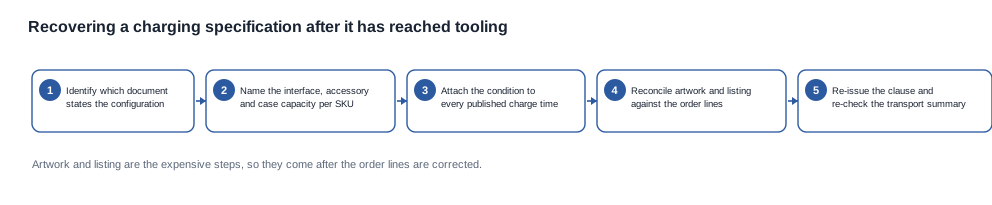
The seven mistakes above share a single root cause, and it is not carelessness. It is that the charging arrangement is described in five places and owned by none of them. The correction is to give it an owner and a single controlled document — a charging clause that states the interface, the accessory list, the case capacity where a case exists, the stated charge time with its condition, and the point at which a change to any of it becomes a priced variation. That clause then becomes the thing the listing team works from, the thing the support script is written against and the thing the logistics booking is checked against.
The practical checklist that comes out of this list is short. Name the interface per SKU. Name the case capacity per SKU, and flag the models where the catalogue publishes none. Keep the case capacity out of the runtime claim. Put a condition next to every charge time. Provision spare cases and a diagnostic step before the first wave of returns. Calculate the charger ratio from a runtime you have measured. And have the transport summary in hand for every battery configuration before the booking is confirmed.
If your programme passes those seven, the charging block of the specification is one that the listing team, the support team and the carrier can all work from, which is the practical definition of the product being ready to ship. If it fails one, the symptom will tell you which document to go and fix.
Tell us the models and the channel, and we will tell you which charging arrangements apply to them and which of these seven mistakes your current specification is exposed to. The charging architectures are described under charging solutions, and the battery side of the platform is covered under battery life and power.
One last thing about how to evaluate a quotation on charging, because it is the cheapest question to ask and it catches several of the mistakes above in one reply. Ask the supplier to restate, in one line and without referring to their brochure, what is in the box for each model on the order, what the interface is, and whether the case charges the frames. A supplier who answers that in a single paragraph has an internal specification that holds together. A supplier who sends the brochure has a catalogue, and a catalogue is exactly the document that cannot answer these questions — it is written to describe a range, not to describe your order.
Related reading
- charging solutions and interfaces
- smart glasses battery life and power
- The claims to interrogate in a supplier quotation — charging red flags
- The forward-looking version of this list — charging checklist for procurement teams
Tell us the models and the channel and we will say which charging arrangements apply.


