
Smart glasses charging smart glasses checklist for procurement teams exists because the charging terms are where a specification quietly stops being true. Every other row on a smart glasses specification sheet describes the product on its own. The charging rows describe a relationship between the product, an accessory, a cable, a customer's habits and a carrier — and any of those five can change the outcome without the product changing. So the twelve items below are written as a gate rather than as a reading exercise: each one has a criterion, an owner, an artefact that proves it, and a condition that stops the order. Items one to five can be closed from documents. Items six to nine need a measurement. Items ten to twelve decide what the customer experiences, and most of them are never written down anywhere.
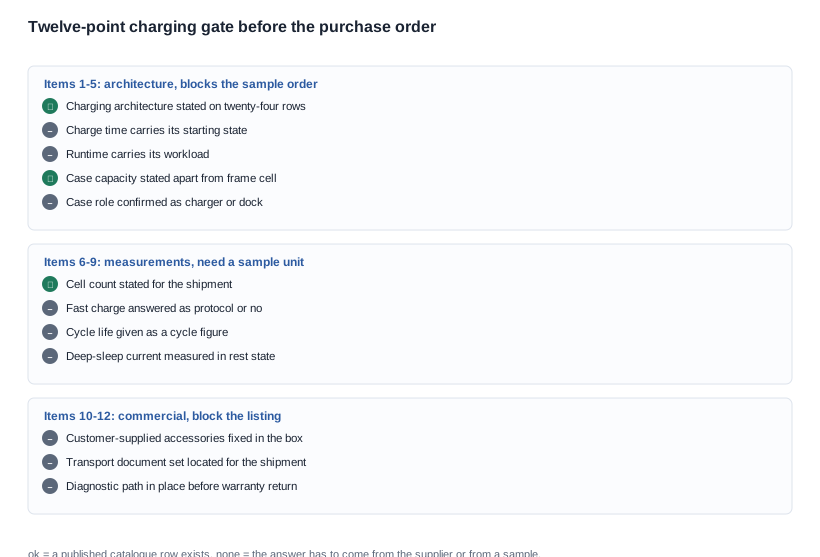
Our catalogue states a charge time and a rated runtime for every model, a case capacity where a case exists, and a charging method on the twenty-four entries that carry one. It states no test condition for any runtime figure and no fast-charge support for any model, which is why four of the twelve items below are marked against us as well as against the industry.
Smart glasses charging: a checklist needs an owner
A list of questions is not a checklist. A question can be answered in a way that satisfies the sender and changes nothing; a checklist item cannot, because each one carries a completion condition that somebody has to sign. That distinction matters commercially, because the charging specification is usually the last block of a specification to be agreed and the first block to be relied on by three other teams at once — the listing team, the support team and the logistics team all build on it.
The buyer this is written for has a specific situation. Usually there is a supplier quote on the desk with a specification page attached, the charging rows are three lines long, and somebody has already asked the question that starts every one of these conversations: does it charge fast enough? The answer on the page is a number with no condition attached, and the number looks like an answer. It is not.
What the buyer is defending against is not a dishonest supplier. Most suppliers in this category are accurate about the figures they publish and silent about the ones they do not, and the silence is the risk. A specification that states a two-hour charge time and says nothing about the starting state is not false; it is a number with two possible values, and the one that lands in the retail listing is whichever one the reader assumed. The same applies to a runtime figure with no workload, a case capacity with no indication of whether the case charges the frames, and a cell count that has been collapsed into a single battery number.
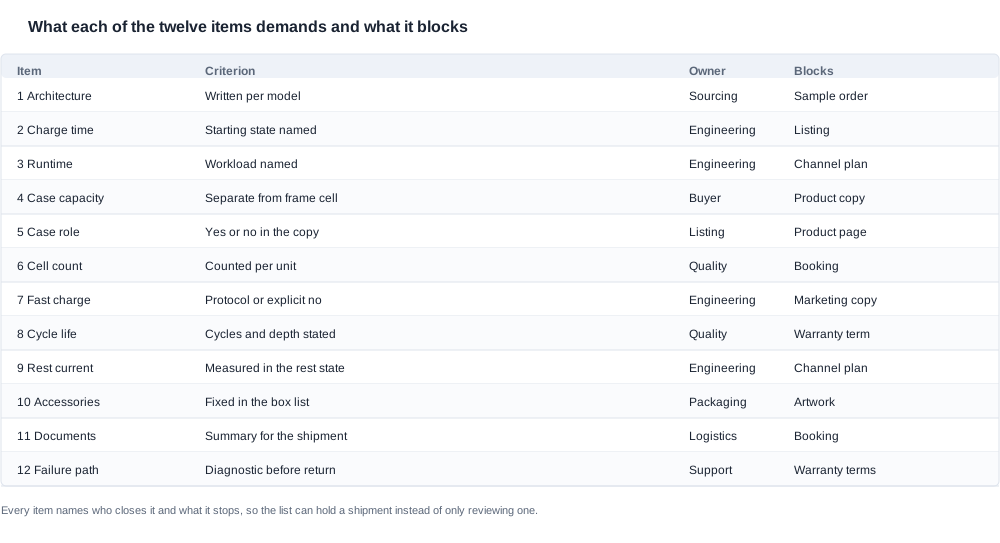
Three consequences follow, and they shape the whole list. First, every item below is written so that it can be marked answered, not answerable from a document, or needs a sample — because a gate that mixes those three states produces a false sense of readiness. Second, the owner of each item is named, because an unowned item in a specification is an item that will be discovered in the week before the container is booked. Third, the item that stops the order is stated, so that the gate can be used to hold a shipment rather than merely to review one.

The twelve items, each with a criterion, an owner and a blocking condition
Items one to five: the architecture, and they block the sample order
1. The charging architecture. Type-C on the device, magnetic contacts on the device, or charge-through-the-case only. The criterion is that it appears in writing rather than being inferred from a photograph of the box. This one answer determines items four, five, six, ten and eleven, so a buyer who leaves it open has not saved work — it has deferred it to the point where it is most expensive to fix. Owner: the product or sourcing engineer. Blocking condition: the architecture is not written into the purchase order.
2. The charge time, with its starting state. A figure without one is two possible numbers. From empty is the convention and should be stated. The criterion is that the supplier names both the starting state and the ending state, because a charge time measured from 20 per cent is roughly a quarter shorter than the same figure measured from empty. Owner: the supplier's engineering contact. Blocking condition: the charge time appears in the retail listing without a stated condition.
3. The runtime, with its workload. Continuous playback, mixed use, or continuous capture. Our catalogue publishes rated figures with no condition, which is exactly the gap this item closes, and it is the gap that matters most to a channel planning a shift pattern or a school planning a day. Owner: the supplier's engineering contact. Blocking condition: a runtime figure is used in a channel planning document.
4. The case capacity, stated separately from the frame cell capacity. A single battery number for a product with a case is a figure that has been added up incorrectly. Frame cells in our range run from 40 mAh to 290 mAh; case capacities are 900, 1200 and 1400 mAh. The criterion is two separate numbers, each attributed to a specific part, and each traceable to the model it applies to. Owner: the buyer. Blocking condition: a single battery figure appears anywhere in the product copy.
5. Whether the case charges the frames. A yes or a no, and it has to appear in the listing as well as in the quotation. A case that stores is a dock, and a listing that shows a charging case for a product with a dock is a support-contact generator. The criterion is that the answer appears in the customer-facing copy, not only in the internal spec. Owner: the listing owner. Blocking condition: the product page and the invoice description disagree.
Items six to nine: the engineering measurements, and they need a sample
6. The number of cells per unit. Counted, not inferred. This determines the battery configuration in the shipment, and therefore the transport documentation and what can travel by air. Several models in this range carry two cells and the catalogue prints them as a cell value and a cell count rather than as a single total — the K01 and the K02 at 90 mAh × 2, the LC-105-1 and the LC-105-2 at 55 mAh × 2, the G07 and the YK12 at 55 mAh × 2, and the YKC02 at 70 mAh × 2. The criterion is that the cell count is stated separately from the cell capacity so that the transport configuration can be described. Owner: the supplier's quality contact. Blocking condition: the shipment is booked without the configuration stated.
7. Fast-charge support. A protocol and a power level, or an explicit no. We publish about an hour of charge time for the D17 and the ZH12 against two hours or less for the rest of the range, and we publish no protocol for either. The criterion is that the answer names the protocol, or states plainly that there is none. Owner: the supplier's engineering contact. Blocking condition: a charge time is quoted as a fast-charge figure in any customer-facing material.
8. Cell cycle life. A cycle figure, not an adjective. This is the number that matters for a school, a retailer or any channel that charges the same units every night for years, because it decides when the second wave of returns arrives. The criterion is a number of cycles at a stated depth of discharge, with the test temperature stated. Owner: the supplier's quality contact. Blocking condition: a warranty period is set that the cycle figure cannot support.
9. Deep-sleep current. A figure in microamps, because it decides the overnight loss and therefore whether a customer picks the product up in the morning. This is the most useful unpublished number in the category and we publish none of it. The criterion is a measured current in the state the product actually rests in. Owner: the supplier's engineering contact. Blocking condition: a channel assumes the product is ready to use without an overnight charge.
Items ten to twelve: the commercial terms, and they block the listing
10. What the customer has to supply. A cable, an adapter, a dock, or nothing. This is the accessory line in the box, and it is the difference between a product that works out of the box and one that generates a first-week support ticket. The criterion is that the accessory list is written into the listing and matches the carton. Owner: the packaging owner. Blocking condition: artwork is approved against a contents list that differs from the one in the quotation.
11. The battery document set. The transport test summary located, and the packing and marking requirements confirmed, before the shipment is booked. A missing summary is a refusal at the carrier, and it arrives after the goods have been paid for and packed. The criterion is that the summary covers the configuration actually shipping, including a case cell where one is present. Owner: the logistics contact. Blocking condition: the booking is confirmed without the summary in hand.
12. The failure and warranty path. What happens when a unit will not charge, and where it physically goes. A device with a case has two components that can fail, and the case is the one customers blame less often and return less often, which means a case failure is often diagnosed as a device failure and returned against the device warranty. The criterion is that the diagnostic step exists before the device is returned. Owner: the support lead. Blocking condition: the warranty terms are published without a diagnostic procedure behind them.
What our own catalogue answers from the twelve, and what it leaves empty
It is worth being explicit about how much of this list our own documentation can close, because a buyer who assumes a catalogue answers everything wastes a week discovering that it does not.
| Item | What the catalogue gives | What is not published |
|---|---|---|
| 1 Architecture | Charging method on the twenty-four entries that carry one | The interface on the L1 Pro and the CY05, and the CY03 and the MT6, and whether a case charges the frames in every configuration |
| 2 Charge time | Two hours or less on most models, about an hour on the D17 and the ZH12 | Starting state, ending state, protocol |
| 3 Runtime | A rated figure on every model, from about six to about twenty hours | Workload, temperature, any test condition |
| 4 Case capacity | 1400 mAh on the L1 Pro and the CY05, and the CY03; 900 mAh or 1400 mAh on the L2 Utral; 1200 mAh on the MT6 folding case; a case with unpublished capacity on the KY06 and the MT5; no case on the V03 Pro | Whether each case is a charger or a dock |
| 5 Case charges the frames | Charging method on the twenty-four entries that carry one | A yes or no stated per case-equipped model |
| 6 Cell count | Cell value and cell count printed as the catalogue prints them | Cell references and chemistry |
| 7 Fast charge | Charge time only | Any protocol or power level |
| 8 Cycle life | Nothing | Cycle count, depth of discharge, test temperature |
| 9 Deep-sleep current | Nothing | Measured rest current |
| 10 Customer supplies | Charging method on the twenty-four entries that carry one | Whether a cable or adapter is in the box |
| 11 Document set | Nothing | Test summary, packing instruction, marking |
| 12 Failure path | Nothing | Diagnostic steps, spare-parts policy |
Read down the right-hand column and the pattern is consistent: the catalogue is strong on the electrical rows that describe the product and silent on everything that describes a relationship — the accessory, the box, the shipment, the customer. That is not an unusual division for a factory, and it is not a criticism of one. It is, however, the reason a procurement team needs this list rather than a catalogue, and it is the reason the first question to ask a supplier is not about the product but about the configuration.
Four of the twelve items are also marked as beyond any catalogue, including our own. The cycle life, the deep-sleep current, the transport document set and the failure path cannot be read from a specification page by anyone, including the supplier, unless someone measures them or requests them. A buyer who wants to know how to evaluate a supplier on those four is really asking how to tell a measured answer from a quoted one, and the honest answer is that it takes a sample and a question.

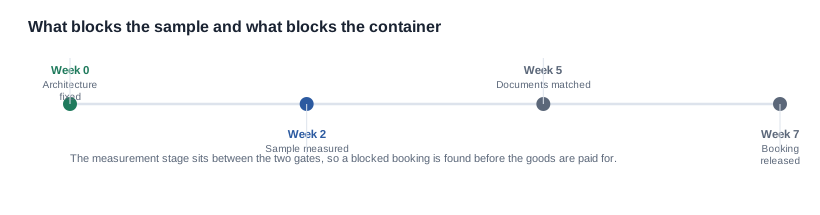
Running the gate: what stops the sample and what stops the container
A twelve-item gate applied all at once at the end of a programme is a review, not a gate. The useful version is staged, because the items have very different lead times and very different consequences when they go wrong.
The first stage runs before the sample order is placed, and it contains items one, five and ten. The architecture has to be fixed because it determines what the sample is. The case question has to be fixed because it determines the customer-facing copy. The accessory list has to be fixed because it determines the carton, and the carton determines the artwork. None of these three can be closed later without a cost, and all three are answerable from a supplier's specification page and a quotation.
The second stage runs on the sample, and it contains items two, three, six, seven, eight and nine. These are the measurements. A buyer who has a sample in hand can time a charge from empty, can run a runtime under a defined workload, can count cells, can test whether a power bank is accepted, can put a cell through a cycle and can measure a rest current. What the buyer cannot do is measure these and call them representative of production — which is why the second stage's output should be a set of observed figures attached to a named sample unit, with the date and the configuration recorded, and why the production release should reference that sample rather than the specification page.
The third stage runs before the container is booked, and it contains items four, eleven and twelve. Case capacity has to be confirmed against what is actually fitted, the transport document set has to be in hand and matched to the shipping configuration, and the warranty path has to exist in the support team's hands rather than in a policy document. These are the items whose failure mode is loudest: a refused booking, a carton that arrives with the wrong accessory, a device returned against a warranty that was never operational.
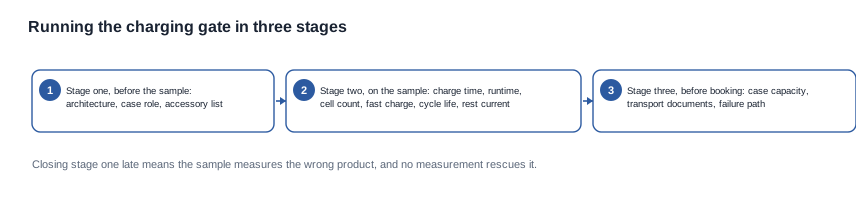
The stage boundaries are where a gate earns its keep. A buyer who has signed off items one, five and ten and shipped a sample can use the sample to close the measurement items without risking the schedule. A buyer who has left items one, five and ten open and shipped a sample has bought a sample of the wrong product, and no amount of measurement will rescue it.

Where a charging checklist still lets a bad programme through
A checklist is a control, and like any control it fails in characteristic ways. Five of them are worth naming, because each of them has produced a real order somewhere in this category and each of them is invisible to the checklist itself.
The checklist is applied to the specification rather than to the sample. The twelve items are answered from a PDF, the PDF is filed, and the sample that arrives is a different configuration. The defence is to require the measurement items to carry the serial number of the sample they came from.
The same number is used for two different questions. A charge time of two hours or less is a catalogue figure with no starting state, and a buyer who reads it as "two hours from 20 per cent" has a specification that will not survive a customer complaint. The defence is to write the condition next to the number every time the number appears.
Two batteries are collapsed into one. A product with a 290 mAh frame and a 1400 mAh case can be described as a 1690 mAh product, and that single number then drives freight, packing and the transport document. It is also a figure nobody published. The defence is item four, and the rule that a derived total is labelled as derived wherever it appears.
The supplier answers the question that was not asked. "Two hours or less" is answered; "how long from empty, to what termination state, at what input current" is not. The defence is to ask the sub-questions in writing, because a written sub-question gets a written answer and a verbal one gets a summary.
The gate passes and the listing does not follow. The checklist was closed, and the product page, the printed manual and the invoice description each say something slightly different about the charging arrangement. The defence is to make the approved contents list and the approved charging clause a controlled document that the listing team works from, rather than a decision that reaches them second-hand.
These five are the ones to watch, and they are the reason the item that stops the order is written into each entry. A checklist that cannot stop anything is a list of questions, and the twelve items here are written to be able to.
Writing the twelve into the agreement, and the limits of what we publish
The checklist earns its keep in the contract. A clause that says the product shall be supplied with a magnetic charging cable and no mains adapter, and the charging method shall be magnetic contacts with the 1400 mAh charging case is a precise, testable obligation. A clause that says charging as per the manufacturer's specification is not, because it hands the whole question back to the party you are trying to hold to an answer.
The commercial negotiation around the twelve items is mostly about timing and allocation rather than price. What can move: the accessory bundle configuration, the delivery split by model so that a slow-moving model does not hold a fast-moving one, the payment milestones against the sample and against production, and the point at which a change to the contents list is re-quoted rather than absorbed. What cannot move: the cost and cycle of a test regime once it is triggered, and the character of mould tooling as a non-recurring cost that only amortises across volume. A quotation that presents those two groups separately is a quotation whose reliability you can judge.
Three clauses are worth having in writing regardless of the rest of the contract. The first states the box contents per model, with the charging method and the stated charge time and its condition, and it makes any change to the contents a priced variation. The second states the documentation set that travels with the goods, including which transport summary covers which battery configuration. The third states the diagnostic procedure that precedes a warranty return, so that a case failure is not returned against a device warranty.
Where our own limits sit is a fair question to ask of any supplier, and ours are specific. We publish the charging interface and the charging method for the twenty-four rows that carry one, the stated charge time, the cell capacity and the case capacity for every model in the range. We publish no certificate numbers, no issuing bodies, no expiry dates, no per-model certificate coverage, no battery test references, no cell chemistry, no cycle life and no deep-sleep current, because our source document contains none of them. We will supply documentation that exists for a specific model and a specific shipment, and we will be explicit when we are relying on a company-level claim rather than on a document for your configuration.
That position is narrower than a supplier who publishes a long list of "typical values" will offer, and it is deliberate. A cycle figure that is a typical value rather than a measured one gets designed into a warranty by somebody, and when the channel's returns exceed the plan, that figure is the first thing anybody will look at.
The charging architectures themselves are described under charging solutions, and the four arrangements they correspond to are set out in full in the beginner's guide to the options.
Send us the model list, the destination market and the box contents you have in mind, and we will mark each of the twelve as answered from our documentation, not answerable from a document, or needing a sample — and we will tell you which of the blanks we can close and which ones need a measurement on a unit in your hand.
Related reading
- The claims to interrogate — charging red flags
- The vocabulary behind the answers — charging glossary
- The transport consequences — battery transport compliance
- The cost side of each architecture — charging cost factors
Send us the model and the destination market and we will mark each of the twelve as answered, unanswerable from a document, or needing a sample.


