

Smart glasses charging smart glasses red flags are the kind of thing that is obvious once somebody has said it out loud, and they are reliably invisible until a customer or a carrier is the one who finds the problem. A charging claim is short, it is repeated by every supplier in the category, and it is almost never wrong in a way that reads as wrong. It is wrong in a way that reads as reasonable, which is why the six signals below are worth a specific check rather than a general scepticism.
Our catalogue states a charge time and a rated runtime for every model, a case capacity where a case exists, and a charging method on the twenty-four entries that carry one. Every charge time in the range is stated without a test condition, and no fast-charge protocol is published for any model — which is itself one of the things a buyer should be checking.
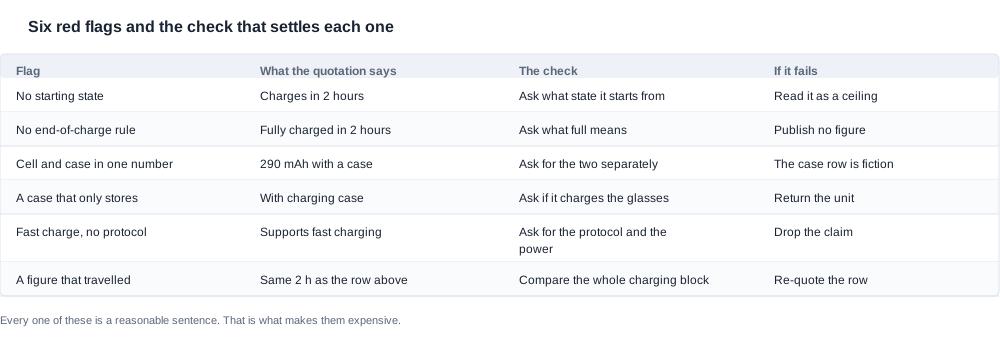
Smart glasses charging: three flags that hide inside the charge time
Flag one: a charge time with no starting state
"Charges in 2 hours" is a statement about a journey from somewhere to somewhere, and the somewhere is the part that gets left out. From empty is the normal convention. From a partial charge it is a different number, and a supplier quoting the second while the reader assumes the first has produced a quotation that is optimistic by an unstated amount.
The check is trivial: ask what the starting state is. A supplier that has measured will answer immediately, and a supplier that has copied will not have the answer at all.
There is a second reason this flag matters commercially rather than technically. A charge time with no starting state cannot be turned into a shift-changeover promise, and a shift-changeover promise is exactly what a channel buyer is often trying to write into a contract. If the quotation does not settle the starting state, the recovery window in the contract is guesswork.
Flag two: a runtime with no workload
This is the most common red flag in the whole category, and it is the one our own catalogue shares. A rated runtime is a number with the method removed, and the three common workloads — continuous playback, mixed use and continuous capture — produce substantially different results from the same hardware.
A quoted runtime with no stated workload should be treated as a best case until it has been proven otherwise, and the way to prove it is to ask what the device was doing during the measurement. A camera model published at five to eight hours and a camera model published at about seven hours are not comparable rows; they may be the same measurement under two different names, or two different measurements, and the quotation will not tell you which.
Flag three: one number for a cell and a case
A quotation that gives a single battery number for a product with a case and a frame is either adding a frame capacity to a case capacity, or presenting the two as one. Both are wrong in a way that matters, because the frame's cell is what the customer's day depends on and the case's cell is what the customer's week depends on.
The check is to ask for the two separately. In our range the frame cells run from 40 mAh to 290 mAh, and the published case capacities are 900, 1200 and 1400 mAh. They should never appear as one number, and a combined figure is the clearest single sign that the charging block was assembled rather than measured.

Three flags that hide in the product and the case
Flag four: a case that stores but does not charge
A case in the box implies a charging function. A dock that only holds the glasses implies nothing of the kind, and the difference is invisible until a customer writes in to say the glasses will not charge. This is one of the most common listing errors in the category, because the product photography looks identical either way.
Seven models in our range are published as shipping with a charging case. Whether the case charges the glasses or only stores charge for them is not published for any of them, which means it is a question to ask rather than a fact to check.
The check is to ask directly, and to have the answer in the listing. If the supplier cannot answer in one sentence, the case is a storage accessory and the product page should say so.
Flag five: a fast-charge claim with no protocol
Fast charging is a claim about a protocol, a power level and a thermal design, and a bare "fast charging" on a specification sheet usually means one of two things: the device charges faster than a very slow baseline, or the figure was copied from a different model in the range.
Our catalogue publishes about an hour of charge time for the D17 and the ZH12 against two hours or less for the rest of the range, and we publish no protocol, no power level and no fast-charge support for any model. A supplier quoting a fast-charge capability should be able to name the protocol and the power, and a supplier quoting only "fast charging" has told you nothing you can put on a product page.
Flag six: a figure that travelled from the row above
This is the quietest of the six and the one that costs the most time. Our own range contains the same interface and the same nominal charge time across models with very different cells, and a figure that has clearly moved from a neighbouring row of a specification sheet is a sign that the sheet was assembled rather than measured.
Comparing the charging rows against the other rows for the same model catches it. So does reading the charging block as a block: an interface, a charge time, a cell, a runtime and a case row that do not belong to the same model are visible once the block is read as a block.
The transport document that has to exist before the shipment date
This one sits outside the charging rows but belongs in the same review, because it is the failure that stops a shipment rather than a listing.
A lithium product without a transport test summary is a consignment a carrier will refuse, and the refusal arrives after the goods have been paid for, packed and shipped. The summary has been a mandatory document since 2020, and its absence in a quotation is a question worth asking about immediately rather than at the shipping date.
The document is specific, and the specificity matters. It names a cell, with a cell part number, a model designation and a test laboratory. A cell substitution invalidates it regardless of whether the finished product has changed in any way a customer would notice. So the check is not "do you have the paperwork" but "does the paperwork name the cell you are ordering".
Two related items belong on the same list. A safety data sheet is a different document from a transport test summary and covers a different question. And the model designation on every document has to match the model on the purchase order, character for character, because a family-level document is not coverage for a single stock-keeping unit.
How to evaluate a transport test summary rather than accept one
A summary that arrives is not the same as a summary that has been checked, and the check takes two minutes. Look at the model designation and confirm it matches the model on the order rather than a family. Look at the cell part number and confirm it matches the cell the supplier quoted. Look at the test laboratory and confirm it is one your own compliance team recognises. Look at the date and confirm the test is current against the applicable requirements rather than being an old test on a current cell.
If the summary names a cell that has been superseded, the document is not wrong — it is for a product that is no longer the one you are buying, and the correction is a request rather than an argument. Asking for the summary that covers the cell in the shipment is the cheapest risk reduction in this article.
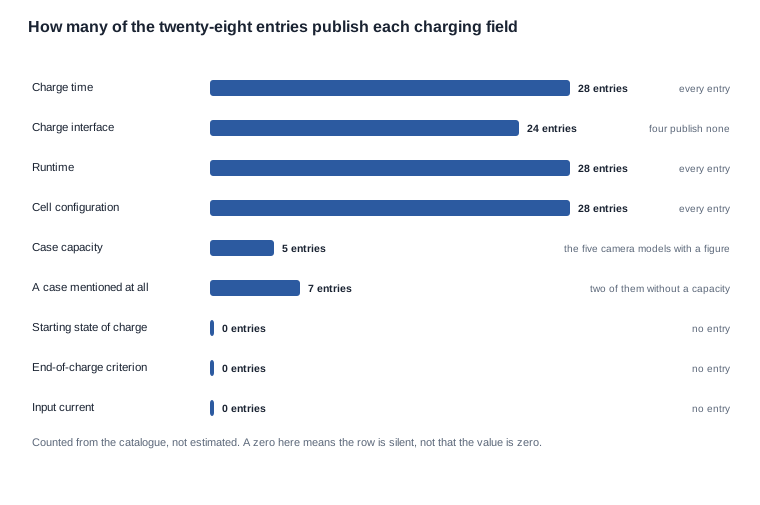
What the catalogue publishes, counted
The counts above are taken from our own catalogue rather than estimated, and they are worth reading carefully because the three zero rows are the ones that decide how you write a claim. Every entry publishes a charge time, a runtime and a cell configuration, and twenty-four of the twenty-eight publish an interface; the four that publish none are the CY03 and the L1 Pro, and the CY05 and the MT6. Five publish a case capacity, and seven mention a case at all. Nothing publishes a starting state, an end-of-charge criterion or an input current.
That is not a criticism of the catalogue. It is the published state of the category, and a buyer who knows it can ask the right question rather than the question everybody asks.
A mains adapter in the box is a second regulated item
If a quotation includes a mains adapter, the adapter is a regulated product in its own right with its own declaration and its own marking, and it is a separate line of documentation from the glasses. The radio equipment the glasses themselves contain is covered by the Radio Equipment Directive (EU) 2014/53/EU, and the adapter is not. Confusing the two is a common shortcut that produces a documentation package with a hole in it.
Not shipping an adapter is also not free. It moves the obligation to the customer and into the extended producer responsibility schemes for packaging and electronics. Neither route is free, and the choice belongs in the commercial brief rather than in the quotation.

Comparing the charging rows against the published rows for that model
A quotation review is not an opinion exercise. It is a comparison between two sets of rows, and it works because the published rows exist.
The five comparisons to make
- The interface. Compare the quoted interface against the published interface for that exact model. If they differ, stop and ask which one is being supplied.
- The charge time. Compare the quoted figure against the published ceiling for that model. A quotation offering a shorter time than the catalogue is either a different model or a different condition, and both need explaining.
- The cell. Compare the quoted cell configuration against the published one, including the number of cells. A cell quoted as 110 mAh where the catalogue publishes 55 mAh × 2 is not necessarily wrong, but it is a derived figure and it has to be marked as one.
- The case. Compare the quoted case against the published case row for that model. Here is the specific case that catches people: the L2 Utral's catalogue page carries a Type-C charging interface line alongside the Utral Pro Max designation, and a case offered at 900 or 1400 mAh — so a reader who takes the case line as evidence of magnetic case charging has read it wrong. The published material does not bind that Type-C line to a configuration, which is exactly why it belongs in a review rather than in a product page.
- The runtime. Compare the quoted runtime against the published runtime band for that model. A quotation offering a runtime outside the published band is either a different model or a different workload.
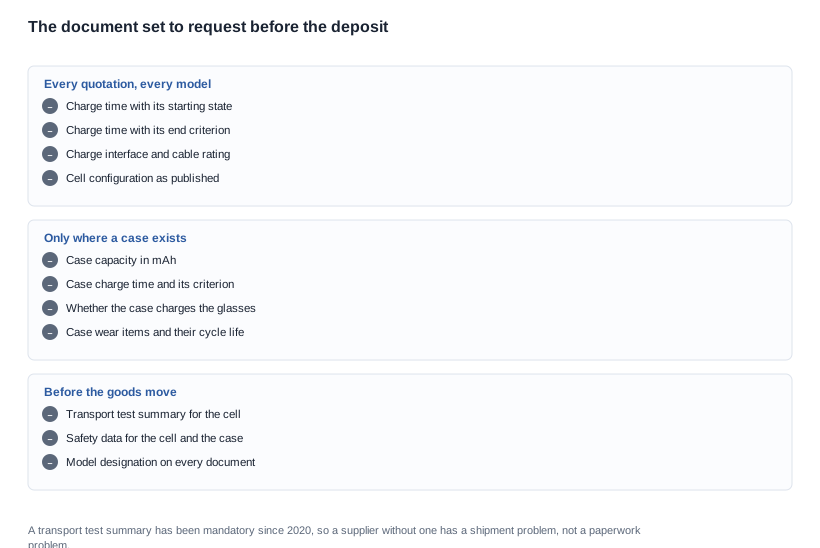
The three documents to request before the deposit
The charging specification sheet, with the charge time, the starting state, the end-of-charge criterion, the input current and the supply assumed. Ask for it as a list rather than as a question, so that a partial answer is visible as a partial answer.
The transport test summary, with the cell part number on it, plus the safety data sheet for the cell and for any case cell.
The model designation list, attached to every document, so that the coverage question is settled by reading rather than by asking.
What a quotation review can settle, and what it cannot
A review against the published rows settles a specific set of questions, and a buyer who knows the boundary of the review is more useful than one who expects it to cover everything.
It settles which model is being quoted. The interface, the cell, the charge time, the runtime and the case row together identify a model or expose that the quotation does not correspond to one.
It settles which claims the published material supports. If the charging rows match, the claim can follow the catalogue ceiling. If they do not match, there is nothing to follow.
It settles whether the documentation scope is right. Model designations, transport documents and the cell part number are all checkable against what is being ordered.
What it cannot settle is everything that requires a measurement: how long a top-up takes, what the case delivers, how the unit behaves on a low-output supply, how many cycles the interface survives, and what the real field figure looks like in a particular channel. Those need a sample and a protocol, and the protocol is the subject of how to measure smart glasses charging.
The commercial cost of leaving a flag unanswered
A flag left unanswered does not stay unanswered; it moves. It moves into a purchase order, into a product page, into a customer's expectation and eventually into a returns trend that nobody can trace back to the quotation. The cost of each stage is different, which is why the review is worth doing while the quotation is still a quotation.
At the quotation stage, a flag costs one email. At the purchase order stage it costs a clause, and a clause is cheaper than a claim. After the shipment, it costs a carrier refusal, a returned pallet or a batch rejection, and the goods have already been paid for. After the launch, it costs a review that a competitor can quote back at you, and it is the only one of the four that cannot be fixed by a process change.
The trade-off worth understanding is that a good review is not an adversarial exercise. A supplier whose rows all reconcile against the published catalogue is a supplier whose catalogue is the same document as ours, which is a property worth having in a supplier. The review narrows the gap between what a supplier says and what a buyer can verify, and both sides of that gap cost more to close after launch than before it.
What to do with a charging block that raises a flag
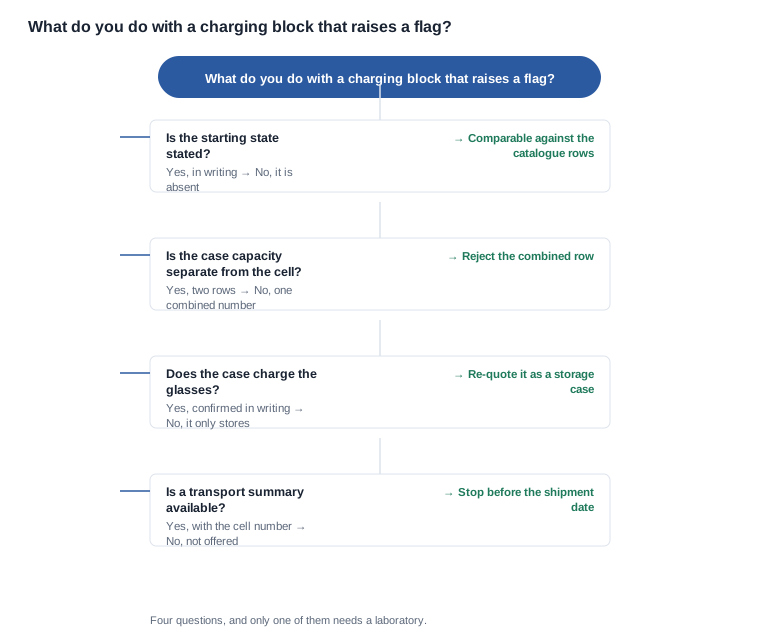
Four questions, in the order that costs least. Ask about the starting state first, because it is free and because it usually resolves the rest of the block. Then check whether the case capacity is separated from the cell, which catches an assembled row. Then ask whether the case charges the glasses. Then check the transport document, which is the only one of the four that can stop a shipment.
A red flag is not a rejection. It is a question that has to be answered in writing before a purchase order carries the figure into a listing, a contract or a warranty.
A hypothetical triage of two quotations
This is a worked case rather than a client project. It makes the order visible.
Assume a distributor comparing two quotations for the same camera model. Both are for the same quantities, both quote a two-hour charge time, and one is a little cheaper per unit. The distributor's technical buyer applies the six flags.
Flag one. The first supplier gives a starting state in writing: a flat cell, with the end condition being a voltage threshold. The second supplier gives "up to 2 hours depending on usage". The second figure is a ceiling with a hedge attached, and the hedge is doing the work the condition should be doing.
Flag six. Comparing the whole charging block, the second quotation's runtime of about eight hours does not match the published band of five to eight hours for that model. It is inside the band, but at the wrong end of it, and the runtime is labelled with a workload the first supplier did not state either. The second supplier's sheet has been assembled from rows rather than measured.
Flag four. The second quotation mentions a charging case but does not say whether it charges the glasses. The question is put in writing and answered within a day: it charges, and it has its own charging time. That figure is not published, so it goes on the request list for the sample.
The transport document. The second supplier offers a transport test summary with a cell part number. The first supplier's summary names a different cell, which is explained as a second source. The distributor asks for a summary for the cell that will actually ship, which is a legitimate request, and the supplier sends it.
The decision. The second quotation is cheaper per unit and is rejected, not on price but on documentation quality: a hedged ceiling, a runtime that does not match the published band, and a case function that had to be chased. The first quotation costs more and needs one extra document. The distributor takes the first, because the extra document can be filed and the hedges cannot.
The decisive step was the third one, and it cost one email.
Send the charging rows and we will mark them
Stated plainly: we publish the charging figures our catalogue holds, in the units it uses, and we publish the empty rows next to them rather than filling them with typical values. We will not infer a chemistry from a milliampere-hour figure, we will not publish a fast-charge capability we have not confirmed, we will not present a case that stores as though it were a case that charges, and we will not convert a charge time into a shift-changeover promise without the starting state that would make it true.
What we can do is check a quotation's charging rows against the published rows for that model, and tell you which of these six flags it raises and what to ask to close it. The commercial side of the same rows is in charging cost factors, the questions buyers ask most often are collected in what buyers most often ask about charging, and the transport side is in battery transport compliance.
Related reading
- The options behind the claims — charging cost factors
- The questions buyers ask — what buyers most often ask about charging
- The transport side — battery transport compliance
Send us the charging rows from a quotation and we will tell you which of these six flags it raises.


