

The same charging hardware produces a different product in each use case, and the published data in our range shows this more clearly than most suppliers will admit, because the charge time and the interface are fixed while the routine is not. This page is written for the buyer choosing a charging approach per channel rather than per product, and it works through the four routines the same hardware has to serve.
Our published positions across the range: two hours or less to charge for most models and around one hour on the D17 and the ZH12, which are the two sport models that publish a shorter charge time than the rest. Magnetic charging across the audio, camera and sport tiers, and Type-C on the D11 and the D12, the V03 Pro and the L2 Utral, and the D17 and the ZH12 and the bone conduction entry. Case capacities at 900, 1200 and 1400 mAh. Cell configurations from 40 mAh up to 290 mAh, with dual-cell configurations where the catalogue prints 55, 70 and 90 mAh per cell, and single 100 mAh and 115 mAh cells. Published runtimes of roughly five to eight hours in the camera tier, roughly six to eight in the audio tier, roughly twenty in the children's models and roughly seven in the bone conduction entry.
So smart glasses charging smart glasses for different use cases is a question about how the same row of specifications lands differently in four very different days.
Smart glasses charging: the routine follows the buyer
The specification each role is defending against
A product manager is running several channels off one platform and needs to know which routine each channel implies, because the same hardware serves them differently. The trap is assuming that a platform is a platform, when the same model is a desk product in one channel and a field product in another.
A procurement manager is pricing the accessory chain and needs to know which channels need a case and which need a cable. The trap here is pricing one accessory chain and discovering at the second channel that it is the wrong chain, because the accessory decision was taken once for the programme rather than once per channel.
A channel buyer is writing the proposition and needs to know what the customer will actually do with the charger on day one. The trap is writing a routine promise into the listing that the accessory set cannot keep, which is the cheapest product defect in the category and the one that only appears in the reviews.
What the three of them are defending against is the same thing: a specification written per model rather than per routine, and then copied into every channel without being re-tested against the routine it lands in. The criteria for deciding a routine are published in our catalogue, but the decision itself is a commercial one, and it belongs to the people who carry the channel.
The reason the routine decision belongs to the channel and not to the factory is worth stating, because it is the point at which a sourcing conversation usually goes wrong. The factory knows what the hardware can do and publishes it. What the factory does not know is where the device will be at the end of a working day in the channel the brand is selling into, who will plug it in, and whether that person has a cable already. Those three answers determine the accessory chain, and they come from the channel. A platform sold into two channels at once therefore has two accessory chains, and the second one is nearly always discovered after the first one has been priced.
That is also where the cost of the decision hides. The accessory chain is a recurring per-unit cost rather than a one-off, it carries its own minimum order quantity, and it has to be forecast per channel rather than per programme. A buyer who has priced one chain and is asked to serve two routines has not saved a decision — they have deferred it to the point where the second chain has to be built from scratch, including its packaging, its artwork and its transport scope.


Four routines and the published rows that decide each
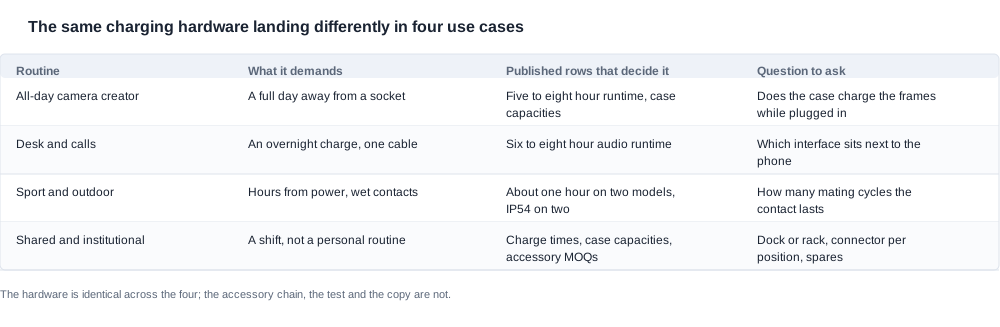
| The use case | What the routine demands | The published rows that decide it | The question to ask |
|---|---|---|---|
| 1. The all-day camera creator | Away from a socket for the whole working day, with the sensor active periodically, which is the dominant load in the camera tier. The published runtime of roughly five to eight hours means the camera is the constraint, and a case only helps if it is carried and charged. The charging question here is really the power-bank question | The camera tier's runtime and the case capacities at 900, 1200 and 1400 mAh | Whether the device can be charged while in use, which is a pass-through behaviour that not every product supports |
| 2. The office and the call | At a desk all day, with intermittent calls. Here the charging approach barely matters — the device sits on the desk and gets charged — and what matters is the interface, because the customer's phone is on the same desk. Type-C means one cable; magnetic means two | The audio tier's runtime of roughly six to eight hours, which covers a working day on the assumption that the device is charged overnight — the assumption the whole product rests on | The interface, and whether a case is wanted for desk storage |
| 3. The sport and outdoor session | Hours away from power, in an environment where the charging contact is exposed to sweat and rain. The published charge time of around an hour on the D17 and the ZH12 matters here more than anywhere else, and the interface matters in a different way: a magnetic contact in a temple is a consumable item in exactly the conditions where it will be used most | The around-one-hour charge on the D17 and the ZH12, and the IP54 catalogue marking on the V06 and the S7 | The contact's life in mating cycles, and the interface's ingress position |
| 4. The shared, institutional or educational product | A classroom, a shop floor, a rental fleet, a hospital ward. A shared product has no personal routine; it has a shift, and the shift is the condition | The published charge times and the case capacities, and the accessory minimum order quantities | The dock or rack arrangement, the connector type per position, and the spare-unit policy. Our retail and education battery and charging page covers this case in more detail |
Two rows in that table carry more weight than the other two, and it is worth saying why. The first is the camera tier's runtime range, because a five-to-eight-hour spread is not a rounding — it is the difference between a device that lasts a working day and one that does not, and it is a difference that no arrangement can close on its own except through a case that is carried and charged. The second is the audio tier's overnight-charge assumption, because it is an assumption rather than a measurement, and every desk deployment inherits it.
A third point cuts across all four routines, and it is the one most often left out of a channel plan. The charge time and the runtime are different rows and they answer different questions. The charge time is how long the device takes to refill, and the runtime is how long it lasts on one refill. A product with a twenty-hour published runtime and a two-hour charge time still needs somewhere to be plugged in every twenty hours, and a product with a five-hour runtime and a one-hour charge time needs a socket five times as often. Confusing the two produces the most common planning error in this category, which is a deployment sized on the runtime and then surprised by the number of charging positions required.
Testing the routine in the environment it will be used hardest
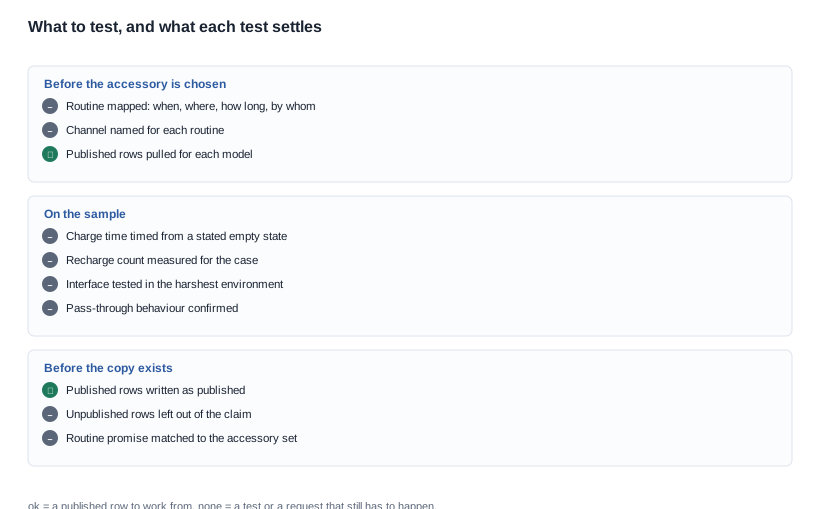
Map the routine before the accessory. When, where, for how long, and by whom. The choosing the right charging approach page sets out the four customer questions, the charging solutions and interfaces page covers the published set, and the AI camera glasses range page lists the models and their rows.
Ask the two rows we do not publish for every model you plan to use in a case: the charging input, and whether the case can charge the frames while it is itself plugged in. Both are absent from the catalogue for every model, and both change what a case is worth.
Measure the recharge count for the case-based channels, and time the charge for the desk-based ones. These are different measurements for the same accessory, and the desk measurement is the one most often skipped because the customer does it alone. A charge time measured at a desk, at the end of a working day, on the charger the customer owns, is the number that decides whether the product gets charged at all.
For the institutional routine, do the rotation arithmetic rather than ordering chargers by habit. Take the runtime you have measured on a sample, subtract the margin you are willing to accept for temperature, age and duty cycle, divide by the length of a shift to get the number of charge cycles each unit needs, and multiply by the units in service. The result is the number of charging positions that have to exist at any moment, and it is the number that appears in the accessory order. It is also the number most often left out, because it is a planning assumption rather than a catalogue row, and nobody at the factory is in a position to make it on your behalf.
Test the interface in the environment it will be used hardest. The contact in a wet temple, the port with debris in it, the dock in a shared rack. Our published rows include the IP54 marking on the V06 and the S7 only, and no ingress marking is published for the rest of the range, so for every other model this is a test rather than a specification.
Decide the listing boundary before the copy exists. The charge times, the interfaces, the case capacities, the cell configurations and the runtimes are published rows. The inputs, the starting points, the indicator behaviours, the case charge times, the pass-through behaviours and the contact lives are not.

Six ways a routine gets designed for the wrong channel
The case was specified for a channel that does not carry it. Symptom: a customer who bought an all-day product finds the reserve battery in a drawer. Root cause: the accessory was chosen for the spec sheet rather than for the routine. Prevention: the routine first.
The desk channel was given a proprietary cable. Symptom: a customer with one cable everywhere has to find another one. Root cause: the interface was chosen for the product rather than for the customer. Prevention: the interface question, answered before the order.
The sport channel was given a contact that is a consumable in exactly those conditions. Symptom: intermittent charging after a season of use. Root cause: the contact's life was never established. Prevention: ask for it in mating cycles, and price the spare.
The institutional channel was given individual charging. Symptom: a rack of units and no way to rotate them. Root cause: a personal routine was assumed in a shared deployment. Prevention: the dock or rack decision, made as a range decision rather than per unit.
The pass-through behaviour was assumed. Symptom: the customer's evening routine does not work because the case cannot charge the frames and charge itself at the same time. Root cause: the row is not published. Prevention: ask, and test it.
The routine was published as the runtime. Symptom: a customer expects a day and gets a charge. Root cause: the charge time and the runtime were treated as one row. Prevention: keep them apart, and publish the routine rather than the number.
The sixth is the one that shows up after launch rather than before it: the channel was assumed to be one channel. A product that goes into a retail listing and a deployment contract in the same quarter has two routines, two accessory chains and two support paths, and the second one is normally the one that was priced in a hurry.
There is a seventh, and it is the most expensive because it is invisible until a customer complains: the accessory was bought to the platform rather than to the routine. A case specified for the platform is a case specified for the loudest model, and in a programme with a five-to-eight-hour camera tier and a seven-hour audio tier the same accessory is right for one and wrong for the other. The preventive step is to write the accessory against the routine rather than against the model list, so that two models on the same platform can carry two different accessory chains. It costs more to carry and it is the only version of the decision that survives the first channel review.
What a per-channel routine is worth, and what goes in the agreement
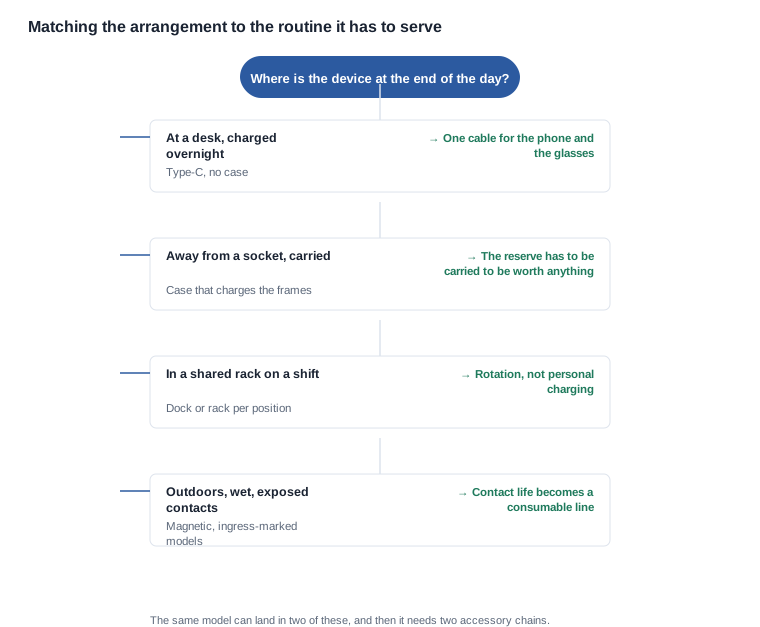
The same product with two routines is two accessory chains, and the second chain is where the cost lives. A channel that runs away from a socket needs a case; a channel that sits at a desk needs a cable; a shared channel needs a rack. Deciding the routine per channel before the order is what keeps the accessory cost proportional to the channel.
The commercial terms worth spending negotiation time on are the ones that follow from the routine rather than from the factory. Unit price and volume tiers, the accessory set and its minimum order quantities per channel, the dock or rack and its connector type, the packaging specification, delivery splitting, payment nodes against inspection, the warranty period with a stated response, the return terms, and the terms of a pilot order. The per-channel accessory minimum order quantity is the line that decides whether a second routine is affordable at all, and it is the line a buyer should check before promising the channel a case. Run the use-cases table as a checklist before the accessory plan is drawn.
The costs that follow the process rather than the volume are the certification and test costs and their lead times, and the character of mould tooling as a non-recurring cost that amortises across the programme. These are not trade-offs in the usual sense, and a quotation that bundles them into a single line with something negotiable is hiding which is which. Ask which of the two a given line is, and if the answer is that they are combined, ask for them separately.
The clauses that make a per-channel routine enforceable are these. The published rows for the configuration ordered, the charging input and the charge-time starting point, the indicator behaviour, the case capacity with its own charge time and its pass-through behaviour, the contact's life in mating cycles, the accessory set with its minimum order quantities, and the warranty period with a stated response. What should be left out of the agreement is as important: any charge-time claim without a starting point, any recharge count that was derived rather than measured, and any routine promise the accessory set cannot keep.
Two clauses are worth adding on the strength of the routine analysis alone. The first is a per-routine accessory schedule, so that the four routines have four explicit accessory lines with their own quantities and their own minimum order quantities, rather than one platform-wide accessory line that every channel draws against. The second is a routine-change clause, so that when a channel's routine is different from the one the accessory chain was priced against, the change is a priced variation rather than a quiet substitution that shows up in the freight.
The reason both clauses earn their place is that the per-channel accessory minimum order quantity is the number that quietly decides whether a second routine is affordable. A case that is technically right but below the minimum order quantity for that channel is not a cheaper solution, it is no solution, and finding that out at the point where the channel asks is expensive.
No charge time without its condition
The working rule we apply: the charging hardware is the least variable part of the proposition and the routine is the most important, and a buyer who designs the routine per channel will get a better product for the same specification. We will not publish a charging input, a charge-time starting point, an indicator behaviour, a case charge time, a pass-through behaviour or a contact life for a model where the manufacturer has not provided one, and we will not present a charge time without its condition.
What we will do is give you the four routines, the published rows that decide each, and the questions to close per channel. The charging solutions and interfaces page covers the published set, the choosing the right charging approach page covers the decision, and the retail and education battery and charging page covers the shared case in detail.
Two practical ways to use that material. If you want to know which model fits a routine before you have a shortlist, the criteria are the published runtime range, the interface and the case status, and we can give you the rows for a given channel in one pass. If you already have a shortlist and the question is what to ask, the acceptance criteria for each routine are already listed above — and a buyer who wants to know how to evaluate the answers should treat any figure that arrives without a condition as an open item rather than a closed one.
What to do next.
- Map the routine per channel: when, where, for how long, by whom.
- Request the two unpublished rows per model, and the case rows per configuration.
- Measure the recharge count for the case channels, and time the charge for the desk channels.
- Test the interface in the environment it will be used hardest.
- Price the accessory chain per channel, and put the conditions in the agreement.
Related reading
- The published set and the interfaces — Charging solutions and interfaces
- The decision framework — Choosing the right charging approach
- The shared and institutional case — Retail and education battery and charging
Tell us the channels, the routines and the volume, and we will tell you which accessory chains the range needs and which rows still need closing.


