

Charging rarely appears on a delivery schedule on its own, and that is the problem. It arrives attached to the cell, to the case, to the connector, to the charger and to the packaging artwork, and each of those arrives with a different lead time, a different minimum and a different set of approval steps. A buyer who asks for "the lead time" gets a number for the electronics and discovers the rest of the arrangement later, usually in the week the artwork is due.
The useful question is not how long the product takes. It is which part of the charging arrangement is on the critical path, and how many configurations of it the programme has committed to. A case-equipped camera line with two published case capacities is a different schedule from the same product with one, and the difference is not visible in any unit price.
Our catalogue does not publish lead times, and the reason is worth stating at the outset: a lead time is set per quotation, against a specific configuration, a specific volume and a specific approval route. What we can do is name the parts that set it, and tell you which of them a buyer controls.

Smart glasses charging: where the schedule sits with a case included
Five items sit on the critical path of a charging arrangement, and they are not equally negotiable.
The cell. It is a bought component with an allocation, and it is the item most likely to be substituted under pressure — which is also the item whose substitution invalidates the transport document and can turn the product's conformity file into something that no longer describes what ships. Cell selection is therefore the decision that has to be closed first, not last.
The case. Where a case is in the bill of materials it brings its own shell tooling, its own cell, its own transport document and its own artwork. The MT6's foldable case adds a hinge, which is a mechanical joint with its own production process and its own tolerance work, and the case for the L1 Pro and the CY03, and the CY05 is a rigid 1400 mAh unit while the L2 Utral is published as 900/1400 mAh, which means one model designation describes two different case configurations.
The charging interface. The contact pads, the magnet assembly and the Type-C receptacle are all tooling items that sit in the product rather than beside it. They are part of the product's own tooling, which means they are on the same schedule as the frame, and a change to the interface is a tooling change rather than a component substitution.
The charger and the cable. If an adapter ships in the box it brings a second approval route, a second set of packaging declarations and its own supply chain. This is the item most often left out of the schedule conversation and most often discovered late.
The packaging artwork. The box has to declare the case capacity, the battery content and the charging arrangements, and if the case capacity is published as two options then the artwork carries two versions. Artwork is usually the last thing approved and usually the thing that triggers a reprint.
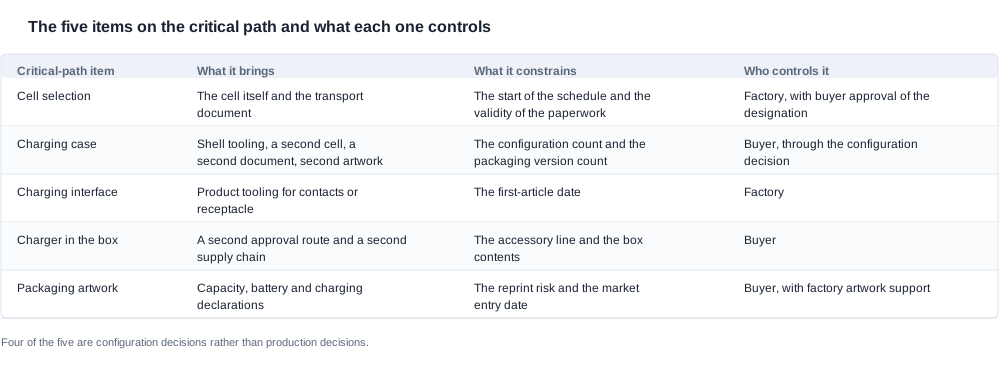
| Critical-path item | What it brings | What it constrains | Who controls it |
|---|---|---|---|
| Cell selection | The cell itself and the transport document | The start of the schedule and the validity of the paperwork | The factory, with buyer approval of the designation |
| Charging case | Shell tooling, a second cell, a second document, second artwork | The configuration count and the packaging version count | Buyer, through the configuration decision |
| Charging interface | Product tooling, magnet or receptacle | The first-article date | Factory |
| Charger in the box | A second approval route and a second supply chain | The accessory line and the box contents | Buyer |
| Packaging artwork | Capacity, battery and charging declarations | The reprint risk and the market entry date | Buyer, with factory artwork support |
The five questions that settle a charging lead-time conversation
These are the questions to ask before a quotation is accepted, because each of them either moves a date or explains why the date cannot move.
-
What is the cell designation, and is it allocated against this programme rather than held in general stock? A cell held in general stock has a date; a cell allocated to a programme has a commitment. The distinction is not visible in a price.
-
How many configurations does the charging arrangement create? Name them. On the L2 Utral the case is published as 900/1400 mAh, so a single model designation is two configurations, and each one carries its own minimum, its own artwork and its own stock.
-
Which approval route does the supplied charger follow, and who owns it? If a charger ships in the box, ask which document covers it, because that document has a lead time of its own and it is not the product's lead time.
-
What is the artwork round count, and how many rounds are included in the quoted schedule? Each round is a week. If the round count is not stated, it is unlimited in practice.
-
What changes the date, and what does not? A supplier that can list the three or four items that move the date is telling you it has modelled the schedule. A supplier that answers "it depends on the quantity" is telling you the date is a function of the order rather than of the parts.
The charging rows that constrict a delivery date
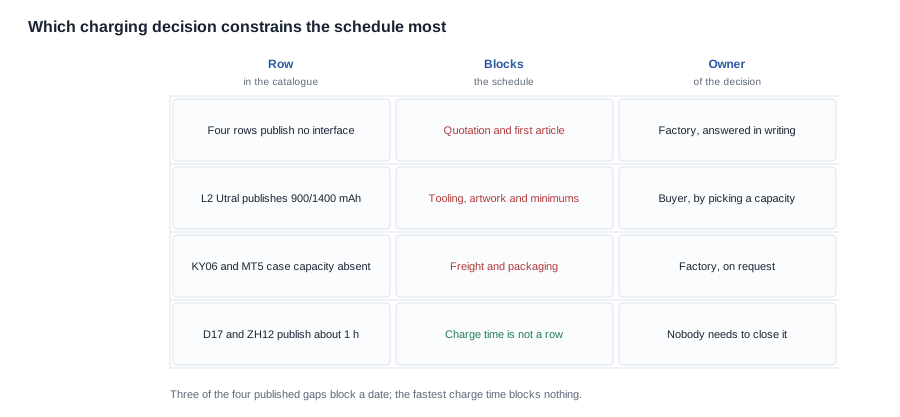
The published catalogue rows have a direct effect on the schedule, and they are not obvious from the specification sheet.
The rows that publish no interface create a quotation dependency. The CY03 and the L1 Pro, and the MT6 and the CY05 publish no charging interface at all. Until that is answered in writing, the factory cannot quote the tooling position for the interface, and the first-article date for those four models is not a date at all — it is a pending answer. This is a row that appears on the spec sheet as a blank and on the schedule as a hole.
The rows that publish two case capacities create a configuration dependency. The L2 Utral's 900/1400 mAh publication means the case tooling, the case artwork and the case minimum are all unresolved until the buyer picks one. A buyer who asks for a price on "the L2 Utral" is asking for two programmes.
The rows that publish a case with no capacity create an evidence dependency. The KY06 and the MT5 are published as magnetic charging with a charging case, and the case capacity is not published for either. That means the freight, the packaging and the battery declaration for those two models cannot be settled from the catalogue, which puts a small but real set of tasks on the pre-production path.
The rows with the shortest published charge time are not the ones that ship first. The D17 and the ZH12 publish ~1 h and everything else publishes ≤2 h. The charge time is a property of the cell and the circuit, not of the delivery schedule, and treating the fastest-charging row as the fastest-delivering row is a category error. Delivery speed is a function of allocation, tooling and documentation, none of which appears in a charge-time figure.
The commercial schedule has its own dependencies. A deposit gates the tooling, and the tooling gates the first article. A sample order is usually the last item in the sequence and very often the first thing a launch date is built on, so a sample order placed late does not merely delay the samples; it moves the date the channel is waiting for. Ask when the deposit falls due, what the sample order contains, and whether the samples come from the production tooling or from a pre-production build. A sample built on a separate fixture can pass an acceptance test that the production unit would not.
The approval route is the sixth item, and it is usually invisible because nobody owns it. A charging arrangement that adds a charger to the box brings a second document with its own turnaround, and a programme that has never run that route before will treat the turnaround as zero. Ask for the route, ask for the turnaround, and ask who inside the supplier initiates it. An approval route that only one person knows about is a route that nobody starts.

How a case capacity decision multiplies configurations
The configuration multiplication is the part of a charging programme that most often surprises a buyer at the first quotation, and it is worth modelling explicitly before the order rather than after it.
Start with one model. Add a charging case and the product becomes two configurations if the case is published with two capacities, and it becomes at least two artwork versions whether or not the case capacity varies, because the box has to carry the case and the battery declaration. Add a charger in the box and the accessory becomes its own line, with its own packaging content and its own document. Add a second colourway and every one of those combinations repeats.
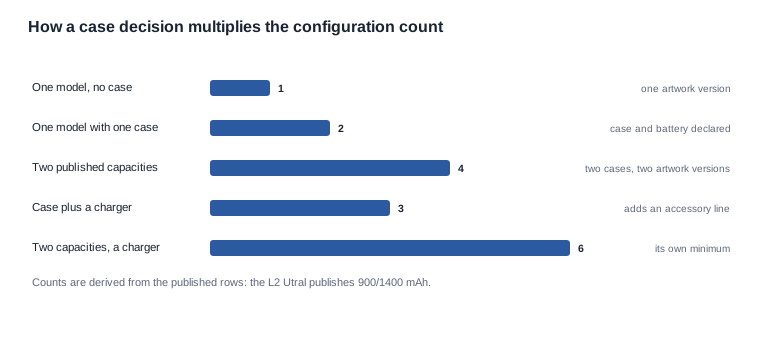
That chart is the commercial form of the arithmetic: one model, one case capacity and no charger is one configuration. The same model with two published case capacities is two configurations and two artwork versions. Adding a charger in the box adds an accessory line. Adding a second case capacity and a charger multiplies both the artwork work and the minimum commitment, because each configuration carries its own minimum and each artwork version has to be produced, stored and eventually discounted.
The practical consequence is that the cheapest configuration is rarely the one with the most options. A buyer who keeps one case capacity and supplies the charger separately, or vice versa, keeps the artwork count down and the minimums low. A buyer who commits to every option pays for the option count in artwork, in stock and in lead time, and receives nothing extra in return unless the channel genuinely needs the choice.
The minimum matters here more than in most categories, because the minimum applies per configuration rather than per model. A programme with two case capacities and two artwork versions can end up with four separate minimum commitments, and quotation arithmetic is usually done on the total rather than on the four. Before accepting a quotation, ask for the minimum broken down by configuration, and ask what happens to the finished stock if one configuration is discontinued. The second answer is what decides whether the extra configuration was worth having.
One more point about repeat orders, because it is the most common way a schedule is broken without anybody deciding to break it. A repeat order that arrives with a different case capacity, a different interface or a different charger is not a repeat order; it is a new configuration with a new minimum, new artwork and a new document set, and it usually arrives with a production schedule that assumes it is the old configuration. A programme that intends to vary the charging arrangement over its life should decide that now, in the agreement, rather than discovering it in the second purchase order.

A worked scenario: a brand adding a case bundle to a spring launch
This is a hypothetical case rather than a client project, and it is written to show the sequence of decisions rather than to report a result.
Assume a brand with an existing camera glasses line in a retail channel, now adding a bundled charging case for a spring launch. The brand has a launch date, an artwork budget for one packaging version, and a compliance file that has to be extended rather than started.
Step one: the configuration decision. The brand establishes the case capacity count before anything else, because it is the decision that multiplies. They choose one capacity for the launch and keep the second as a later price point. That single decision removes an artwork version, removes a tooling question and halves the configuration count.
Step two: the row that has no answer. The candidate models are case-equipped camera rows, and four of them publish no charging interface. The brand asks for the interface in writing for each, before the quotation is accepted, and the answer arrives with the quotation rather than after it. Until it arrives, the brand's first-article date for those models is not a commitment.
Step three: the charger decision. The brand asks whether an adapter ships in the box. The answer is that a cable ships and an adapter does not, which means the accessory line is simple, but the brand writes it into the order anyway, because a cable that is assumed rather than specified is a cable that is sometimes missing.
Step four: the cell. They ask which cell is allocated to the programme and confirm the designation against the transport summary. The cell is the item with the earliest dependency, so they close it first even though it is not the item anybody talks about in a launch meeting.
Step five: the artwork. The box carries the case capacity, the battery declaration and the charging arrangement, and the brand approves a single artwork version. They also fix the artwork round count in the quotation, because a round count that is not stated is a round count that is unlimited.
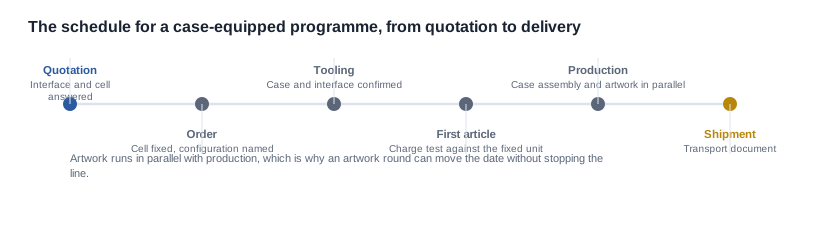
Step six: the schedule. They build the schedule from the dependency chain rather than from the factory's headline date: cell first, then interface tooling, then first article, then case assembly and artwork in parallel, then the transport document for the case cell, then shipment. The date the brand commits to the channel is derived from that chain, and the supplier is asked to confirm each link.
The result is a launch with one configuration, one artwork version and a schedule with no unowned dependency in it. None of that was visible in a unit price, and the case-capacity decision made at the start saved more time than any negotiation afterwards.

What we publish about charging lead time, and what a buyer must ask for
On charging and schedule, that we do not publish lead times, and we would rather explain why than print a figure that would be wrong for most of the quotations it was applied to. A lead time in this category depends on the cell allocation, the tooling position, the configuration count, the approval route and the volume, and a catalogue number covering all of those would be a number that fits none of them. Lead time is given per quotation, against a named configuration.
What we can publish is the structure of the constraint, and that is what the table and the chart above set out: which items are on the critical path, which decisions multiply configurations, and which catalogue rows create a dependency that has to be closed before a date can be committed. We publish the charging interface for 24 of the 28 rows and leave four blank; we publish the case capacity on five rows and two case rows without it; we publish no tooling cost, no NRE, no minimum and no price tier, because none of those appear in our published material.
What can be negotiated. The configuration count, the per-configuration minimum, the artwork round count, the accessory list, the packaging version count and the payment and delivery schedule structure. A buyer who reduces the configuration count before the quotation is accepted negotiates more effectively than one who negotiates the unit price after it.
What cannot be negotiated. The certification cost and the certification lead time, which are fixed per product family, and the physical lead time of a bought cell, which is a function of an allocation rather than of a negotiation. The customisation route is worth understanding early, because a charging arrangement that changes the case, the interface or the packaging is a customisation request rather than a catalogue order, and the two are scheduled on different clocks.
What a buyer should ask for in the quotation is a short list, and it is the same list whichever factory answers it: the configuration names with the minimum for each, the cell designation with the allocation basis, the artwork round count and the artwork content, the accessory list, the date each link in the chain is expected to close, and the list of things that would move the date. A supplier that answers all six has modelled the programme. A supplier that answers with a single headline date has given you the number you would have got from a price list, and it will not hold when the programme changes.
The terms to put in the schedule. Write the cell designation and the allocation basis into the order. Write the configuration count, with each configuration named. Write the artwork round count and the artwork content. Write the accessory list. Write the shipping state of charge, because a programme that holds goods at full charge is holding an argument with the carrier. And write the change-notification obligation on the cell, the case, the connector and the firmware, with a re-issue obligation on the documentation package, because a silent change is the fastest way to turn a committed date into an uncommitted one.
The next step. Send us the models, the quantities, the target market, the case requirement and the launch date you are working back from, and we will tell you which charging arrangements exist for that requirement, how many configurations the case decision creates, and which of the schedule dependencies you are most likely to be waiting on. The arrangements themselves are described under charging solutions, the customisation route under OEM and ODM customisation, the battery questions under battery life, and the regulatory sequence under how regulations affect battery life.


