

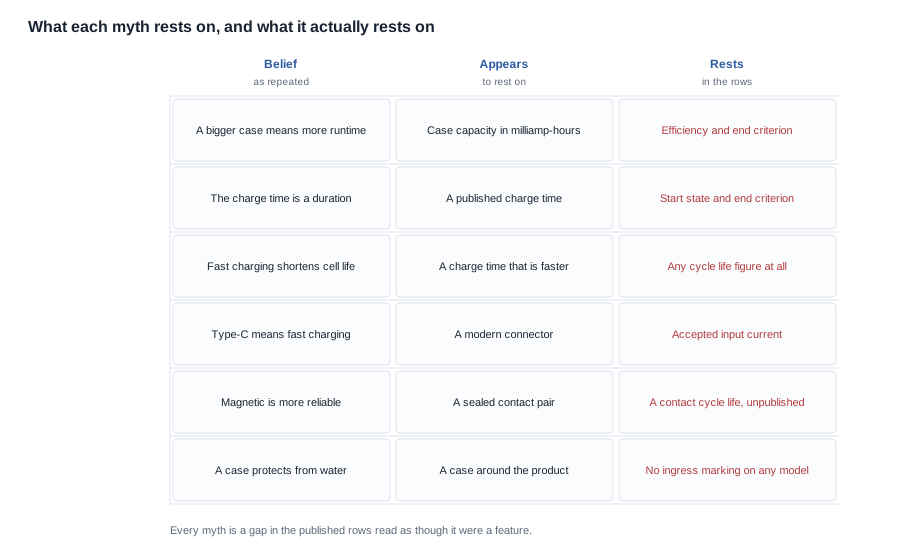
Six charging beliefs recur in this category with enough regularity to be worth naming, and they are not all wrong. Some are false. Some are true statements used for a purpose they cannot support. Two of them are unanswerable from the published material, which is a third category that buyers rarely allow for, and it is the one that costs the most.
What unites all six is that each of them rests on a missing condition. A charge time without a starting state. A case capacity without a conversion efficiency. An interface without a contact cycle life. A protection rating without the model it applies to. In every case the belief survives because nobody has been made to state what is missing, and it costs money at the point where it is finally contradicted — in a return, in a review, or in a warranty claim.
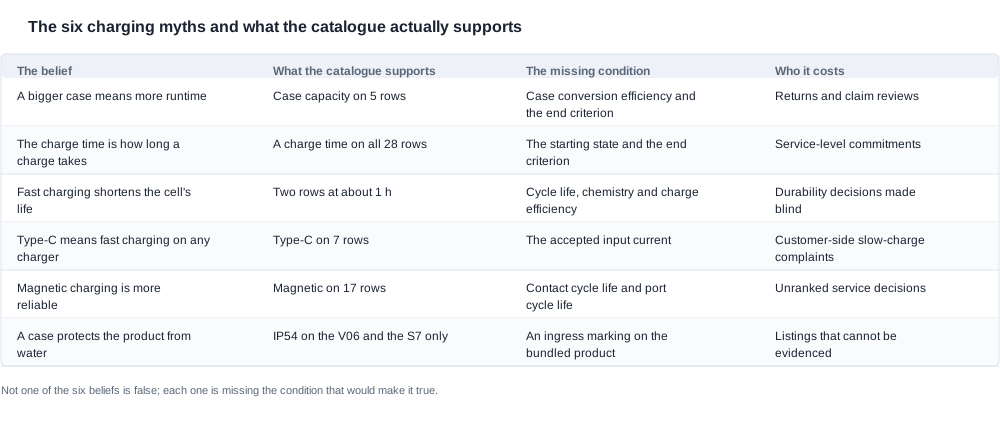
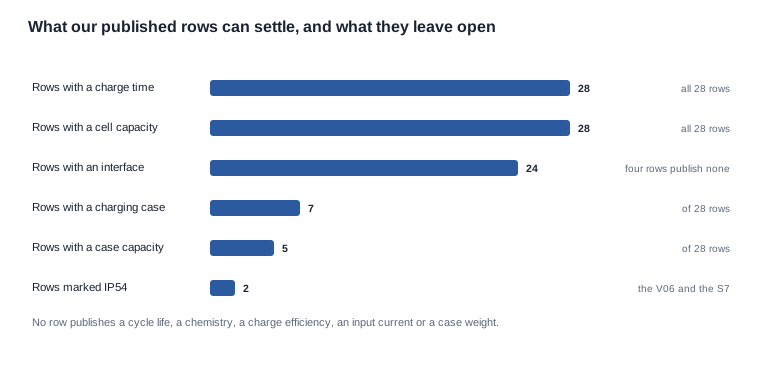
Our catalogue publishes a charge time for all 28 model rows and publishes the starting state and the end criterion for none of them. It publishes a charging interface on 24 rows and a contact cycle life on none. It publishes case capacities on five rows and conversion efficiencies on none. Every myth below is a shadow cast by one of those gaps.
Smart glasses charging: six myths that survive an unpriced condition
Myth one: a bigger charging case means more runtime. It is the most common belief in the category and it is false. Our case capacities are 1400 mAh on the L1 Pro and the CY05, and the CY03, 900/1400 mAh on the L2 Utral, 1200 mAh on the MT6's foldable case, and unpublished on the KY06 and the MT5 which are published as having a case at all. A case carries spare energy, and the hours it produces depend on the conversion efficiency of the case and on the end criterion the product applies — and neither of those is published for any model. What a case extends is the interval between charges for someone away from a socket. It does not extend the working day.
Myth two: the published charge time tells you how long a charge takes. It tells you an upper bound under conditions nobody has stated. Twenty-six rows publish ≤2 h and the D17 and the ZH12 publish ~1 h, with no starting state and no end criterion on any of them. A buyer who turns that into a service-level commitment is committing to a number generated under conditions unknown to both parties.
Myth three: fast charging shortens the cell's life. This is the myth that sounds the most technically plausible and the one our published material can say least about. We publish no cycle life for any cell or any case, no chemistry and no charge efficiency, and the same is true of the two rows that publish ~1 h. Nothing in a charge-time figure establishes a durability relationship, in either direction. The honest position is that the question cannot be settled from published rows, which is a different answer from "no" and a much more useful one, because it tells a buyer that the decision needs a measurement rather than a belief.
Myth four: Type-C means it will charge quickly on any charger. Type-C describes the connector geometry and nothing else. Seven of our rows publish Type-C — the V03 Pro, the L2 Utral, the D11, the D12, the D17, the ZH12 and the bone conduction model — and we publish no input current for any of them. A port that accepts a defined connector but has no stated current accepts whatever is offered, which is precisely how a two-hour charge becomes an overnight charge in a customer's hand.
Myth five: magnetic charging is more reliable than Type-C. There is no published basis for ranking them. We publish a contact cycle life for no model and a port cycle life for no model, so the reliability comparison has no data behind it in either direction. What can be said is structural: a magnetic interface degrades through surface condition and alignment, and a Type-C interface fails through the cable or the port. Which of those a channel can absorb depends on its service model, not on a ranking that does not exist.
Myth six: a charging case protects the product from water and impact. It protects it from impact, to the extent that a case is a shell, and it does nothing at all for water ingress. The sharper version of this myth is worth stating because it is checkable: the only two rows in our catalogue carrying an IP54 marking are the V06 and the S7, and neither of them publishes a charging case. No charging case in the range is published on a model with an ingress rating.
A bigger case does not buy more hours
The arithmetic that produces this myth is correct up to the point where it stops. The L1 Pro, the CY03 and the CY05 carry a 1400 mAh case against a 290 mAh product cell, so the case holds several times the product's charge, and the natural inference is that the customer gets several times the running time. Three things break the inference, and all three are unpublished rather than unfavourable.
The first is conversion. Moving charge out of the case and into the product passes through a circuit, and the loss depends on the current and on the behaviour of both cells at that current. The second is the end criterion: a charge is finished when the product says it is finished, and how much charge is actually present at that moment depends on the threshold the product applies. The third is that a case cycle is not a working day at all. The customer has to be present, with the case, and the customer's day is not made longer by the existence of the device.
The commercial consequence is a wording rule rather than a technical one. A case capacity may be published, a case may be described as carried spare energy, and a channel may build a good/better structure out of the L2 Utral's 900/1400 mAh publication. What cannot be published is the conversion from a case capacity into hours, because the two unpublished figures in the middle of that conversion are exactly the ones that make it untrue.
Fast charging is a condition, not a product grade
The second myth deserves the same treatment from the other direction, because it is often used to avoid the first. Two rows publish ~1 h, and the belief forms that these are "fast-charge models" and therefore a different grade of product.
The claim cannot survive contact with the published rows, because a grade is a property of the product and a charge time is a property of a measurement. Without a starting state, ~1 h might describe a charge from empty or a charge from a fifth of capacity, and those two readings differ by enough to change whether a unit is ready for a shift. Nothing else in the catalogue distinguishes the D17 and the ZH12 from the rest of the range on charging grounds: both are Type-C, both publish their cell capacity and their runtime, and neither publishes an input current.
What the two rows do support is a genuine commercial observation: the range contains two charging figures that differ from the other twenty-six, on two Type-C sport models. A buyer can use that as a reason to measure those two models first, on the assumption that a faster published figure usually means a more capable charge circuit. It is a reason to investigate. It is not a grade, and it cannot go on a product page as one.

How a charging myth reaches the customer before the data does
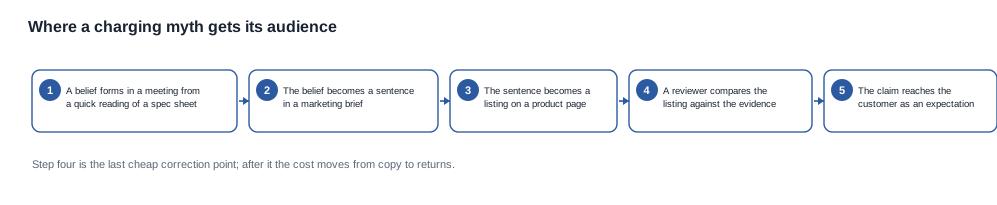
The mechanism by which a myth survives is worth understanding, because it is almost never a deliberate choice by anybody. It runs in four steps, and the intervention points are different at each step.
-
A belief forms in a meeting, usually somebody who has read a specification sheet quickly and drawn a conclusion the specification did not support.
-
The belief becomes a sentence in a marketing brief, where it survives because a brief is a summary and summaries drop conditions.
-
The sentence becomes a listing on a product page, where it is reviewed by whoever reviews listings and where the reviewer is checking the claim against the evidence rather than against the brief.
-
The claim becomes a customer expectation, which is the point at which the belief stops being an internal problem and becomes a return rate.
The expensive step is the third one, because the listing review is the last point at which the claim can be corrected cheaply. After that, the myth is in the hands of customers, and correcting it means a copy change, a support script, a complaint-handling policy and possibly a product recall of the description. The intervention that matters is therefore to make sure that the sentence in the brief has its condition attached before it reaches the listing, which costs one sentence at the brief stage and a great deal at the listing stage.
Running the audit once is cheaper than running it on every revision. The procedure has four steps: pull every charging sentence out of the marketing material, the packaging insert and the listing template; mark each one against the published rows; classify it as supported, unsupported or unanswerable; and mark whether it is a sentence the channel actually intends to publish. The last step is the one that saves the work, because a sentence nobody is going to publish does not need a correction, a qualifier or a decision. On a typical camera glasses page with a bundled case, six sentences survive the first step and two survive the fourth, and the four that fall away are the four that carry the risk.
There is a second path, and it is the one most buyers forget to look for. The myth enters through a comparison table rather than through a brief: a buyer sorts by capacity, concludes that the 290 mAh camera rows are superior to the 40 mAh children's rows, and the conclusion travels into a shortlist, a price negotiation and a launch decision. Nothing was published that said the conclusion, and nothing will ever be published that contradicts it, because the conclusion came from the comparison rather than from the claim.

The commercial value of a myth-free charging position
Removing a myth is cheap; the reason myths persist is that nobody is measured on removing them. The commercial value comes from three places, in descending order of size.
The first is the returns rate and the support cost, which is the largest and the slowest to appear. A channel whose listing promises hours the case cannot deliver gets returns described as "not as advertised", which is a category that is expensive to handle and difficult to defend. A channel whose listing describes the case as carried spare energy gets a complaint about endurance only if the customer expected endurance, which the copy has already addressed.
The second is the claim-review risk, which is the fastest to appear and the easiest to measure. A listing claim that cannot be evidenced is removed by a platform or a retailer reviewer, and the removal is public and immediate. Removing the condition from the sentence is cheaper than removing the listing.
The third is the negotiating position. A buyer who can state precisely which claims are supported by published rows and which are not is negotiating from a position that a buyer with a copied claim sheet is not, because the first can tell a supplier that the charge time needs conditions and the second can only repeat the number. This shows up as a better answer to the question of what the buyer will publish, which is a question that decides the relationship more often than the unit price does.
The practical output of a myth-free position is not a shorter product page. It is a set of sentences that can be defended, each carrying the condition that makes it true, and a purchase order that can refuse a lot against them. That is a modest artefact and it is also the one thing in this category that a competitor cannot copy, because it is built from measurements the buyer took.
A worked scenario: a channel that removed six sentences from its listings
This is a worked case rather than a customer case. What it shows is the order.
Assume a distributor with a camera glasses line and a bundled charging case, running a retailer that reviews claims before listing. Two complaints have been running for a year: endurance complaints on the case bundle, and "charges very slowly" complaints that the support team has been answering with a replacement unit.
Step one: find the sentences. They pull six claims out of the product pages and the packaging insert. "Up to five times the battery" is the case claim. "Charges in under two hours" is the charge claim. "Fast, safe Type-C charging" is on the insert. "Magnetic charging for a secure connection" is in the spec block. "Water-resistant" is on the box. "Long-lasting battery" is in the insert. Six sentences, one page.
Step two: test each against the rows. The endurance claim cannot be evidenced, because the case conversion and the end criterion are unpublished. The charge claim is published on every model but with no conditions. "Fast, safe Type-C" contains two unmeasurable words and a connector type. "Magnetic charging for a secure connection" is true and says nothing measurable. "Water-resistant" is not published for any case-equipped model, and the only two rows with an IP54 marking publish no case. "Long-lasting battery" is a runtime claim with no workload attached.
Step three: rewrite rather than delete. The endurance claim becomes carried spare energy, with the case capacity in milliamp-hours and the charge time with its starting state, supply and end point attached. "Fast, safe Type-C" becomes the connector type, the charge time with conditions, and the shipping state of charge. The ingress claim is removed from the case bundle entirely. The runtime claim gains its workload. Two sentences survive; four go.
Step four: fix the support side. The slow-charge complaints are traced to contact condition on the magnetic models, and the support script is changed from "replace the unit" to "clean the contacts and retest", with the consumable added to the packaging insert and to the depot's stock list. The replacement rate falls.
Step five: use the position. At the next quotation the distributor states the acceptance criteria it has already written — a charge time with conditions, a case capacity in milliamp-hours, an accessory list — and the supplier's programme is evaluated against them. The negotiation is no longer about price alone, because there is now a document that says what a good unit is.
None of the six sentences had been false. That was never the problem. The problem was that each one was missing the condition that made it true, and the missing conditions were free to add when the page was written and expensive to add later.
The terms that keep a myth out of the next product revision
We publish the rows we hold, and we will not repeat a claim our rows do not support. We publish the charge time exactly as the catalogue states it — 26 rows at ≤2 h, the D17 and the ZH12 at ~1 h — the cell capacity, the rated runtime, the interface where the catalogue states it and the case capacity where it exists, and one weight in the whole catalogue, the MT6 glasses unit at 158 g including the battery and the camera and excluding the foldable case.
We publish no cycle life, no chemistry, no charge efficiency, no input current, no contact cycle life, no safe charging temperature range and no case weight, and we will not fill those rows with typical values. We also make no vision, health or eye-protection claim for any product in any market.
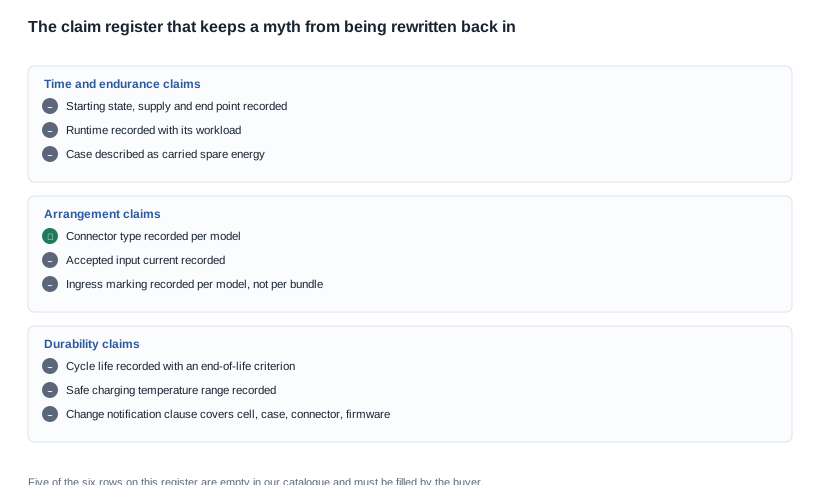
The terms that keep the myth out. Write the starting state, the input source and the end criterion into the acceptance criteria wherever a charge time is claimed. Write the case capacity in milliamp-hours on the order line, so that a page cannot promise hours the case has not been shown to deliver. Write the ingress marking per model, because an ingress claim on a bundled product is a claim about a bundle that no single row in the range supports. Write the safe charging temperature range into the agreement if the supplier will state it, and take the protection language out of the copy if they will not. Write the runtime workload into the claim register alongside the figure. And put a change-notification obligation on the cell, the case, the connector and the firmware, because a myth usually returns the same way it arrived: quietly, through a new revision. The register is reviewed at the same gate as the artwork, because a claim that appears in a new packaging version without a matching register entry is a myth that has been reintroduced by a supplier who was never told it was wrong.
The next step. Send us the models, the quantities, the target market and whether a case is in the box, and we will tell you which charging arrangements exist for that requirement, which claims our published rows settle outright, and which ones you have to measure on your own units before they go anywhere near a listing. The arrangements are described under charging solutions, the measurement procedure under how to measure charging, the comparison method under how to compare charging options, and the surrounding battery facts under battery life.


