
Smart glasses charging: the multiplication sign that breaks the comparison
Smart glasses charging smart glasses how to compare is a question where one row in the catalogue causes most of the errors, and the row is the cell capacity. The published notation for a dual-cell model reads as a multiplication, and a buyer who reads it as a single figure will draw conclusions about both endurance and charge time that the product does not support.
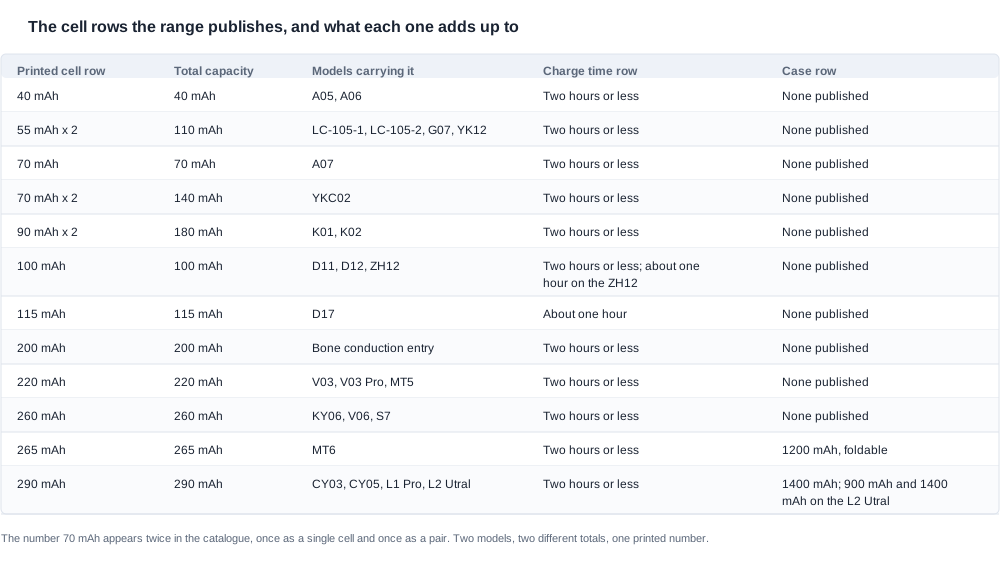
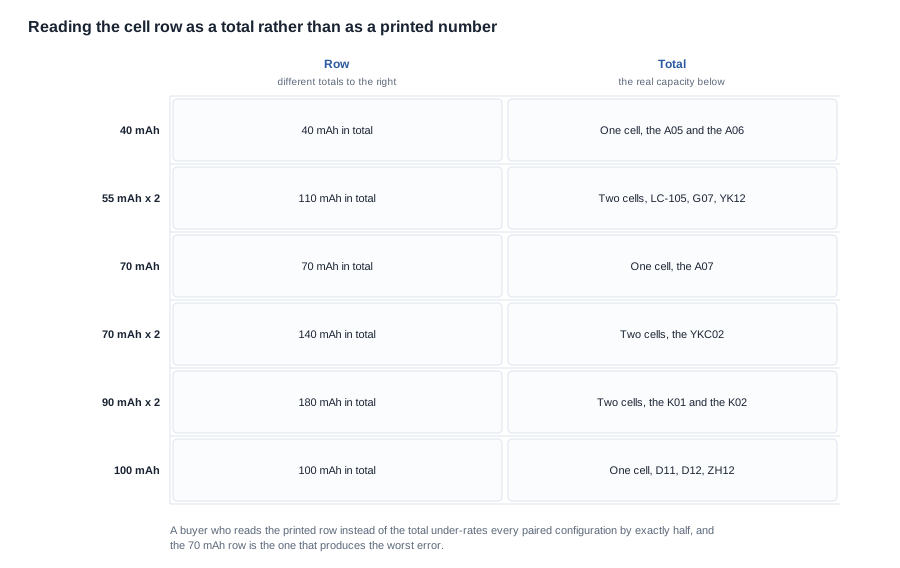
The short answer: total the cells before you compare anything, and treat the charge time as a property of the cell row rather than as a separate figure. A 90 mAh × 2 configuration holds 180 mAh across two cells, not 90 mAh. The trap is sharper than it looks, because the catalogue prints 70 mAh twice — once as a single cell on the A07 and once as a pair on the YKC02 — so two models in the range carry the same printed number and hold different amounts of energy. The range publishes cell configurations of 40 mAh, 55 mAh × 2, 70 mAh × 2, 90 mAh × 2, 100 mAh, 115 mAh, 200 mAh, 220 mAh, 260 mAh, 265 mAh and 290 mAh. Charge times are two hours or less across the range with two exceptions, the D17 and the ZH12 at roughly one hour. The charging interface is magnetic on most models and Type-C on the D11 and the L2 Utral, the D17 and the D12, and the V03 Pro and the ZH12. Cases are published at 900, 1200 and 1400 mAh.
This page is written for the buyer who has to make that comparison. It sets out the row that decides, the rows that are printed next to it, the test that closes the question, and the commercial terms that move.
Who is doing this comparison and what a wrong read costs
A brand-side product manager is usually choosing between two platforms for a new line and has one printed row that looks comparable. A channel buyer is writing a listing and needs to know whether "all day" can be supported by the published figure. A procurement manager is comparing a supplier's quotation against an incumbent and has noticed that the two configurations print the same cell number and will not accept that as a difference until it is explained.
What each of them is afraid of is specific. The first is a product that reaches the end of a working day flat, which arrives as a return with a vague description. The second is a listing sentence that says "twenty hours" next to a cell row that says 40 mAh, and a customer who reads both and concludes the product is broken. The third is a programme that has ordered against a doubled capacity that turns out to be a single cell, because the freight, the packaging and the certification file were all sized against the wrong number.
All three are cheap to prevent at the RFQ stage. The last one is the expensive one, because cell configuration drives the transport documentation, and the transport documentation is on the critical path for any shipment of a lithium cell.

What a charging configuration actually costs, and where the money hides
Charging is not a feature row. It is a cell, a protection circuit, a charging path, a connector, a cable or dock, a case in some configurations, and a set of files that travel with the goods. Two products with the same printed cell number can carry completely different charging designs, and the price difference between them is usually not in the cell.
The cell is a commodity with a qualification attached. A cell that has passed the transport testing required for your shipment route is worth more than an identical cell that has not, and the testing is per cell type, not per product. When two quotations differ on unit price and one of them includes the transport paperwork, the cheaper quotation is not cheaper — it is a different scope, and the difference will surface at the shipping stage rather than at the invoice.
The charging path is a design decision, not a line item. The interface decides the cable that goes in the box, the counter space it occupies, whether a customer can share one cable across a range, and whether the buyer needs to specify a regional adapter. It also decides what the packaging looks like, which is a cost most buyers discover late because it belongs to the artwork rather than to the electronics.
The case is a second battery with its own schedule. Where a case is published, it adds a second cell to the transport file, a second charge cycle for the user to think about, and a second object that can fail. Where a case is not published, the buyer is left planning a day's charging with a number that does not exist yet.
The software and the accessory set are where the hidden cost sits. A charging app, a firmware routine, a charging case, a replacement cable, a USB-C or Type-C cable in the box rather than a bare device: none of these is a large number on a quotation, and together they decide what a customer receives and what a customer complains about.
The negotiating room is therefore not in the unit price alone. It is in the number of configurations you commit to, the case configuration, the pack contents, the artwork round count, the per-market accessory set, and the transport scope. A channel served only from markets where approvals already exist is worth a materially better programme than one that requires new testing, and that is a decision to make before the quotation rather than after it.
The five rows, their thresholds, and what a soft answer sounds like
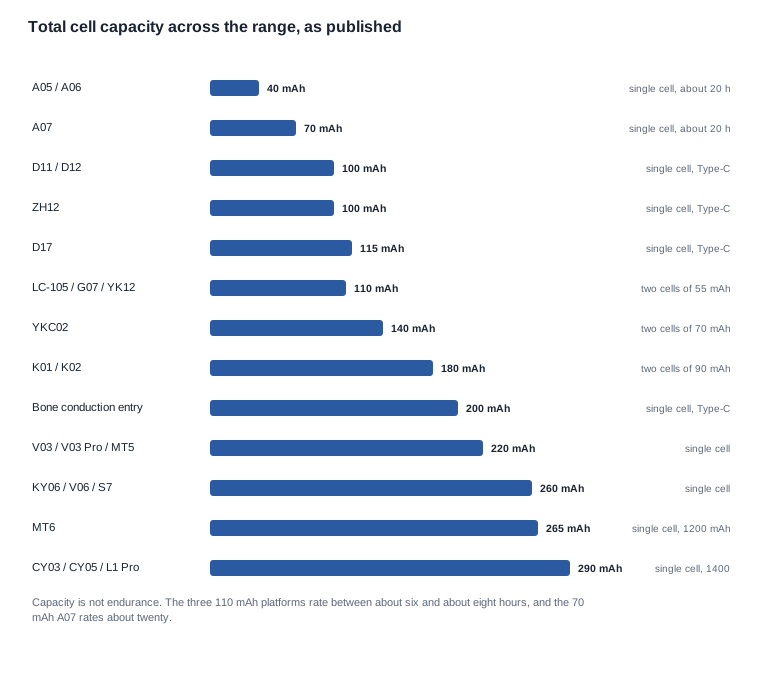
1. The cell row, read correctly. A 90 mAh × 2 configuration holds 180 mAh across two cells, not 90 mAh. The K01 and the K02 publish 90 mAh × 2, the LC-105 pair and the G07 and the YK12 publish 55 mAh × 2, the YKC02 publishes 70 mAh × 2, and the A05 and the A06 publish 40 mAh as a single cell. The A07 publishes 70 mAh as a single cell as well, and this is the pair that catches people: the same printed number, twice the energy on the YKC02. Reading the × 2 rows as a single cell is the error that makes a light product look like the heavy one, and it is the error that gets a programme ordered against the wrong freight and the wrong paperwork.
2. The charge time row, against the cell row. Two hours or less against 115 mAh on the D17 and 100 mAh on the ZH12 is a different charge profile from two hours or less against 290 mAh on the CY05 and the CY03, and the L1 Pro or the L2 Utral. Neither published figure states a test condition, so the ratio between them is indicative rather than measured. The pass line for a supplier is a figure with the state it was taken in, because a charge time measured from a depleted cell and one measured from a partially charged one are not the same number.
3. The interface row, which is a compatibility fact and a packing fact. Magnetic and Type-C are published per model, and the interface determines the cable that goes in the box, the counter space it occupies and whether a customer can share one cable across a range. The charging options piece works through the audio tier and the case options through the camera tier. A supplier who answers "magnetic or Type-C" without naming the model has answered a different question from the one you asked.
4. The case row, which is a second battery and a second schedule. The MT6's 1200 mAh case is foldable, the CY03 and the L1 Pro, and the CY05 carry 1400 mAh cases, and the L2 Utral is published with both 900 and 1400 mAh. The KY06 and the MT5 are published as magnetic charging with a charging case, and the case capacity for those two is not published. The case's own charge time and input are not published for any model, which is exactly the number a buyer needs to plan a day's charging.
5. The runtime row, read against the capture load. The published figures run from roughly 20 hours on the A05, the A06 and the A07 to roughly 6 hours on the G07 and the YK12, with 5 to 8 hours on the camera tier, about 7 to 8 hours on the audio tier, and roughly 8 hours on the LC-105 pair, the K01 and the K02. The sport tier is a separate set of rows, and the three sport models publish their own band: the YKC02 at roughly eight hours, the ZH12 at roughly eight hours and the D17 at roughly seven. Every one of them carries no test condition, so a comparison between two models is a comparison of two mixed-use figures.
The warning that applies to all five rows: these numbers are not directly comparable across models. Two platforms with the same printed cell number can have different charge paths, different case options and different loads, and the runtime figure in particular describes a duty cycle that is not published. Before building a comparison table, write down which column is a published row, which is a supplier statement and which is your own measurement, and never mix the three in one row without a note.

Running the comparison: the totals, the protocol, and the sample that closes it
The verification path for this category is arithmetic first and testing second. Most of the questions here can be closed with a calculator and a written answer from the supplier; only the last one needs a sample.
Step one: build a totals column before you build a comparison. For every candidate, write the cell count and the per-cell capacity separately, and then write the total. A 90 mAh × 2 is 180 mAh. A 55 mAh × 2 is 110 mAh. A 70 mAh × 2 is 140 mAh. Do the same for the case, and keep the case on a separate line, because a case total added to a product total is a number that describes two objects rather than one.
Step two: pair the charge time with the capacity it belongs to. Treat the pair as the unit of comparison rather than the charge time alone, and ask the supplier for the state the figure was taken in. A fast charge on a small cell and a slow charge on a large cell are two different products to plan around, and the turn-around time a warehouse cares about is a function of both.
Step three: record the interface, and check it against the pack contents. The interface changes the box, the travel story and the return economics, because a customer who did not receive a cable writes a review about a product that was never faulty.
Step four: record the case, and mark the case's own charging as unpublished unless the supplier gives it. Do not assume the case follows the product. A case that charges over the same interface in the same time is a design decision, and a supplier who will not state it is telling you the case is a different charge profile.
Step five: check the runtime against the load you intend. A continuous capture is a different load from the mixed use the published figure describes, and a buyer who plans a field-service day on a mixed-use figure will be planning on the wrong number. The battery comparison piece covers the audio tier and the battery life discussion the children's tier.
Step six: confirm the transport position. A lithium cell in a shipment is its own compliance question, and a two-cell configuration is a two-cell question. The transport compliance checklist covers it, and whether a cell can be swapped is a separate question entirely.
Step seven: run one charge-and-runtime test on a sample of each finalist, on a fixed protocol. Record the starting state, the ambient temperature, the time to the charge-complete indication, and the runtime to the point where the product becomes unusable for the load you care about. One unit per model, one run, and the numbers written down. This is the only step in the whole comparison that produces a result rather than a description, and it is the step most often skipped because the printed rows appear to settle it.

Where a charging comparison produces a false winner
The lightest-looking configuration is not the longest-running one, because the × 2 notation is doing work the eye skips. The K01 and the K02 print 90 mAh and hold 180 mAh.
The same printed number on two models is not the same product. The A07 prints 70 mAh and holds 70 mAh; the YKC02 prints 70 mAh and holds 140 mAh. This is the row that catches out buyers who have already learned the multiplication rule and assume they have seen everything.
The fastest charge is on the two models with the smaller cells, which is the opposite of the intuition that a fast charger serves a big battery. The D17 charges in about an hour on 115 mAh and the ZH12 in about an hour on 100 mAh, while the 290 mAh camera models are published at two hours or less.
A model with a case is not a model with a long runtime, and treating a case as a runtime figure is how a customer's day ends with a dead product at four in the afternoon. The MT6's 1200 mAh case is a second object with its own charge cycle.
The biggest cell is not the longest runtime. The A07 holds 70 mAh and rates roughly 20 hours; the G07 and the YK12 hold 110 mAh and rate roughly 6 hours. Capacity and endurance are different questions, and the catalogue publishes one number for capacity and a different one for runtime, neither with a stated condition.
The audio tier and the camera tier are not comparable on runtime at all, because the load is different. A camera platform that rates about 7 hours is doing something more demanding than an audio platform rating about 8 hours, and comparing them as endurance figures is comparing two different activities.
A charging comparison made on a sample with a different cell configuration is not a comparison. A unit with a different cell in it, or with a different firmware charging routine, is a different product for this purpose. Check the model designation on the unit against the designation on the paperwork before you measure anything.
The commercial shape of a charging programme, and where our catalogue stops
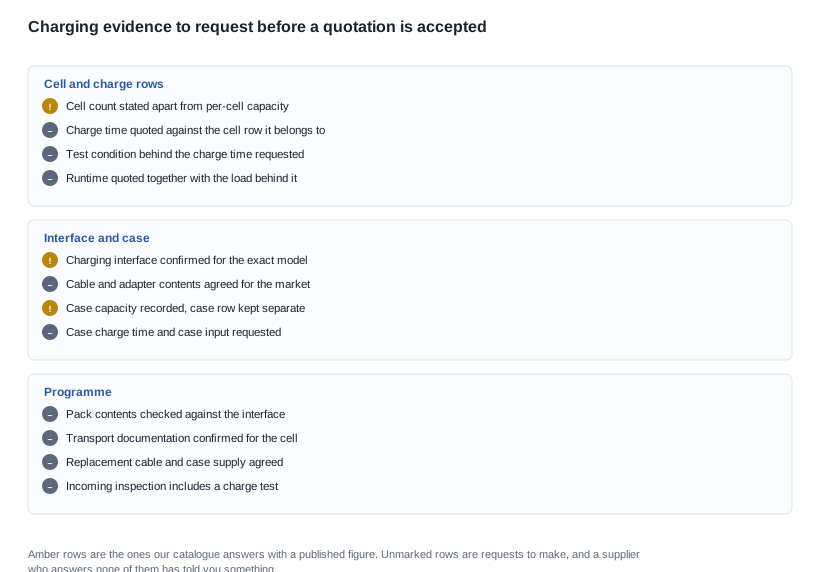
A charging programme is negotiated around the case line more often than around the product line, because the case carries its own minimum order quantity and it is frequently the number that constrains. The terms worth negotiating time on:
- Minimum order quantity, particularly on the charging case as a separate accessory line, because the case MOQ and the product MOQ are frequently different numbers and the case is often the one that constrains.
- The pack contents, specifically whether a cable and a power adapter are included, which is a per-market decision with an artwork consequence.
- The packaging specification and the artwork round count.
- Delivery splitting against a sample-approval milestone, which is granted more easily than a price concession because it moves the risk onto the schedule where it belongs.
- Payment nodes and holdback: a deposit with the order, a balance after the goods pass inspection, and a retention released against the documentation.
- The warranty period with a stated response, and the replacement-cable policy, which in this category is a return-rate decision rather than a service decision.
Two costs in a charging programme are quoted rather than negotiated, and the second one has a knock-on effect that is easy to miss. Certification cost and certification lead time follow the process and the testing body rather than your order size, and for a lithium cell they are a per-cell-type cost. Tooling is often amortised across the first order, so the useful questions are over what volume it is amortised and what happens to the tooling if the programme is discontinued. Below both sits the cell and the charging path themselves, because a supplier who will not change the cell type or the charging circuit is telling you the charge profile is fixed — and a cell change also moves the transport file.
The file to request before the deposit is: the cell configuration written as cell count and per-cell capacity, with the total stated; the charge time with the state it was measured in; the interface, per model; the case configuration and capacity, or a written statement that no case is supplied; the transport documentation covering the exact cell type in the exact configuration; the certificate numbers for the rest of the conformity file, with the issuing body and validity dates; and the model designation written on the quotation.
The clauses that keep a charging programme honest are: the cell configuration and the interface as line items; a notice obligation before any change of cell type, cell count, charging circuit, interface or firmware charging routine, because each of those changes the published rows without changing the product name; the charge time and runtime figures as the supplier's own published rows, so a later change is a breach rather than an ambiguity; the acceptance criteria from the sample protocol; and a clause on who bears the cost when a lot fails the acceptance criteria.
Two platforms, three markets, and the rows that decided it
This is a worked case rather than a live order. That order is the point of it. Assume a brand-side buyer launching an outdoor audio line for three markets, with one retail partner who insists on Type-C, one channel that expects a full working day of intermittent use, and a shipping profile that makes a two-cell configuration more paperwork than a single-cell one.
Step one: the totals. The three candidates are a 90 mAh × 2 platform (180 mAh in total, magnetic, roughly 8 hours rated), a 100 mAh single-cell platform (100 mAh, Type-C, roughly 7 hours rated) and a 115 mAh single-cell sport platform (115 mAh, Type-C, about an hour to charge, roughly 7 hours rated). Read as printed, the buyer ranks the 115 mAh model first, the 100 mAh second and the 90 mAh last. Read as totals, the ranking inverts on paper, because the 90 mAh row is the biggest number in the set. The printed row is a trap and the totals are the truth, and the truth still does not decide the programme.
Step two: the load. The published runtimes are roughly 8, 7 and 7 hours, and the buyer needs a working day of intermittent use rather than a continuous one. The 90 mAh platform carries the most energy, and the two Type-C platforms charge faster. The 115 mAh model turns around in about an hour, which matters for a warehouse and for a retail partner's replenishment, and its published runtime matches the 100 mAh model with 15 mAh less capacity, which tells the buyer the two are built for comparable loads.
Step three: the transport and the interface. The single-cell configurations are simpler to document, and the retail partner's Type-C requirement removes one of the two candidates outright. That is a channel decision, not a technical one, and it is worth making before the sample order rather than after.
Step four: the decision. The buyer splits the programme: the 90 mAh platform for the endurance variant where the customer is away from a socket for a day, and the 115 mAh sport platform for the retail variant where fast turn-around and a Type-C pack matter more. The case option, which in this category is a second schedule rather than a second answer, is left out of the first release and treated as an accessory line with its own minimum order quantity.
The decisive decisions were all made from the published rows plus a totals column, and none of them required a lab. The sample test then confirmed what the rows implied, and it is the only reason the buyer can put a charge figure in the listing with a condition attached.
Our own position is that we publish the cell configuration exactly as the cell count and the per-cell capacity, because the count is the part that is easy to lose. We publish the charge time, the interface, the case capacity and the runtime, and we do not publish a test condition for any of them, because we do not hold one, and we will not supply a typical value to fill the gap. We publish no charge time for any charging case, no case input, and no case for a model whose catalogue entry does not name one.
What to do next.
- Build the totals column for every candidate, and keep the case on its own line.
- Ask each supplier for the cell configuration, the charge time with its state, the interface, the case configuration and the transport documentation, in one message.
- Check the runtime against the load you intend to run, and treat the published figure as a mixed-use number.
- Run one charge-and-runtime test per finalist on a fixed protocol, and record the starting state.
- Write the cell configuration, the interface and a change-notice clause into the purchase order, and quote no runtime figure you have not measured on your own units.
Send the two configurations and the load you intend, and we will lay the rows side by side and mark which of them the catalogue answers and which it does not.


