
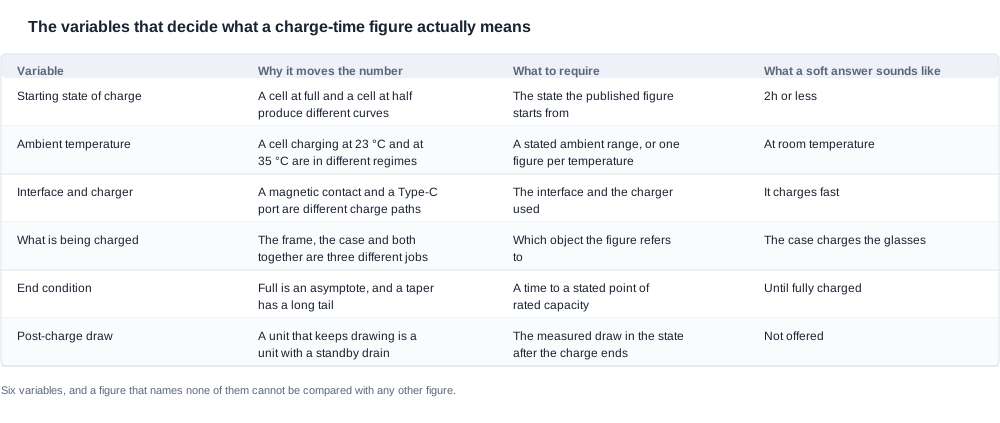
A charge time is one of the easiest numbers to quote and one of the hardest to compare, because four variables sit underneath it and a figure that names none of them cannot be compared with any other figure. Smart glasses charging smart glasses how to measure is therefore a question of fixing four variables before starting the timer — the starting state of charge, the temperature, the interface and charger, and what is actually being charged — and then taking four measurements rather than one.
Our published data across the range: two hours or less to charge for most models, around one hour for the fast-charging sport models, magnetic charging across the audio, camera and sport tiers, Type-C on D12 and the L2 Utral, ZH12 and D17, and the D11 and the V03 Pro, and charging cases at 900 mAh, 1200 mAh and 1400 mAh. Cell configurations range from 40 mAh to 290 mAh.
Smart glasses charging: a routine you sell, not a printed number
The three sentences that settle a charging decision
Name four variables with every figure — the starting state, the temperature, the interface and charger, and which object is being charged — and then measure a defined state rather than "full", because a time to 80 per cent of rated capacity is repeatable where "full" is an asymptote. But the more important decision comes before the measurement: the buyer is not choosing a charge time, they are choosing the routine the customer has to learn, and a case in the box is a different routine from a cable in the box. Check the interface condition on receipt as well, because in a wet or dusty channel that is where the product actually fails.
Three buyers, three different charging decisions
A buyer in this category is usually making one of three decisions, and each of them is a different decision with a different cost of getting it wrong.
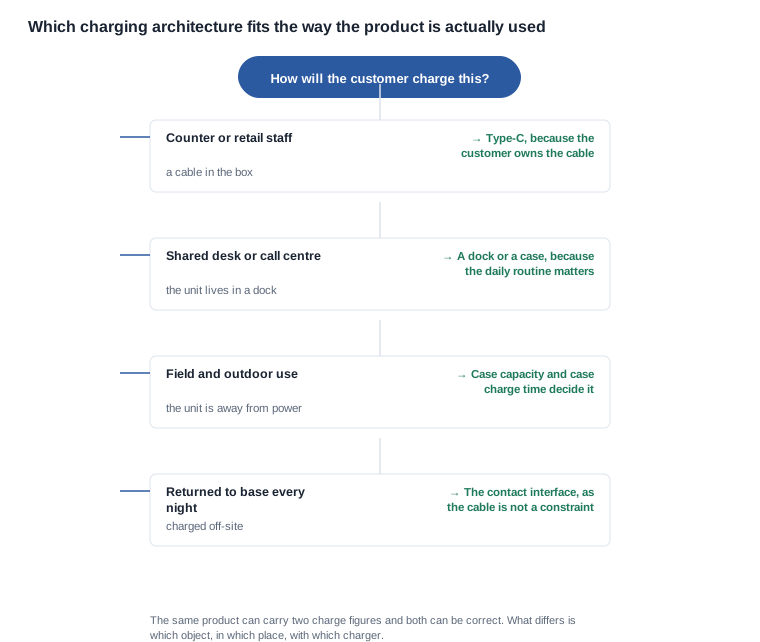
Deciding between a magnetic-contact product and a Type-C product. They hold two samples, a channel plan and a packaging budget. The real question is not which is faster — it is which routine the customer in that channel already has, and which one the buyer has to teach. A cable that the customer owns is a product with no accessory; a dock that the customer must be given is a product with an accessory minimum order quantity, a packaging slot and a second failure path.
Deciding whether a charging case belongs in the box. They hold a unit price target and a view on the accessory cost. This decision is made by arithmetic that a buyer can do before any sample arrives, and it is made badly when the case is treated as a gift rather than as a component of the charging system.
Checking a supplier's charge time against what a customer will experience. They hold a published figure and a channel where the ambient temperature swings. The gap between the two is where the complaint comes from, and closing it costs one afternoon.
The charging case is the most under-considered element in this category
A case changes the customer's routine rather than the product's specification, and that is exactly why it is under-considered. The published case capacities in our range — 900 mAh, 1200 mAh and 1400 mAh — describe the case, not the glasses. The case's own charge time and capacity determine the routine the customer has to learn: how long the case sits on a socket, how many times the case can refill the frame before it needs the socket itself, and what happens on a weekend when neither happens.
A buyer who quotes a case capacity in a listing without quoting the case's own charge time is describing a specification the customer never experiences. And a buyer who treats the case as an accessory has not asked whether the case is part of the product for regulatory purposes, whether it carries its own cell certification obligation, or whether the contacts in it have a wear life that has to be in the acceptance criteria.
What the charging buyer is trying to avoid
A charge time that is really a partial-charge time. A cell at full and a cell at half produce different charge curves, and a bench test that starts from a flat cell measures a different thing from a customer who tops the product up for ten minutes before a shift.
A figure measured on a different charger. A low-power supply gives a longer charge time with the same product, and a different cable on a Type-C model changes the result again. If the charger is in the box, it is part of the specification; if it is not, the specification has to name the class of charger the figure assumes.
A charging fault reported in the second year that is actually a standby drain. A product that keeps drawing current after the charge completes is a product with a real failure mode, and it lives on a bedside table for a fortnight.
A wet-weather failure attributed to the wrong component. The interface's condition and contact reliability are where a product fails in a wet or dusty environment, and two models in our range carry an IP54 catalogue marking with no test report number published, the V06 and the S7, so the evidence has to be requested rather than assumed.

The thresholds that make a charge-time figure comparable
Send these to every supplier in the same form. The right-hand column separates a supplier who has measured the product from one who is relaying a component specification.
| What to ask the supplier for | The pass line | What a soft answer sounds like |
|---|---|---|
| Charge time, with the starting state | A figure plus the state the cell started in | "2h or less" |
| Charge time, with the temperature | A figure at a stated ambient temperature | Not offered |
| Charge time, with the charger named | The charger and the interface used | A figure with no charger |
| Charge current profile | The current over time, not only the total | "Fast charging" |
| Cell temperature during the charge | A stated limit and the measured behaviour | Not offered |
| Behaviour at the end of the cycle | Whether it indicates full, stops drawing, or enters a maintenance state | "It charges fully" |
| Standby and maintenance drain | A figure for the post-charge state | Not offered |
| Case capacity and case charge time | Both, for the exact model | A capacity with no time |
| Model designation | A published designation for the exact configuration | A series name only |
The starting state has to be specified, and the published figure should state one
A cell at full and a cell at half produce different charge times, and a customer who tops the product up for ten minutes is experiencing neither a full nor a flat charge curve. When a supplier quotes a charge time, the starting state is part of the figure, not a footnote to it, and a figure whose supplier cannot name the starting state has been measured from a condition that is unlikely to occur in your channel.
The temperature is the variable most often missing, and it is the one that produces the complaints
A cell charging at 23 °C in a factory is charging in a different regime from one charging in a warehouse at 35 °C, and the difference in charge time is not small. If you ship to markets with a wide temperature range, the test needs a temperature dimension rather than an assumption. This is also the row that produces the "it charges slowly" complaint that arrives through a distributor rather than through the customer, because the distributor's warehouse is a different place from the customer's house.
The interface and the charger are two separate variables
A magnetic contact and a Type-C port are different charge paths with different contact resistances and different thermal behaviour. The charger itself matters too, because a low-power supply gives a longer charge time with the same product and a different cable on a Type-C model changes the result again. Two suppliers quoting "two hours or less" with no charger named may be quoting two different measurements of the same nominal figure.
What is being charged decides what the number means
The glasses, the case, or both. Where a case is part of the product, the case's own charge time and capacity determine the customer's routine, and the published case capacities describe the case rather than the glasses. A listing that says "1400 mAh case" and a customer who expects the glasses to run all day on that number is a mismatch between a case figure and a frame expectation, and it is one of the most common complaints in this tier.
"Full" is an asymptote, not a point
On a charger that tapers into a maintenance voltage, the time to full is not a repeatable measurement — the last few per cent take an unbounded amount of time and the moment you call it finished is arbitrary. A time to a stated point of rated capacity is repeatable and more useful for planning a routine, because a customer planning an overnight charge is planning to have a certain amount of charge available, not to have reached a mathematical limit.
The cell temperature during the charge is the first visible sign of a problem
It has to be measured at the cell, not at the case, and it is invisible from the outside in every case where the electronics are enclosed. A supplier who will state a limit and a measured behaviour has run the measurement; a supplier who cannot has not watched a thermal profile.
Running a charge measurement that another buyer could repeat
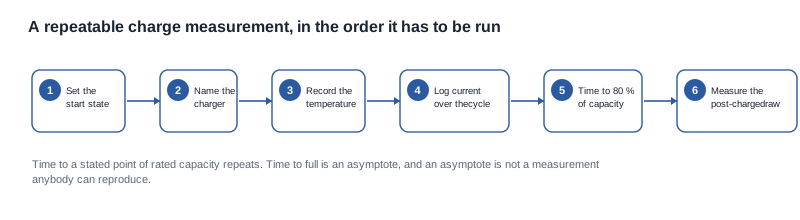
1. Check the charge time against the published figure from the stated starting state. This is a five-minute check and it catches a substantial proportion of problems, because most published figures assume a flat cell and most customers charge from somewhere in the middle.
2. Check the interface's condition and its contact reliability. Look at the contacts for wear, oxidation or debris, and check that the mating surface is clean. In a wet or dusty environment this is where a product fails, and the ingress evidence has to be requested rather than assumed.
3. Check whether the case charges the glasses, and how long that takes. Where a case is in the box, this is the number the customer actually experiences, not the frame's own charge time. Measure the case as its own product.
4. Check that the unit's firmware and the charger behave correctly together. A proprietary charger paired with the wrong firmware revision is a support issue that presents as a charging fault, and it is invisible in any specification.
5. Measure the current over the whole cycle, not just the total. The shape tells you where the time goes: a long tail at low current is taper, and a plateau is where the charger is holding rather than charging. A flat profile with a long taper is a different product from one that draws hard and finishes quickly, and the two suit different routines.
6. Observe the behaviour after the charge completes. Does the unit indicate full, stop drawing current, or enter a maintenance state? A device that keeps drawing is a device with a standby drain, and that has to be a decision rather than a discovery.
7. Put the acceptance criteria into the purchase order. A charge time that is measured in an email is a charge time you cannot refuse a lot for. A charge time written into the order as a tolerance against a stated starting state, a named charger and a stated temperature is a standard.

Where a charging programme goes wrong in the channel
A charge time is quoted without a starting state and is compared with a customer's ten-minute top-up. The symptom is a complaint that the product "never finishes charging". The root cause is that the figure was accepted as a number rather than as a measurement with a condition. The prevention is to publish the starting state alongside the figure, and to print it on the product page.
The product charges slowly in a warm warehouse and the complaint arrives from a distributor. The symptom is a claim that reaches the brand through the distributor rather than through the customer. The root cause is that the temperature dimension was never part of the test. The prevention is to run the measurement at more than one ambient temperature and to publish the range.
A charging fault is reported and the cause is the wrong charger. The symptom is a fault that appears on some units and not others, with no pattern the brand can find. The root cause is that the charge path was never specified, so any charger was assumed to work. The prevention is to name the interface and the charger in the specification and in the documentation pack, and to state whether the charger is supplied.
The case is in the box and nobody knows how long it takes to charge. The symptom is a customer who treats the case as an overnight-only accessory and then finds the product flat by day three. The root cause is that the case was treated as an accessory rather than as part of the charging system. The prevention is to measure and publish the case's own charge time alongside its capacity, and to treat the case as a product with a specification.
The unit draws current on the shelf and the battery is flat on delivery. The symptom is a customer receiving a product that appears not to hold a charge. The root cause is that standby and maintenance drain was never measured. The prevention is to measure the post-charge state, to record it, and to treat a significant drain as a defect rather than as a specification.
A contacts decision is made on speed and the wear life is discovered afterwards. The symptom is an increasing proportion of units that charge intermittently, typically appearing months after launch. The root cause is that the contact wear life was never established, and it is a wear characteristic rather than a defect. The prevention is to ask for the wear life on the charging contacts as a figure, and to put a contact inspection into the incoming criteria for later lots.

What the charging architecture is worth in negotiation
Negotiable, and this is where the effort belongs. Whether a charger is included in the box, and against what specification, is a negotiated number and a low-cost one for an electronic product with no tooling implication. The case as a standard inclusion versus an optional accessory is a decision with an accessory minimum order quantity attached, and the minimum is usually the line that decides whether a case-based proposition is workable at your volume. Delivery splitting against a sample-approval milestone is often granted more easily than a price concession, because it moves the risk onto the schedule where it belongs. Payment scheduling is a standard area: a deposit taken with the purchase order, a balance on the inspection sign-off, and a retention against the documents protects the buyer on the failure that costs most. The temperature dimension of the published charge figure is negotiable in the sense that a supplier willing to state a range is more useful than one who will not.
The charger and the case are approved per configuration, and that schedule is not yours to move. A charging product carries two separate approval lines — one for the charger that ships in the box and one for the charging case — each priced per configuration and each queued at the test laboratory rather than negotiated at the quotation. Tooling for the charge path is a one-off setup that the first order usually carries, so the useful questions are over what volume it is amortised and what happens to the tooling and the charging contacts if the programme is discontinued. Also not negotiable is the charge path: a supplier who will not change the interface, the contacts, the charger or the power management is telling you the charge behaviour is fixed, and the programme should be built around that fact.
Documents to request before the deposit. The charge time with the starting state, the temperature and the charger named. The charge current profile. The cell temperature limit. The standby and maintenance drain figure. The case capacity and case charge time for the exact model. The certificate numbers with the issuing body and the validity dates.
Clauses to write into the contract. The charging interface and the charger as line items. The acceptance criteria for the sample, referencing the measurements above. A clause requiring notice before any change of interface, contact, charger or power-management firmware. A clause stating whether the charger and the case are supplied, in what quantity, and under which minimum. And a clause on who bears the cost when the sample does not meet the acceptance criteria.
A worked scenario: a field-service channel with a case in the box
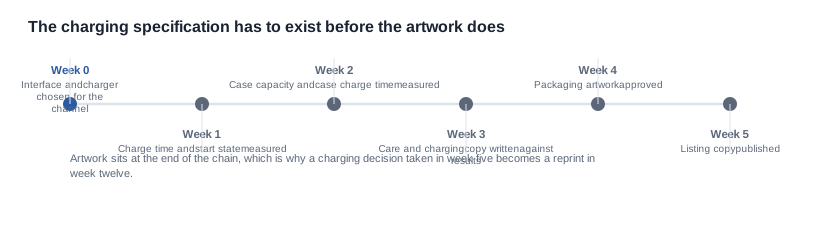
A field-service distributor has to fit the charge time to the gap between two jobs or the figure is irrelevant, and the five steps below are the order in which that fit gets decided.
Assume a distributor building a field-service line for technicians who work on customer sites, where the product is charged between calls rather than overnight, and where a Type-C cable is not always within reach.
Step one is the routine, not the speed. The distributor's question is not which product charges fastest. It is what happens to a technician who finishes a site at four in the afternoon with a half-charged product. The distributor's own data says the typical gap between sites is two hours, and the answer has to fit that gap or it does not matter that the product charges in one hour from flat.
Step two is the candidate set. One candidate charges in around an hour from a stated state and arrives with a case at one of three published capacities. The other candidate charges in two hours or less across the range and uses a magnetic interface. The distributor's channel has no shared dock and no guaranteed socket at a customer site, which removes the dock option from consideration entirely and makes the case the deciding element.
Step three is measuring the case as its own product. The case capacity is published at 900, 1200 or 1400 mAh, and none of those figures says how long the case itself takes to charge, or how many times it can refill the frame. The distributor measures the case separately: its own charge time, its own refill count, and its behaviour when the frame is put in flat rather than partly charged. The refill count turns out to be the number that decides the routine, and it is not published anywhere.
Step four is the acceptance criteria. The distributor writes the case behaviour into the purchase order — the refill count, the case charge time, and the interface condition on receipt — because a case that fails to make contact on the first attempt is a return, and the return is attributed to the product rather than to the accessory.
Step five is the copy. The listing describes the case as a case: its capacity, its charge time and the routine it creates. It says nothing about the frame running all day on the case's capacity, because that is not what the case does.
The decisive decisions were about the routine and the accessory, and the two published charge figures — one hour and two hours or less — only became relevant once the routine was written down.
What our charging rows fix and what they leave open
We publish the charge time, the interface and the case capacity exactly as the catalogue states them, and we publish the fact that the catalogue states no test condition for any of them. We will not supply a starting state, a temperature or a charger that the catalogue does not state, because a condition we invent is a condition nobody tested, and it becomes a figure the customer can falsify.
We will also not quote a case capacity as a product specification for the glasses. The published case capacities — 900 mAh, 1200 mAh and 1400 mAh — describe the cases, and the case and the frame are two products with two routines. We publish no charge current profile, no cell temperature limit and no standby drain figure, and we will not estimate them, because those three rows are precisely the ones that separate a charging design from a charging claim.
What we can do is check your measurement against the published rows for that model and tell you which of the four variables the published figure already fixes and which it leaves open. The charging architecture is under charging solutions, the comparison method is in how to compare smart glasses charging, the datasheet reading is in reading a charging datasheet, and the regulatory dimension is in how regulations affect charging.
Three actions for the charging specification
Write the customer's charging routine in one line. When, where, how long, and from what state. If the line cannot be written, the charge figure will not decide anything.
Send the nine-row request to every supplier in the same form, and ask for the case as a separate product. A case figure without a case charge time and a refill count is a specification the customer never experiences.
Send us the four variables and the charge time you measured, and we will tell you what the published figure already fixes. The route is also at sample evaluation, where the measurement session is set out.
Where the measurement method comes from
Send us the four variables and the charge time you measured, and we will tell you what the published figure already fixes.


