
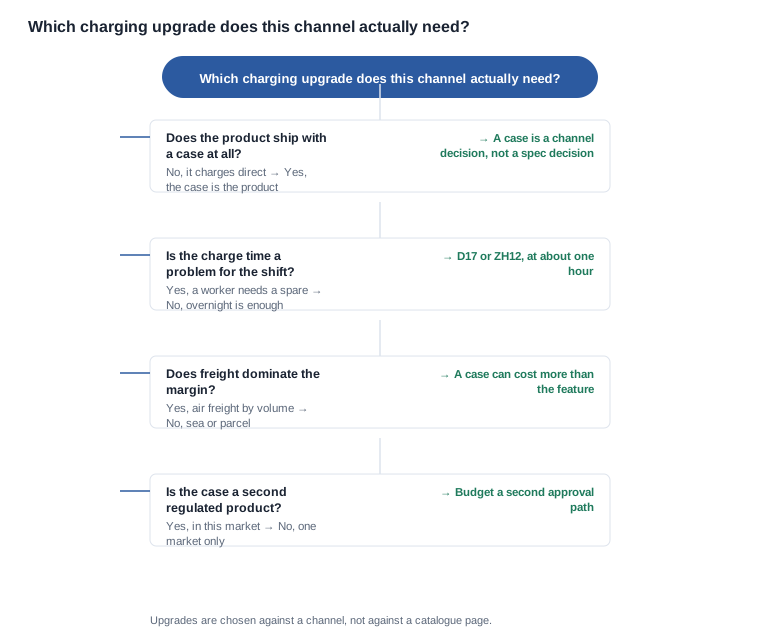
The charging upgrade worth paying for depends on what your channel already contains, not on which model looks the most advanced. Three upgrades are available on published configurations — moving from direct charging to a case, moving up a case capacity, or moving to the one-hour charge figures on the sport models — and each one serves a different channel. Choosing wrongly adds cost and volume without changing the number of complaints you receive.
Smart glasses charging: upgrade one, adding a case to a line
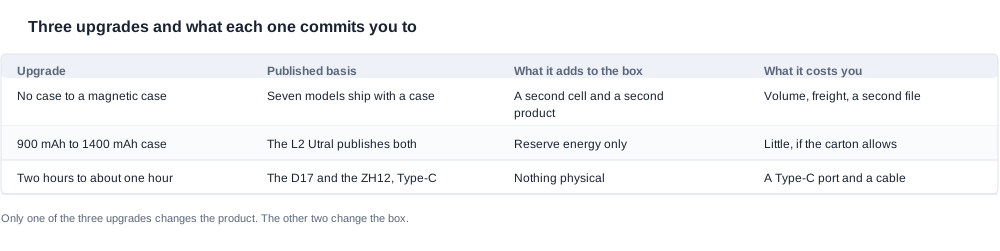
Seven models in the range are published as shipping with a charging case: the CY03 and the MT5, the L1 Pro and the L2 Utral, and the KY06 and the MT6, and the CY05. Five of them publish a capacity — 1400 mAh on the L1 Pro and the CY05, and the CY03, 900 or 1400 mAh on the L2 Utral, and a foldable 1200 mAh on the MT6. The KY06 and the MT5 publish a case with no capacity.
What the upgrade actually changes in the box
Adding a case is not a feature addition. It changes the product from something that charges directly into something that charges into a container, and that has four consequences a buyer has to plan for.
The box gains an object. A case is a moulding with its own tool, its own carton nesting and its own packaging artwork. A line that shipped a bare product now ships a product in a case, and the carton dimensions change.
The energy path gains a stage. The customer now charges the case, and the case charges the glasses. Whether the glasses also charge directly while in the case is not published for any model, and the question is worth asking before you commit because it changes the instruction on the packaging.
The documentation gains a second object. A case with its own cell is a second regulated assembly with its own transport documentation, its own safety data and its own market treatment. The charging case as a second regulated product question is not academic once a case is in the carton.
The spare-parts strategy gains a line. A case is a wear item with a finite life, and a customer whose glasses are fine but whose case hinge has failed is a replacement case rather than a replacement unit. Whether the case can be replaced independently is a service decision with a cost attached.
When the step from no case to any case is worth more than the capacity step
For most channels, the step from no case to any case is worth more than the step between case capacities. That is a statement about the shape of the upgrade rather than about the millimetres of reserve involved.
The reason is that a case changes the customer's behaviour, and behaviour is what a channel actually sells. A product that charges into a drawer is a product that gets used; a product that needs a cable is a product that gets used when a cable is to hand. The capacity step, by contrast, changes how long the product survives between charges, which matters only in the channels where a full day of intermittent use is the norm.
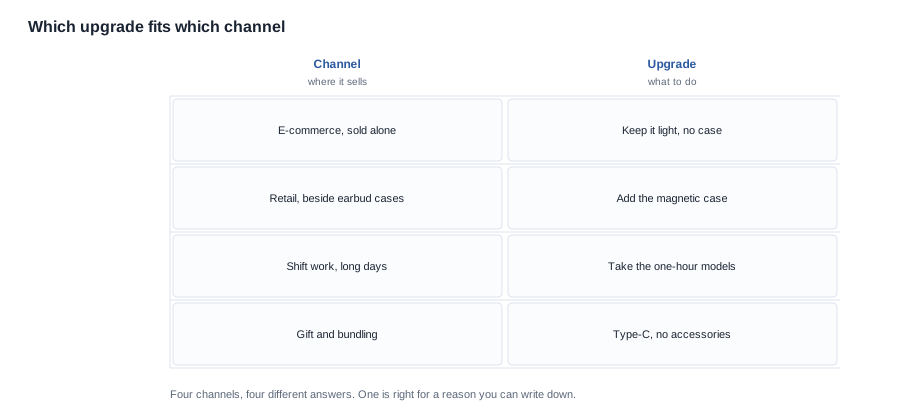
The case is worth making when the customer is not already carrying a charging cable, when you sell through a channel where the product competes with earbuds and their cases, or when your retail presentation can show the case. It is not worth making when your buyers are buying a second device alongside a phone, or when freight cost dominates the margin.

Upgrade two: the step between a 900 mAh and a 1400 mAh case
The L2 Utral is the clearest case here, because the catalogue presents its case as configurable at either 900 or 1400 mAh on the same platform, with the same Type-C interface line and the same 13 MP and 290 mAh product. The case is the variable, not the product.
Two ways to think about the step, and why the second one is more useful
The first way is capacity, and it is the weaker argument. A 900 mAh case and a 1400 mAh case both turn a product with an about-seven-hour runtime into a product that survives several days of intermittent use. The difference between them is usually marginal for a consumer, because the consumer does not think in milliampere-hours and will not notice which one is in the carton.
The second way is form, and it is the commercially stronger argument. The MT6's case is published as foldable, which is a packing and merchandising decision rather than an electrical one. A foldable case changes the retail display, the carton volume and the way the product is presented next to earbud cases. A buyer thinking about the 900 and 1400 mAh step should be asking which of the two opens the channel, because the answer to that question is worth more than the capacity difference.
When the capacity step is worth paying for
The step is worth paying for in three specific situations, and the commonest situation is none of them.
- A channel where the product is left in a vehicle or on a site between uses. A larger reserve then removes a mid-shift charge entirely, and the saving is a unit of downtime rather than a convenience.
- A gift or bundle arrangement where the case is the presentation. Here the capacity is nearly irrelevant and the fit of the case to the channel's other accessories is everything.
- A tender where the specification names a reserve. In a technical tender the capacity becomes a scored line, and the argument moves from value to compliance.
Upgrade three: the one-hour charge on the D17 and the ZH12
Two models in the range publish approximately one hour of charging over Type-C, against the two hours or less published across the rest of the catalogue. That is a genuine upgrade and it is a differentiator in a category where everybody claims a fast charge.
The two models are not otherwise identical, which is worth noting before you treat them as one option. The D17 publishes 115 mAh and about seven hours of runtime; the ZH12 publishes 100 mAh and about eight hours. The D17 carries remote control and photo capture features, the ZH12 carries remote capture and surround sound. So the charge-time advantage is a property of the platform, while the other differences are product positioning.
What the one-hour figure does and does not tell you
It does tell you that the unit completes a full charge quickly under whatever conditions the supplier used. That is a real and useful difference against a two-hour ceiling, and it is the number to put on a product page, written as a ceiling.
It does not tell you what is available after ten minutes. Partial-charge behaviour is not published for these models, and that is the number a buyer actually experiences when they realise they need the product for a shoot in twenty minutes. If your channel's customers do exactly that, the upgrade does not solve their problem.
It does not apply to the case. If the product also ships with a case, the one-hour figure describes the glasses, not the case, and the two are usually not on the same path at all. Whether the case charges the glasses or the other way round, and whether the case has its own charge time, is not published anywhere in the range.
It does not say what supply it assumes. A Type-C port on a laptop delivers a fraction of a wall supply. The one-hour figure needs a supply condition attached before it can be published as a customer-facing number.

The freight line that decides before the feature line does
On consumer electronics parcels shipped by air, volumetric weight frequently becomes the largest single logistics line for a product of this size, and for a cased variant it can exceed the difference between a cased and an uncased unit price. That is why the case decision is often a freight decision.
There is a trap here that catches people reading a catalogue. The only published weight in the whole range is 158 g, and it is the weight of the MT6 glasses unit — that figure includes the battery and the camera module and it excludes the foldable charging case. The weight of the case itself is not published. So 158 g is not a basis for a freight calculation, and treating it as one will understate a cased shipment by the weight of the case plus the carton that holds it.
Model the freight on actual carton dimensions rather than on product weight, and ask for the cased and uncased carton dimensions separately before you compare two quotations on landed cost. The comparison that matters is not unit price against unit price. It is landed cost per unit against landed cost per unit, and the cased variant has a different answer.
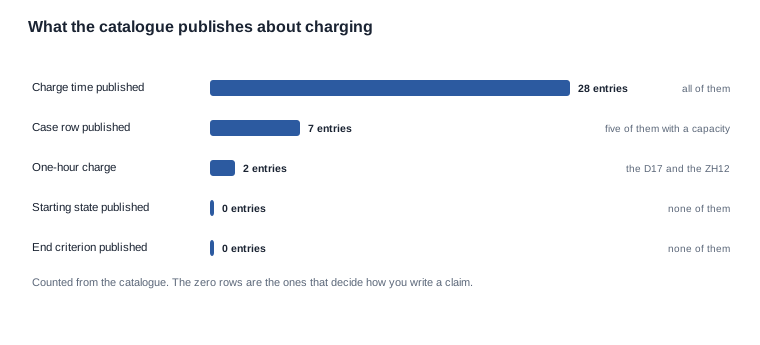
The counts above are the published state of the range. Every entry publishes a charge time, which is a well-populated row. Seven mention a case and five publish a capacity for it. Two publish a one-hour figure. Nothing publishes a starting state or an end-of-charge criterion, and those two zeros are what decide how the one-hour figure can be written on a listing.
Why a case is a second product with its own paperwork
A case with a cell in it is not an accessory. It is a second assembly with its own transport documentation, its own safety data and its own treatment in each market where the product sells. That is a commercial fact with a schedule attached, and it is the reason a case upgrade often costs more in approval time than in tooling.
The practical consequence is that a case upgrade is a change to the SKU tree rather than a change to a specification. It creates a new model designation, a new box, a new set of documents and a new approval path. A buyer who treats it as a specification change will find that the artwork was locked before the case was decided.
What an upgrade does to your configuration tree
The most expensive part of an upgrade is rarely the hardware. It is the multiplication of configurations, and the multiplication is predictable, which means it can be planned.
Start from a single model and a single colour. Add a case option and that is two configurations. Add a second colour and it is four. Add a market with its own adapter and documentation set and it is eight. Every one of those eight needs a box, a label set, a line in the technical file, a row in the inspection standard and a line in the packing list. The cost of the eighth configuration is not eight times the cost of the first, because the documentation and artwork work does not divide the same way, but it is certainly more than the unit price difference suggests.
There are three ways to keep the tree small, and they are worth deciding before the order rather than after.
Decide the case before the colour. The case is the configuration that changes the carton, the freight band and the documentation set. The colour changes the artwork and the label. Doing the case second means the carton artwork is drawn twice.
Agree a single configuration count rather than a unit count. A supplier that is asked for "one thousand units" will treat the colour split as their problem. A supplier that is asked for "two configurations at five hundred units each" will treat it as a real constraint, and the per-configuration minimum becomes a negotiable number rather than an accounting detail.
Put the configuration freeze before the artwork approval. This is the single most useful clause in the whole commercial conversation, because it converts an artwork rework into a scheduled event. A change after artwork is a reprint; a change before artwork is a revision.
The four negotiating numbers in a charging quotation that actually move
The unit price is the number everybody negotiates and the number that moves least. The four numbers that move are the per-configuration minimum, the artwork round count, the documentation scope per market, and the packaging or tooling commitment behind the case.
The trade-offs are specific. A larger committed configuration count in exchange for a lower per-configuration minimum is a good trade when the configurations are certain and a bad one when they are not, because the supplier is pricing the risk of a configuration that never reaches volume. A narrower documentation scope for one market in exchange for a faster launch is a good trade when the market is a test rather than a commitment. And a larger first order against a case that is not the one you may keep is a bad trade, because the case is the part of the product with a service life and it is the part that ages out of the assortment first.
What is worth asking, in the order of how much it moves: how the per-configuration minimum is calculated, how many artwork rounds are included, what documentation is included per market, and what happens to the packaging commitment if the programme is discontinued in the first year.
Five questions to settle before you commit to an upgrade
- Does the case charge the glasses, or does it only store charge for them? These are different products, and the difference is invisible until a customer is stranded with a dead pair.
- What is the case charge time, and what does the case itself charge from? Neither is published for any model in the range.
- Is the case covered by the product warranty, and can it be replaced independently? A case that cannot be replaced becomes a disposal decision rather than a service decision, and the disposal cost lands on your channel rather than on the customer.
- What are the packed carton dimensions for the cased and uncased variants? This is the number your freight model actually needs, and it is the number that decides whether the upgrade is worth it.
- Is a charger or a cable included in the box? Not published for any model in the range, and it appears on every product listing you will write.
A hypothetical upgrade decision, worked through
This is a hypothetical case rather than a real engagement, and it exists to make the order of decisions visible rather than to report an outcome.
Assume a European distributor that already sells earbuds and their cases into the same retail accounts. They are considering adding an AI camera glasses line and have three candidate configurations on the table: an uncased model, the L2 Utral with a 900 mAh case, and the L2 Utral with a 1400 mAh case.
Step one: the channel. The distributor's customers browse the same shelf as the earbud cases, and the merchandising question is whether the glasses sit next to them or in a different bay. A cased model sits next to them. That settles the shape of the decision before any specification is read, which is the right order for a channel decision.
Step two: the capacity step. The distributor compares the 900 and 1400 mAh cases and finds that the capacity difference does not change the customer proposition at all, while the carton difference does: the 1400 mAh case changes the shelf footprint and the freight line. They take the 900 mAh case and treat the extra reserve as a non-factor, which is the honest conclusion.
Step three: the freight model. The distributor asks for the packed carton dimensions of the cased and uncased variants, and finds that the cased carton pushes the shipment into a higher weight band on their air freight contract. The added case cost is recovered in the shelf placement rather than in the unit price.
Step four: the one-hour option. The distributor asks whether the one-hour sport models are available in the same channel format, and is told that the fast-charge models are magnetic-contact and case-free rather than Type-C, which changes the accessory plan again. They keep the L2 Utral and drop the fast-charge idea, because the fast-charge models do not solve a problem this channel has.
Step five: the paperwork. The distributor asks what the case adds to the documentation set for the two markets they sell into. The answer is a second transport document and a second product in the technical file, and the distributor prices the extra review time into the launch schedule rather than discovering it in week nine.
The result is a programme with two configurations rather than three, a decision taken on shelf placement and carton dimensions rather than on milliampere-hours, and a documentation plan that includes the case from the start.
Where our catalogue stops on upgrade advice
The boundary we hold: we will not recommend a charging arrangement on the basis of a specification figure alone when the customer-facing behaviour — does the case hold charge, can it be replaced, what happens at ten minutes — is unpublished. The figures exist; the experience is the part you are buying, and for this range the experience is not documented.
We do not publish minimum order quantities, unit prices or lead times as fixed numbers on this site; all three are confirmed per enquiry and depend on configuration. What we will do is tell you which published models share a platform and differ only in charging arrangement, so an upgrade does not quietly become a different product with a different approval path.
The charging solutions overview covers the arrangements and the regulatory treatment of the case as a separate object. The four arrangements are explained in smart glasses charging basics, the runtime figures behind the decision are in battery life and what the hours mean, and if your channel is e-commerce-led, the OEM-ready range lists which configurations are available in their published form.
Related reading
- Smart glasses charging basics — the four arrangements explained
- Does the charging case need its own report — treating the case as a regulated object
- Battery life and what the hours mean — reading runtime figures honestly
Tell us your channel, your freight method and your target retail price, and we will tell you which published configurations fit and what each charging arrangement commits you to.


