
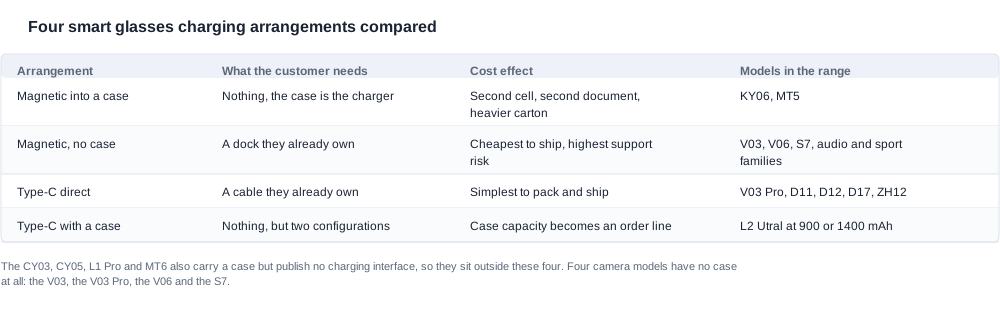
Smart glasses charging comes in four arrangements, and every model in the current catalogue uses one of them: magnetic contact into a charging case, magnetic contact without a case, Type-C direct, or Type-C with a case. Which one you pick changes your packaging, your freight, your accessory revenue and the customer support you inherit more than it changes the bill of materials. This guide is written for a buyer meeting this category for the first time, so it assumes you know what a purchase order is and nothing about batteries. It gives you the four arrangements in plain terms, the model list that shows which is which, the six questions worth asking in a first quotation, and how to read the answers you get back.
The one thing to take away before the detail: in this category the charging arrangement is a product decision, not an accessory decision. It decides whether there is a second battery in the consignment, whether the carton has a second object in it, and whether your customer owns anything at all when the box is opened.
Smart glasses charging: four arrangements, one distinction
Arrangement one: magnetic contact into a charging case
The frames drop into a case that carries its own cell. The published cases in this catalogue run 900 mAh, 1200 mAh and 1400 mAh. The models using this route are the KY06 and the MT5, both of which the catalogue states as magnetic charging paired with a charging case. The CY05 and the CY03, and the MT6 and the L1 Pro also ship with a case but do not publish a charging interface at all, and the L2 Utral pairs a case offered at 900 mAh or 1400 mAh with a Type-C charging interface.
This is the arrangement built for retail. The case is not merely a charger; it is a storage product and the reason a buyer keeps the product rather than losing it. A model with a 1400 mAh case supports a genuine "charge every few days" proposition for a customer who would otherwise think about power before every use.
The trade-off is freight and shelf space. The case adds volume to every unit, and volumetric weight on a consumer electronics parcel often exceeds the difference in unit price between a cased and an uncased variant. It also doubles the number of things that can arrive damaged in a parcel.
Arrangement two: magnetic contact without a case
The frames have contacts and no case at all. The V03 is the clearest example, publishing a 220 mAh cell, a charge time of two hours or less, a five-to-eight-hour runtime and magnetic charging with no case in the box. The V06 and the S7 are the sport models in the same arrangement, both publishing a 260 mAh cell, a five-to-eight-hour runtime and magnetic charging, and both carrying the IP54 marking. The AR glasses entry and the AI electrochromic entry are magnetic as well.
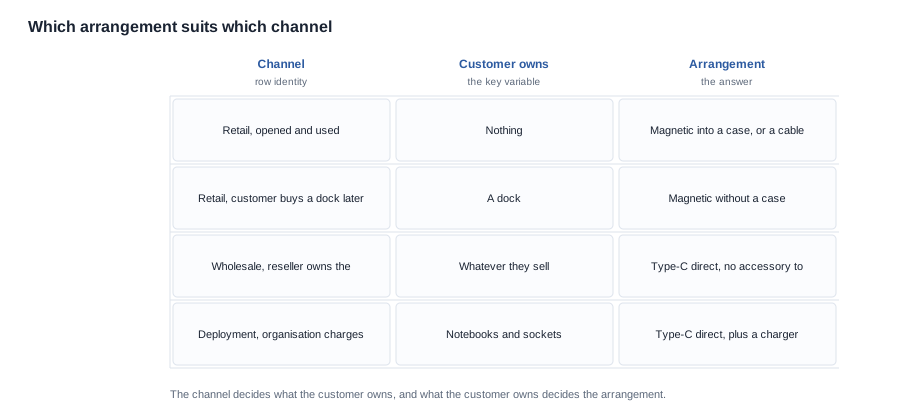
This is the arrangement where the customer has to own a dock, and that is the whole of the decision. If the channel expects a customer to open a box and have a working product, a magnetic model without a case in the box is a support topic from day one. If the customer is expected to buy a dock — because they already own one, or because the channel stocks one — then the arrangement is fine and it is the cheapest way to ship.
The dock is also the arrangement where the failure mode is invisible, and that matters for a first-time buyer who has not yet built a support process. A frame that looks seated on a dock and is not charging is indistinguishable from a broken product, and the customer will conclude that the product is faulty. The usual mitigation is a visible charge indicator, and we publish no charge indicator behaviour for any model in this range, so it is one of the things to ask about rather than one you can assume. A second mitigation is a line of instruction about charging on a non-metallic surface, and that belongs in the manual from the first run rather than in the support script.
Arrangement three: Type-C direct
The frames have a USB Type-C port and no case. The D11, the D12, the D17, the ZH12 and the bone conduction entry are in this arrangement, all publishing a charge time of two hours or less with Type-C charging, and the D17 and the ZH12 publish roughly one hour.
This is the simplest arrangement to manufacture, package and ship, and it is the one that fits a channel where the customer expects to find a cable in the box because every other product they sell works that way. The published charge time is two hours or less for the D-series entries, and the two sport models publish approximately one hour. We publish no fast-charge protocol for any model in the range, so that one-hour figure is a charge time and not a statement about a protocol — if fast charge is part of your proposition, the number to quote is the one hour, and what is still not published is how much of that charge is available after ten minutes.
Arrangement four: Type-C with a configurable case
The L2 Utral sits in its own category: thirteen megapixels, a 290 mAh frame cell, a runtime of about seven hours, a Type-C charging port and a charging case offered at either 900 mAh or 1400 mAh depending on configuration. The catalogue also carries a "Utral Pro Max" label on that entry.
Two things to raise in writing before that label propagates into your listings. First, "Utral" reads as a typographical rendering of "Ultra" — confirm the intended designation with the supplier rather than assuming. Second, a model code that reads differently on the supplier's document and on your packaging creates genuine problems at customs and in the event of a quality claim. Fix the string once, everywhere, before artwork is locked.
What the range actually looks like, model by model
Here is the whole range in the form a first-time buyer needs: the charging arrangement, the frame cell and the case status, so you can see which questions apply to which models.
| Arrangement | Models | Frame cell | Case |
|---|---|---|---|
| Magnetic with a case | KY06, MT5 | 260 mAh, 220 mAh | Present, capacity not published |
| Magnetic with a case | CY03 and CY05, and L1 Pro | 290 mAh | 1400 mAh |
| Magnetic with a case | MT6 | 265 mAh | 1200 mAh, foldable |
| Type-C with a case | L2 Utral | 290 mAh | 900 mAh or 1400 mAh |
| Magnetic, no case | V03 | 220 mAh | None |
| Magnetic, no case | V06, S7 | 260 mAh | None, IP54 on both |
| Type-C, no case | V03 Pro | 220 mAh | None, photochromic lenses |
| Type-C, no case | D11, D12 | 100 mAh | None |
| Type-C, no case | D17 | 115 mAh | None, about one hour charge |
| Type-C, no case | ZH12 | 100 mAh | None, about one hour charge |
| Magnetic, no case | K01, K02 | 90 mAh × 2 | None |
| Magnetic, no case | LC-105-1, LC-105-2, G07, YK12 | 55 mAh × 2 | None |
| Magnetic, no case | YKC02 | 70 mAh × 2 | None |
| Magnetic, no case | AR glasses, AI electrochromic | 100 mAh | None |
| Magnetic, no case | A05, A06 | 40 mAh | None |
| Magnetic, no case | A07 | 70 mAh | None |
Two rows in that table are the ones a first-time buyer will get wrong. First, four camera models — the S7 and the V06, and the V03 and the V03 Pro — have no case at all, so a "camera model with a case" assumption is wrong on four of eleven. Second, two models ship with a case and do not publish its capacity: the KY06 and the MT5. In a table like this, an empty case cell and a case cell with no number are different problems, and both need to reach the supplier before the order rather than after it.
What to ask for in a first charging quotation
Six questions, and the order matters because the early ones are free and the late ones cost money. They are also the six questions that separate a quotation you can evaluate from one you can only accept.
- For each model on the order, what is the charging method? Interface stated per model, not per family. You should get magnetic or Type-C for every line, and you should be able to tell from the answer whether the case is in the box.
- For each model, is there a charging case, and what is its capacity in mAh? A number, not a description. Where the answer is that the capacity is not published, that is a legitimate answer and it is a row you have to close separately.
- What is the stated charge time, and from what starting state? Two hours or less is the common figure across the range and about one hour on the D17 and the ZH12, but a charge time without a starting state is two possible numbers, and the one that reaches your listing is the one your reader assumed.
- What is in the box? The device, the case, a cable, a mains adapter, and which of those the customer has to supply. This is the accessory line, and it is the difference between a product that works on arrival and one that produces a first-week contact.
- What documentation travels with the shipment? For a lithium product this is a transport test summary, and where a case is in the box the summary has to cover the frame cell and the case cell as one configuration.
- What is not published? Ask for the rows the catalogue leaves open — the charge time condition, the case charging role, the cell cycle life, the deep-sleep current, the case capacity where it is missing. A supplier who answers this question has an internal specification; a supplier who answers with a brochure does not.
Before you order, run the six answers against a shortlist rather than against a single supplier, and weight them the way the channel does rather than the way the factory does. The criteria that matter to a retail buyer are the accessory line and the case role, because those are what the customer meets. The criteria that matter to a wholesale buyer are the freight consequence and the number of distinct configurations on the order. The criteria that matter to a deployment buyer are the charger ratio and the spare-parts route. All three are answerable from the six questions above, and none of them requires a price to evaluate.
Two questions to add once the first round is done, and both are about how the supplier behaves rather than about the product. Ask what happens when a model changes between the sample and the production run, and ask whether the answer will be given in writing. The first is the question that decides whether the charging clause is worth anything, and the second is the question that tells you whether the clause will be honoured.


How to read the answers you get back
The answers arrive in the vocabulary of the factory, and three phrases cause most of the confusion.
"Charging case" may mean a case that charges the frames or a case that stores them. In this catalogue the camera models that state a charging mode for the case — the KY06 and the MT5, both magnetic charging paired with a charging case — are stating a charger, and the three models that publish a 1400 mAh case with a frame cell of 290 mAh and a runtime of about seven hours are the same. For the models whose catalogue page carries a case capacity and a charge time but no separate charging-mode line, we ask rather than infer. The practical rule for a buyer: the case capacity and the case role are two separate rows, and a quotation that only has one of them is half an answer.
"Fast charging" is the phrase that causes the most damage downstream, because it is usually attached to the two models that publish about an hour and is usually read as a protocol. The catalogue publishes a charge time for every model and a protocol for none of them, so a claim of fast charging is a claim about a test condition nobody has shown you. If the charge time matters to your proposition, quote the time and state the condition once you have it.
"Up to 8 hours" is the runtime phrase, and the word that carries the ambiguity is up to. Our catalogue publishes runtimes as ranges on the camera models — five to eight hours on the V03 Pro and the V06, and the V03 and the S7 — and as points on the audio models, about eight hours on the K01 and the K02, about seven on the D11 and the D12, about six on the G07 and the YK12. A camera that is recording draws more current than one that is idle, so the same model will give different numbers in different use, and the range is doing real work in that sentence. The rule for a buyer is to plan against the low end of the range, and to replace the published figure with one you have measured before you commit a deployment to it.
What changes when the model carries a camera
The four arrangements describe how power arrives. A buyer who has worked only with audio products will underestimate one variable, and it is the one that decides whether a published runtime can be used in a plan.
In this catalogue the camera models are the V03 Pro and the KY06, the L2 Utral and the V03, the L1 Pro and the S7, the V06 and the CY03, the CY05 and the MT5, and the MT6 — eleven in total. Their published frame cells run from 220 mAh to 290 mAh and their published runtimes from five to eight hours, where the audio models publish smaller cells with runtimes of about six to eight hours and the children's models publish 40 mAh and 70 mAh cells at about twenty hours.
The pattern is not a mistake in the catalogue and it is not an inconsistency to argue with. It is the difference between a device that is mostly idle and a device that is capturing images. A camera that is recording is the dominant consumer of the power budget, and a design that sized the cell for audio and then added an imaging chain shows the effect in the third hour of use rather than in the first. The megapixel figure attached to these models — eight on the MT5 and the V03, the CY03 and the V03 Pro, and the MT6 and the CY05, and the KY06, thirteen on the S7 and the L2 Utral, and the L1 Pro — describes the imaging chain and tells you nothing about the power budget directly, which is exactly why the missing test condition is the thing to chase.
For a first-time buyer the practical consequence is short. When the model carries a camera, plan the deployment against the bottom of the published range, measure it yourself on a sample under the workload the product will actually be used in, and do not put a runtime figure into a channel plan or a customer listing until that measurement exists. The audio models are more forgiving, because their published figures are points rather than ranges and the margin between an idle and a busy device is narrower.
The mistakes a first order makes
Four mistakes, in the order they usually happen.
Assuming the customer owns a cable. A Type-C model with no cable in the box means the customer sources one. They will source the cheapest one they can find, and the support queue will hear about the current it delivers. The fix is one line on the order.
Treating a case as free. A case changes the parcel, the freight, the transport scope and the artwork, and it is a second object that can arrive damaged. A buyer who has budgeted the frame and not the case has under-budgeted the carton.
Copying the catalogue runtime into a channel plan. The published figure has no test condition, so a deployment sized on it has no margin. Plan on a derated figure you have measured.
Naming a model where a configuration was needed. The L2 Utral is the one that catches people, because it publishes two case capacities and the order line says only the model name. Write the capacity into the order line.
There is a fifth, quieter one: not asking whether the case is covered by the warranty and whether a case can be replaced independently of the frames. Both answers appear in your listing and in your returns rate, and neither is published for any model in the range.
A sixth, and it is the one a first-time buyer is most likely to make because the quotation looks complete: accepting a number without a condition. A charge time of two hours or less and a runtime of about seven hours are both real, both published, and both incomplete without the test condition behind them. The condition is what turns a specification into a claim you can defend, and the condition is the thing a buyer should be asking for even when everything else on the page is answered. A supplier who answers the condition question has a specification; a supplier who does not has a set of numbers, and the numbers will be repeated in your listing whether or not they are ready for it.
Follow the channel, not the factory line
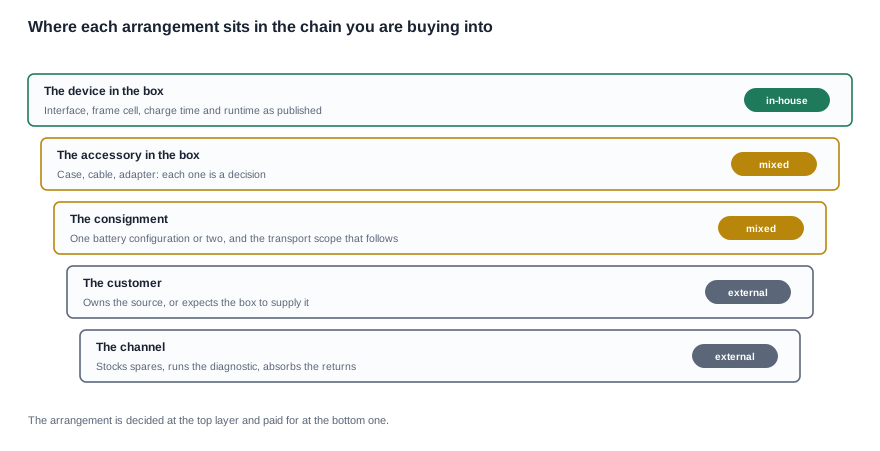
Concretely, the charging arrangement should follow the channel, not follow whatever the factory has on the line. A cased model earns accessory revenue and reduces the "where did I put them" problem; an uncased Type-C model ships cheaper and frustrates nobody who already owns a cable. Both are correct, and choosing between them is a distribution decision rather than an engineering one.
We do not publish a price list, a minimum order quantity or a fixed lead time on this site — all three are confirmed per enquiry and depend on configuration. What we will tell you plainly is which models use which arrangement, which accessory questions we can answer from published material, and which are not published.
The OEM-ready range lists the configurations available for sampling in their current form. If your product is camera-led, the case question interacts with the camera bill of materials, and the AI camera glasses range sets out which of the eleven camera models ship with a case and which do not. For how a charging case is treated as a separate regulatory object in its own right, the charging solutions overview covers the transport and labelling side. For battery runtime conditions, battery life specifications sets out what the published hours do and do not mean.
Related reading
- Does the charging case need its own report — treating the case as a separate regulated object
- Charging upgrade considerations — when a cased model beats an uncased one
- Battery transport requirements for imported units — the paperwork side of shipping a lithium product
- The vocabulary behind these arrangements — the terms a supplier quote is built from
Tell us your channel, your target retail price and your shipping method, and we will tell you which charging arrangements the catalogue supports and what each one commits you to.


