
Does the charging case need its own report? In practice it does, and the reason is structural rather than bureaucratic: a charging case is a separate battery assembly, so the transport file for the case is not the transport file for the device whose main cell it recharges. The catalogue's charging-case rows sit on camera pages only — five camera models publish a case capacity, two show a case without a figure, and four carry no charging-case row at all. Nothing on any page publishes a cell part number, a test summary reference, a transport classification or a certificate number. So no transport document can be produced from this material alone, and a forwarder working from a single document covering the glasses alone will correctly refuse the case.
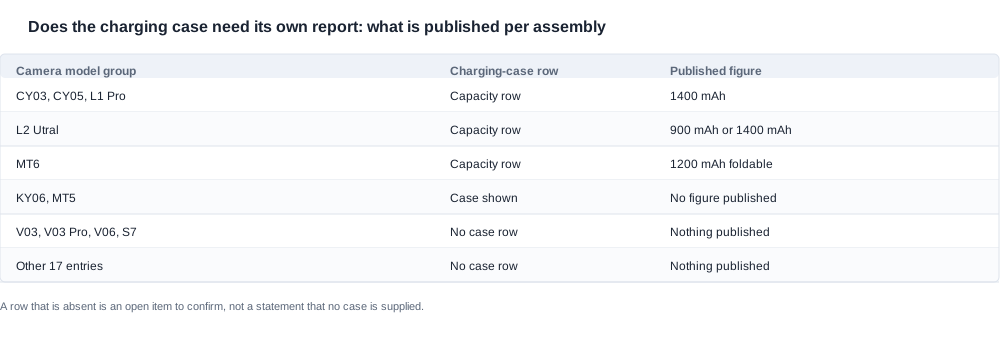
The answer therefore has three parts, and a logistics team needs all three rather than the first one alone. Published: charging-case capacity on five camera models — 1400 mAh on the CY05 and the L1 Pro, and the CY03, 900 mAh or 1400 mAh on the L2 Utral, and a foldable 1200 mAh on the MT6; a case shown without a capacity figure on the KY06 and the MT5; and no charging-case row on the V06 and the V03, and the V03 Pro or the S7. Not published: every transport-document identifier for every model, along with cell part numbers, chemistry, rated voltage, watt-hour rating, state-of-charge rules and transport classifications. Ask the supplier: a document list per assembly, per shipping mode, for a named model, plus the written identity of the cell fitted in each assembly.
That third part is where the commercial value sits. A camera product shipped with a charging case is, for transport purposes, two items rather than one, and the second item is the one that causes holds at the forwarder rather than at the border. This is the cheapest of all the due diligence questions in the range to ask and the most expensive one to discover at the loading bay.
Does the charging case need its own report: the answer in three parts
What the catalogue publishes about cases
The charging-case rows in this catalogue are concentrated on the camera tier, and the distribution is worth reading carefully because it is the only published statement about cases in the whole range. Five of the eleven camera models publish a case capacity: the CY03 and the CY05, and the L1 Pro — each at 1400 mAh, the L2 Utral with two published figures of 900 mAh and 1400 mAh, and the MT6 with a foldable 1200 mAh case. Two more camera models show a case without a figure: the KY06 page carries the charging-method row 磁吸充电配充电仓, and the MT5 page is titled as a case-equipped model and carries the same charging-method row. Four camera models carry no charging-case row at all — the V03 Pro and the V06, and the S7 and the V03.
That last group is the one most often misread. The catalogue prints no charging-case row for those four models; it does not state that they carry no case either. The distinction decides a logistics question, because a row that is absent is an open item to be confirmed with the supplier, while a row that says something is a fact to be relied on. No case capacity is published for the remaining seventeen entries either — the audio models, the sport models, the kids models, the AR entry, the electrochromic entry and the bone-conduction entry — so the case question, where it applies at all, applies to the camera line.
Why a capacity figure is not a transport input
The published numbers on these pages are electrical capacities in milliampere-hours, and a capacity is not a transport classification. Transport treatment for lithium items is worked out from energy — watt-hours — and from the chemistry, the assembly construction and the packing configuration. Watt-hours come from rated voltage multiplied by capacity, and the rated voltage is not published for any model in this range. The chemistry is not published either, and neither is the state-of-charge rule that decides how much energy a cell may hold at despatch.
The practical consequence is that no buyer can derive a transport position from the catalogue, and this is not a gap that careful reading closes. A buyer who assumes the published 1400 mAh figure is enough to classify the case will be wrong, and the mistake surfaces at the forwarder rather than at the design stage. The same applies to the device cell: the catalogue publishes the cell capacity of every camera model, from 220 mAh on the MT5 and the V03, and the V03 Pro through to 290 mAh on the L1 Pro, the CY05 and the L2 Utral, and the CY03, but the published row is a capacity and not the energy value the transport calculation consumes.
This is also why a partial document is worse than no document. A forwarder who receives a partly correct reference will act on it, and a wrong classification on a shipping paper is a different kind of problem from a missing one: the first one is a statement made by the shipper, and the second is simply an absence that can still be closed. If you are given a document and it does not match the assembly in the box, the check that catches it before the container leaves is the one to insist on.
The four cell populations inside one camera line
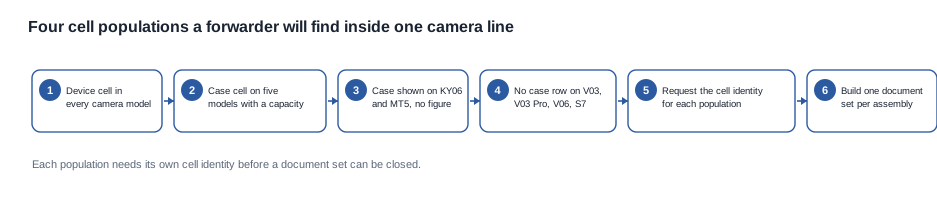
A camera product in this range is not one cell population. Before a logistics team can build a file, it has to establish how many distinct cell populations exist across the line, because each one needs its own identity and its own document. There are four, and separating them early is what makes the rest of the work tractable.
The device cell, in every camera model. Every camera model in the range publishes its own cell capacity, and every camera model contains its main cell as part of the equipment. This population is the simplest: one assembly, one cell, one set of documents per model string. The complication is that the catalogue publishes no firmware, no cell part number and no chemistry, so even this population cannot be documented from published material alone.
The case cell on the five models with a published capacity. The CY05 and the L1 Pro, and the CY03 — each at 1400 mAh, the L2 Utral at 900 mAh or 1400 mAh, and the MT6 at a foldable 1200 mAh are the models where a second, separately documented cell is known to exist from the catalogue. Note that the L2 Utral publishes two figures in a single row without stating which corresponds to which variant — the catalogue gives two variant names and two case capacities and does not publish the assignment between them, so a request has to cover both possibilities.
The two models with a case and no figure. The KY06 and the MT5 are the awkward middle case: a case is shown, but no capacity is published for it. A logistics team cannot treat these as case-free, because the catalogue does not say that either — it shows a case and leaves the figure open. The cell population therefore exists and its size is unpublished, which makes these two models the ones most likely to need a document request before the first despatch.
The four models with no charging-case row. The V06 and the V03 Pro, and the V03 and the S7 carry no case row, so for a buyer the honest position is that the presence or absence of a case in the box is an unpublished item for these four. If the answer turns out to be that a case is supplied, the line grows a second cell population and a second document set; if the answer is that none is supplied, the line stays at one. Deciding this before the production run costs one question, and discovering it at the loading bay costs a hold.

Why one document covering both assemblies stalls a shipment
Contained in equipment and shipped alone are different declarations
The distinction the transport framework encodes is between a cell contained inside equipment and a cell shipped on its own. A device whose main cell is fitted inside the housing follows the contained-in-equipment route, with the documentation, marking and packing that route implies. A charging case is a housing, a protection circuit, contacts and a cell in one assembly, and when it is packed as a separate item in the carton rather than fitted to the device, the forwarder can reasonably treat it as a battery shipped on its own.
That is why the answer to this question is not a yes or a no but a document-per-assembly answer, and why the practical first step is to establish how the case is actually packed. Is the case shipped in the same box as the glasses, in a separate box, or as an optional accessory ordered separately? Does the case arrive with the device as one retail unit, or does it travel as a separate line on the packing list? These are packing decisions, they are usually made for presentation reasons rather than for transport reasons, and they determine which document set applies. A buyer who does not know the answer cannot instruct a forwarder, and a forwarder who is not instructed will apply the most conservative treatment available.
Where the cost of a hold lands
A consignment held at the forwarder is not a customs event. It happens before the goods leave the consolidation point, it happens after the goods have been paid for and packed, and the cost lands on the party that cannot change the documentation quickly — usually the importer rather than the factory, and often the distributor rather than the importer. The expense categories are ordinary and unglamorous: storage, re-packing or re-labelling, a delay to the delivery date, and the loss of a booked slot in a container or an air consolidation.
The commercial damage is usually larger than the direct expense. A first bulk order that arrives after the buying season has opened is a different commercial outcome from one that arrives before it, and the difference falls across the whole line rather than across one model. For a distributor, the first shipment sets the pattern that a buying department plans against; a hold on the first shipment does not delay one delivery, it delays the whole schedule behind it.
The test of a supplier's logistics competence is therefore available in a single email, and it is worth sending before the first order rather than after it. The question is whether the glasses' documentation covers the case. A supplier who answers that the glasses' test summary covers the case is telling you that the case was treated as part of the equipment, which is a position that holds only when the case is genuinely never shipped as a separate item. A supplier who answers that the case is a separate assembly requiring its own cell test summary and its own description is telling you the opposite, and that is the answer that lets a forwarder clear the consignment.
It is worth naming who settles a disagreement between a forwarder and a supplier, because it is rarely the person who first raises it. The forwarder works from the documents and the packing list; the supplier works from the cell identity and the assembly. When the two disagree, the disagreement is nearly always about how an item is packed rather than about what is inside it, which means the resolution is a packing decision rather than a laboratory question. A buyer who establishes the packing configuration in writing before the production run removes most of this category of argument, and the decision is cheap because it belongs to the importer who has to live with the answer.
The same reasoning applies to the point where two suppliers give different answers for the same model. In practice the divergence is not about the cell; it is about whether a case is supplied at all, and the four camera models with no case row are the models where that divergence appears. This is the practical reason to resolve the case question per model rather than per product line: a line-level answer can be right for the range and wrong for the configuration in the carton, and the document set is built from the carton.

Assembling the compliance file before the production run
The documentation for a lithium product is assembled before the first production run, not before the first container, because the test summaries and the cell identifications have to exist for the product to be built and cannot be produced on demand at the loading bay. The list below is the working set a logistics lead should confirm internally, and each item is a question to the supplier rather than a number to be looked up.
- A test summary for every distinct cell. Each cell fitted in the product needs its own test summary under the UN 38.3 framework, and the case cell counts as a distinct cell whenever it is a different cell. Ask: which cell part numbers are fitted in which assembly, for a named model, and can a test summary be provided for each one.
- The cell identification itself. Model, chemistry, rated voltage and rated capacity are the four inputs a transport calculation needs, and the catalogue publishes only capacity. Ask: the four values per cell, so that the energy figure can be calculated rather than asserted.
- An assembly description for each battery-containing item. The device and the case are separate assemblies and need separate descriptions. Ask: a description per assembly, covering the housing, the protection circuit and the contacts.
- The packing configuration for each assembly. Whether the case ships in the device box or separately is what determines the treatment, and it is a decision the importer usually makes. Ask: which configuration the supplier quotes against, and confirm it matches what will actually be packed.
- The shipping mode for each destination. Requirements differ by mode and by route. Ask: the document list your forwarder requires per mode, stated by them rather than assumed, before the first purchase order is placed.
- The authorised signatory. A document that names no signatory is a document that gets rejected. Ask: who signs on the supplier's side, and whether the documents are issued per model string or per shipment.
- The position on retest dates. Test summaries carry a validity horizon, and a product that stays in production past that horizon has a compliance problem that is invisible at the start. Ask: the retest position for each cell, and what happens to a shipment if a summary expires mid-programme.
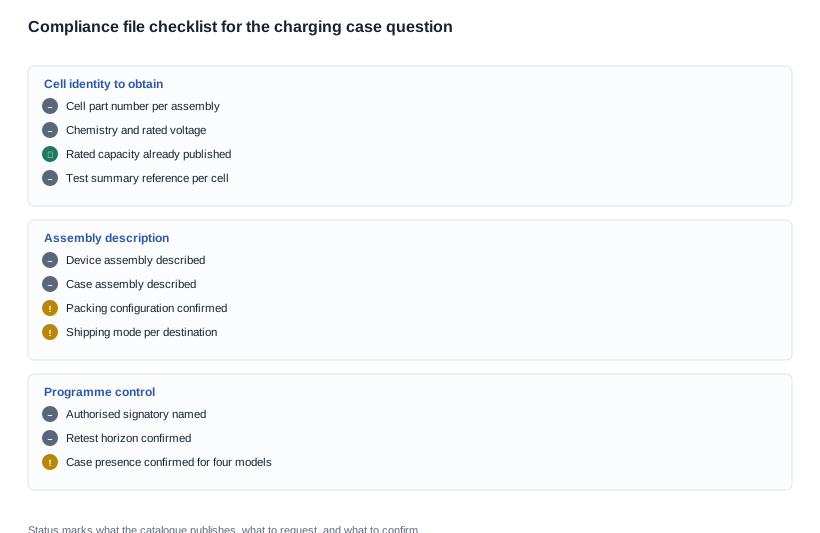
The order of that list is deliberate. Items one to four establish what the assemblies are and what documents exist for them; item five establishes how they must be presented; items six and seven establish whether the file survives a programme rather than a shipment. A logistics team that works the list in this order will usually find that the expensive ambiguity sits in item four — the packing configuration — because it is the item nobody owns inside the business.
Two partial outcomes are common and both are workable. A supplier who confirms a case is not supplied for the four models with no case row simplifies the file to one assembly for those models, and the confirmation is written down as an unpublished item resolved. A supplier who confirms that a case is supplied everywhere in the camera line makes the file larger, and the buyer has to decide whether the retail presentation is worth a second document set per shipment. Either way the decision belongs to the buyer, and it belongs at the point where the packing list is being designed rather than the point where the container is being sealed.
Where the boundary of this answer sits
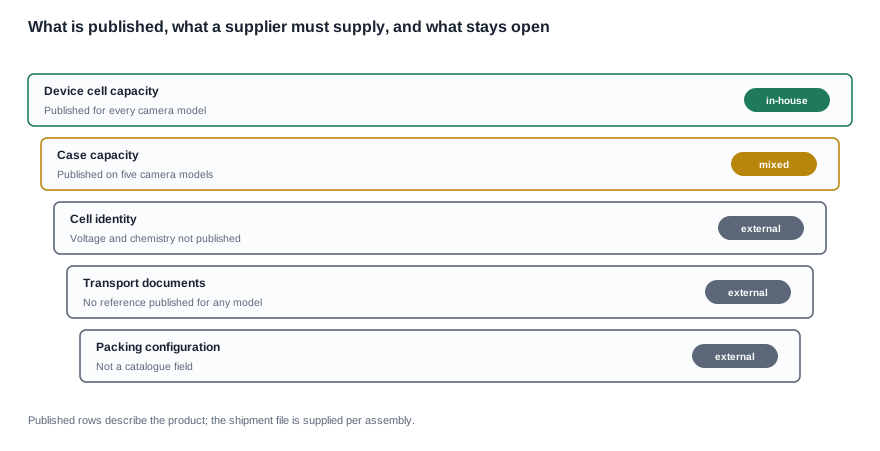
The published position has a clear edge and it is worth being exact about where the edge sits. The catalogue supplies the hardware rows: a case capacity on five camera models, a case shown without a figure on two, no case row on four, and the device cell capacity for every camera model in the range. It supplies no transport document, no cell identity beyond capacity, no classification and no certificate number. A documentation request built on those two halves — published rows for what the product contains, supplier documents for what the shipment must declare — is a request that can actually be answered.
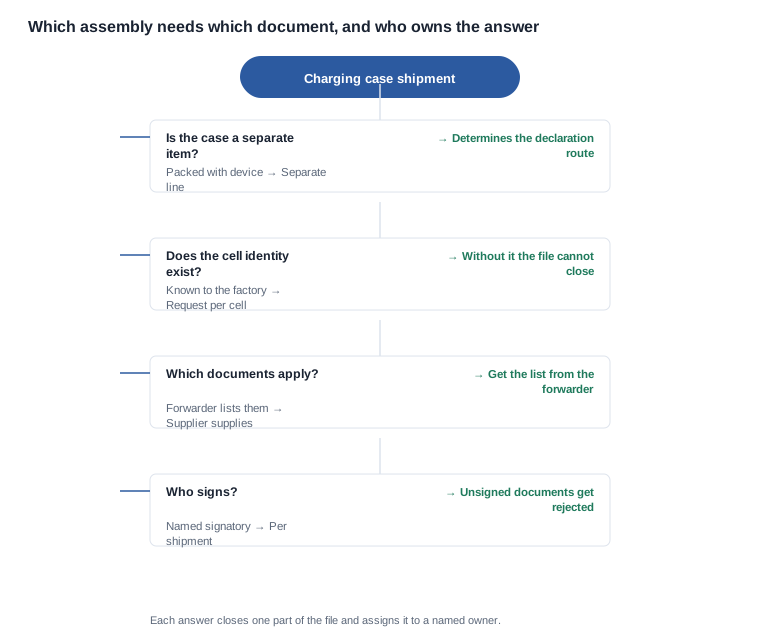
The limit of the answer is equally clear. Documentation we hold for a specific model and a specific shipment can be supplied; test report numbers, cell part numbers and transport classifications do not appear in the published material, and a partly correct reference is worse than no reference at all, because a forwarder acts on what it is given. A buyer who needs the document before the order is placed should ask for it by name; a buyer who needs the position before the supplier is chosen should ask for the cell identity, because the identity determines whether the document they are waiting for will exist.
What this answer does settle is the structure of the problem. The case is a separate assembly, the case cell is a separate cell, the packing configuration decides the treatment, and the request is per assembly rather than per product. Those four statements are enough for a logistics lead to build a request schedule and a compliance file, and they are enough to tell whether a supplier's answer to this question is a considered one or a reassurance.
The wider compliance picture for lithium goods sits on the battery transport page, the document-level detail is in battery transport compliance documentation, and the rest of the buyer checklist sits in battery transport compliance buyer checklist. On the product side, the charging-side specification gaps are covered in smart glasses charging advanced considerations and in what the spec sheet never tells you about charging, while the warranty consequence of treating a case as an accessory is in smart glasses charging buying mistakes to avoid. The case options published for the camera tier are set out in AI camera glasses charging case options.
Related reading
- The document set a lithium shipment actually needs — battery transport compliance documentation
- The rest of the buyer-side file — battery transport compliance buyer checklist
- Which camera models publish a case capacity — AI camera glasses charging case options
- The charging rows and the gaps between them — smart glasses charging advanced considerations
- What a charging datasheet leaves out — what the spec sheet never tells you about charging
- Where treating a case as an accessory goes wrong — smart glasses charging buying mistakes to avoid
Send the model, the shipping mode and the packing configuration, and we will tell you which assemblies a forwarder will ask to document.


