

A first order is written by someone who expects to need the contract. The second order is written by someone who does not, because the relationship feels established. These are the mistakes that follow from that, and they are all variations on a single cause: the first agreement described a programme, and the programme has since become something else.
The specific failure is not that the repeat order is badly written. It is that the repeat order is rarely written at all. Most repeat programmes run on the first agreement plus a series of emails and purchase orders, and the emails accumulate the changes while the agreement stays where it was. By the time somebody needs to prove what was actually agreed, the proof is spread across a purchase order, a quotation revision, a change request and a phone call, and none of them is complete.
Six mistakes recur at this stage. They are set out below in the order they appear chronologically, which is also the order in which the next agreement should address them: the assumption that the first agreement still covers everything, the drift of acceptance criteria, the negotiation that starts with price, the destination market list that was never re-checked, the substitution rule that was dropped because it had not bitten yet, and the tooling and firmware clauses that quietly did not survive.
The practical conclusion is uncomfortable but simple. At the repeat stage the highest-value work is not renegotiating the unit price. It is finding out what has changed since the last agreement, because almost every expensive repeat-order dispute in this category traces back to a change that was absorbed in conversation and never written down.

Smart glasses contract: why the first one stops covering the programme
A contract in this category is written around a configuration, and a configuration is not a product name — it is a combination of published rows that a receiving inspector can check. The camera models in our own catalogue illustrate how quickly a combination moves. There are eleven of them, and they split into eight at 8 MP and three at 13 MP. Four of the eleven have a charging case, and the case capacities across the camera line run at 1400 mAh for the L1 Pro and the CY03, and the CY05, at 900 or 1400 mAh for the L2 Utral, and at 1200 mAh in a folding case for the MT6, while the KY06 and the MT5 carry a case whose capacity is not published and the V03 Pro carries none at all. The charging interface is published on twenty-four of the twenty-eight catalogue entries and is absent from the four rows for the CY05 and the CY03, and the MT6 and the L1 Pro. The ingress marking appears on two models only.
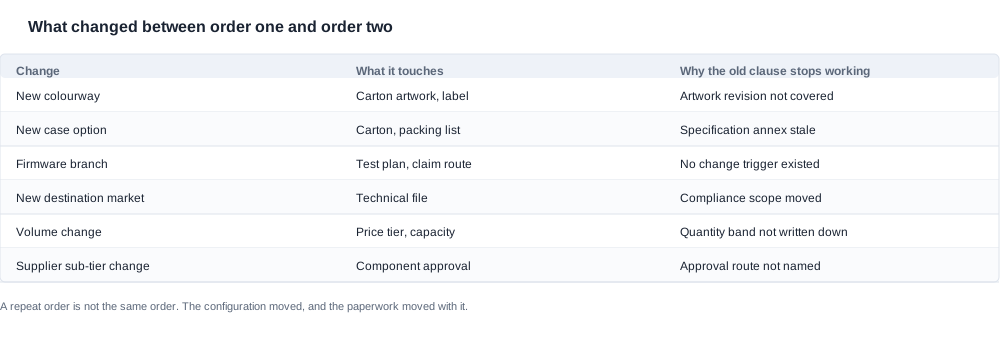
Each of those rows is a decision somebody made at some point. A repeat programme typically takes on at least three new ones: a colourway, a case option, a firmware branch, a destination market, a volume band or a different sub-supplier for one component. Each of them is individually small. Together they are enough to move the configuration away from what the first agreement described, and the first agreement does not have a mechanism for noticing, because mechanisms that were never written into it cannot start working later.
The second reason the first contract stops covering the programme is regulatory rather than commercial. A change in configuration can move the documentation requirement with it, and in the European Union that means the technical file under the Radio Equipment Directive (EU) 2014/53/EU and the traceability obligations under the General Product Safety Regulation (Regulation (EU) 2023/988, applicable since 13 December 2024). A colourway change on the carton is administrative. A new case option changes what is in the box and can change the declared configuration. A new firmware branch can change what the product is declared to do. The question at the repeat stage is not whether the change is significant — it is significant in every sense — but whether the documentation still covers it.

The configuration drift nobody writes down
Drift has a characteristic signature: every individual change is reasonable, and no single one of them would trigger a documentation review. The channel asks for a darker frame for the retail line. A customer wants the model with the folding case rather than the fixed one. A firmware update is pushed to fix an issue the buyer's own testers found. Each of these arrives as a request, is handled by the person who handles requests, and is recorded in a task tracker rather than in the agreement.
By the tenth order, the goods that arrive are not the goods the agreement describes, and no single person can say when they stopped matching. This is why the first question at the repeat stage is not about price. It is: what has changed since the last agreement, and does the documentation still cover it. That question has to be asked by someone with the authority to compile the answer, which in practice means it has to be asked of the people who took the requests — the channel manager, the product owner and the person who approved the firmware.
The output of that question should be a change log, and it should be attached to the new agreement as an exhibit rather than summarised in an email. A change log for this category does not need to be long. Six rows cover nearly everything: a new colourway, a new case option, a firmware branch, a new destination market, a change in the volume band, and a change of sub-supplier for a component. Each row carries what changed, when, who approved it, what documentation it touches, and whether the price or the date moves as a result.
There is a specific trap in this exercise, and it is worth naming because it is easy to miss. A change in the description of the product is not the same as a change in the product. Our published endurance figures are a good example of why the distinction matters: the catalogue gives a rated run for every entry, with the camera models running at 5~8 hours for the V06 and the S7, and the V03 Pro and the V03, at 6~8 hours for the KY06 and the MT5, and about 7 hours for the CY03 and the MT6, and the CY05 and the L2 Utral, and the L1 Pro. None of those figures comes with a test condition, and the charging time is published for every entry — two hours or less for twenty-six of them and about an hour for the D17 and the ZH12 — but without a starting state or an end criterion. A retail listing that quietly upgrades a 5~8 hour band into "all day" is not a change to the hardware. It is a change to the promise, and the difference between the two is exactly what a returns reserve is built from.
A second trap sits alongside it, and it is the one that catches buyers who have been running the programme successfully for two years. A configuration that is documented is not necessarily a configuration that is fixed. The published rows describe the product as offered; the programme runs on a build that was agreed for the first order and has been re-used, without argument, on every order since. Those two things are usually the same. Occasionally they are not, and the occasion is nearly always a component that was substituted inside the factory during a constrained supply period and was never written down on either side. That is why the change log at the repeat stage has to include the sub-supplier column, even though no buyer has ever asked for it and no supplier has ever volunteered it.
The reverse trap is worth naming as well, because it pushes in the opposite direction and produces a different kind of loss. Buyers who have been burned by an undocumented change sometimes over-correct, and rebuild the entire specification schedule for every repeat order. That is defensible but expensive in a way that does not show up on a supplier's invoice: it consumes the buyer's own legal and quality time, it lengthens the approval cycle on every order, and it invites the supplier to re-quote from scratch each time, which is precisely the commercial instability the buyer was trying to remove. The proportionate answer is to re-state the configuration schedule against a change log, which means the schedule is refreshed rather than rebuilt.
Criteria agreed verbally, and the standard they became
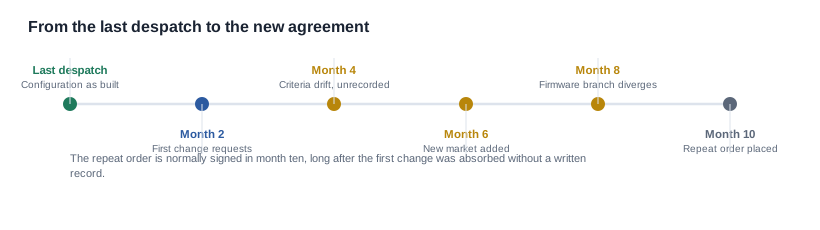
The second repeat-stage mistake is the quietest one. Acceptance criteria agreed verbally in month three become the standard by month nine, and by then nobody can say where they came from. The supplier is shipping to a specification that exists only in the memory of four people, three of whom have left, and the buyer is asserting a standard it cannot produce in writing.
The cure is not expensive and it is not a negotiation. Re-state the criteria in the repeat agreement, with their methods, and note any change together with the reason for the change. The reason matters more than it looks: a criterion that changed because a measurement method was found to be wrong is a different event from a criterion that changed because the goods stopped meeting it, and the two need different handling. The first is a correction. The second is a supplier performance conversation, and it should be had explicitly rather than absorbed into a redrawn sentence.
The criteria worth re-stating in this category are the ones that touch published rows, because those are the only ones with a number against them and therefore the only ones a receiving team can actually apply. What is the cell capacity that has to be present. What the charging interface is, on the four models where the catalogue does not publish one. Whether the unit carries the charging case the schedule names and at what capacity. Which resolution tier. Which colourway, and whether the run is mixed or single. Each of these is checkable by an inspector with the schedule in hand, and each of them is checkable in a way that a subjective standard like "acceptable finish" is not.
There is also a question of what happens to the goods that arrive against the old standard. A repeat order that changes the criteria usually changes the product in some way, and the units already in the channel were built to the previous standard. A short transitional statement — which standard applies to which units, and for how long — prevents a stock problem from becoming a returns problem.
The mechanical test for whether a criterion has really been re-stated is simple and worth applying to every row: could somebody in the receiving team apply it without asking a question? If the answer is no, the criterion is a description rather than a criterion, and the disagreement is not going to happen at the point of rejection — it is going to happen in a dispute about what was meant. Two categories are worth separating inside that test. A criterion that needs a measurement instrument the buyer does not have, such as an acoustic threshold or an ingress test, is not wrong so much as unusable without a named method and a place to record the result. A criterion that needs a judgement — finish, appearance, the general impression of the unit — is where the real disputes live, and it should be anchored to a signed physical sample rather than to a description.

The four clauses dropped first and paid for last
Treating the price adjustment as the only negotiation. A unit price that has moved is often explained by a real component cost change, and that explanation may well be true. The problem is not the price conversation; it is that it displaces the ones that matter. The acceptance window, the re-sequencing rule, the substitution requirement, the change-control trigger list and the ownership clauses are all cheap to re-state in a repeat agreement and expensive to introduce into a live programme. Opening with the unit price signals that the unit price is the only term worth negotiating, and the agreement will be settled on exactly that basis.
Not re-checking the destination markets. A market sold into in year one may have changed its requirements, and a market added in year two may need something that was never done the first time. Compliance scope is re-examined whenever the destination list changes, and the re-examination is not a formality: it is the point at which a technical file is confirmed as covering the configuration and the labels are confirmed as carrying the right traceability information.
Dropping the substitution rule because it has not bitten yet. It has not bitten because nothing has been unavailable. The rule is worth having precisely when it is inconvenient to write and trivial to include. A same-capacity substitution is invisible on the published rows and visible in field behaviour, and the rows it would be invisible against are exactly the ones the agreement depends on — the cell capacity, the charging interface, the case capacity, the resolution tier. At the repeat stage the substitution rule should also say what happens to a unit already approved, because a substitution approved for the next build is a substitution that has already changed the programme.
Assuming the tooling and firmware clauses survived. They frequently did not, because they were the two a buyer was most willing to drop on a first order and the two most expensive to raise on the second. Raise them now; the cost is lower than a first-order objection, provided you raise them. The practical form of the question is not whether the supplier will hand over the mould, but whether the buyer has the drawing, the revision history and the right to move production, and whether the firmware and the application build sit with the buyer or with whoever wrote them.

The sequence that keeps the leverage
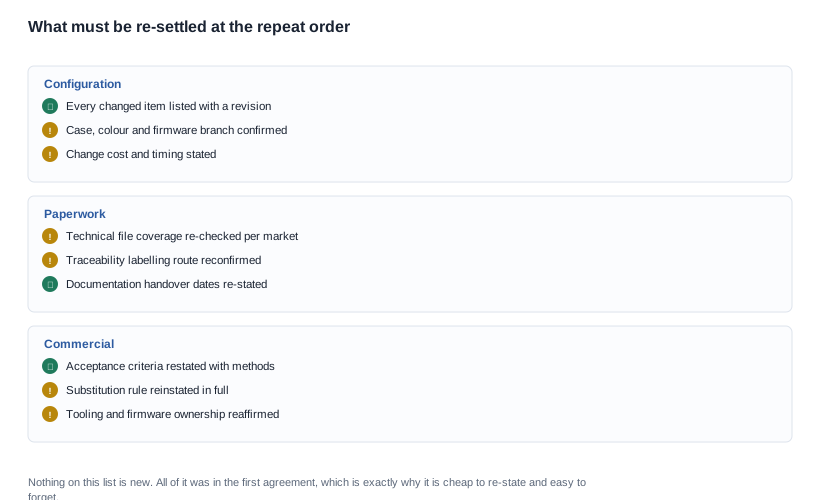
The order in which these are addressed is not a matter of taste. Ask the configuration question first, because it determines whether the documentation work is even the right conversation — if nothing changed, the documentation question disappears. Then re-state the criteria, because that is cheap and everything else attaches to them. Then the substitution rule, then the destinations, then the ownership clauses, and only then the price.
Doing it in that order means the price discussion happens with the substance already settled, which is the only order in which a price agreement is worth having. It also means the buyer can tell, from the supplier's answers, whether the relationship is one where the paperwork is maintained or one where it is reconstructed on demand. A supplier that can produce a change log for the last six months has a process. A supplier that reconstructs one from memory has an inbox.
Two practical mechanics are worth adding to the sequence. First, the change log should be compiled by the buyer's side before the supplier is asked, because a supplier asked to list what changed will list what they remember being asked for, which is a different and much shorter list. Second, the repeat agreement should attach the previous agreement as an exhibit and state which document prevails on a conflict, so that the parts of the programme that did not change are still governed by something.
The trade-off deserves a sentence. Every clause re-stated is a clause the supplier has to re-negotiate, and a supplier asked to re-confirm eleven clauses at the start of a repeat order can reasonably ask what has changed. The answer is that most of them have not changed, which is the point: re-stating a clause that has not changed is the cheapest insurance in the agreement, and re-stating one that has changed is the only way to find out that it has.
It is also worth separating what a repeat stage is actually for, because the mistake is to treat it as a cheaper version of the first order. It is not. The first order is about establishing that the programme can run at all: which configuration, which documentation route, which acceptance method, which remedy. The repeat order is about preserving an outcome that already works while something underneath it moves. The commercial conversation at the repeat stage — price tier, capacity reservation, delivery window — is genuinely worth having, and it is worth having with the substance settled rather than instead of it. Our published material does not include unit prices, minimum order quantities or production lead times, so those three have to be written into the repeat agreement in order to exist at all; the same is true of the price tier, the capacity reservation and the delivery window. What is published is the configuration space the tier attaches to, and that is the part a buyer can check before the commercial conversation opens.
What Cynrin puts into a repeat agreement
We will put the changed-configuration question, the re-stated acceptance criteria with their methods, the substitution rule, the re-checked destination market list and the ownership clauses into a repeat agreement, and we will tell you plainly whether a given change would need reassessment rather than reassuring you that it would not. Where a change does need reassessment, the assessment is usually short — a colourway is administrative, a case option or a firmware branch needs the configuration and the documentation re-checked against it.
Our unit prices, minimum order quantities and production lead times are not published, and neither are the certificate numbers, the sensor part numbers, the field of view, or the frame weights on any model other than the MT6, where the catalogue records the glasses body at 158 g including the cell and the camera and excluding the 1200 mAh folding charging case. A repeat agreement resting on figures we cannot evidence inherits the same weakness as the first one, and it inherits it at a point where the buyer's alternatives are much narrower.
For the clause detail, see contract terms. The eight omissions that cost buyers money cover the first-order list this one assumes was closed, how a contract affects lead time covers the schedule clauses, and the quality consistency page is where the criteria should be settled before they are written down.
Related reading
- Eight mistakes that cost money — the first-order list
- How a contract affects lead time — the schedule clauses
- Quality consistency — what the criteria should say
- Contract terms and agreements — the clause detail


