

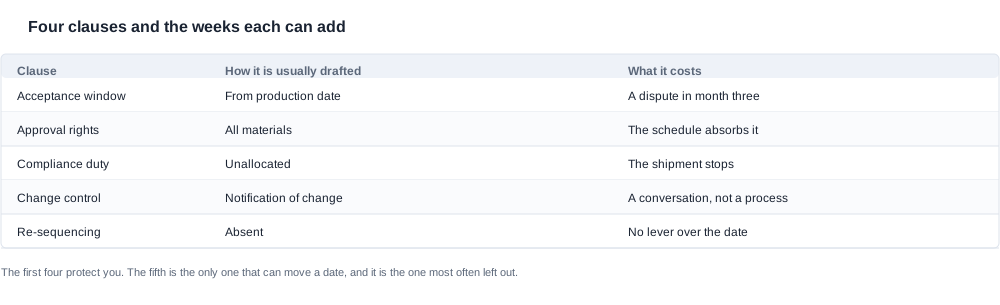
A contract can add weeks to a lead time without adding a single day to the schedule, and the mechanism is clause choice rather than production capacity. The four clauses below account for most of that delay, and all four are decided in an afternoon that is usually spent elsewhere — usually on the payment structure.
This matters more in this category than the subject suggests, because the product itself is not the hard part of the schedule. The hardware is assembled from standard components, and the real uncertainty in a smart glasses order sits in three places: what has to be approved before the line can start, what has to be documented before the carton can be printed, and what has to be decided before the goods can leave. All three are decisions, not manufacturing operations, and all three are governed by clauses.
The conclusion is that the schedule a buyer should be protecting is not the production lead time — which in our published material is not published and therefore cannot be planned against anyway — but the elapsed time from order to despatch, which the contract does govern. The four clauses below are where that time is won or lost, and the fifth section sets out the one clause that can actually move a date rather than merely protecting it.
Smart glasses contract: four clauses and the weeks each adds
The four clauses are not unusual and none of them requires a lawyer to draft. They are unusual in the sense that buyers rarely think of them as schedule clauses at all, because they sit in the general conditions rather than in a schedule annex, and they are decided on a day when the commercial terms are what everybody is looking at.
Clause one: the acceptance window. Necessary in every agreement, because without it the buyer cannot reject a visible defect. But a window measured from the production date rather than from arrival is a window that expires before the goods exist, and it converts a routine inspection into a dispute three months later. The schedule cost of a badly drafted acceptance window is not the inspection itself; it is the escalation, because a rejection that the buyer is not confident about gets deferred, and a deferred rejection is usually a reshipment rather than a credit.
Clause two: approval rights. A clause giving the buyer approval over "all materials" is convenient to write and impossible to administer, because every artwork revision, every firmware build and every packaging proof needs a named approver with a deadline. Where the contract requires approval of everything without stating who approves and by when, the schedule absorbs the ambiguity — usually as a stall at the point where the line is waiting to be released.
Clause three: compliance ownership. In the European Union, radio equipment sits under the Radio Equipment Directive (EU) 2014/53/EU and traceability under the General Product Safety Regulation (Regulation (EU) 2023/988, applicable since 13 December 2024). A contract that does not say who is the manufacturer of record and who is the responsible economic operator produces a question at the point where answering it requires three people and a fortnight. Unallocated obligations do not delay a production line. They delay a shipment, which is worse, because the line can absorb a pause while a despatch window cannot.
Clause four: change control. A clause saying the supplier "shall notify the buyer of significant changes" without defining significant, or without saying what happens next, produces a conversation rather than a process. Firmware updates and component substitutions in particular need a trigger list and a named approver, because both can land in the middle of a production window, and a substitution that lands inside the window is a hold on the whole batch rather than a change to one unit.
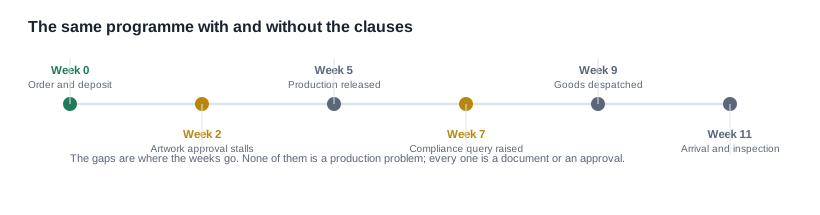
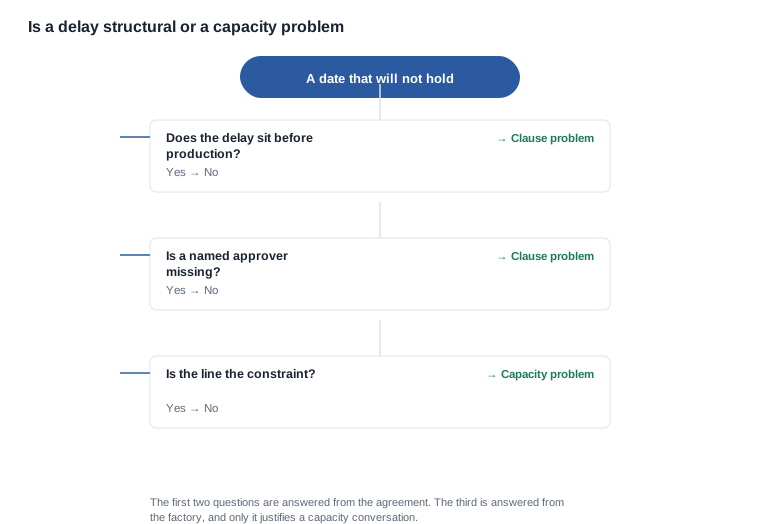
Before going clause by clause it is worth separating two problems that look identical on a calendar. A schedule delay is a delay the contract could have prevented: an approval with no owner, a window measured from the wrong event, a compliance role that nobody holds. A capacity delay is a delay the line cannot avoid: a component that has to be sourced, a process step that has to be re-run, a sub-supplier's own queue. The two are diagnosed differently and they are settled by different conversations, so telling them apart before the negotiation starts is worth more than any specific clause.
There is a quick test that works most of the time. Ask what happens to the date if every document arrives on the day it was promised. If the date would still hold, the constraint is in the production route and the conversation is about capacity. If the date would still slip, the constraint is in the documents and the conversation is about the agreement. In our experience the second answer is more common than buyers expect in this category, because the route is short and the paperwork behind it is long.
The other half of the distinction is that a capacity delay is usually the supplier's to explain and a schedule delay is usually the buyer's to fix. A buyer who opens the conversation with "your lead time is too long" has made an assertion that is usually wrong and that the supplier can rebut with a production plan. A buyer who opens with "our approval clauses have no named owner, so please tell us who on your side needs what by when" has made an assertion that is almost always right and that moves the conversation to the only place where a date can actually be recovered.

The acceptance window that expires before the goods exist
The acceptance window is the clause most often drafted in the wrong place, and the error is consistent enough across this category to be worth stating as a rule.
The rule: the window runs from arrival at a named place, and the named place is a place the buyer controls. "From the date of production" is not a trigger a buyer can observe. "From the date of arrival at the destination warehouse" is. The difference between the two is not semantic — it is the whole shipping period plus the clearance period plus the inland transit, and in this category that interval is routinely longer than the window itself.
Three parts have to be right, and buyers routinely get two of the three. The trigger, as above. The length, which has to match the buyer's own receiving cycle rather than a round number — a first order moving through a freight forwarder has a longer cycle than a repeat order from the same channel, and a single window applied to both will be wrong for one of them. And the remedy, which has to be stated as replacement, credit, rework or an allowance, because a window with no remedy attached ends in an argument rather than an outcome.
The schedule effect of getting the trigger wrong is worth spelling out, because it is counter-intuitive. A window measured from the production date can expire before the goods are inspected, which means the buyer's receiving team performs an inspection it has no right to act on. Inspections performed without authority are performed anyway, and the findings are recorded, and then the buyer's commercial team has to decide whether to pursue a rejection that the contract has already closed. That decision takes longer than the inspection did, and it usually ends in acceptance by silence. The weeks in this scenario are not in the supply chain; they are in the buyer's own process, which is the part nobody puts a delivery date against.
There is a second version of the same error that is less obvious. A window that runs from arrival but whose length is stated in days without saying which days — business days or calendar days — is a window that quietly shrinks by a third, because the freight forwarder's calendar is not the buyer's. In a programme with a launch date attached, a window that is eleven working days instead of seven calendar days is the difference between catching a bad batch and shipping it.
Approval rights with no owner and no deadline
The approval clause is where schedules go to hide in this category, because the clause reads like a protection and behaves like a queue.
The mechanism is simple. A contract requires the buyer to approve the artwork, the packaging, the firmware build and possibly the test plan. Each of those is a real gate in the production route, and each one waits for a decision from a named person. If the agreement does not name the person, the approval does not have an owner, and an approval without an owner does not have a deadline either — because a deadline is something you can hold somebody to, and there is nobody to hold.
What happens then is predictable and it is slow. The line waits. The production slot waits. Nobody can say who is holding it up, because the clause does not say who was supposed to act. And the buyer cannot even tell the supplier to escalate, because escalation requires a person to escalate to.
The fix is not to remove the approval right. It is to attach three things to each approval item: a named role, a deadline expressed in days, and a consequence if the deadline passes without a response. That last element is the one that does the work. A clause stating that a late approval is treated as approval converts an open question into a scheduled event, and it protects both sides — the buyer gets a default behaviour instead of a stall, and the supplier gets a defined date instead of an open-ended wait.
The number of approval items is worth checking too. In a first order in this category there are usually four or five: the specification annex, the artwork and carton, the packaging proof, the firmware build and the test plan. If the agreement says "all materials are subject to buyer approval" it has actually created a single gate with an undefined scope, and that gate will be contested at the least convenient moment. Listing the five items separately costs a paragraph and removes the argument.


Compliance ownership and change control written as intention
The compliance clause and the change control clause are grouped here because they fail in the same way: both are drafted as statements of intention rather than as procedures, and a statement of intention does not have an owner or a step attached to it.
Compliance ownership fails by omission. The agreement says the supplier will comply with the applicable requirements, and nobody is assigned. The question that surfaces is not whether the product complies — it is who answers when a customs authority, a market surveillance body or a channel partner asks. And that question has an unusually expensive answer in this category, because the underlying evidence sits with the factory and with sub-suppliers: the certificate numbers, the issuing bodies and the validity dates are not published, so they have to be sourced from whoever holds the file. A clause that assigns the role without assigning the sourcing work moves the delay rather than removing it.
The clause needs four names, not one: who is the manufacturer of record, who is the responsible economic operator in the destination market, who holds the technical file, and who signs the declaration of conformity. These are four different questions and they frequently have four different answers, which is why "the supplier shall be responsible for all regulatory matters" resolves nothing.
Change control fails by vagueness. "Significant changes" is not a definition, and the party who has to apply it — usually the factory's project engineer — will apply it differently from the party who wrote it. The clause needs a trigger list, a named approver on each side, a notice period, and a statement of what a change costs and what it moves. Without the last one, a change arrives as a request under time pressure, which is the worst way to negotiate and the fastest way to lose a date.
The schedule interaction between the two is worth noting, because it is where a well-drafted pair of clauses can undo each other. A generous change control clause with no notice period means a substitution can be made during the production window, which holds the batch. A strict compliance clause with no sourcing plan means the documentation arrives after the carton has been printed, which holds the despatch. Neither is a production problem and both cost the same number of weeks.

The one clause that can move a date
Four of the clauses above protect the buyer. The fifth is different: it gives the buyer a lever, and it is the only one that can move a date rather than merely prevent one from slipping.
A stated re-sequencing rule answers three questions. What happens if a stage slips — does the whole order shift, or does the buyer get a partial despatch. Who decides — the supplier unilaterally, the buyer unilaterally, or jointly with a stated default. And whether the slot is held or rebooked, which is the question that determines whether a two-week slip becomes a two-week slip or a two-month one.
A supplier who describes the mechanism for holding a slot has given you something usable. A supplier who says the slot will be fine has given you nothing, because "fine" is a forecast rather than a mechanism, and forecasts do not survive the first real slip.
Partial despatch is the element most often omitted and it is the most valuable one in practice. A buyer who has a launch date and a channel commitment does not want one shipment of everything on one date; a buyer wants the committed quantity to arrive first and the balance to follow. A clause that permits split deliveries against a written delivery plan converts a single point of failure into two, and the delivery plan is a document the buyer already needs for the freight booking and the customs entry.
There is a condition on the lever, and it is worth stating plainly: the re-sequencing rule only works if the acceptance window is measured from arrival. If the buyer has already accepted the goods by the production date, then a partial despatch has nothing to be accepted against, and the two clauses contradict each other. This is the clearest example in this category of why the clauses have to be read together rather than one at a time.
The clause is also the one that most affects what a buyer should ask about capacity in a factory conversation. Our production capacity is not published, so the buyer cannot look it up; what the buyer can do is ask whether the factory holds a slot against a stated configuration and what the mechanism is when a slot is released. The answer to that question is the same mechanism as the re-sequencing rule, and a factory with one has both.
Drafting order, and what we will not sign without
Draft the schedule clauses before the commercial ones. Most agreements are drafted commercial-first, which means the payment structure gets the attention and the schedule gets whatever is left — and the schedule is where the delays live. It is not unusual for a buyer to spend three weeks negotiating a deposit percentage while the clause that would have saved three weeks of schedule was settled by default because nobody read it.
Within the schedule, three items need names rather than descriptions: who approves artwork, who approves firmware, and who may re-sequence a slot. Write those three down and the rest of the schedule becomes arithmetic. Leave them blank and the arithmetic has three unknowns in it, which is where the weeks go.
A workable drafting sequence looks like this, and it takes one session rather than three. Open with the delivery plan: the dates, the split delivery structure, the packing list format and the document set that has to be assembled before despatch. Then fix the acceptance window against that plan, because the window determines how long the buyer holds the inspection queue and therefore when the despatch can be signed off. Then write the approval gates against the artwork and firmware dates, with a named approver, a deadline and the late-approval default for each. Then allocate the four compliance roles. Then write the change control trigger list, because it has to be agreed before anything can change. Then, and only then, write the re-sequencing rule and the commercial structure, both of which now have a schedule to attach to.
Two things should be checked before the session rather than during it. The first is that the buyer's own side has named approvers, because a clause that requires an approval the buyer cannot resource is a clause that will be missed. The second is that the supplier has named the role that holds the technical file, because the compliance allocation is meaningless if that name is a placeholder.
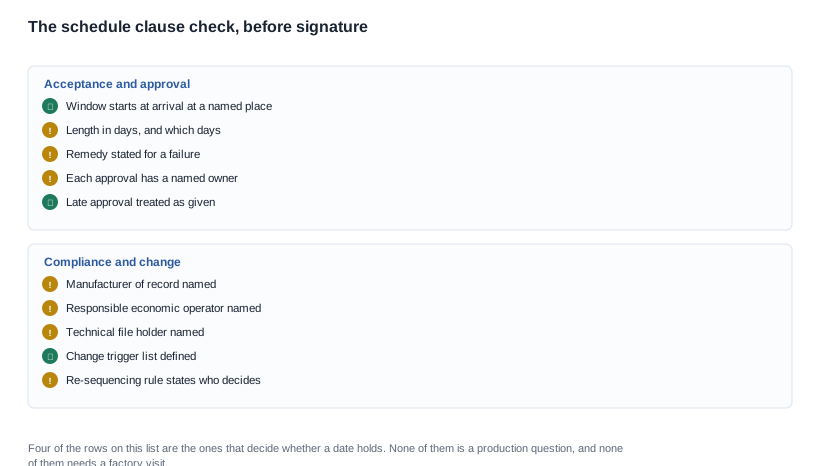
We will draft these clauses and we will not sign an order that leaves compliance ownership unallocated or approval rights without named owners. Where a clause cannot be agreed, we will say so at quotation stage rather than at the shipping date.
Our unit prices, MOQ figures and lead times are not published, and a contract signed against figures we cannot evidence is one that will be renegotiated. This is a particular problem in this article's subject, because a lead time is precisely the number a buyer most wants to fix and most needs to write down. The published material gives the buyer the configuration, the cell capacity, the charge time, the rated run, the charging interface on twenty-four of the twenty-eight catalogue entries, the resolution tier for all eleven camera models and the case options — and the schedule around all of that has to be written into the agreement.
The contract terms section covers the clauses themselves, the eight omissions that cost buyers money is the companion list for the first-order stage, lead time negotiation covers the schedule conversation with the factory, and reading a contract goes through a contract line by line.
Related reading
- Contract mistakes — the eight omissions
- Lead time negotiation — the schedule conversation
- Reading a contract — clause by clause


