

Eight contract mistakes recur in this category, and every one of them is invisible until a dispute starts, at which point the argument is about evidence nobody gathered. None of them requires a lawyer to fix. They are all omissions, and omissions are what cost money in a contract written for a dispute that never came.
The eight are set out below in the order they surface: what the draft says, what actually goes wrong, and the clause that closes the gap. Three of them — the undefined product, the undefined acceptance window and the unallocated compliance duty — account for most of the exposure, because each one hands a later problem to the wrong desk. The remaining five are cheap to close and are routinely left open because they looked administrative on the day.
The short version for a buyer with a quotation to sign this week: if the agreement does not name the configuration, does not attach a method to its quality criteria, does not start the acceptance window at arrival, and does not name who holds the regulatory obligations, then do not sign it yet. Those four can be settled in an afternoon, and each one is worth more than the margin a hard negotiation on unit price would win.
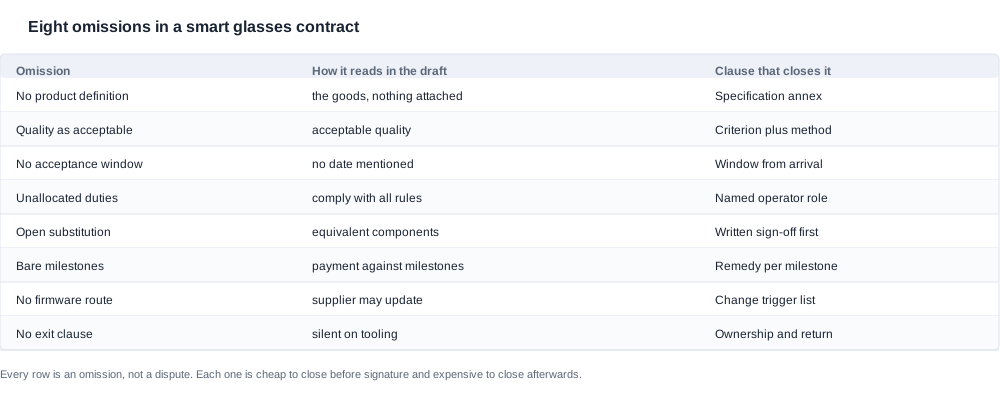
Smart glasses contract: eight omissions and what each one eventually costs
A smart glasses contract is unusual in how little of it is about the product. The product is described in a catalogue, and the catalogue is the same for every buyer in the category. What a buyer is actually purchasing is a set of promises about a configuration they will not be able to hold in their hands until the goods arrive: that this cell capacity was built in, that this charging method was used, that this artwork revision was approved, that the paperwork was filed by somebody with a name attached to it.
Because the catalogue is public and shared, the contract cannot do any work on the product itself. Its entire job is to bind four things the quotation leaves open — the configuration, the tolerance, the documentation and the remedy — and every one of the eight mistakes below is a failure to bind one of them. That is why they are omissions and not errors. Nobody wrote something wrong; somebody failed to write something.
The cost structure of an omission is worth understanding before the list, because it is unusual in B2B hardware. An error in a clause usually produces a visible problem at goods-in: a wrong colourway, a missing accessory, a carton with the wrong label. Those are cheap. An omission produces nothing visible at all at the point of delivery, and that is exactly why it survives until the moment it becomes expensive — usually a customs query, a returns spike, or a second order that arrives configured differently from the first.
One consequence deserves attention because it changes what a buyer should insist on. When the product description is public and shared across every supplier in the category, the agreement cannot be used to obtain a better product than the catalogue offers. It can only be used to pin down which build of that product arrives, who is accountable for it, and what happens when it does not. Buyers who arrive at the contract stage hoping for a specification advantage are negotiating in the wrong place entirely; the specification is fixed by the time the quotation exists, and the contract is where the accountability is fixed.
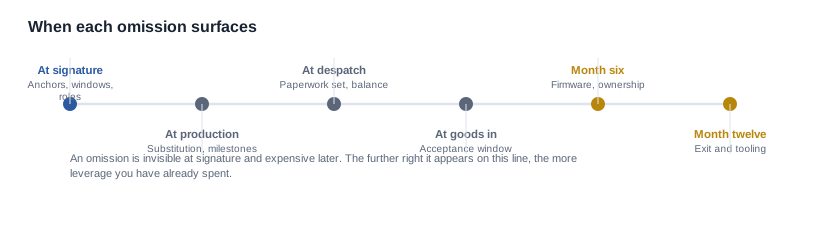
There is also a sequencing effect that works in the buyer's favour at the right moment and against them at the wrong one. At quotation stage, an omitted clause is nearly free to add: nobody has yet paid for the tooling, nobody has printed the carton, nobody has committed the production slot. At the repeat-order stage the same clause costs a negotiation that starts from a weaker position, because the programme has already paid for the assets the clause was supposed to protect. The table below maps each omission to the moment it becomes expensive, and the moment column is the one to read twice — several of the eight are visible in the contract on the day and only useful in month four.

Omission one: the product is never pinned down
The most common version of this mistake is a contract that refers to "the goods", "the products" or "the devices" and attaches nothing at all. The parties both believe the model is settled, because they have been discussing it in emails for six weeks. The emails are not attached, and by the time the goods arrive the discussion has moved on.
The fix is a configuration schedule, and the schedule has to carry the published figures rather than a product family name. Our own catalogue is a good illustration of why, because several of its rows look interchangeable until you read them together:
- The cell capacities across the camera models are not one number. The V03 and the V03 Pro carry 220 mAh, the L2 Utral and the L1 Pro, and the CY03 and the CY05 carry 290 mAh, the MT6 carries 265 mAh, and the S7 and the KY06, and the V06 carry 260 mAh. A contract that says "camera glasses" has specified nothing that a receiving inspector can check.
- The charging method is published on twenty-four of the twenty-eight catalogue entries and is not published on four of them — the CY05 and the CY03, and the L1 Pro and the MT6. Those four have a case capacity published (1400 mAh for three of them, a 1200 mAh folding case for the MT6) but no charging interface row at all. A schedule that asserts a charging method for those four is asserting something the catalogue does not carry.
- The resolution tier splits the eleven camera models into eight at 8 MP and three at 13 MP. A contract that says "high resolution camera" is not a specification, and one that says "13 MP" is a promise about a sensor characteristic that has to be tied to a model.
- The charging time is published for every entry, but the way it is published does not say what a full charge means in a way a buyer can audit. Twenty-six entries show two hours or less and two show about one hour, with no starting state and no end criterion given.
The practical test is simple: hand the schedule to somebody who has never seen the product and ask them to tell you, from the document, which unit is in the carton. If they cannot, the schedule is missing the fields that matter — and the fields that matter are the ones with a number against them, because a number is what the receiving team can check.
Omissions two to four: quality, acceptance and the unanswered regulatory question
Quality defined as "acceptable" is not a criterion and cannot be applied by two parties who disagree. The phrase appears in a large share of the agreements in this category because it is the shortest way to finish the sentence, and it carries no method with it. A criterion without a method produces an argument about interpretation; a criterion with a method produces a decision.
Writing the method into the clause is not hard, and in this category the method has to cover at least three things. First, the sample: a dated, signed physical reference, because "acceptable" is not measurable and a sample is. Second, the inspection record: what is actually captured, by whom, and against which unit identifier, because an inspection summary with no unit identifier cannot be used to reject anything. Third, the disposition: what happens to a unit that fails, who signs the concession, and whether rework is permitted at all. A contract that names those three things has, without saying so, created an audit trail.
No acceptance window means the buyer quietly loses the right to reject anything visible, because the goods are accepted by silence. This is the most expensive of the eight in cash terms, because a defect that is found by the end customer rather than by the receiving team is a return, a refund, a logistics cost and a customer service cost, all of which land on the buyer at roughly the wrong moment to be absorbed.
The clause has three moving parts and buyers routinely get two of them right. The trigger has to be arrival at a named place, not the production date, because a window measured from the production date expires before the goods exist — this is the single most common drafting error we see on this clause and it is worth checking first. The length has to be realistic for the buyer's own receiving cycle, which for a first order arriving through a freight forwarder is not the same as a repeat order from the same channel. And the remedy has to be stated: replacement, credit, rework, or a defined percentage allowance. A window with no remedy attached is a window that ends in an argument rather than in an outcome.
Unallocated compliance obligations are the expensive version of the same failure. Who is the manufacturer of record for the destination market? Who is the responsible economic operator in the European Union under the General Product Safety Regulation (Regulation (EU) 2023/988, applicable since 13 December 2024)? Who holds the technical file under the Radio Equipment Directive (EU) 2014/53/EU? Which entity signs the declaration of conformity?
Leaving these unallocated means finding out at the first customs query who was supposed to answer, and that discovery happens at the port rather than at the desk. A consignment held at the border is not a delay of a few days; it is a delay of a few days per unit of stock you have already paid for, plus a demurrage line, plus a channel conversation with your own customer. And the question of who answers is not merely a question of who pays: in this category it is frequently a question of whether anyone can answer, because the certificate numbers, the issuing bodies and the validity dates are not published and have to be sourced from the sub-supplier who holds the file.
The three obligations above are also the ones most often thought to be someone else's problem, because they sit in a department the buyer does not control. They are not. The declaration of conformity in the destination market is the brand's legal act. The technical file is prepared by the factory but is held on the brand's side of the border. The contractual mechanism that connects the two is the clause naming who does what, and it is the cheapest clause in the agreement to write.


Omissions five to eight: substitution, milestones, firmware and the way out
No component substitution rule. A same-capacity substitution between runs is invisible on the specification sheet and visible in the field. The rule does not need to forbid substitution; it needs to require notice, a written approval from a named person on the buyer's side, and a re-approval trigger when a substitution touches a published row. The published rows are what make this clause enforceable in a way that nothing else is: if the cell capacity, the case capacity, the charging method or the resolution tier has changed, the configuration has changed, and the buyer is entitled to know before the change ships rather than after.
This is the one clause in the list that buyers most often refuse to accept, and the reason given is usually that it is a sign of distrust. In practice it is a sign of a supplier that expects to substitute and has not priced the approval step. A supplier who has no substitution history has nothing to refuse.
Milestones without remedies. Payment against a milestone means nothing without a stated consequence if that milestone is not met. Most agreements in this category have a payment structure of four stages — a deposit, an artwork milestone after a proof is approved, a production milestone after the acceptance criteria pass, and the balance against a shipping document set — and the stages are frequently written as events with no consequence attached. Attach a remedy to each one and state how long the supplier has to correct, and the milestone becomes a schedule control rather than an aspiration.
No firmware change-control route. An update in month eight can change a behaviour your customers depend on, and nothing in the contract says whether that is a defect or a feature. Add a clause that defines what constitutes an acceptable change, who approves it, what notice the buyer receives before it is pushed, and how a change that has already shipped is handled when it causes returns. The last element is the one that matters commercially and the one that is most often left out: without it, the cost of a bad firmware push falls entirely on the side that did not write it.
No exit clause for tooling and firmware ownership. This is the most expensive omission in the list, because it surfaces when the relationship is already ending and nobody has leverage. Who owns the mould, the tooling, the printed artwork, the application source and the firmware build? Can the mould be moved to another supplier if this one stops? What notice applies, and how long is the tooling held after the last order? These questions are free to answer in the first agreement and extremely expensive to answer in the twelfth, because by then the buyer is negotiating with a supplier who has nothing left to lose from the relationship.

How the eight omissions surface, and what the evidence costs
Each omission has a discovery moment, and the discovery moments are predictable enough to be used as a review schedule rather than waited for. The undefined product surfaces at the first goods-in inspection, when somebody tries to match the carton to the purchase order and cannot. The quality criterion surfaces in the first claim, when the parties discover they disagree about what was tested. The acceptance window surfaces on the day it expires, which by definition is the day the buyer can no longer act on what it found. The unallocated compliance duty surfaces at the first border query, which is usually the day before the stock is needed. The substitution rule surfaces in the field. The milestone remedy surfaces at the first late delivery. The firmware route surfaces at the first unexpected update. The exit clause surfaces at the end.
Read in that order, the eight mistakes are also a prioritisation tool, because the discovery moment is the proxy for cost. Three of them surface at a point where the buyer still controls the outcome — the goods-in inspection, the first claim and the border query. Three surface after the money has been spent and the customer is involved — the field substitution, the returns caused by a firmware push and the rework of a failed lot. Two surface only at the end of the relationship, and those two are the ones nobody budgets for.
The counter-question is worth putting to a supplier, because the answers separate a programme that has been run before from one that has not. Ask what the last rejection was and why it happened. Ask which component was changed last and who approved it. Ask which certificate is held by a sub-supplier rather than by the factory. Ask what the last firmware change did to the return rate. A supplier that answers all four without hesitation has the process behind the clauses; a supplier that answers all four with a description of what should happen has a brochure, and the clauses in the agreement will be doing the work that a process should be doing.
The same due-diligence logic applies to the counterparty's own paperwork, and it is worth running before signature rather than during the first claim. Ask which entity in the supplier's group signs the declaration of conformity for this model, and whether that entity is the one named on the proforma invoice. Ask what happens to the order if a sub-supplier is withdrawn, and how much notice the buyer would receive. Ask whether the supplier can produce the technical file on request within a week, and whether a third party can read it. These are supplier evaluation questions rather than clause questions, and the answers decide how much weight the clauses have to carry.
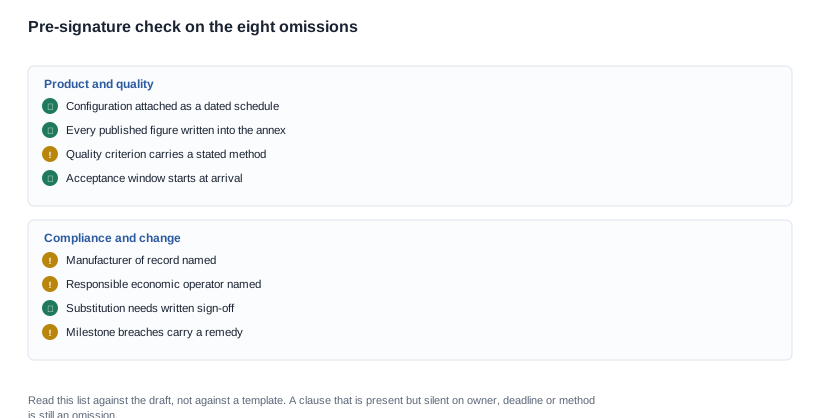
The review itself is short enough to run in one sitting. Take the draft agreement, lay it against the eight rows above, and mark each one as present, silent or absent. Present means the clause exists and carries an owner, a threshold and a method. Silent means the clause exists but does not say who, how much or by when, which is functionally the same as absent. Absent means there is no clause at all. In our experience across this category, the silent category is the largest, and it is the one a buyer can close in a single exchange of emails.
What Cynrin will put in the agreement, and what we will not sign
Here, a contract in this category is mostly a mechanism for fixing values that a public catalogue cannot fix, and the mechanism only works if each value is attached to a document with a revision. We will put the configuration schedule, the quality criterion with its method, the acceptance window running from arrival, the milestone structure with remedies, the change-control route and the ownership clauses into the agreement without argument, and we will not sign an order that leaves the compliance obligations unallocated.
Where a clause cannot be agreed we will say so at quotation stage rather than let it surface later. The substitution rule is the one that most often gets refused, and the refusal is itself information about the supplier's process rather than about the relationship.
Minimum order quantities, production lead times and our unit prices are not published, and neither are the certificate numbers, the sensor part numbers, the field of view or the frame weights on any model except the MT6, where the catalogue records the glasses body at 158 g including the cell and the camera and excluding the 1200 mAh folding charging case. A contract signed against figures that cannot be evidenced is a contract that will eventually be renegotiated, and the renegotiation will happen at the moment the buyer can least afford it.
The contract terms section covers the clauses themselves, the payment terms page sets out the milestone structure in detail, and the quality consistency checklist is the right place to settle the criterion and its method before they are written into an agreement.
Related reading
- Reading a contract — clause by clause
- Payment terms — the milestone structure in detail
- How a contract affects lead time — the schedule clauses
- Contract mistakes at the repeat stage — what changes after the first order


