

Lead time is negotiated in a fixed order, and buyers who arrive out of order give away the parts they had the most leverage on. The sequence below starts where the leverage is highest and ends with the date most buyers try to negotiate first. The core claim is simple: a duration quoted without a named binding stage is a typical figure, not a commitment, and no clause written around it will change that. What a buyer can actually secure is a schedule made of stages, each with an owner, each with a release condition, and each with a cut-off underneath it.
Why a smart glasses lead time is negotiated as a sequence
Who is reading this and what the calendar is costing them
The reader here is a procurement manager working for the brand, a channel buyer or an importer with a launch date that is not moving and a factory that has given a number. The question underneath is never the general one. It is which stage is holding the order, who owns it, and what happens to the delivery date if it moves. What they are managing is not the number of weeks; it is the credibility of a date they have already put in front of a retail partner, a marketplace listing or a sales team.
That is why a lead time conversation goes wrong so consistently. The supplier has quoted a duration, the buyer has a date, and both are now negotiating the difference between two numbers, when the useful information is in the structure of the schedule rather than in either number. A buyer who leaves with a shorter duration but without a stage map has paid for a number, not for a schedule.
There is also a sourcing position to establish. Because a factory can quote a shorter duration for a configuration that reuses existing components and a longer one for a configuration that needs a new part, the duration is partly an argument about the configuration. Fixing the configuration is therefore part of negotiating the date, not a separate activity that happens afterwards.
One further distinction earns its place early, because it is the source of most of the arguments buyers have with each other rather than with the factory. A factory duration ends when the goods leave the line. A landed duration ends when the goods are in the buyer's warehouse and can be sold. Between those two points sit the pre-shipment inspection, the booking, the consolidation, the transit and the destination clearance, and each of them can add a week without anybody in the supply chain doing anything wrong. When a sales team and a procurement team are working from different numbers, this is usually why. Ask for both, in writing, with the handover point named, and the disagreement usually dissolves into a scheduling conversation that can actually be solved.
The six constraints behind every duration a supplier quotes
Every duration in this category is the sum of the same kinds of constraint, and a buyer who can name them can locate the delay without an investigation.
Component availability. The cell, the camera module and the charging case are the long-lead items, and the gap between the two is what most often separates a quoted duration from a delivered one. A camera model that ships with a 1400 mAh case carries a materially different procurement commitment from a model that ships with a magnetic contact only.
Artwork and packaging approval. A custom colour, a moulded logo or a bespoke retail box adds a cycle, and the cycle belongs to the buyer even though the waiting happens at the factory.
Firmware and software build acceptance. A build that has to be compiled, flashed and tested against acceptance criteria adds days, and the acceptance step is the part that gets overlooked.
Compliance documentation. The document set for a destination market is written once per configuration and per market, and it is a schedule item even when it is not on anyone's checklist.
Assembly and test capacity. This is the only constraint that is really the factory's, and it is the one the buyer has the least visibility into.
Transport and booking. A production slot that ends on a date with no sailing on it is a schedule with a hole in it.
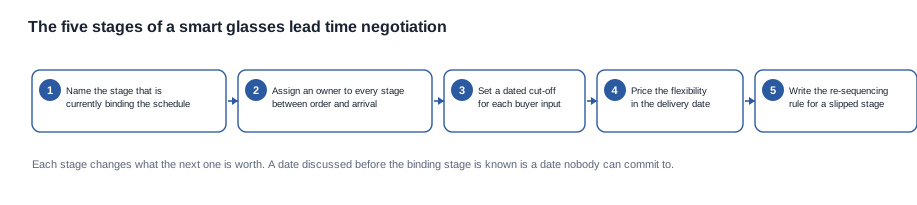
The sequence in this flow matters more than the speed. Running the third stage before the first produces a cut-off for a configuration nobody has frozen, and the cut-off then fails on arrival.

Finding the stage that is actually binding the schedule
The question that separates a commitment from a typical figure
Before any number is discussed, get one answer: which stage is currently binding on this configuration. Assembly, component arrival, firmware, artwork approval, compliance documentation, or transport booking. Six suppliers asked this question give six different answers, and the spread between them is the real lead-time range you are dealing with.
A supplier who cannot name a binding stage is quoting a typical figure. A typical figure is useful for planning and useless for contracting, and the difference between the two shows up later as a missed date with no mechanism behind it.
The way to ask is to make the answer specific rather than general. Not "how long does it take" but "what has to happen before assembly can start on this configuration, and is that in place today". The first question produces a duration; the second produces a status. A supplier who can answer the second question is telling you where the order actually is.
What the binding stage changes about the rest of the negotiation
Naming the binding stage changes what you can ask for next, because it tells you which of the two levers is available. If the binding stage is a buyer stage, you have a lever you can pull yourself — close the input faster, approve earlier, or move the date. If the binding stage is a factory stage, you have a lever that has to be negotiated — a slot, a priority, a component allocation.
It also tells you which parts of the duration to believe. A supplier who names component arrival as the binding stage is describing a supply chain position, which is checkable: ask when the parts are committed and against what order. A supplier who names assembly as the binding stage is describing a queue, which is not checkable in advance, which is exactly why it needs a mechanism rather than a number.
| Binding stage | Who can move it | What to ask next | What to write down |
|---|---|---|---|
| Component arrival | Supplier, with priority | When the parts are committed and against what order | A dated allocation, not an estimate |
| Artwork approval | Buyer | When the proof goes to the approver | A cut-off date and one named approver |
| Firmware acceptance | Buyer | When acceptance criteria are issued | A written criteria set and a date |
| Compliance documents | Shared | Who owns the file and what it covers | An owner and a document list |
| Assembly and test | Supplier, with priority | Whether the slot is held or re-sequenced | The re-sequencing rule |
| Transport booking | Shared | Which sailing the date has to reach | A booking cut-off and a mode |
Assigning ownership to every stage between order and arrival
The stage map that turns a dispute into a single answer
Write down every stage between the purchase order and the arrival at your warehouse, and mark it as ours or theirs. The disputes that occur three months later are almost never about the schedule itself; they are about who owned a stage that nobody had assigned.
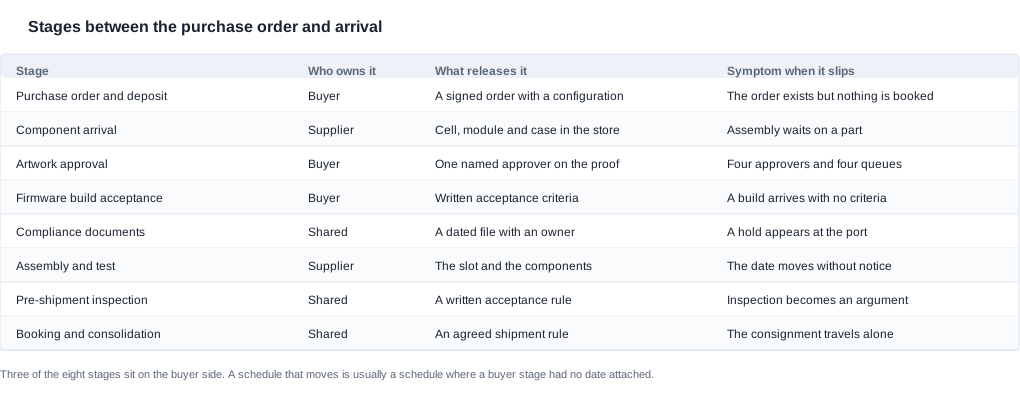
Owning your own stages gives you something to give in exchange, which is what makes the conversation a negotiation rather than a request. A buyer who can say "artwork approval will be closed by the fourth working day" has made a commitment, and a commitment is currency.
The stage map also settles a question that otherwise gets argued twice. When a date moves, the map answers what moved and who caused it in one step, instead of starting an argument about causes. That is the difference between a supplier relationship that survives a slip and one that does not.
Keep the map to the stages that can actually change. A stage that always takes the same amount of time and never fails does not need an owner on a schedule, it needs a line in the process description. The map is for the things that move.
What to ask before you accept a duration
Eight questions, each with a completion test that a supplier can satisfy in writing.
- Which stage is binding on this configuration today? Completion test: a stage name, not a description of the whole schedule.
- When is the long-lead component committed, and against what order? Completion test: a date and an allocation reference.
- Does the quoted duration include the compliance file for our destination market? Completion test: yes or no, written into the quotation.
- Which parts of the duration are your stages and which are ours? Completion test: a list that names at least one stage on each side.
- What happens to the date if our artwork arrives a week late? Completion test: a stated number of days, not a reassurance.
- What happens to our slot if another order takes priority? Completion test: a re-sequencing rule with a named authoriser.
- Which sailing or flight does the date have to reach, and what is the booking cut-off? Completion test: a mode and a date.
- Is this duration specific to our configuration and quantity, or a catalogue figure? Completion test: the quotation repeats our configuration string back to us.
Questions six and seven are the ones that reveal whether the duration was built for this order or borrowed from a previous one.

Turning buyer inputs into dated cut-offs
Publishing your own deadlines before the order is placed
Almost all of the negotiation value in a lead time is on the buyer's side of the line. Artwork approval, firmware sign-off, the packaging proof and the destination details belong to the buyer, and every one of them can be given a cut-off that the buyer can meet. Publishing those cut-offs internally before the order is placed converts a class of future argument into a scheduled task, and it is the cheapest of the five stages by a wide margin.
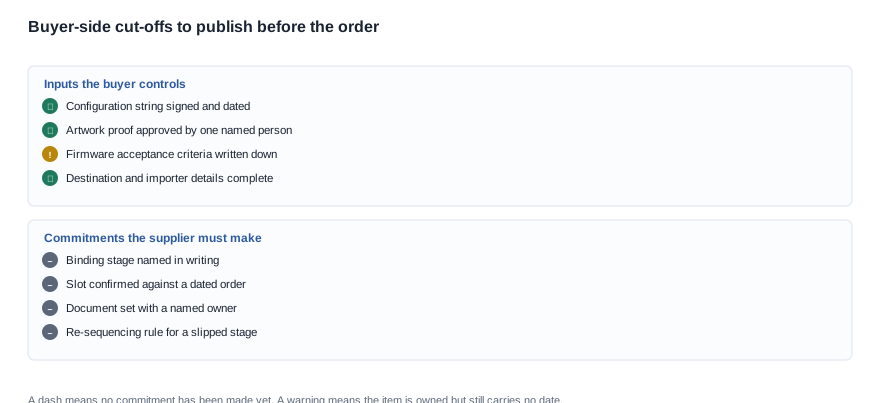
The four items in the upper group are the ones that produce the most argument when they are left informal, because each of them involves more than one person inside the buying organisation. Artwork approval with four stakeholders is four queues. Firmware acceptance with no written criteria is a build that arrives with no standard attached, and the standard then gets written after the goods exist.
What happens when a buyer input arrives late
A cut-off without a consequence is a preference, and a preference is what most schedules have. Write what happens: the date moves by a stated number of days, or the slot is released and re-booked against availability, or the input is accepted late and the schedule absorbs it at the next available slot. Any of the three is workable, because each one can be operated. What does not work is silence, because silence produces an argument rather than an outcome.
The version that works best is the one where the consequence is written on both sides. The supplier commits that a late input moves the date by a stated number of days rather than by an open-ended delay, and the buyer commits that a late input will be notified on the day it is late rather than discovered later. Both commitments are small, and together they remove the most common cause of a broken schedule.

Pricing a movable date and writing the re-sequencing rule
What flexibility is worth when the date can move
If the delivery date is movable, say so and find out what it is worth. Most factories have a cheaper slot in a quiet period than in a busy one, and a buyer who will take a fortnight later is often the difference between a price that works and one that does not. Where the configuration reuses existing components or an existing charging case, that is usually the cheapest available time saving, because it removes a stage rather than compressing one.
There is a limit to how much this is worth, and the limit is worth stating before the negotiation rather than discovering afterwards. A date that moves into a period where the retail programme has already been announced is not worth anything to the buyer, because the constraint has moved from the factory to the market. A date that moves inside the buyer's own inventory window is worth the difference between the price tiers, and nothing more.
The three honest answers about slot protection
What happens if something upstream slips by two weeks? A supplier who says the slot is held, and who can describe the mechanism that holds it, is giving you a real answer. One who says it will be fine has told you the slot is unexamined, because nothing has been decided about it yet, and the first dispute over another customer's order will move you.
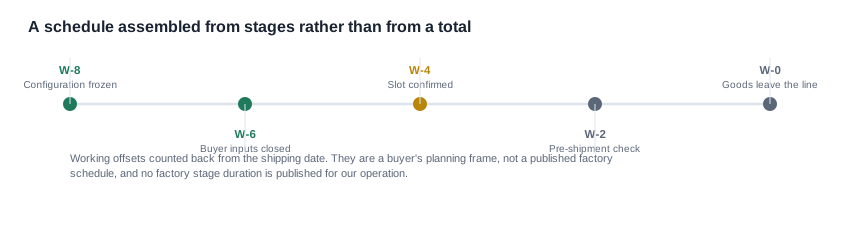
The timeline above is the shape of the answer in practice. The offsets are a planning frame counted back from the shipping date, not a factory schedule, and the purpose of the diagram is not the numbers — it is that each mark has a named condition attached to it.
There are three honest answers here and one dishonest one. The slot is protected by a named mechanism, and you ask what it is and who authorises it. The sequence holds by default because nobody has decided otherwise, which is not protection. The slot is released and you can re-book against availability, which is workable and should be priced as a risk by the buyer rather than argued about. The dishonest answer is the confident promise from a supplier who has never described a mechanism.
A worked example of the sequence in a camera-model order
The sequence below is an illustration rather than a customer account. No buyer, supplier or order is described, and no quantity or date is claimed; a camera model with a charging case, an on-shelf date already fixed, and a single destination market are assumed, so that each question and the answer it produces can be traced in turn.
Suppose a buyer is opening a programme for a camera model that ships with a charging case, for sale into one market, with a first order and an on-shelf date already set by a retail partner. The decision to work through is what goes into the agreement, in what order, and which date has to be treated as the real one.
The sequence runs like this. The buyer asks which stage is binding and is told component arrival, because the case is not committed for that configuration. That answer removes assembly from the conversation and points the buyer at the only stage where priority can be negotiated. The buyer then asks for the stage map, which reveals that the compliance file for the destination market has no owner. That is the second finding, and it is the one that would otherwise have surfaced at the port rather than at quotation. The buyer publishes cut-offs for artwork and firmware acceptance, which sit on their side and can be met. The buyer asks what flexibility is worth and learns that a fortnight later removes a component constraint but does nothing for the retail date, so the date is treated as immovable and priced accordingly. Finally the buyer asks about slot protection and receives a re-sequencing rule rather than a promise, which goes into the agreement with a named mechanism behind it.
Six questions, and the output is not a date. It is an agreement where every stage has an owner, the buyer's own deadlines are published, and the one element that cannot be protected is identified in advance rather than discovered in the month it matters.
How we quote a lead time without publishing one
What we will put in writing and what we will not
We do not publish a standard lead time, a stage duration or a production capacity figure, because none of them is meaningful without a configuration, a quantity and a set of dates. Production capacity and daily output are not published, and we will not quote a duration from a catalogue page and let it stand as a commitment.
What we will do is name the binding stage for the specific configuration, produce a schedule with an owner against every line, set your cut-offs in writing, and put the re-sequencing rule into the agreement. If we cannot meet a date, we will say so at quotation rather than at the shipping date, which is the difference between a supplier and a vendor.
We will also decline to hold a slot against an order whose configuration has not been frozen, because a slot held against an open specification is a slot that will be re-sequenced when the specification settles, and the buyer will not be told until it happens. We will say so at the time of quoting rather than letting it surface four weeks later.
If a date has to be immovable for market reasons, say that plainly at quotation and we will price the priority against the constraint rather than promising it and re-sequencing later. Give us the configuration, the quantity and the date your own business has committed to, and we will tell you which of them the schedule is actually sensitive to. The lead time section covers the full sequence and the six constraints.
Related reading
- Negotiating the schedule in detail — the three branches
- Lead time mistakes — what adds weeks
- Production capacity negotiation — the slot conversation


