

Smart glasses contract smart glasses how it works is easier to explain as a sequence than as a set of clauses, because a contract in this category is not one thing. It is a chain of eight documents, each one referring to the one before it, and the chain breaks at a specific joint each time. The eight stages below are the joint list, and the second column is the document that holds each one together.
We publish no contract terms, because a contract is a bilateral document and the terms depend on the configuration, the volume and the relationship. What follows is the mechanics rather than the terms: how the chain is assembled, where it comes apart, and which two joints are worth the buyer's attention.
The reason the chain metaphor is worth using is that it explains a fact buyers find confusing. A contract in this category can be perfectly drafted and still fail completely, because a contract is not the mechanism that makes an order work — the documents are. The agreement decides what the documents must contain and who owns them; the documents are what actually carry the order from an enquiry to a warranty claim. Where a buyer expects the agreement to protect them, and the protection actually lives in a document that was never produced, the failure looks like a breach of the agreement when it is really a missing piece of the chain.

Smart glasses contract: a chain of clauses, not a document
There are eight stages between an enquiry and a warranty claim, and each one is joined by a document that the stage before it produces. The joints in order are: enquiry to specification, specification to quotation, quotation to terms, terms to production, production to inspection, inspection to despatch, despatch to acceptance, and acceptance to warranty.
Each joint fails in its own way, and the failure modes are worth reading together because they are not variations on a theme. Joint one fails because two parties described the same feature differently. Joint two fails because the price was quoted against a different build than the one written down. Joint three fails because a deposit was paid with no signed specification behind it. Joint four fails because production was released against a verbal agreement. Joint five fails because the inspection had nothing to compare against. Joint six fails because the shipping documents were assembled on the day. Joint seven fails because the payment trigger and the acceptance window were not the same event. Joint eight fails because the line between a defect and wear was never drawn.
What makes this a useful way to think about the category is that it converts a vague worry — "our contract is not working" — into a specific question: which joint is broken? And that question has a specific diagnostic, because each joint leaves evidence behind when it is healthy and leaves a gap when it is not. A healthy joint one leaves a signed annex. A healthy joint five leaves a dated sample in the buyer's possession. A healthy joint seven leaves a single date that appears on both the shipping documents and the acceptance clause.
The eight stages also have a natural order, and the order is not the order of a contract's clauses. The buyer's first task is not to draft terms but to establish what is being bought, because everything downstream is a reference back to that. This is a general principle of procurement in this category and it is worth stating plainly: the agreement records the transaction, but the transaction itself is the annex, and the annex is the only document in the set that a buyer can hold in their hand and use to check a delivery.
One further observation before the joints themselves. The chain has one property that makes it fragile in a way most chains are not: several of the eight documents are produced by parties outside the buyer-supplier relationship. The technical file may sit with a sub-supplier, the artwork approval with a print house, the test evidence with a laboratory. Each of those is a document with a holder who is not the counterparty, and each is therefore a place where the chain can stall without anybody having done anything wrong.
There is a second fragility, and it is specific to a category where the product specification is published and identical for every buyer. Because the catalogue says the same thing to everyone, a buyer cannot use the product description to tell two suppliers apart, and a supplier cannot use a bespoke specification to justify a premium. The chain is therefore the only place where this category's differences actually live, which is why a buyer who treats the agreement as the whole transaction is looking at the wrong half of it. The agreement records what the parties agreed; the documents are what the programme actually runs on. Where those two diverge — which is common, because the agreement is written once and the documents are produced every order — the documents win, and they win because they are what the receiving team, the customs entry and the claims process actually read.
That is the reason to think of this category's contracts as chains rather than as documents. A chain can be inspected: you can walk it, count its joints and find the weak one. A document can only be read, and reading it tells you what the parties intended rather than what the programme will do.
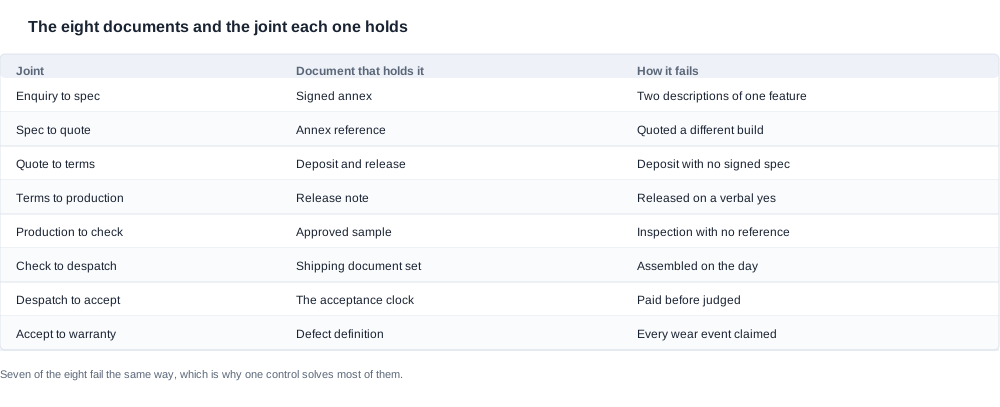

The first four joints, from enquiry to production
1. Enquiry to specification — the signed annex. The joint is the document, and it fails when two parties describe the same feature differently — most often an AI feature, where one side hears a local capability and the other hears a server one. The annex states what the product does and what it explicitly does not do, and the second half is the half that prevents the argument. In this category the second half is unusually important, because the published data has a lot of open rows: the certificate numbers, the sensor part numbers, the field of view, the video specification and the frame weights on all but one model are not published, and a contract that lists only the published fields leaves the impression that nothing else is being promised. It does not settle the row; it settles whether the row is open.
2. Specification to quotation — a price against that annex. The joint is the annex reference, and it fails when the price is quoted against a different configuration than the one that was written down. A quotation without a configuration reference is a quotation about a generic product. This is not a drafting nicety in a category where the same model ships with a 900 mAh case or a 1400 mAh one, and where the charging interface is published on twenty-four of the twenty-eight catalogue entries and absent from four — so a quotation that names a model without naming its case and its interface has specified roughly half the object.
3. Quotation to terms — the stages, the documents and the clocks. The joint is the deposit and the release condition, and it fails when a deposit is paid with no signed specification behind it, which is how a programme ends up building to a description nobody agreed. The payment structure usually has four stages — a deposit, an artwork milestone after a proof is approved, a production milestone after the acceptance criteria pass, and the balance against a shipping document set — and each of them has a trigger that has to be observable by the party paying. A deposit that is the first payment of a four-stage structure is the buyer's largest single commitment, and it is made on the basis of an annex that may not yet exist.
4. Terms to production — the release condition. The joint is the production release note, and it fails when production is released against a verbal agreement. It is a small document and it is the one that stops the most expensive failure in the chain, because everything upstream of it can be corrected before the line starts and nothing downstream of it can. The release note should carry the configuration string, the accepted artwork revision, the approved sample identifier, the test plan and the acceptance criteria. It is short, it is dated, and it is the only document in the chain that everybody has to agree on.
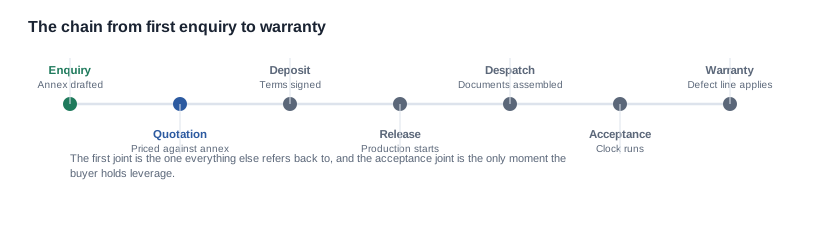
The last four joints, from inspection to warranty
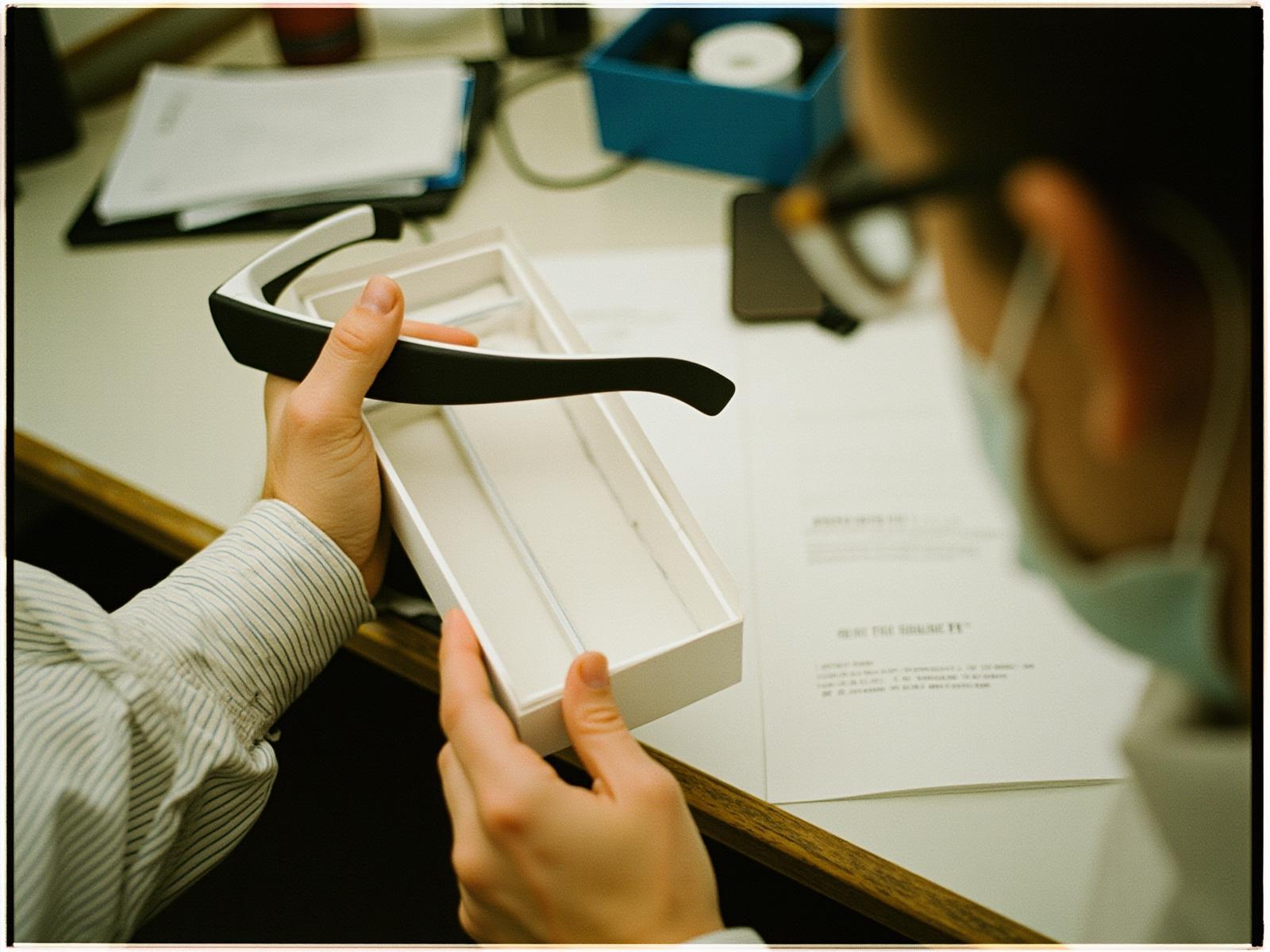
5. Production to inspection — the reference and the count. The joint is the approved sample, and it fails when the inspection has nothing to compare against. An inspection without a reference cannot fail anything, which is why it protects nobody. The count matters as much as the reference: an inspection of three units from a batch of ten thousand is a spot check and should be described as one, and the clause should say what happens when a defect is found in a spot check — whether the batch is held, whether the remaining units are inspected, and who pays for it.
6. Inspection to despatch — the document set and the balance. The joint is the shipping document set, and it fails when the documents are assembled on the day. On a lithium consignment this is the battery transport test summary, which has been mandatory since 2020 and is the item that stops a shipment rather than delaying it. The wider point is that the shipping document set is also the payment trigger for the balance, so the joint is carrying the money as well as the compliance, and a document set assembled under time pressure is a document set with an error in it.
7. Despatch to acceptance — the acceptance clock. The joint is the number of days, and it fails when the payment trigger is not the same event. If the money moves on shipment and the acceptance window opens after delivery, the buyer has paid for goods it has not judged, and the inspection gate in stage five becomes decorative. The rule that makes this joint work is short and absolute: one event, two functions. The same date has to appear on the shipping documents and in the acceptance clause, and it has to be a date the buyer controls — arrival at a named place, not the production date.
8. Acceptance to warranty — the period, the exclusion and the route. The joint is the definition of what is a defect and what is wear, and it fails when the line is not drawn. On this product the line is real: a worn seal, a hinge that has started to move, a contact that has corroded. Where it is not drawn, every wear event becomes a warranty event and the dispute is about the boundary rather than about the product. The definition also has to cover the published endurance bands, because the catalogue states a rated run for every entry — 5~8 hours for the V03 Pro and the V06, and the V03 and the S7, 6~8 hours for the KY06 and the MT5, about 7 hours for the L2 Utral and the L1 Pro, and the CY03 and the CY05, and the MT6 — with no test condition attached, which means the boundary between "as described" and "not as described" cannot be drawn from the catalogue alone.
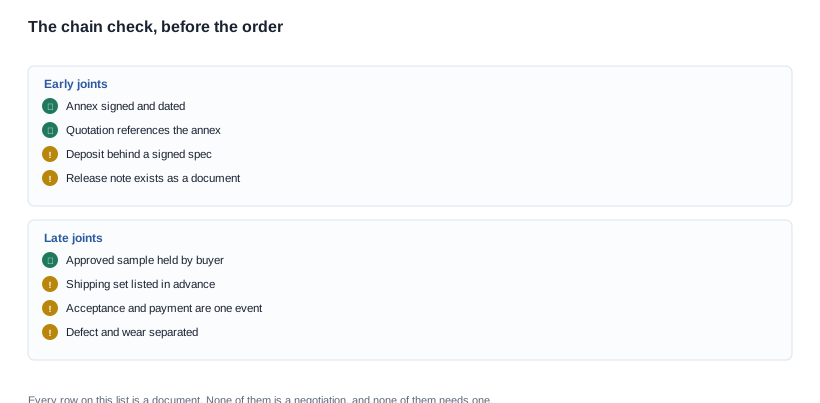
The pattern behind all eight failures
Every one of the eight failures is the same failure: a document that is one step earlier in the chain was not produced, so the document that depends on it has nothing to refer to. The remedy is not more contract language. It is a document at each joint.
This is worth stating carefully, because it is counter-intuitive for buyers who have been trained to look for a stronger agreement. A longer agreement does not fix a missing release note. A stronger clause does not fix an inspection with no sample. What fixes them is producing the eight documents, and an agreement whose only job is to say what each of those documents must contain, who owns it and what happens if it is late.
There is a second pattern underneath the first, and it is specific to this category. The failures cluster around the fields the catalogue leaves open. The joint one failure — two descriptions of the same feature — happens because the annex has to describe something the published data does not describe. The joint two failure happens because a quotation names a model without its case and its interface. The joint eight failure happens because the endurance band has no condition attached. In each case the missing document has to carry an open row, and an open row is where a chain breaks.
So the diagnostic that follows is practical. When a chain breaks in this category, ask which of the eight rows it broke at, then ask what that row needed that the published data does not provide. The answer identifies the supplier-side question that would have prevented it, and it is usually a question about a document rather than a question about the hardware.
There is a third pattern, visible only when the eight are read side by side, and it concerns who is standing at each joint. At joints one, three and eight the buyer is the active party: writing the annex, paying the deposit, judging the claim. At joints two, four and six the supplier is active: quoting against the annex, releasing production, assembling the documents. At joints five and seven the buyer is active again: inspecting against the sample, running the acceptance clock. So the chain alternates, and the joints where the supplier is active are the ones most likely to fail quietly, because the buyer is waiting rather than checking. That is why a buyer who wants a chain that holds should spend attention on the supplier-active joints, and why the document delivery schedule belongs in the buyer's agreement rather than in the supplier's own procedure.

The two joints worth the most attention
Stage one is worth the most attention because everything else refers back to it. The specification annex is the single point on which the packing list, the release note, the inspection and the claim all depend. If it is loose, everything downstream inherits the looseness; if it is tight, the later joints become administrative. And the cost of fixing it is the lowest of the eight, because at that stage there is no tooling, no artwork, no production slot and no money committed.
Stage seven is worth the most attention for the opposite reason. It is the buyer's only leverage in the chain, and it expires at the moment of payment. Every other stage is a gate the buyer controls before the goods exist; stage seven is the only one where the buyer holds a right that disappears on a date. A buyer who has paid against the balance and has not opened the carton has no inspection and no rejection, and the five-stage inspection gate that preceded it becomes a formality.
If a buyer could only check two things before signing, these are the two: that the annex carries every field the buyer's receiving team will need, and that the acceptance window starts at an event the buyer controls and that the payment trigger and the acceptance clock are the same event. Both are checkable in five minutes on a draft, and both are the difference between a chain that holds and a chain that breaks at the most expensive joint.
There is a third that is close behind and is often missed: joint four, the production release. It is not on the list of two because it is an internal document rather than a negotiating point, and because a buyer rarely sees it at all. It is on this list because it is the last moment at which a mistake is still cheap. After the release note, the only corrections available are a re-tool, a reprint and a re-inspection.
Where Cynrin sits in the chain
Concretely, we publish the product configuration and the capability gaps, and we will not present contract terms we have not agreed as a published policy. What we contribute to the chain is accurate information about what the product does and does not do, so that each document describes the same object.
Concretely, that means we can produce or arrange the documents on the supplier side of the chain — the configuration schedule, the approved sample record, the test plan and its pass criteria, the technical file for the markets in scope, and the shipping document set. What we cannot supply are the buyer-side documents, because they require the buyer's authority rather than our production: the destination market list, the artwork approval, the claim route with a named contact, and the signing authority. The chain has both halves and the buyer owns half of it.
What we can do is take a buyer's contract and mark which of the eight joints it establishes, and tell them where the chain is weakest for the specific configuration they are buying. That is more useful than a generic clause list, because the weak joint depends on the configuration: a build with a published charging interface has a different weak joint from one of the four models where the interface is not published, and a build that ships with a case has a different weak joint from the V03 Pro, which has none. Our unit prices, MOQ figures and production lead times are not published, so the commercial side of the chain has to be written into the agreement in order to exist.
The commercial context is under contract terms and agreements, the clause list is in the contract checklist, and the sequencing advice is in contract practical advice.
Related reading
- The clause list — contract checklist
- The sequencing advice — contract practical advice
- The commercial context — contract terms and agreements
Send us a contract and we will tell you which of the eight joints it establishes.


