

A smart glasses contract checklist is twelve clauses in the order they should be worked through, and the order is the substance of the advice. The first clause is the reference for all the others, and clauses two to four determine the shape of the whole programme. Clauses five to eight describe the transaction. Clauses nine to twelve describe what happens when something goes wrong, and they are the ones cheapest to write now and most expensive to argue about later.
Smart glasses contract: twelve clauses and why their order matters
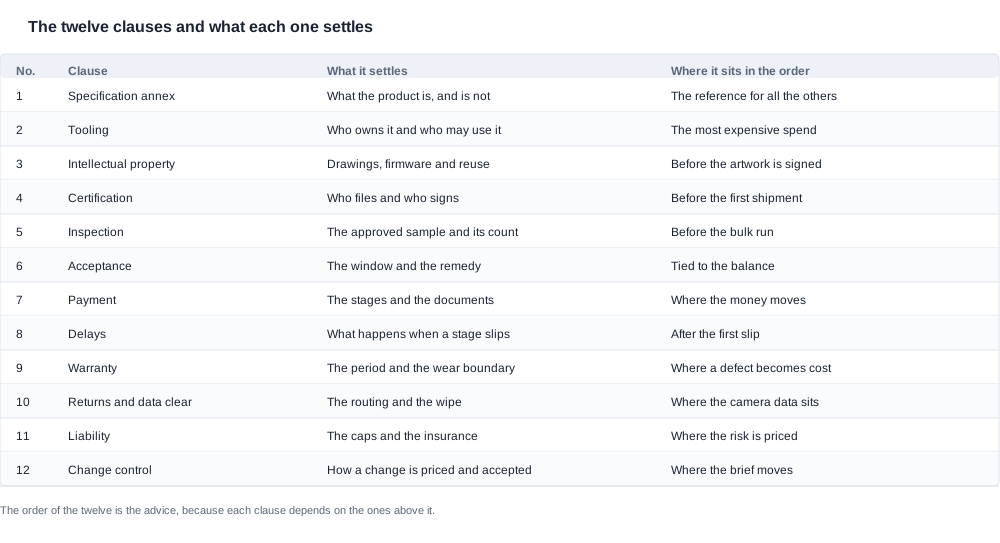
Read the table downwards and a structure appears. The first four clauses establish what the product is and who holds the assets and the obligations attached to it. The middle four describe how the transaction itself operates. The last four describe the failure states, and they are the four that most agreements leave vague because they are the four that only matter after something has gone wrong.
We publish no contract terms, because a contract is a bilateral document and the terms depend on the configuration, the volume and the relationship. What follows is the clause list and the reasoning behind the order, not a set of our own terms.
The three groups, and what each group is for
The twelve divide into three groups, and each group answers a different question about the programme.
The first group establishes the facts: what the product is, who owns the assets created to build it, and who carries the legal obligations attached to selling it. The second group describes the transaction: how the product is judged, how long the judgement window lasts, when money moves, and what happens when a date slips. The third group describes the failure states: what a defect is, where a returned unit goes, what a liability costs, and how the programme changes when the brief moves.
The grouping is not cosmetic. A buyer reading the agreement clause by clause will do better if they read the three groups in turn rather than jumping to the clause that worries them. The first group is short and is usually where the real work sits, because the specification annex and the certification allocation are decisions that have to be made by the buyer rather than copied from a template. The second group is where the schedule is set. The third group is where the consequences are, and it is the group that gets deferred.
Who is reading this and what the list is for
The reader is a brand-side procurement lead, a channel buyer or an importer who has either a draft to review or a programme to open. The situation behind the list is always one of the same three: a draft from a supplier that has to be read against the product it governs, a first order that needs a short agreement, or a second order that has outgrown the first one.
The value of a fixed twelve-clause list is that it turns a legal document into a sequence of decisions, and each decision can be taken by the person who is actually able to take it. Clause one is the buyer's specification. Clause four is a question about who signs a declaration in which market. Clause ten is a question about what happens to the data on a returned unit. Three different people, in three different departments, each answering one question.

The reference clauses that everything else points back to

Why these four come first
The four reference clauses come first because everything after them is written in their terms. The specification annex defines what the unit is, so the inspection reference, the acceptance band, the warranty exclusions and the liability cap can all point at it. The tooling clause defines who holds the assets, so the intellectual property clause can distinguish the artwork from the build. The certification clause defines who is responsible in each market, so the payment clause can be written without a separate paragraph about regulatory risk.
Working them in a different order produces the familiar drafting problem where clause nine refers to a specification that clause one has not yet defined, and clause eleven refers to a liability position that nobody agreed. The remedy is not to add a definitions section at the front; it is to put the four reference clauses in front, where they belong.
One. The specification annex
Signed by both sides, describing what the product does and — the part that gets left out — what it explicitly does not do. Every other clause refers back to it, and without it a dispute is a dispute about facts.
What it does not do is as useful as what it does. A product that publishes a 220 mAh cell and a five-to-eight-hour runtime is making a statement about a configuration, and the annex has to say whether that configuration includes the charging case, which charging interface applies and whether the runtime is a rating under a stated profile. Where a published figure has a caveat, the caveat belongs in the annex rather than in a brochure.
Two. The tooling
Who owns it, who paid for it, who may use it after the relationship ends. It is the most expensive irreversible spend in the programme and it outlives the order by years, which makes it the clause most often left open.
The schedule matters as much as the ownership. A clause that transfers ownership of "the tooling" without listing what the tooling consists of is a clause that will be argued about, because the argument will be about whether a particular physical asset was covered. A list of the assets, with their identifiers, removes the argument before it starts.
Three. The intellectual property
Drawings, firmware source, and who may reuse them. Silence here becomes a dispute rather than a decision, and it becomes one at exactly the moment the brand least wants it.
There is a practical distinction worth drawing between the drawing and the code. A retail artwork can usually be replaced; a commissioned firmware build usually cannot, because the source may sit on top of components the factory owns. A clause that assigns both without acknowledging that difference tends to be resisted on the code and quietly ignored on the artwork, and the artwork is the half that ends up in someone else's catalogue.
Four. The certification
Who prepares the technical file and who signs the declaration. The declaration is the brand's legal act in the destination market, and the file is the factory's work, and conflating them creates a liability nobody priced.
Our own published position is the model for this clause: the factory's catalogue carries a company-level export certification page whose content is images rather than text, the catalogue text contains no reference to CE, FCC or RoHS, there is no per-model certification row, and the child models carry a certification position that is recorded as not provided. A clause written against that position names who holds what, and it does not pretend an export certification page is a model-level document.
The clauses that describe the transaction
Five. Inspection
The approved sample, the sample count, and the timing. An inspection without a reference cannot fail anything, which is why it protects nobody.
The sample has to be an exhibit rather than a courtesy, because the sample is what the bulk run is judged against. Without the sample as a reference, a receiving team applies its own judgement to a container, on a day when the container has just arrived.
Six. Acceptance
The number of days, and the remedy, tied to the payment trigger. The acceptance clock and the balance should be the same event, or the money moves before the goods are judged.
This is the clause that decides who carries the risk of a borderline unit, and the remedy has to be named rather than implied. A credit, a replacement, a rework and a return are four different commercial outcomes with four different cash and logistics consequences, and "the goods will be dealt with reasonably" chooses none of them.
Why the acceptance clock has to be tied to the balance
The two clauses are usually written by different people and reviewed in different places, which is why the link between them is so often missing. The acceptance clause is drafted with the goods-in team, who are focused on how long they have to raise a discrepancy. The payment clause is drafted with finance, who are focused on when the balance is released.
Left unlinked, the acceptance window closes on a date and the balance is released on a different one, and the gap between them is where the exposure sits. A supplier whose goods have already been paid for has no commercial reason to resolve a discrepancy that the buyer raised in the last week of the window.
The version that works ties the balance release to the close of the acceptance window rather than to the arrival of the goods, and says so in one sentence in the payment clause that refers back to the acceptance clause rather than restating it. It is a small drafting discipline and it is the difference between an inspection and a formality.
Seven. Payment
The stages, the document that releases each one, the currency, and the exchange risk. The stages should be visible to both sides as a sequence, because a buyer who cannot see the sequence cannot manage the cash.
The document behind each stage is what makes the stage checkable. A stage released by a document is a stage that can be tracked; a stage released by an event is a stage that has to be argued about.
Eight. Delays
What happens when a stage slips. A terms sheet with no delay clause means the first delay is improvised, and improvised delays are where the cost lands on the party with less leverage.
The clause should distinguish the stages, because the stages do not slip together. A production slip and a print lead-time slip are different problems with different remedies, and a clause that treats them as one forces a single number onto two very different events.

The clauses that describe what goes wrong
Nine. The warranty
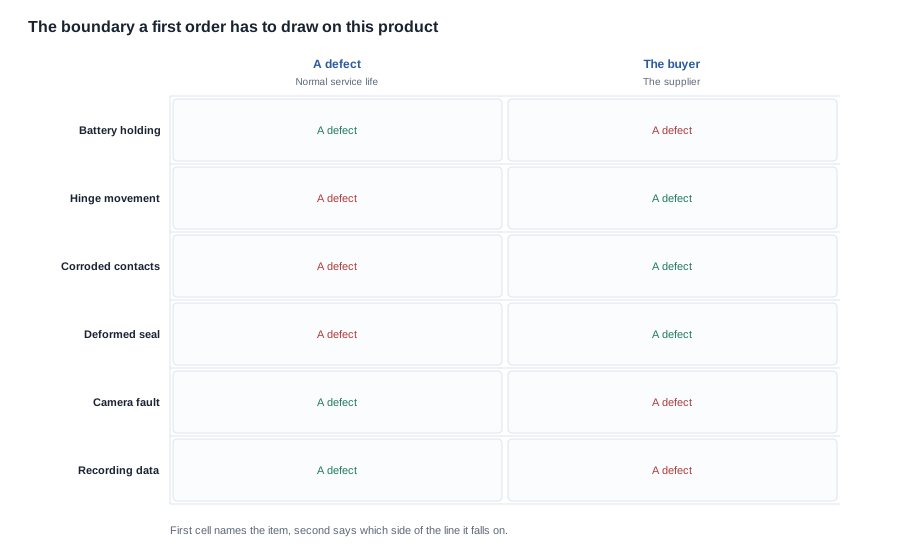
The period, the exclusions, and the boundary between a defect and normal service life. On this product that boundary is real: a seal that has taken a set after a season, a hinge that has started to move, a contact that has corroded. If the agreement does not draw the line, every service event becomes a warranty event.
The clause works by naming the exclusions rather than by describing the defect, because "normal service life" is a phrase nobody agrees on. Three named items and a date is enforceable; a general phrase is not.
Ten. Returns and the data clear
The reasons, the routing, the cost, and the documented wipe. A returned camera glasses unit still holds the previous owner's recordings, and a returns process without a clearing step is not finished.
That last point is specific to this product and it is not a theoretical privacy point. A camera device that returns to a warehouse with recordings still on it and goes back into stock is a data incident waiting to happen, and the clause that prevents it is short: the unit is wiped before it is re-stocked, the wipe is recorded, and the record is available to the buyer's compliance team on request.
The data clear, and why it is not optional on a camera product
Clause ten is the one that seems out of place in a hardware agreement and then turns out to matter more than its neighbours. A returned unit with a camera on it is not a box of parts coming back; it is a device that may still hold the recordings of the person who used it, and possibly still holds them when it goes back into stock.
The clause that prevents this is short. The reasons for return are listed, the routing is set, the freight responsibility is stated, the cost of the return is assigned, and the unit is cleared before it is re-stocked. The clearing step has to be recorded, because a wipe that cannot be evidenced is a wipe that did not happen, and because the buyer's own compliance function will ask for the record eventually rather than immediately.
There is a second, quieter reason to write it. A device with a camera and a storage chip is a device whose condition on return is partly a question of what it has recorded. If the returns process has no step for the data, then the condition question and the privacy question are answered by the same person on the same day, usually under time pressure. Separating them costs one line.
Eleven. Liability
The caps, the exclusions and the insurance position. Uncapped liability on a consumer electronics programme makes the deal effectively uninsurable, and it is the clause that quietly ends a negotiation.
The number that matters here is the multiple. A cap expressed as a multiple of the amount paid on the order is one commercial proposition; a cap expressed as a multiple of lifetime programme value or of a figure that includes tooling is a cap nobody can price, and the buyer will discover that during the negotiation rather than after it.
Twelve. Change control
How a change is proposed, priced, scheduled and accepted. The cheapest change and the most expensive one appear identical when they are requested the same way, and a clause that puts both through the same written route is worth more than a discount.
Change control is also where the certification file is protected, because four substitutions — the radio module, the antenna path, the cell and the housing — reopen work that has already been paid for, and none of them feels like a certification change at the moment it is made.

The three that are not negotiable on a first order
One, five and six
The specification annex, the inspection reference and the acceptance clock. Each is short, each is cheap to write, and each is the thing that decides what happens when the goods are not what was expected. The expensive clauses — eleven, twelve, three — are the ones a first order can reasonably defer, because their consequences arrive with the second order and by then they are still writable.
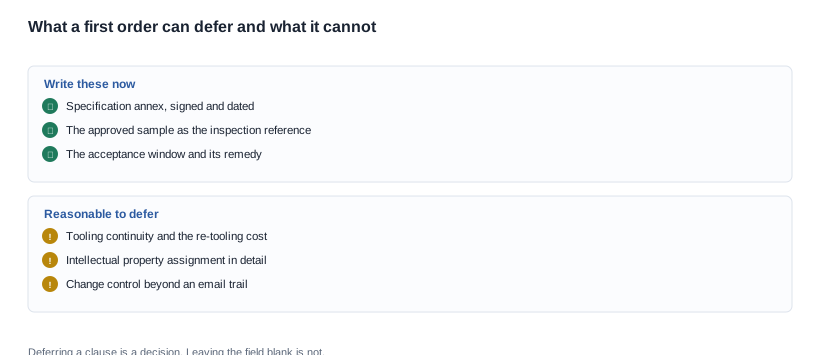
Deferring a clause is a decision with a reason behind it. Leaving the field blank is not a decision, it is a default, and the default on a liability cap or an intellectual property assignment is rarely the one either side would have chosen.
There is one further consideration for the deferrable group, and it is about timing rather than content. A clause deferred to the second order has to be drafted before the second order is placed, and the second order is usually placed by a different person from the one who wrote the first agreement. If the deferral is not written down as a deferral — as a line in the file saying which clauses are outstanding and when they will be revisited — then the second agreement inherits the first one silently, and the clause is never written at all.
Recording the deferral is what makes the deferral safe. An agreement that says "clause eleven is deferred to the second order" is a live item with an owner and a point in the programme. An agreement that simply omits clause eleven is a clause that nobody is going to notice is missing.
Why the deferrable ones are deferrable
The three expensive clauses share a property that makes deferral safe: their consequences arrive with the second order, and a second order is the point at which there is enough history to write them properly. A liability cap written before the first shipment is a guess about a risk the buyer has not yet taken. An intellectual property assignment written before the first build is a paragraph about an asset that does not yet exist.
The three non-deferrable ones share the opposite property: their consequences arrive with the first shipment, and the first shipment is the one where the parties know least about each other.
We Publish No Term We Have Not Agreed
Where our contribution to the contract stops
The boundary we hold: we publish the product configuration and the capability gaps, and we will not present contract terms we have not agreed as a published policy. What we contribute to a contract is accurate information about what the product does and does not do, and a review of the draft against the product's actual behaviour.
That means the published catalogue rows are what we can put in writing: resolution tier, cell capacity, charging interface, charging time, rated runtime with its caveat, case configuration, and the Bluetooth version for the audio range. It also means the gaps are stated in the document rather than left to be argued about — the sensor part numbers, the field of view, the ingress test report numbers, the certification numbers, and the frame weight of every model, with the single published exception being the MT6 glasses body at 158 g including the battery and the camera and excluding the folding charging case.
What we can do with a draft
What we can do is take a draft and mark which of the twelve the product's behaviour makes urgent, and which can reasonably wait for the second order. The commercial context is under contract terms and agreements, the full clause list with the reasoning is in what to ask before ordering, and the counterparty checks are in contract supplier verification.
Related reading
- The full clause list — what to ask before ordering
- The sequencing advice — contract practical advice
- What a first order can defer — when can you skip it
Send us a draft and we will tell you which of the twelve the product's behaviour makes urgent.


