

Smart glasses contract: why first orders fail on sequence, not drafting
Where first-order contracts fail
Most first-order problems in smart glasses contracting are sequencing failures, not drafting failures. The price gets negotiated before the specification is written, so the price is for a product nobody has described, and every conversation after that is an attempt to recover the difference. The eight instructions below are therefore a sequence, not a checklist — each one produces a paper that the next one needs. Do them in order and a first order is a controlled experiment. Do them out of order and it is a negotiation with a shipping date attached. The most expensive single decision on a first order is not which supplier to pick or what unit price to accept; it is whether to agree the price before or after the specification exists.

Who is running this programme, and what is actually at risk
The reader is a brand-side buyer, a channel buyer or an importer taking on a supplier for the first time, usually with a launch date that has already been announced. The task is to get a first shipment ordered, built to a specification, delivered against a date, and capable of being accepted or rejected on stated grounds. The worry underneath it is rarely about the quality of the product. It is about the first shipment being wrong in a way nobody can point at, and about the first defect claim being impossible to make because nobody agreed how one is made.
Those two worries are disproportionate to the size of a first order, and that disproportion is itself a clue. A first order is small, so a mistake is cheap in units and expensive in time, because the launch date does not move when the goods are late. A first order is also the order after which a supplier relationship becomes either easy or difficult, and the mechanism that decides which one it is is almost never the unit price. It is the sequence of the paperwork.
There is a third thing in play that buyers tend to underestimate: the first order is where the supplier decides what you are. A buyer who arrives with a requirement page, a dated configuration and a written acceptance test is a buyer the factory can plan for, and the quotation that comes back will be more precise. A buyer who arrives with a budget and a model name will get a quotation that is precise about price and vague about everything else, and the vagueness will be resolved later, by the buyer, at a point where the buyer has less leverage.
The eight instructions in the order they have to happen
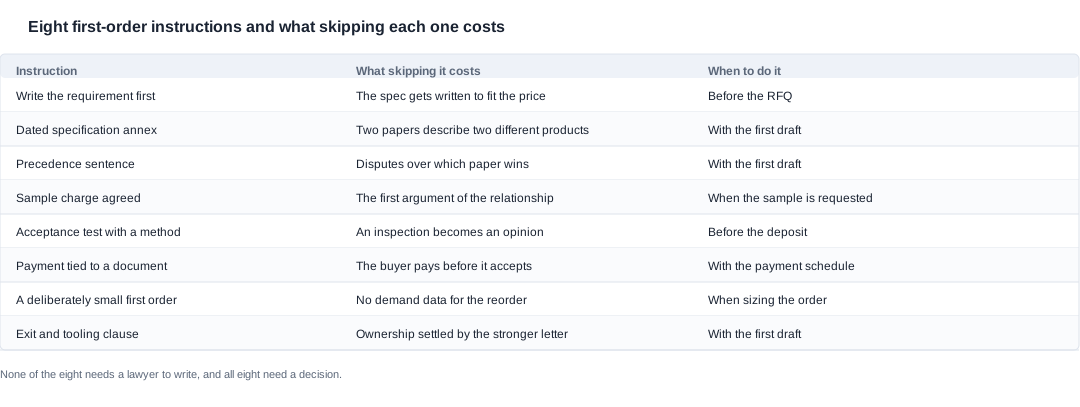
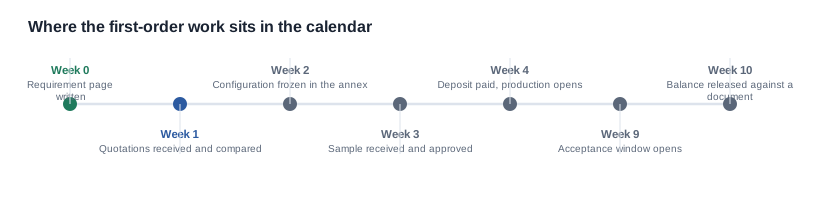
The eight instructions are described in full in the sections that follow. The order is the point: the first four happen before the quotation is even requested, and the last four happen between the quotation and the shipment. A buyer who does the first four and skips the last four has a clean order with no acceptance regime. A buyer who does the last four and skips the first four has a precise acceptance regime for a product nobody has described.

The four instructions that belong before the quotation is requested
Write the requirement before asking for a price
One page, written before any supplier is contacted, describing what the product has to do rather than what it costs. Every later step is checked against it, and it is the only document in the file that nobody else writes. This is the highest-leverage half hour in the entire procurement cycle for this category, and the reason is not efficiency. It is that a requirement written first is a constraint on the supplier, while a requirement written after a price is a justification for it.
The distinction shows up immediately in the quotation. A supplier asked for a requirement gets a quotation that says what is and is not available in that configuration, including the rows that are open — in this catalogue, the charging interface on four camera models, the charging case capacity on two further models that have a case, and every frame weight in the range except one body weight published for the MT6. A supplier asked only for a price gets a price, and the open rows are filled in later by whoever happens to be in the room, which is usually the person least able to say what the right value is.
So the requirement page has a specific shape: the product, the configuration options you will accept, the target market, the quantity bands you might order, and the rows that must be closed before a quotation means anything. It does not need to be long. It needs to be written by you and dated, because a requirement page that the supplier wrote is a specification that the supplier will pass.
What the requirement page leaves out, and why that is the point
The most common failure in a requirement page is that it tries to settle everything, and a page that settles everything settles the things the supplier should have been asked about. The rows that belong on the requirement page are the ones that describe the commercial intent of the order: what the product is for, which market it is destined for, how many units you might commit to and in what bands, what the branding and packaging have to achieve, and which compliance markets have to be covered at launch.
The rows that do not belong are the ones that describe the product's internals. Sensor part numbers, field of view, the acoustic figures for the audio range, ingress test report numbers and certification document numbers are not published for this range, and no amount of requirement-page drafting will make them appear. What the requirement page should do instead is name the rows as questions the supplier must answer in the quotation. A requirement page that says "frame weight to be stated, scope to include the battery and exclude the charging case" is more useful than one that guesses a number, because the first version produces an answer and the second produces a dispute.
The same logic applies to the commercial rows. Minimum order quantity, unit price, production lead time and capacity are not published and are quoted per project, because the variables that determine them are not knowable in advance. The requirement page should state the quantity bands and the target market, and the quotation should answer them. A requirement page that states a price is a negotiation opener dressed as a document, and it is the single clearest sign that the sequence has already gone wrong.
Freeze the configuration into a dated annex
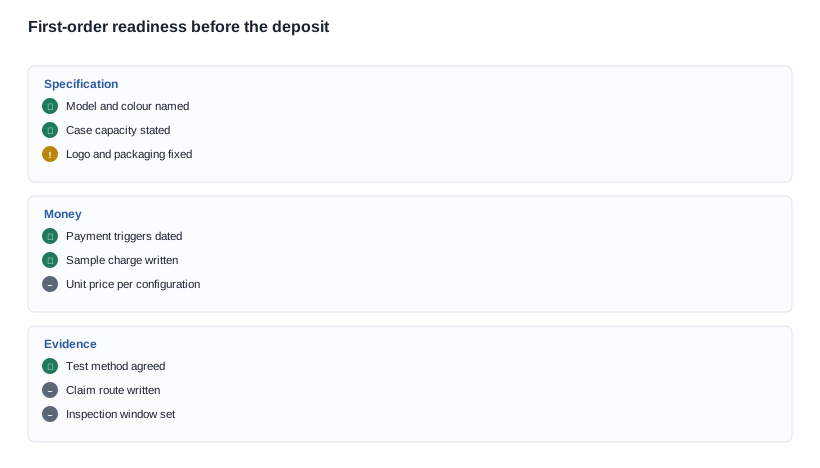
The requirement page says what the product should do. The annex says what has been ordered, precisely enough to be built and checked. Model, tier, colour, case configuration, charging interface, packaging, logo treatment, firmware build, quantity — each one written as a value rather than as a family, and the whole thing dated and signed by both sides.
This is where the open rows have to close. A configuration that says "a camera model with a charging case" is not a configuration, because in this catalogue the camera models run 220, 260, 265 and 290 mAh cells, carry 8 MP or 13 MP sensors, and pair with 900, 1200 or 1400 mAh cases, with four of them publishing no charging interface at all. Those are the differences that determine the unit price, the packaging, the accessory line and the certification scope. Naming the model family and resolving the configuration later is how two programmes end up with the same purchase order number and completely different products.
The exit test is simple: could a factory build from your annex without asking a question? If it would have to ask, the annex is a description and you are back at myth two.
Set the order of precedence in one sentence
The specification annex prevails over the purchase order, and a signed change prevails over the annex. One sentence, written into the agreement rather than agreed verbally.
The reason to do it before the quotation is that a precedence sentence changes what the supplier thinks the order is. Without it, the purchase order is the document, and a careful factory will quote against the purchase order and keep the specification in the annex as a reference. With it, the specification is the document, and the purchase order becomes a scheduling convenience. The price moves slightly in the right direction, and more importantly the supplier knows which set of words is going to be measured.
Agree the sample scope and the sample charge in writing
Two small things, and they are remarkable for how often they become the first argument of a relationship. The scope: what the sample includes, what it excludes, whether it is a production unit or a hand-built pre-production unit, who pays the freight, and whether the sample cost is credited against the first order. The charge: how much, when it is paid, and what happens to the money if the order does not follow.
The reason to write them is not distrust. It is that a sample request sent in an email creates an implicit agreement whose terms both parties remember differently, and because the amount is small enough to be uncomfortable to query, it tends to survive until the first invoice, at which point it is much larger than the sample. Agreeing the charge while nobody is invested in winning it is the cheapest negotiation in the whole category.
The four instructions that decide what happens after the deposit
Write the acceptance test with its method, not just a limit
An acceptance criterion without a method is an opinion waiting to happen. The criterion says "charges correctly"; the method says from what state, with what instrument, on how many units, checked at what point in the process, and recorded where. Only then can a third party apply the criteria and reach the same answer as the buyer.
This matters more in this category than in most, because the failure modes are slow and present in a way that disguises themselves. A unit that does not charge correctly from the case can present in the field as a unit that runs out by the afternoon. The rated runtime of a camera model in this range is around seven hours, so a partial charge is a matter of hours rather than of a dead unit, and the first customer report is a customer report about battery rather than about charging. A unit and case pairing test is therefore a separate line, not a subset of a general function test. The what to ask before ordering list sets out the full set of criteria worth having on a first order.
Tie the balance payment to a document the buyer controls
The number of days the buyer has to inspect, and the point at which the balance falls due, should be the same event. If the money moves on shipment and the acceptance window opens after delivery, the buyer has paid for goods it has not accepted, and the only remaining remedy is a claim, which is slower and less certain than a withheld payment.
The document that releases the balance has to be one the buyer can produce. A third-party inspection report works, a signed acceptance note against written criteria works, and in some corridors a bill of lading works. What does not work is a document the supplier issues, because that turns the payment trigger into a supplier decision.
Make the first order small enough to be wrong about
This is a deliberate instruction rather than a financial one. A first order should be sized so that the buyer can be wrong about the demand, the returns rate, the defect rate and the market response, and still be standing when the answer arrives. The purpose of the first order is to generate the demand data, the return reasons and the failure modes that the second order should be built on — and none of those exist before it.
The commercial argument for this is usually made in the wrong direction. The argument is not that a smaller order is cheaper. It is that a first order is an information purchase, and the information has to arrive before the second order is placed, or it arrives too late to change anything. A first order that is too large to be wrong about is a bet, and a bet made in the absence of demand data is a bet made on someone else's general sense of the category.
Write the exit while nobody is invested in winning it
What happens to the tooling, the artwork, the firmware build and the file set if either party leaves, or if the programme is abandoned at the reorder. This is the cheapest clause to write at the start of a relationship and the most expensive to argue about at the end of one, because by then the value is at stake and the argument is about the value rather than about the wording.
Three things to cover: who owns the tooling and when that ownership transfers, what happens to the artwork and the packaging files, and what access the buyer has to the technical file and the production records if the programme ends. The last of these is the one that is most often left out and most often regretted, because it is the point at which a supplier who ends a programme gracefully and a supplier who ends it abruptly are distinguished.

The two details that turn a first order into a controlled one
The data-clear step in the returns process
A returned camera unit still holds the previous owner's recordings. A returns process without a documented clearing step is a privacy exposure, and it is an exposure that lands on the party that receives the unit, which is usually the buyer's own returns desk rather than the factory.
It is one line in a process document, and it belongs next to the warranty clause rather than inside a support script. Concretely: the unit is returned in a state that has been cleared, or it is cleared by a named party before it is handled again, and the instruction is visible to the person receiving the parcel. The alternative — a support agent asking the customer to delete their footage and accepting a returned unit without checking — is the version that ends up in a data incident rather than in a returns log.
The same reasoning applies to a unit that arrives damaged in a way that suggests a battery problem: the returns channel needs to be told that the cell may be damaged, so that the unit is not repackaged and shipped as an ordinary return. That is a separate line in the same instruction, and it costs nothing to write.
The acceptance window as a quality signal
An acceptance window with a defined consequence is not a legal formality; it is the thing that makes an inspection get done properly, because the buyer holds a right that depends on it. Without a window and a consequence, an inspection is a formality, and the first genuine quality conversation happens at a claim, when the evidence is weakest and the position is weakest.
This is worth stating carefully, because it is counter-intuitive. A well-drafted acceptance window makes the supplier more likely to be careful, not less. The mechanism is simple: where the buyer's right to reject is real and dated, the goods-in check becomes a meaningful act, and meaningful acts catch the fault that the bench test missed. Where the right is theoretical, goods-in becomes a box count, and the fault is caught by the customer instead.

What not to do, and what a supplier is really contributing
Two things not to do, and they are worth stating as plainly as the eight instructions.
Do not over-negotiate the price on a first order. The negotiation cost is paid in relationship capital, and the information gained about the specification is worth more than the money saved. A first order where the buyer wins every point of the price is a first order where the supplier is under no obligation to make the next one easy, and the buyer is going to ask for the next one.
Do not accept an agreement signed with a blank annex. A blank annex is not a place to fill in later. It is a place where two parties will write two different things and both will believe they are right, and it is discovered at the moment of least leverage.
What a supplier is genuinely contributing in this category is worth naming, because buyers often fail to recognise it and then wonder why the price is not lower. A factory that has already run the compliance assessment for a configuration can hand the documentation over as a routine part of a shipment, and a factory that has not is selling a product that cannot be booked for some destinations, and its quotation looks lower than the one that can ship because the compliance work is not in it yet. That gap is the mechanism behind most of the price differences a buyer sees between quotations in this category, and it is also why two quotations cannot be compared until the documentation scope has been aligned on both sides.
What we can review, and what to send us
We publish the product configuration and the capability gaps, and we will not present contract terms we have not agreed as a published policy. What we contribute to a contract is accurate information about what the product does and does not do, and a review of a draft against the clauses the product's behaviour makes urgent. Unit prices, production lead times and minimum order quantities are not published, because they are quoted per project and a standing figure would be wrong for most orders.
What we can do is review a draft and tell you which of the eight instructions the draft is at risk on, and why. The commercial context sits under contract terms and agreements, the counterparty checks are in contract supplier verification, and if you want to know which parts of a contract you can genuinely leave out for a small order, when you can skip it is the shorter version of that question.
Send us the draft, the model, the quantity and the market, and we will tell you which of the eight is the one most likely to be skipped, and which two are the ones that will matter in month three.
Related reading
- The clause list — what to ask before ordering
- The counterparty checks — contract supplier verification
- What to skip — when can you skip it
Send us a draft and we will tell you which of the eight it is at risk on, and which two will matter in month three.


