

Smart glasses contract: what a quality clause has to bind
What a quality dispute is usually about
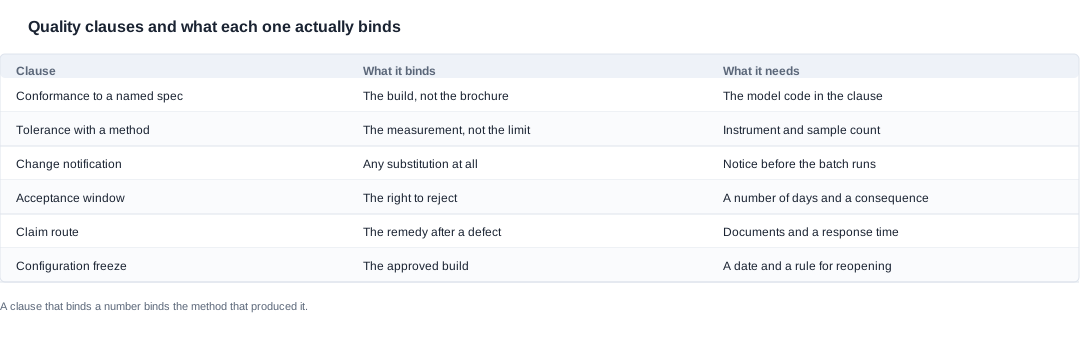
Most quality disputes in smart glasses contracting are not disagreements about quality. They are disagreements about what was promised, at a moment when neither side could check. The four clauses that genuinely bind are narrow and unglamorous: conformance to a written specification for a named model code, tolerances that carry a measurement method, change control that requires notice before a batch runs, and an acceptance window with a defined consequence. Four clauses, each of which does one job, will prevent more arguments than a paragraph of general quality language. Everything else in a quality section — the general statement of intent, the reference to good workmanship, the reassurance about materials — is decorative, and decorative quality language is worse than none, because it invites a buyer to believe that the specification gap has been closed.
Who is reading this, and where the money actually goes
The reader is a brand-side buyer, a channel buyer or an importer who has a quality problem in a live programme and is trying to work out whether the contract can carry it. The task in front of them is narrower than it looks: not to decide who was right, but to decide which clause was missing and to put it in the next agreement. That is a procurement decision, and it is worth making it explicitly, because the alternative — spending a month reconstructing a fault that happened in month four — produces an outcome nobody wanted and a supplier relationship that has already absorbed the cost.
The four clauses below matter more than they look because of what this category's published data does and does not contain. A great deal is published: the rated runtime for all 28 models, the charge time for all 28, the charging method for 24, the Bluetooth version for 14, the camera resolution for all 11 camera models, the charging case capacity for 5, an ingress rating on 2, and a body weight on exactly one model. A great deal is not published at all: the camera sensor part number and the field of view are unpublished across the entire range, and so are the ingress test report numbers, the certification document numbers and every frame weight except that one body weight.
That gap is the whole reason a quality clause has to be written the way it has to be written. A buyer cannot write "the product shall conform to the published specification" for a row that does not exist in the published specification, and a buyer cannot write a tolerance for a measurement nobody has agreed how to take. In both cases the answer is not a number. It is an obligation on the manufacturer to supply the missing row, or a method that the supplier has agreed in writing. A clause that cites a figure we invented is a clause we cannot honour, and it is also a clause that cannot be enforced.

The four clauses that do the work when the specification is incomplete
Conformance language that names the model code
A clause saying the product conforms to the published specification is only as strong as the specification it points to. In this range, much is not published: a unit weight is available for one model, the MT6 glasses body at 158 g including its cell and camera and excluding the foldable charging case, whose 1200 mAh capacity is published but whose own weight is not. The camera sensor model and the field of view are not published at all. A clause pointing at "the published specification" in that territory points at a hole.
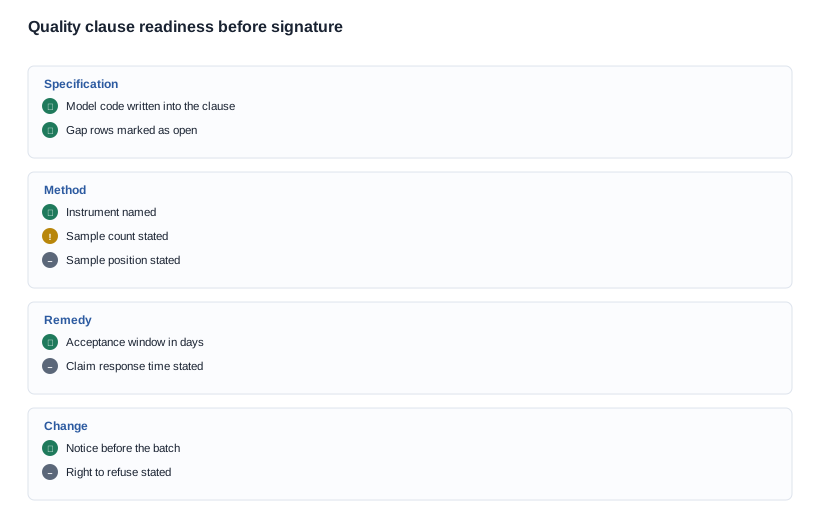
The rewrite is to write the obligation as conformance to a written specification for the exact model code, with an obligation on the manufacturer to supply that specification where their own is incomplete. That converts an absence into a duty to fill it, and it is the difference between a clause that fails silently and a clause that produces a document when it is needed.
The model code has to be the code, not the product name, and this is not pedantry. One model in this catalogue appears under its own designation and is also marked with a second name, which is exactly the situation that produces a conformance argument about a product that is entirely correct. The clause should name the code, the configuration string, and the date of the specification it refers to.
Tolerances that carry a method rather than a number
Where a measurement is agreed, the useful part is how it is measured. A weight tolerance written as a plus-or-minus figure without a method can be met or missed depending on which scale and which operator, and a tolerance that can be missed by a supplier who is trying is not a tolerance.
The same applies to charge time, to the rated runtime and to the acoustic output. Each tolerance should name the instrument or the procedure, the number of samples, and whether the sample comes from the start, the middle or the end of the run. A method agreed before production is worth considerably more than a tight number agreed after the first complaint, and there is a specific reason for that in this category: the published charge time is a duration without a stated starting charge state and without a termination criterion, so it cannot be used as a pass line without adding those two things. The moment you add them, you have written a method, and the moment you have written a method, the clause becomes enforceable.
A method agreed in advance also has a second benefit that buyers rarely count. It defines what a good unit looks like at the goods-in gate, which is the cheapest place in the whole chain to catch a fault.
Change control, the clause that prevents most drift
Substitution within a specification row is the most common cause of a drift that surfaces at reorder. A same-capacity cell change, a different sensor supplier with the same stated resolution, revised packaging artwork — each of these leaves the published rows intact while changing the product. That is what makes them dangerous: nothing on paper moves, so the specification cannot detect them and the acceptance test cannot detect them, and the difference appears in the field.
The clause that earns its place is change control: written notice before any component, artwork or firmware version changes, with the buyer holding an approval right on anything visible in the finished product, and a defined trigger for re-approval. Our practice is to notify a buyer when a component or artwork version changes and to ask before substituting, but a clause makes that a contractual duty rather than a courtesy. A courtesy is worth what the relationship is worth on the day it is needed, and a clause is worth the same on every day after that.
There is a fourth clause that costs nothing and prevents a fifth category of dispute: the acceptance window. State how many days the buyer has to inspect against the agreed criteria, what happens if nothing is raised inside that window, and who bears the freight in each direction. In a category where a defect may only become visible after a charge cycle or a firmware update, an unstated window is an argument waiting for a slow-moving product.
Where the published data stops and the obligation has to begin
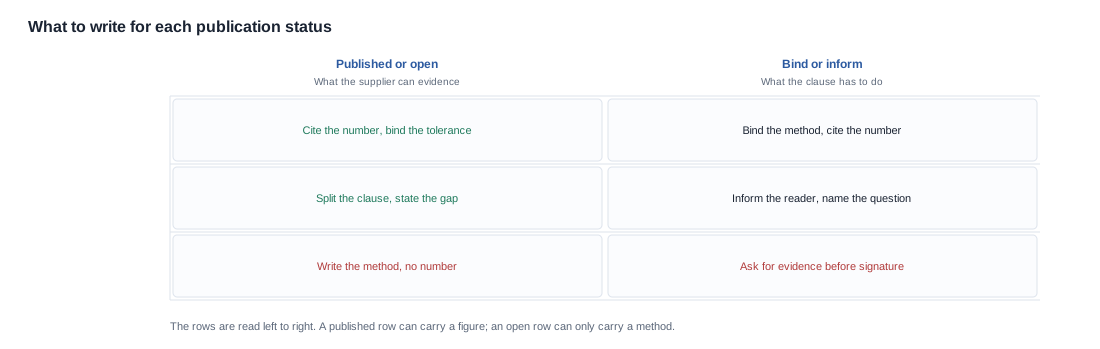
The matrix is the practical version of the four clauses, and it is worth reading across rather than down. A published row can carry a figure and a tolerance, because there is something to measure. An open row can only carry a method and an obligation, because there is nothing to measure yet. The mistake buyers make is writing a figure into the second kind of row, and the mistake suppliers make is accepting it, because nobody wants to be the one who says the number does not exist.
The rows you can write a figure against
The published rows are unusually good in this category and they cover most of what a quality clause needs to bite on. The rated runtime is published for every model in the range, and the spread is wide enough that a clause that ignores the model code is worthless: about six hours on the G07 and the YK12, about seven hours on the camera models with a 290 mAh cell and on the D11, the D12, the D17, the MT6, the electrochromic entry and the bone conduction entry, about eight hours on the AR model, the K01 and K02, the LC-105 pair, the YKC02 and the ZH12, a six-to-eight-hour band on the KY06 and the MT5, a five-to-eight-hour band on the S7 and the V06, and the V03 Pro and the V03, and about twenty hours on the three children's models in the range, which are a different product class with a different certification profile and should not share a clause with anything else. The charge time is published for every model as well, with two of the sport models at about an hour and the rest at up to two hours.
A camera model gives a buyer a resolution tier to write against — eight on the V03 Pro and the CY03, the MT6 and the CY05, and the V03 and the MT5, and the V06 and the KY06, and thirteen on the L2 Utral and the S7, and the L1 Pro — and a cell capacity to write against, and a charging interface to write against on the models that publish one. A buyer who wants a conformance clause with something in it can have one for most of what matters, provided the clause names the model code and the configuration.
The rows that can only carry a method
Four camera models in the range publish a cell capacity, a charge time, a charging case capacity and a rated runtime, and publish no charging interface at all. The correct treatment is to write the obligation to specify, not to write the interface. A buyer who assumes a magnetic interface for those models is relying on a pattern in the range rather than on a published row, and the pattern is not a row.
The same applies to a charging case capacity where a model has a case but no published capacity, to the sensor part number and the field of view across the whole range, to the ingress test report numbers on the two models that carry an IP54 marking, and to every certification document number. The export certification page in the catalogue carries images rather than text and states no certification position in words, so it cannot be used to infer that any particular model holds a particular approval, and a conformance clause that leans on it is leaning on the wrong document.
In all of these cases the clause is the same shape: the manufacturer shall state the value for the model code, in writing, before production, and it becomes part of the configuration. The value arrives later, and it arrives from a party with a duty to supply it.

The five elements that make a conformance clause usable by a third party
A conformance clause is not one sentence, and the reason buyers write it as one is that they are describing the outcome rather than the mechanism. The outcome is that the delivered product matches the approved one. The mechanism is five elements, and every one of them is missing from most drafts. The test of whether a clause is complete is not whether it sounds binding. It is whether a third party, holding only the clause and the shipment, can reach the same conclusion the buyer would reach.
One, the identification. The model code, the configuration string and the date of the specification being incorporated. Not the product name, because in this category a product name can resolve to more than one build — one model in the catalogue appears under its own designation and is also marked with a second name — and not a family, because a family is a catalogue convenience rather than a thing that can be built. This element is cheap to write and it is the one most often left out.
Two, the incorporation. A statement that the named specification is attached as an exhibit, with a revision number, and that it prevails over anything else in the file that describes the same attribute. Without this, the specification is a document the buyer holds and the supplier has never seen, and a conformance obligation measured against it is unenforceable in practice.
Three, the sample tie-in. A reference to the approved sample, identified by a unit serial or a date, and a statement that the production run is built to it. The sample is the only part of the evidence chain that a buyer physically holds, and it is the only element that ties a written specification to a physical object. It is also the element that catches the file written for an earlier build, because a file can be internally consistent and still describe a product that has since changed.
Four, the method. For every attribute that will be measured, the procedure, the instrument, the sample size, the sample position and the pass line. This is the element that turns a tolerance into something a third party can apply, and it is the element that stops a quality dispute from becoming a recollection contest.
Five, the record. A statement of where the measurement result is written down and who holds it, and how long it is kept. A measurement that produces no record did not happen, in a dispute, and this matters most for the tests that run on a sample rather than on every unit, because those are the ones that get skipped when a batch is behind schedule.
There is a sixth thing that is not part of the clause but is part of the same discipline, and it is worth putting next to the five because it is what makes them enforceable in a real programme: the acceptance window and its consequence, discussed above. A clause that binds the production run and a clause that gives the buyer a dated right to reject the shipment are two halves of the same mechanism. The first decides what the goods are; the second decides what happens when the goods are not that. A buyer who has only the first is a buyer whose only remedy is a claim, which is slower, less certain, and considerably more expensive than a withheld payment.
The practical test for a draft is to ask a colleague who has never seen the programme to read only the quality clauses and tell you which model they describe, what pass line they apply, and what happens to a unit that misses it. If they cannot answer all three from the clause alone, the quality section is not a set of binding terms — it is a statement of intent, and the difference between the two is exactly where the money goes.

How drift reaches the customer when the clause is missing

The sequence is worth reading once, because every step of it is normal. A cell or a sensor changes in the supply chain and nobody notices, because the change is a procurement decision taken somewhere upstream of the factory. The published row stays the same, so nothing on paper moves and the specification is still accurate. The first article at goods-in still passes the written criteria, because the criteria were written against the unchanged row. The difference appears in the field, usually as a return, usually several months after the batch shipped. And by then nobody can trace it, because there was no change clause and therefore no record of a change.
The reason this is so hard to catch by inspection is that the criteria were never wrong. They described the product as it was, and the product as it was approved is no longer the product that was built. Only a change clause can close that gap, because only a change clause creates the record.
The second failure mode is the one that costs more and is easier to prevent: a quality dispute that is actually a documentation dispute. A unit arrives that behaves differently from the approved sample, the buyer raises it as a defect, and the supplier asks for the tolerance that was agreed. If the tolerance was a figure without a method, neither party can say whether the unit is inside it, because the question of how it was measured was never answered. The argument then becomes about whose memory of the bench test is correct, and memory is the weakest evidence in a contract file. A method in the clause, agreed before production, settles it with a document.
What we will and will not put into a quality clause
This article is about the four clauses that do work when a specification is incomplete, and we will draft those clauses against your own acceptance criteria rather than against a template.
We will supply a written specification for the exact model code on request, and we will tell you which rows in it we hold and which we do not. The camera sensor model and the field of view are not published in our documentation, and neither are the ingress test report numbers, the certification document numbers or the acoustic figures for the audio range. The catalogue publishes a body weight of 158 g for the MT6 glasses body, including its cell and camera and excluding its foldable charging case, and no bare frame weight is published for any model in the range. We will not fill a contractual row with an industry-typical value, because a clause that cites a number we invented is a clause we cannot honour.
What we will not agree to is a conformance obligation measured against a specification the buyer has not seen, or an acceptance tolerance with no method attached to it. Both are common in drafts, both are reasonable-sounding, and both make the agreement weaker than the parties believe it to be.
What we will do is take a use case, a configuration and a market, and tell you which parts of the specification are settled, which are open, and which have to come from a sub-supplier. The contract terms section covers the commercial half, the documents to request list is the evidence pack, quality consistency is where drift appears, and the certification checklist covers the compliance clauses.
If you send us the model code, the quantity and the target market, we will tell you which of the four clauses your current draft is missing, and which published rows you can already write a figure against. That is a shorter answer than a template, and it is one you can act on this week.
Related reading
- Documents to request — the evidence pack
- Quality consistency — where drift appears
- Certification checklist — the compliance clauses
Send the model code, the quantity and the market, and we will tell you which of the four clauses your draft is missing.


