

A smart glasses contract in this category is doing work that a specification sheet would otherwise do, because so much of the specification is unpublished — no capacity figures, no defect rates, no warranty periods, no certificate numbers, and for twenty-seven of the twenty-eight models in our range no published weight. That makes the supporting documents the contract in practice, rather than an annex to it, and it is why the six documents to request before signing matter more than the order form they accompany. A signature on a one-page order form with nothing behind it is an agreement to receive a product whose identity, quality threshold and remedy are all undefined. This guide sets out the six documents, explains what each one actually binds, names the three that buyers reliably skip and a seventh worth adding for a long programme, and gives the reading order that catches a weak clause before it costs money.
Smart glasses contract: the six documents that make the agreement bind
The buying task behind a contract document request
The reader is a procurement manager on the brand side, a channel buyer or an importer who is about to sign a supply agreement that will govern several production runs rather than a single order. The situation is more common in this category than in most, because the products are new enough that the buying relationship tends to start with an enthusiastic supplier and a small first order, and then run for years without anyone revisiting the paperwork.
The fear is not the price and it is not even the quality in the abstract. It is that the agreement will be found to be silent on the thing that goes wrong. A programme that produces a different camera tier than the sample was approved against, a shipment that arrives with a case option nobody ordered, a batch that fails an inspection in a way that nobody defined as a failure — in each case the question is not whether the supplier did something wrong, it is whether the documents say what happens next. Silence in a contract is not neutral. It defaults to a dispute.
Three commercial realities shape how a buyer should read these documents. The first is that the specification is thin, so the contract has to carry more of the definition than it normally would. The second is that the market moves: components change, firmware advances and production lines relocate, so a contract written at signature needs a mechanism for change rather than an assumption of permanence. The third is that the buyer's brand is on the product, which means the buyer is more likely than not to carry market-facing obligations that the agreement should have allocated.
Why the supporting documents are the contract
A clause in a supply agreement is only as strong as the document it points to, and in this category the pointing is doing a great deal of work. A conformance clause that says the goods shall conform to the specification is worth nothing if the specification is a product catalogue page with no tolerances, no methods and no version reference. The buyer's protection is not the clause; it is the annex.
This is not a drafting nicety. It changes what happens on day one of production, because the documents are read by the people who operate the process rather than by the people who signed them. A factory quality engineer working from a conformance clause with no attached method has to decide for himself what a tolerance means, which sample to pull and from where in the run, and what happens when it fails. Whatever he decides becomes the standard, and his buyer does not find out until a claim.
The practical consequence is that the six documents have to exist before the first production run rather than before the first dispute. And each of them has to be written by someone who understands the product, because the buyer is not going to be able to supply the missing method later either.

The six documents, and what each one binds
The six-document stack, side by side
| # | Document | What it binds | What happens without it |
|---|---|---|---|
| 1 | Configuration lock sheet | The model code, options and artwork that "the product" means | Every obligation refers to something arguable |
| 2 | Specification annex | Each tolerance, its method, sample size and sampling point | Conformance is decided by the inspector |
| 3 | Quality and acceptance annex | The acceptance criteria, the acceptance window and the consequence of silence | Rejection has no timetable |
| 4 | Documentation and conformity annex | The evidence that travels with the goods | Clearance depends on the forwarder improvising |
| 5 | Delivery and risk annex | Incoterm, named place, packing basis and cut-off | Risk and cost sit unallocated |
| 6 | Commercial annex | Price, currency, milestones, minimum, price validity and tooling ownership | Cash terms and non-recurring cost stay informal |
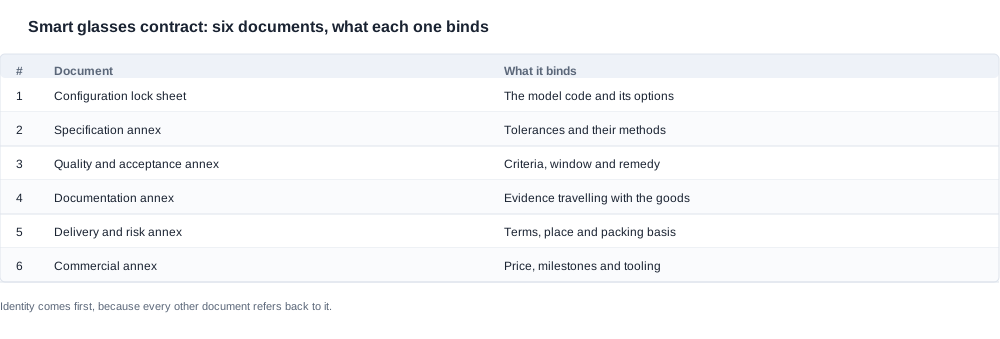
The stack is not a list of equal items. The configuration lock sheet and the specification annex are the two that everything else refers back to, and if either of them drifts, the other four documents are describing something that no longer exists. This is why the model code question has to be settled first and locked at signature: the model code in a quotation can change before the goods ship, while the model code in a signed sheet does not.
Why a clause without a method is not a specification
The single most consequential thing a buyer can add to a specification annex is a method, and it is the thing most often missing. A tolerance without a method is not a tighter specification; it is an invitation for the person holding the instrument to decide what the number means.
Four things turn a number into a method, and a competent annex has all four for every tolerance that matters. The procedure: what is actually done, in what order, with what equipment, and who performs it. The sample size: how many units are drawn, because a single unit tells you nothing about a batch. The sampling point: where in the production run the units are taken from, because a sample drawn at the end of the line and a sample drawn from finished stock are not the same population. And the limit: the number at which the batch fails, expressed as a threshold rather than a description.
The published rows in a catalogue give you the reference values that make this possible — the runtime band for a model, the charge time, the charging method where one exists — and they give you a way to phrase the tolerance without inventing a figure. What the catalogue does not give you is the method, the sample size, the sampling point or the limit. Those four have to come from the supplier, in writing, and the buyer should insist on them in the same document as the tolerance rather than in a later quality agreement.
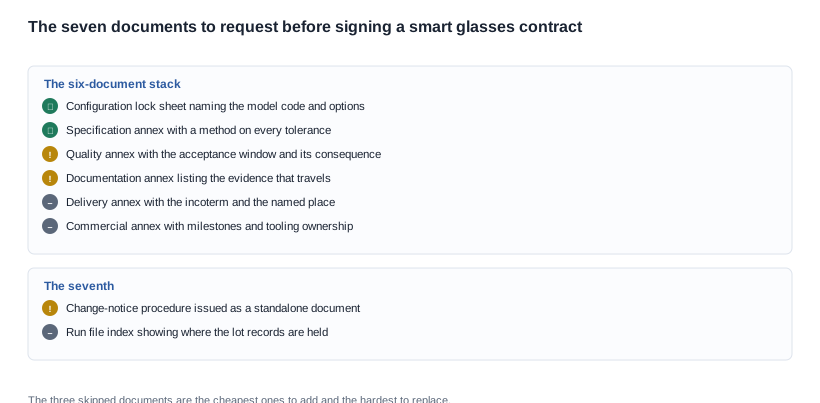
The three documents buyers skip, and the seventh worth adding
Change control
Change control is skipped because it feels like an internal process matter rather than a commercial one. It is the opposite. Change control is the clause that prevents most quality disputes, because the disputes are not usually about whether something was wrong — they are about whether the thing that shipped was the thing that was approved.
If the arrangement runs beyond a couple of reorder cycles, ask for the change-notice procedure as a standalone document rather than as a clause. Clauses are read once at signature, by lawyers; a procedure that is handed to both engineering teams gets followed. That single change tends to be the difference between a substitution being notified and a substitution being discovered at the third reorder by a customer rather than by you.
What the procedure has to contain is specific: which changes require notice, to whom, how far in advance, what form the notice takes, what the customer may do if notice is not given, and what happens if a change has already shipped. That last point is the one that converts a notice obligation into a real control, and it is the one most often left implicit.
The acceptance window
The acceptance window is skipped because silence feels like agreement. It does not, and the practical result of leaving it out is that the buyer has no enforceable way to reject a non-conforming batch at all — because the batch has simply never been rejected.
An acceptance window works only if it has three parts: the period, the decision, and the consequence of not deciding. That last part is the whole point. A window that says the buyer will notify the supplier of acceptance or rejection within a stated number of days, and that silence constitutes acceptance, gives the supplier a date to work to. A window with no stated consequence for silence gives the supplier a reason to wait, because an unresolved inspection is an inspection that can be argued later.
The related question is what happens when a batch does fail, and it belongs in the quality annex rather than in a conversation. The options are rework at the supplier's cost, replacement units, a credit against the invoice, a price reduction, or rejection with return. Which one is available, and whether the buyer can choose, is a commercial term that should be agreed before a failure rather than after one.
Programme end terms
Programme end terms are skipped because the end feels distant at signature. They are the only thing that protects a buyer whose supplier has moved on by the time the programme reorders, which in this category tends to happen in a year or two rather than in five.
Three clauses belong there. The horizon over which a configuration remains available: how long the model code, the firmware and the tooling stay in production, and what happens to an order placed near the end of it. The tooling position: who owns the mould and the fixtures, whether they are released on request, and on what terms. And the obligation to notify a buyer whose configuration is to be discontinued, with a period that is long enough to reorder.
We publish no warranty period, no service turnaround time, no spare-parts availability horizon and no configuration-availability horizon in our documentation, and the reason is the same as for every other unpublished figure: a number that is not in an agreement is a number nobody is bound by. Putting these in the agreement is what converts them from a policy page into an obligation, and a buyer who needs them should insist that they are written into it.
The run file index, as a seventh document
There is one document that is easy to add and frequently missing: the run file itself, or an equivalent index of what was recorded for a given production lot. It is what makes a later quality conversation possible at all — a defect found by a customer in month eight can only be traced to a production window if something recorded that window.
Ask for the index rather than the whole file. The index tells you whether the records exist and where they are held, which is the part that matters to a buyer deciding how much to rely on them.
 A factory that keeps one will say so plainly; a factory that has never been asked usually has to describe where the records would be if they were kept, and the answer is informative.

Checking the stack before you sign
The reading order
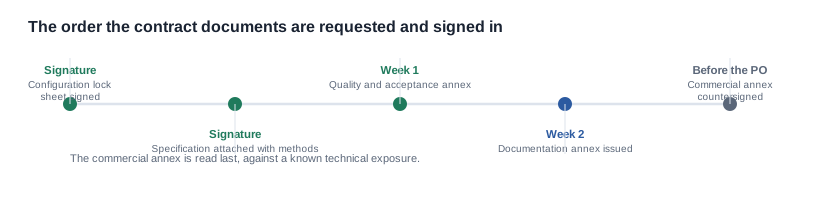
Reading six documents front to back is the wrong way round, because it treats all six as equally binding when they are not. The order below works because each document narrows the ones after it.
- Lock the identity. The configuration lock sheet first, because everything else refers to a model code and its options. If the model code is ambiguous, stop — no clause below it can be read.
- Read the specification for methods. Look for the four method elements on every tolerance that matters, and for the absence of any invented number where the catalogue publishes one.
- Read the acceptance terms for their consequences. The window, the decision, and what happens when nobody decides.
- Read the documentation annex against the goods. Check that the evidence listed is the evidence the destination market needs, for this configuration.
- Read the delivery annex for the unallocated risk. The incoterm, the named place, the packing basis, and the cut-off.
- Read the commercial annex last. By then the technical exposure is known, and the price, the milestones and the non-recurring costs can be judged against it.

The four questions to ask about each clause
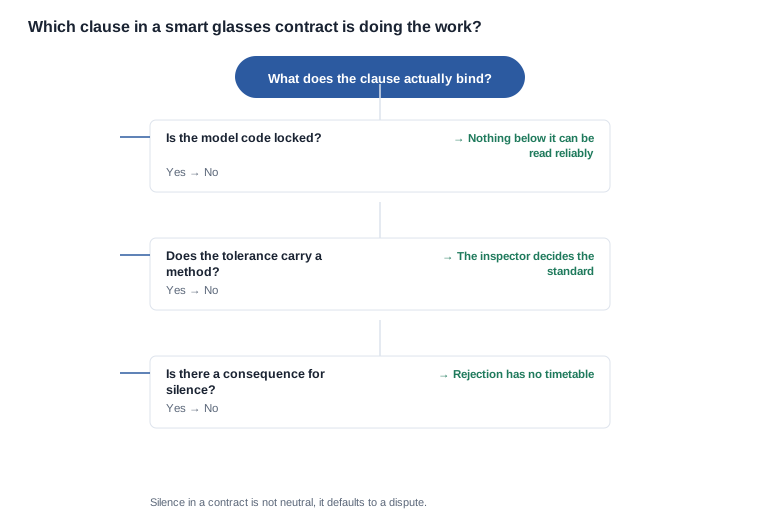
Before accepting any clause in the stack, put four questions to it, and treat a clause that cannot answer all four as a clause to redraft rather than to accept.
What does it bind, and to what — a named model, a configuration, a production lot or a general product? What triggers it, and how would somebody know the trigger had occurred? What is the consequence of not complying, and does the consequence actually reach the party who would have to act on it? And what has to be true for this clause to still be accurate in eighteen months, given that components change, firmware advances and lines move?
Those four questions are the whole of a supplier due diligence exercise on paper, and they are the reason the three skipped documents matter. Change control is the answer to the fourth question. The acceptance window is the answer to the third. Programme end terms are the answer to the fourth as well, applied to the commercial relationship rather than the product.
The questions to ask the supplier are therefore not many, and the answers should arrive in documents rather than in a call. Ask for the six documents as a set, at signature, with the model code on the first page of each. A supplier who supplies five and explains the sixth in a call is telling you which one they expect to be the most difficult, and it is worth knowing that before you agree to it.

Where contract disputes in this category actually come from
Three disputes and their causes
The specification changed and nobody wrote it down. A component was substituted, a firmware branch was updated, or a second source was introduced for a cell, and the goods that arrived were perfectly good products that did not match the approved sample. The symptom is a rejection at the customer's warehouse that the supplier cannot understand, because the difference is in a component the buyer did not know existed. The control is the change-notice procedure, and it is the cheapest of the seven documents.
The batch was conforming and the customer still rejected it. The quality annex defined a threshold for the factory's inspection and nothing for the buyer's own incoming inspection, and the two disagree. The symptom is a shipment that passes the supplier's check and fails the buyer's. The control is to make the acceptance criteria the same document on both sides, with the method attached, so that there is one threshold rather than two.
The tooling was paid for and cannot be released. A mould or a fixture was developed for the programme and, at the end of it, the buyer discovers that ownership is ambiguous — the supplier considers it part of its tooling, the buyer considers it paid for in the unit price. The symptom appears at the worst moment, usually when the buyer is trying to move production. The control is the ownership clause in the commercial annex, stated at signature, with the amortisation treatment spelled out.
The commercial terms that move and the ones that do not
Most of what a buyer negotiates in a supply agreement in this category is negotiable, because most of it is commercial practice rather than a fixed cost. The trade-offs worth making are the ones where a term is cheap to give and expensive to lack: a longer acceptance window in exchange for an inspection right, a higher first deposit in exchange for a lower price at volume, a defined price validity period in exchange for a forecast commitment.
What does not move is the cost of the work itself. Testing, tooling, certification and the documentation effort are real costs with real lead times, and a term that pretends otherwise will be renegotiated in the middle of the programme, which is the worst time to be negotiating. The better approach is to fix the scope of that work before it starts, because the scope is what moves.
There is also a structural point about the trade-offs themselves. Buyers who only negotiate price end up with a contract that is precise about price and silent about everything else, which is the wrong distribution of precision in a category where the specification is unpublished. The total cost of a sourcing failure in this category is not the price difference between two suppliers; it is a programme that stalls or a shipment that cannot be placed. Precision on the documents is cheap by comparison.
A contract worked through, and the limits of our own file
A contract stack reasoned through, clause by clause
The scenario below is written to carry an argument rather than to report a client engagement. No customer, order or engagement is described; the model, the volume, the market and the contract horizon are assumed so that the reasoning can be followed from the first request to the countersigned annex.
A brand-side buyer is opening a new product line and will place an initial order of several hundred units, with reorders expected over two years. The range is a camera model and an audio model. The supplier is a factory the buyer has audited once, and the brand is new to the category.
Step one is the configuration lock sheet, and it surfaces two things that a quotation did not. The camera model has a case option that the buyer has not specified, and the audio model has a Bluetooth version that the catalogue publishes for one of the two and not for the other — so the buyer asks for the audio model's version in writing before signing, because the difference is invisible in the goods and visible at the point of sale. Both are locked on one page.
Step two is the specification annex, and the buyer's rule here is simple: no tolerance without a method. The supplier supplies a method set for the battery, the charging and the camera tier, and where a published catalogue row exists the tolerance is written against that row rather than against a number the buyer proposed. The runtime band for the camera model, the charge time, and the resolution tier all appear as the reference values, and the supplier supplies the sample size, the sampling point and the limit.
Step three is the quality and acceptance annex, where the acceptance window is written with its consequence: a stated number of days after delivery, with silence constituting acceptance, and a list of remedies available to the buyer if a batch fails. The buyer also asks for the inspection right that lets its own incoming inspection use the same criteria, which is the clause that removes the second-threshold problem before it arises.
Step four is the documentation and conformity annex, where the evidence listed is the evidence the destination market needs for this configuration, and where the buyer adds the ongoing production obligation — evidence on a stated cycle, not collected ad hoc when a customs query appears.
Step five is the delivery and risk annex, with the incoterm, the named place, the packing basis and the cut-off, and step six is the commercial annex with the price, the milestones, the minimum, the price validity period and the tooling ownership clause.
The seventh document is added because the horizon is two years: the change-notice procedure goes to both engineering teams as a standalone document, and the run file index is requested with it, which is also the moment the buyer asks what the supplier's answer sounds like.
What we will put into an agreement, and what we keep out
Here, we will supply the configuration lock sheet, a written specification for the exact model code with agreed methods, our change-control procedure and acceptance criteria before production begins. Those are the documents that make an agreement in this category mean something, and we would rather put them in the stack than leave them to a policy page that binds nobody.
What we will not do is sign a conformance clause that references a specification neither of us has seen, and we will not accept an acceptance window with no stated consequence for silence. Those two refusals are the whole of our position on the quality side of the agreement, and they are made because the alternative is an agreement that cannot be enforced by either party.
Warranty periods, service turnaround, spare-parts availability and the horizon over which a configuration remains available are not published in our documentation, and we would rather put them into an agreement where they bind than leave them where they do not. The same applies to capacity figures, minimum order quantities, defect rates and certificate numbers: we do not publish them, and we will not insert a figure into an agreement that we cannot evidence from a document.
What we will do is take a model, a quantity, a market and a contract horizon, and tell you which configurations exist, which rows of the published data you can write into a specification annex as reference values, and which clauses have to come from the supplier's own operation because they describe that operation rather than the product.
A contract document list
Send the models, the quantities, the target market and the length of the programme, and we will tell you which of the six documents we can produce for that configuration, what the published rows allow you to specify against, and which clauses will have to be written from the supplier's side rather than from the catalogue. If you already hold a draft agreement, send it and we will mark the clauses that bind nothing.
Related reading
- contract terms section
- Quality implications — the four clauses that do the work
- Cost breakdown — the commercial side
- Certification checklist — the compliance annex
Send the models, the quantities, the market and the contract horizon, and we will show you which parts of a smart glasses contract can be written from published data and which have to come from the supplier's own operation.


