

Smart glasses contract: sign-off runs as a sequence of gates
The order of the checks
A contract sign-off in smart glasses is a sequence of checks rather than a reading exercise, and the sequence matters because each check depends on the one before. There are five gates, and each has an exit criterion that can be stated in one sentence and judged in one moment. The template below is a standard operating procedure a procurement team can run in a single afternoon and reuse at every order, and the discipline that makes it work is recording three possible outcomes rather than two: a gate passed, a gate failed, and a gate accepted as open with somebody's name against it. That third outcome is the one that turns a checklist into a management record, because a decision somebody made can be revisited, whereas an omission nobody recorded cannot.

Who is in the room, and what the sign-off is actually protecting
The reader is a brand-side sourcing manager, a channel buyer or an importer who is about to sign, or who has been asked to sign something that somebody else has already negotiated. The situation is a draft agreement in front of the team and a decision due this week. The task is not to read the whole document carefully — nobody does that reliably, and a document that requires complete attention to be signed correctly is a document that will be signed carelessly at least once.
What the sign-off protects is narrower and more concrete than the agreement itself. It protects the launch date, the money already committed, and the channel relationship that depends on the goods arriving and being acceptable. A mistake in the commercial terms can be renegotiated; a mistake in the specification or the compliance ownership surfaces somewhere the buyer does not control. That is the asymmetry the five gates are built around, and it explains why gate four — the one with the fewest words in it — is the one that can stop a programme.
The second thing a sign-off protects is the team's own memory. In eight or twelve months, somebody else will be handling a claim, a repeat order or an audit, and the question they will need answered is what was actually agreed and who agreed to it. A sign-off that records gates produces that answer. A sign-off that produces a signature produces only the fact that a signature happened.

The five gates, and what each one has to establish
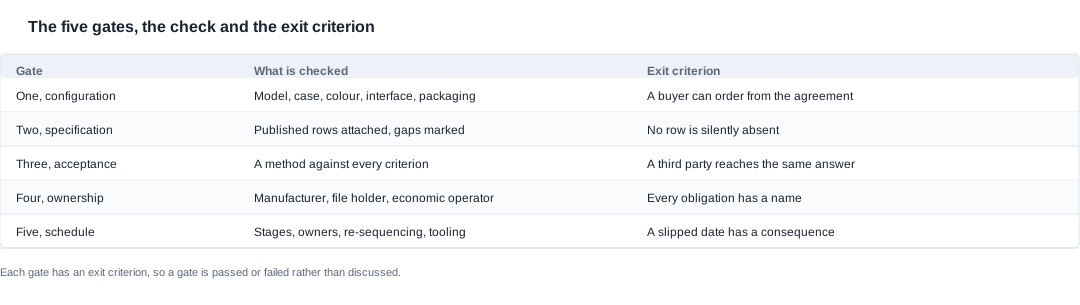
The table is the template. The exit criterion in the third column is the part that is usually missing from a sign-off procedure, and it is the part that makes the gate a gate rather than a topic for discussion.
On a repeat order the gates are re-run, and it is worth deciding in advance that they will be, because a repeat order is where a procedure quietly stops being a procedure. The argument for skipping is that everything has been agreed once and the configuration has not changed. The argument against it is that the configuration is exactly what changes without anyone deciding to change it: a cell swapped for one of the same capacity, an artwork file updated, a firmware build moved forward. The gates that matter on a repeat order are one, three and four, and the shortest version of the re-run is to confirm that the configuration string, the acceptance criteria and the file holder are the same as they were at the last signature, in writing, rather than by memory.
Gate one, the configuration is a schedule
Check that the agreement names the model designation, the case configuration, the colourway, the charging interface and the packaging, and that each is written as a value rather than as a family. In this catalogue, a camera model runs 220, 260, 265 or 290 mAh cells, carries an 8 MP or a 13 MP sensor, and pairs with a 900, a 1200 or a 1400 mAh case, and four of those models publish no charging interface at all — so "a camera model with a charging case" is not a configuration for any of them.
Exit criterion: a buyer can order from the agreement without asking a question. That test is deliberately practical. It is not asking whether the configuration is complete in the abstract; it is asking whether the order can be placed from the paper alone, because that is what will actually happen.
Gate two, the specification is attached with its gaps marked
Check that the published rows are attached — cell capacity, rated runtime, charge time, Bluetooth version, charging method, case capacity where it exists — and that the unpublished rows are listed as unpublished rather than omitted. The rows that need marking in this category are specific: the charging interface on four camera models, the charging case capacity on two further models that have a case, the camera sensor part number and the field of view across the entire range, the ingress test report numbers, and every frame weight except the one body weight the catalogue states for the MT6.
Exit criterion: no row is silently absent. The word "silently" is doing the work. A gap that is marked is a gap the supplier has been asked about; a gap that is omitted is a gap nobody has noticed, and it will be noticed at a border, at a goods-in check, or by a customer.
Gate three, acceptance criteria carry a method
Check each criterion for a method, not just a limit. The rows in this category that most often lack one are packaging print registration, lens condition, charging function on a sample, and the connection of a unit to its case and to a phone across at least two models. The unit-and-case test is a separate line rather than a subset, because a charging fault presents in the channel as a unit that runs out early rather than as a unit that does not charge.
Exit criterion: a third party could apply the criteria and reach the same answer. This is the gate that takes longest, and it is the gate most often deferred to "after the sample", which is exactly backwards. The point at which a method is agreed is the point at which it is cheap; after the first complaint it is no longer a method, it is a reconstruction.
Gate four, compliance ownership is allocated by name
Check that the agreement names the manufacturer of record, the holder of the technical file, and the EU responsible economic operator where the destination requires one under the General Product Safety Regulation, Regulation (EU) 2023/988, which has applied since 13 December 2024, alongside the radio position under the Radio Equipment Directive (EU) 2014/53/EU. A catalogue's export certification line is a company-level capability, not a per-model certification row, so it cannot be used to infer that a given model holds a given approval.
Exit criterion: every obligation has a name against it. Not a department and not a role — a name, or at least a named legal entity. An obligation attached to a function is an obligation that moves when the person does, and this is the gate that surfaces at a border rather than at a desk.
Gate five, the schedule and the late clauses
Check that every stage between the purchase order and the arrival has an owner and a deadline, that the re-sequencing rule describes a mechanism and a named decision-maker, and that the tooling, firmware and app-source ownership is stated. This gate has two halves and they fail differently: a schedule with no owner is a hope, and an ownership clause with no exit is a dispute in waiting.
Exit criterion: a slipped date has a defined consequence. That consequence does not have to be a penalty. It has to be a consequence — a right to cancel the balance, a re-sequencing decision with a named decision-maker, a revised documentation date — because what makes a date binding is not the threat but the fact that something follows from the slip.

The three outcomes a gate can have
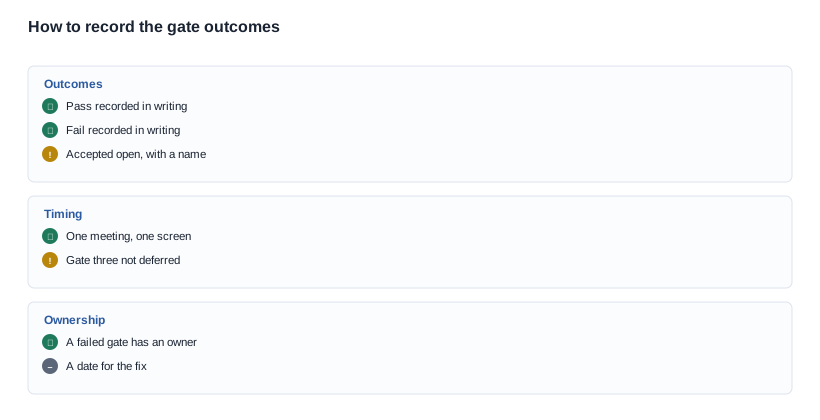
Record each gate as pass, fail, or accepted-open. The third category is the one that makes this a procedure rather than a formality, and it deserves a paragraph of its own.
An accepted-open item is a decision that somebody made, in the knowledge that the item was not closed, with a name attached to it and a date by which it will be. That is a completely different thing from an omission. An omission can be discovered by anybody at any time, including a customs authority, a customer, or a member of the team in year two who is trying to work out whether the goods were compliant. A decision can be revisited, challenged, escalated, or reversed by the person who made it. The difference between the two is the difference between a programme with a problem and a programme with a history.
The rule that goes with it is short: an accepted-open item is only legitimate if it has a name and a date. Without both, it is a failure that has been relabelled in order to let the sign-off continue, which is worse than a failure because it removes the signal.
The second rule is about which failures stop the order. Not every failed gate should stop the order. A gate two failure on a single unmarked row is worth a note in the specification, because the row can be closed in the documentation handover and nobody's shipment is stopped. A gate four failure on an unallocated compliance obligation is worth a delay, because that one surfaces at a border, and a border is a much more expensive place to fix an allocation than a desk. The judgement is not about severity in the abstract; it is about where the failure surfaces, and that is a question each gate should be read against.

How to run the session so the gates actually happen
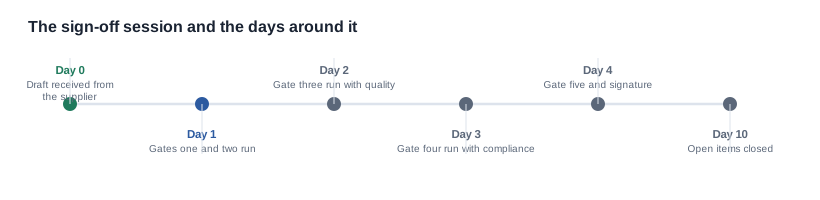
Four practical points, and they are the difference between a procedure that runs and a procedure that is on a shelf.
Run all five in one meeting, in this order, with the agreement open on a screen. Not in parallel, and not in a review that each department does separately and sends back. The gates are sequential because each depends on the one before: a quality reviewer who reads a specification whose gaps have not been marked will comment on a gap that gate two was supposed to close, and the review will stall on something that is not actually a dispute. The order is the procedure, not the individual checks.
Put the agenda in the order of the gates, and put gate three in the middle of the meeting rather than at the end. Gate three takes longest and is the one most often deferred, and it is the gate that a quality claim in month nine will be measured against. If it is going to be deferred, defer it at the start of the meeting when there is still time to do it properly; if it is going to be done, do it with the people who will have to apply it.
Bring the person who will receive the goods, not only the person who negotiates them. A gate that is passed by a procurement team and then applied by a different team fails at the application, and it fails silently, because the goods-in check that nobody was told about is a goods-in check that does not happen.
Write the outcome of every gate down while the meeting is still running. A gate outcome recorded two days later is a gate outcome reconstructed from memory, and memory in a negotiation is shaped by what was said last.
The two questions to ask when a gate fails are the same in every case: what would have to be true for this to pass, and who can make it true. A gate that fails for a reason nobody can act on will fail at the next order as well, and the second failure will be more expensive because the first one was recorded as somebody else's problem.
The sign-off record: what a gate outcome has to capture
A procedure is only as good as the record it leaves, and the record for a sign-off is small. Five gates, three outcomes each, so fifteen entries, and each entry has four fields. Which gate. Which outcome: pass, fail, or accepted-open. The reason, in one sentence, in the words of the person who decided it. And a name against it, with a date if it is not a pass.
That is the whole record, and it is worth being strict about the fourth field, because a gate outcome without a name is not a decision. It is a note in a meeting, and it will be read as a decision by whoever finds it, which is the failure mode the third outcome was designed to avoid. The date matters in the same way: an accepted-open item with no date is an accepted-open item that will still be open when the first shipment arrives, at which point it is no longer a scheduled item and has become a discovery.
The record should also carry two things that are easy to lose and expensive to reconstruct. The first is the list of documents that were attached at signature, with their revision numbers, because the exhibits are the agreement and everything else refers to them. The second is the specific open items with their owners and dates, kept as a separate short list rather than as lines in the gate record, because the gate record is a historical document and the open items list is a live one, and mixing the two is how a live item quietly stops being reviewed.
Where the record lives matters more than it sounds. A sign-off record kept in one person's inbox is a personal record, and it will not survive that person leaving, which is the same argument that applies to the technical file and for the same reason. A sign-off record kept in the contract file, with a retention period, is a document, and it will still be there when somebody needs to know what was agreed in week two of a programme that is now in its second year.
The cheapest improvement to the whole procedure is to make the record part of the signature package rather than a separate deliverable. The buyer is already sending the signed agreement to the supplier; attaching the fifteen gate entries costs a second page and means that the record and the agreement enter the counterparty's file at the same moment, in the same message, with the same date.
The question a procurement manager should ask at the end of it
The sign-off ends with a question that is worth asking out loud, because it converts the meeting into a decision: if this order is delivered and something is wrong with it, which of the five gates would have caught it? A team that can answer that question for each of the failures it is worried about has a procedure. A team that cannot has a reading exercise, and a reading exercise produces a signature rather than a control.
The answer is usually uneven, and the unevenness is the useful part. If the team can say which gate would have caught a documentation problem at the border and cannot say which would have caught a specification drift between the sample and the production run, then the programme has a well-covered compliance half and an uncovered quality half, and the time to fix that is before the order rather than after the first claim. A team that answers evenly — every gate would catch everything — is not being realistic, and the procedure is being run as a form rather than as a control.
What we will and will not sign
We will draft these clauses, and we will not sign an order that leaves compliance ownership unallocated or that sets acceptance criteria without methods. Where a clause cannot be agreed, we will say so at quotation rather than at the shipping date, which is the whole reason a sign-off procedure exists: the failures it catches are cheap to catch in week one and expensive to catch in month four.
Unit prices, minimum order quantities, production lead times and capacity slots are not published in our documentation, and a contract signed against figures we cannot evidence is one that gets renegotiated. What we will do instead is set them for the specific order, write the configuration, the delivery basis, the acceptance criteria and the change-notification commitment into the agreement, and mark as Not published the rows we genuinely do not hold — the camera sensor part number, the field of view, the ingress test report numbers, the certification numbers, and every frame weight in the range apart from the 158 g body weight published for the MT6, which excludes its foldable charging case.
The contract terms section covers the clauses each gate checks. The seven contract questions are what buyers ask most often and are the shortest version of the same material, the eight mistakes that cost money are the omissions this procedure is designed to catch, and quality consistency is what gate three is protecting.
If you want the procedure in a form you can hand to a colleague, send us the model code, the quantity and the target market and we will mark the five gates against that specific configuration, noting which of them are open on the published data and which of them can be closed immediately.
Related reading
- Seven contract questions — what buyers ask most
- Eight mistakes that cost money — the omissions
- Quality consistency — what gate three is protecting
Send the model code, the quantity and the market, and we will mark the five gates against that configuration.


