

Most factory audits begin with a site visit and end with an impression. The ones that find real problems begin with paper, because paper is dated, versioned and difficult to produce on demand. The travel is the expensive part of a smart glasses factory audit in both money and calendar time, and it is also the part that generates the least reliable evidence when it is the first thing you do. Request six document families before you book a flight, and the visit stops being an open discovery and becomes a verification — which is cheaper, shorter, and far more likely to produce a decision you can act on. This guide sets out what to request, what a refusal to produce a document actually tells you, which questions paper can settle and which only the floor can, and how to build a two-hour agenda out of a document set instead of a two-day tour.
Smart glasses factory audit: the documents that narrow the visit
The buying task behind an audit request
The reader is a brand-side procurement manager, a channel buyer or an importer who has decided to go and inspect a factory, and who is trying to make that decision worth the cost. The buying situation is usually one of three: a first order in a new market where the counterparty is unknown, a volume increase on an existing supplier where something has changed, or a supplier evaluation where the price is competitive and nothing else is known.
In each case the buyer's real question is narrower than "is this factory good". It is which model this factory can build, on which schedule, and how to evaluate that from a distance., to the specific standard the buyer's market requires, consistently enough that a second order is safe. A visit answers the general question beautifully and the specific question badly, because a factory can show you its best line and its tidiest bench on the day, and neither is the line that will build your product.
The other thing that makes documents-first the better order is reversibility. A document request costs a supplier a day of somebody's time and costs the buyer nothing. A site visit costs several thousand in travel, a working week of somebody's time, and a day on the floor that cannot be repeated until the next trip. Once you have travelled, you have already decided that the supplier is worth evaluating seriously, and the pressure to reach a favourable conclusion is real even when the evidence does not support one. Paper first removes that pressure, because the decision to travel is made against a written file rather than against an impression.
Why most audits begin with paper rather than with travel
The reason is that a document is evidence and a site is a demonstration. A document has an issue date, a version, an author and a scope, and it can be checked against a public register or a named laboratory. A demonstration has a date and nothing else.
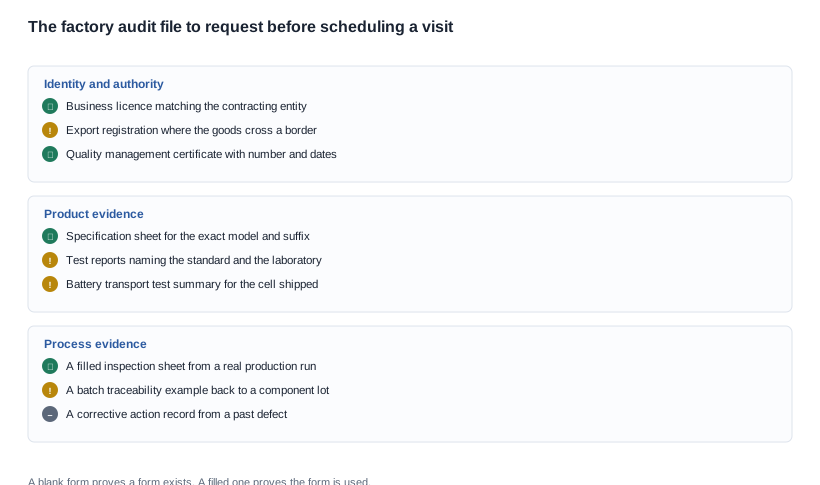
This distinction matters most on the three questions that decide an audit's outcome. The first is whether the supplier is the entity you think it is: a business licence in the contracting name, matching the bank account beneficiary, is a document, and it is checkable in an afternoon. The second is whether the evidence you have been shown applies to the model you intend to buy: a specification sheet for the exact model and suffix, a test report naming the standard and the laboratory, and a battery transport test summary for the cell that actually ships. The third is whether the quality system produces records rather than impressions: a filled inspection sheet from a real production run, an example of a batch traced back to a component lot, and a corrective action record from a past defect.
Those three groups can be asked for in writing, in a single message, with a request that names your model and configuration rather than the range. What comes back either narrows the visit or tells you not to make it. Both are better outcomes than a day on the floor producing an impression that later turns out to be wrong.
The questions to ask, and the order to ask them in, decide the value of the trip. There is one asymmetry worth stating plainly. A supplier can produce a convincing document set for a capability it does not have, particularly a quality management certificate held by a company that subcontracts the work you care about. What it cannot do is produce a filled inspection sheet from a real run of your product type, a traceability example that ties a finished unit to a component lot, and a corrective action record from a defect that was actually investigated. Those three are the ones to press on, because they are the ones that are expensive to fabricate.

The six document families to request before travelling
The six document families, side by side
| # | Document family | What it establishes | The single item that proves it |
|---|---|---|---|
| 1 | Entity and authority records | Who contracts with you and who signs | The business licence in the contracting name |
| 2 | Model-level product evidence | That the claims apply to your configuration | The specification sheet for the exact model |
| 3 | Transport and battery documentation | That the goods can be offered to a carrier | The test summary for the cell that ships |
| 4 | Process and inspection records | That quality is a system rather than an instinct | A filled inspection sheet from a real run |
| 5 | Traceability and corrective action | That a problem can be found and explained | A unit traced back to a component lot |
| 6 | Sub-supplier and site register | Which parts of the product are made where | The register of critical components and their source |
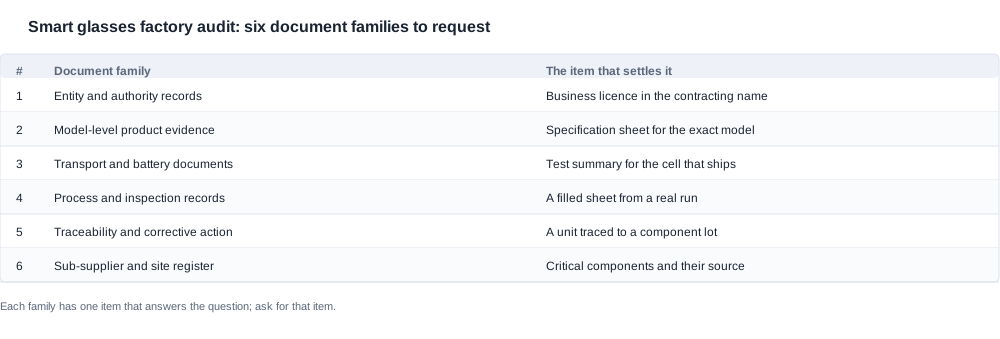
Each family has one item inside it that actually settles the question, and asking for that item specifically is what makes the request answerable. The business licence in the contracting entity's name settles family one, because the alternative is a certificate that belongs to somebody else. The specification sheet for the exact model — including the suffix, because a designation with a suffix is a different product — settles family two. The battery transport test summary for the cell that actually ships settles family three, and it is the document most often missing at first contact and the one most likely to stop a shipment later.
Family four is where a request usually produces a template. A blank inspection form proves that a form exists. A filled one, with dates, quantities and results, from a run of your product type, proves that the form is used. Family five is the sharpest test in the whole set: ask how a finished unit is traced back to a component lot, and if the answer is a date code on the box, keep asking, because a date code identifies a period rather than a lot.
Family six is the one that most often surprises a buyer, because it shows how much of the product is made by somebody else. A camera model in particular is a complicated assembly, and the register of which components are bought in, from whom, and under which approval is the most direct evidence of how a factory manages the parts of the product that carry the most risk.
What a refusal to produce a document actually means
Suppliers decline to send documents before a visit for ordinary reasons: confidentiality, or simply that the person who holds them is not the person you are emailing. Treat a refusal as information rather than as a verdict, and give the supplier an easy way round it. Ask for the document with commercial details redacted but the certificate number, the dates and the issuing body left intact, and almost every refusal disappears at that point.
Two or three refusals against the same family are red flags in the file rather than administrative friction. What is genuinely informative is a pattern rather than a single refusal. A supplier who can produce every document except the ones that concern the specific model you intend to buy has told you something precise, and it usually has one common explanation: the model-level evidence for your configuration does not exist yet, and everything else you have seen was a category-level claim. That is a finding worth more than the visit you were about to pay for.
Two further refusals deserve separate handling. A refusal to give a certificate number, while offering a scanned page with the number blanked out, is a request for anonymisation rather than a concealment, and it is reasonable. A refusal to explain what a document covers, while offering to send it, is a different signal entirely, and it is the one to escalate to a second question rather than a second request.
What documents can settle, and what only the floor can
The matrix of evidence
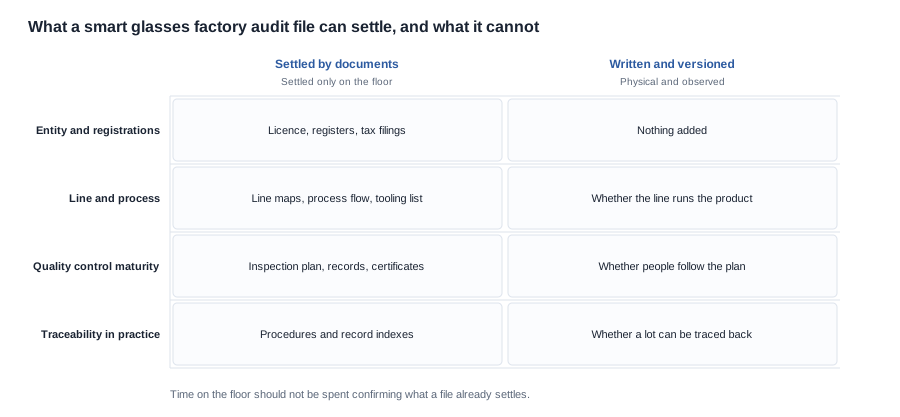
The value of asking for paper first is that it sorts the questions into two piles before you travel. The first pile — entity, registrations, scope, dates — is settled by documents and should not consume any of the time on the floor. The second pile — whether the line runs your product, whether people follow the plan, whether a lot can actually be traced — cannot be settled from a file at all, and it is what the visit exists to answer.
The mistake is treating a visit as the way to answer both. A day spent confirming the registered address, the certificate number and the model designation is a day spent confirming what a document already established, and it is the day that makes auditors tired and judgements lazy.
There is a third pile that gets lost in both: the questions that neither documents nor a one-day visit can answer. Whether a factory will hold a date three months out, whether it will prioritise your order over a larger one, and whether it will tell you when something goes wrong are all behavioural, and the only evidence for them is a small first order with a delivery that lands on the date it was given. That is why the first order in a new relationship should be small enough to be worth learning from and specific enough to test the behaviour.
The catalogue rows that make the request specific
A document request is far more effective when it names the product, and our catalogue gives a buyer enough specificity to name it precisely. The range covers twenty-eight models: eleven camera models, eight audio models and three sport models. That means a request for "your smart glasses range" is ambiguous in three directions, and a request for "the specification and test evidence for the L2 Utral with the 1400 mAh case" is not.
The published rows also let a buyer state a scope question in the request rather than in a later argument. The camera resolution tier is published for all eleven camera models — eight at 8 MP and three at 13 MP — so a test report that covers one tier does not cover another, and the request can ask directly which tier the report covers. The charging method is published for twenty-four models and not at all for four camera models, which tells a buyer in advance that there is a document to ask for on those four and no published answer to check it against.
One published measurement is worth noting as a quality signal rather than a specification. Our catalogue carries a single weight figure in the whole range, for the MT6 glasses body, and it is specific enough to be useful: 158 g including the 265 mAh cell and the camera and excluding the 1200 mAh folding charging case, whose own weight is not published. A factory that measures one unit carefully enough to publish that distinction has the measurement discipline that an audit is trying to establish, and a factory that answers the same question with a range is telling you something else.

Turning the document set into a visit agenda
The five-step build
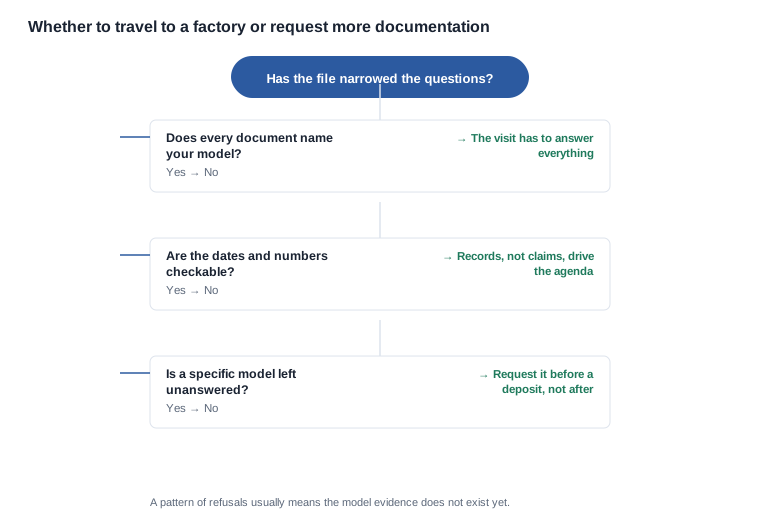
- Ask for the pack against your exact model and configuration, not the range. One message, one model, one destination market. A request scoped to the range produces a pack scoped to the range.
- Check the numbers and dates yourself. Certificate numbers, issuing bodies, validity periods and scope statements. An expired or unnumbered document is not a document with a gap; it is not evidence.
- Compare the line map against what you intend to place. Which line builds your model, which steps are in-house, and what the sub-supplier register says about the rest.
- Ask for the three expensive-to-fake items. A filled inspection sheet from a run of your product type, a unit traced back to a component lot, and a corrective action record from a defect that was actually investigated.
- Build the agenda from what the documents could not settle, and nothing else.

What the visit has to add
Once the file is in, the visit becomes short and specific. Four things on the floor are worth more than anything else, and they are the four that documents cannot fake.
Walk the line that builds your model, not the line that is tidiest, and watch a finished unit rather than a display unit. Check whether the inspection sheet you were sent is the form actually in use on that line. Ask where a specific unit on the shelf was assembled and who signed it off, and see whether the answer comes quickly. And examine the rework area — the size of it and whether it is being used tells you more about the real defect rate than any figure in a report, and it is the one observation a supplier cannot stage in advance.
The visit should end with two documents agreed in principle: the record you will ask the supplier to keep for your lots, and the notice procedure you will use to tell them what to change. Without those two, an audit produces information you will have to collect again.
Where factory audits produce false confidence
Four traps
The tidy factory. A supplier who prepares for a visit can prepare a great deal, and the preparation is usually the wrong line, a swept floor and a rehearsed explanation. The defence is to arrive with a unit identifier from a real production lot and ask to see that unit's paperwork.
The certificate that covers the wrong thing. A quality management certificate is a statement about a company's management system at a site, not about a product, a model or a customer's order. Reading it as product assurance is the most common misreading in this category, and it is the reason the certificate number, the issuing body and the validity dates matter more than the logo.
The sub-supplier that is invisible. A factory can be audited thoroughly and still not control the part of the product that actually fails. The register of critical components, their sources and their approval status is what turns this from a possibility into a known quantity, and it is the register that most often does not exist.
The audit that finds nothing because the questions were not written down. A visit conducted from memory produces findings that cannot be followed up, because there is nothing to follow up against. Every question on the floor needs an owner, an expected answer and a written result, and the questions that came from the documents are the ones worth writing down.
The commercial terms around audit work
The total cost of an audit is rarely the issue; the issue is who pays for the failures it prevents and who pays when it produces nothing useful. Three terms are worth settling in the agreement rather than in an email.
The first is the frequency and the trigger. A calendar audit on an annual cycle is a compliance formality. A triggered audit — after a quality failure, a component change, a move to a second production site — is a control, and the trigger should be written so that the buyer can invoke it without a negotiation about whether the circumstances qualify, and before you order the next run.
The second is the access scope: which areas, which records, which people, and whether the buyer may bring its own quality engineer or an independent inspector. The third is the cost allocation when the audit finds something. An audit that finds a systemic issue is going to cost the supplier more than the audit did, and if that cost is ambiguous in advance, the audit becomes something both sides prefer to postpone.
There is a trade-off worth naming. A demanding audit scope raises the price of the relationship and lowers the number of suppliers willing to enter it, which narrows the buyer's options. A buyer running supplier due diligence in this category for the first time should expect to narrow the field, and should plan for it rather than discovering it.
A factory audit file worked through, and what we will hand over
A factory audit file reasoned through
The scenario below is constructed to carry an argument, not reported from a client engagement. No customer, order or engagement is described; the model, the quantity, the market and the trip are assumed so that the reasoning can be followed from the first request to the end of the visit.
A buyer is opening a camera model into a European market and has one candidate factory that quoted well. The counterparty is a new relationship and there is no shared history. The buyer has budget for one trip.
Step one is the request, and it is scoped tightly: one model, one configuration, one destination market. Six families come back. The business licence matches the contracting entity and the bank account, and the quality management certificate has a number, an issuing body and validity dates that are still current.
Step two is the scope check, and it finds two things. The test report names a laboratory and a standard, but it covers the base configuration rather than the case option the buyer intends to order. The battery transport test summary is present, but it is for a different cell from the one the catalogue describes for that model. Neither is a disqualification, and both would have been discovered at the forwarder or at a customs query rather than in the buyer's own file.
Step three is the three expensive-to-fake items. The inspection sheet comes back filled, with dates and quantities, from a run of camera models — a good sign, and the first question it answers is whether the form in use on the floor is the same form. The traceability example comes back thin: a unit traced to a production date and a box, not to a component lot. The corrective action record is genuine and shows a real defect that was investigated.
Step four is the visit, which is now two days rather than five. The line that builds the model is walked, the inspection sheet is checked against the one on the floor, the unit in stock is traced with the same questions that were answered on paper, and the rework area is observed. The traceability gap is confirmed on the floor, which is worth knowing, and it is converted into an action: a lot identifier and a retained sample per production run.
Step five is the two documents agreed at the end — the per-lot record and the change-notice procedure — which is what makes the first visit worth the second one.
What we will provide and what we will not
The short answer: we will provide the documents that exist for a given configuration and say plainly which ones we do not hold. We will supply the specification rows for the exact model, the charging and runtime rows as published, the transport arrangement that applies to the cell in that configuration, and our own inspection and change-control procedures.
What we will not do is compile a document pack that implies a compliance position we cannot evidence, and we will not produce a certificate number, an issuing body or a validity date from memory. Individual certificate identifiers are not published in our documentation — that is a gap in our records, and we will not fill it with a plausible-looking reference. The same applies to capacity figures, defect rates and minimum order quantities, for the same reason.
We will also tell you where our own evidence is thinner than we would like it to be. The catalogue carries a company-level export-certification page and no per-model certification rows, and the certification scope of a named model is a written request to us rather than a search. If that is inconvenient for your file, it is the accurate position, and you should hold any supplier to the same standard, including us.
How to start a factory audit file request with us
Send the model, the configuration, the destination market and the date of your planned visit, and we will tell you which of the six document families we can produce for that combination, which ones have to come from a sub-supplier or a laboratory, and what a buyer should insist on seeing on the floor once the file is in. If you have already requested a pack from a supplier and want it read, send it and we will mark the items that settle a question and the ones that do not.
Related reading
- factory audit section
- Advanced factory audit guide — what a second visit should sample
- Certification checklist before ordering — reading test reports properly
- Battery transport — the document that stops shipments
Send the model, the configuration and the market, and we will show you which parts of a smart glasses factory audit file we can produce and which have to come from a laboratory or a sub-supplier.


