
AI camera glasses for content creation is the use case where the camera family's published rows matter most and where the published gaps bite hardest, and that is worth saying at the start. The platform features published across this family are first-person content capture, everyday stills, hands-free calling, meeting recording and AI translation, with a low-power Bluetooth connection, an integrated camera module and an AI voice assistant. That is a genuinely complete description of what the category is for. What is not published is anything that would let a buyer tell a creator what the footage will contain: no sensor model, no field of view, no video resolution, no frame rate, no aperture, no stabilisation and no low-light behaviour, for any model in the range.
So the creative decision and the procurement decision sit in different hands, and this article is about that gap and about the protocol that closes it. The structure is deliberately the buyer's rather than the creator's: a production stage, the constraint that applies at that stage, and the acceptance criterion that settles it. A creator will tell you what they want to shoot; a procurement team has to turn that into something a supplier can be held to.
The catalogue publishes eleven camera models — the V03 and the L2 Utral, the V06 and the MT6, the KY06 and the V03 Pro, the CY05 and the CY03, the L1 Pro and the MT5, and the S7 — and every published row referenced below belongs to one of them.
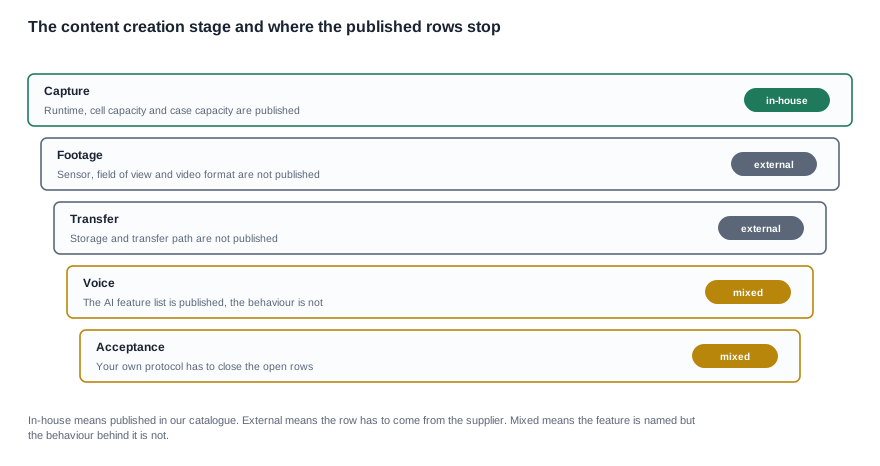
AI camera glasses for content creation: the production stages and the gap at each one
A creator's working day has three stages that matter to a buyer, and the published material covers them very unevenly. The chart above shows the split: the capture stage is largely documented, the footage stage is not documented at all, and the voice stage is documented as a feature list rather than as behaviour.
The capture stage is where the product earns its place in a shoot. The unit has to be on, recording, and powered for the whole session without an interruption, and the buyer has rows for that: a rated runtime published for every camera model, a frame cell capacity published for every camera model, and a case capacity published for five of them. The runtime figures are 5 to 8 hours on the S7 and the V03, and the V03 Pro and the V06; 6 to 8 hours on the KY06 and the MT5; and about 7 hours on the L1 Pro and the CY05, and the MT6 and the CY03, and the L2 Utral. The charge time is published for every camera model at two hours or less, which is a ceiling rather than a measurement and comes without a starting state or a stop rule.
The footage stage is where a creator decides whether the product works, and it is the stage with the least published material. The resolution tier is published — 8 MP on eight models, 13 MP on the S7 and the L1 Pro, and the L2 Utral — and nothing else about the imaging is. The camera imaging reference covers what each of the unpublished parameters does to a shot, and the short version is that the tier is a shelf argument and everything a creator judges by is not published.
The voice stage is where the AI feature list sits. The features are named and published, which is a real asset for a listing, but the behaviour behind them is not: the trigger conditions, the failure modes, what happens in background noise and what happens when the feature is used continuously are all unspecified. The AI features section sets out the published list, and the CY03 common questions piece shows the same gap handled at model level for one model.
The three stages also fail differently, and that difference matters more than the volume of published rows. A capture-stage failure is visible: the unit stops, the session stops, the problem is obvious and it is usually a power problem. A footage-stage failure is invisible until the footage is reviewed, which is often the day the shoot is edited, which is too late to reorder. A voice-stage failure is intermittent and environment-dependent, so it is frequently written off as a user error rather than as a defect. A procurement team that writes one acceptance criterion for the whole product will cover the first of these three and none of the others.
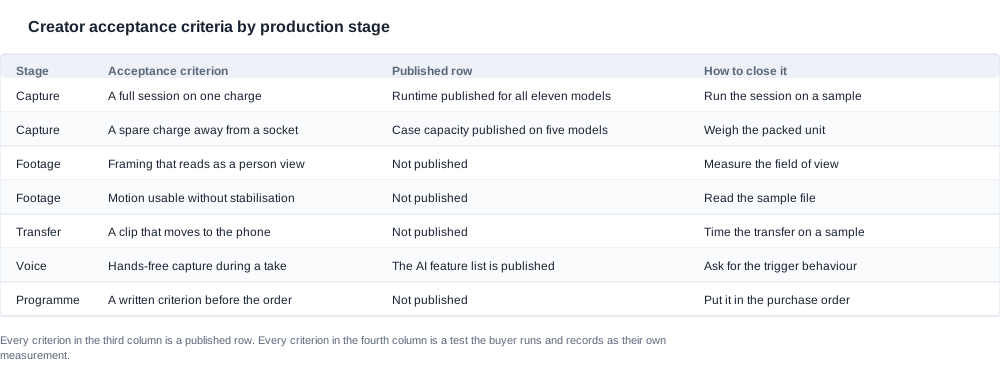
Stage one: capture, and what the published runtime row supports
The capture stage is the stage where the published rows do most of the work, and it is worth being precise about what they support. The published runtime is a rating, not a prediction. It tells a buyer how the catalogue classifies the unit's endurance; it does not tell a buyer how long a particular shoot will last, because no test load, screen state or ambient condition is published with it, and because the figure appears as a band on some models and as a single value on others. A band of 5 to 8 hours and a single value of about 7 hours are different kinds of claim, and planning a production day around either of them requires the test condition.
Three constraints follow from the published rows, and each one becomes a criterion rather than a hope.
The first constraint is session length against the published band. The buyer does not have to invent a number here — the creator does. A session has a length, a number of takes and a turnaround between them. Write those three down, then check them against the published runtime of the model under consideration, and note which one binds. If the session plus the turnaround exceeds the top of the published band, then either the session needs a second charge or the unit needs a case, and both of those are commercial decisions that the buyer has to make now.
The second constraint is where the second charge comes from. Five camera models publish a case capacity — the L1 Pro and the CY05, and the CY03 — each at 1400 mAh, the L2 Utral at 900 or 1400 mAh, and the MT6 in a 1200 mAh foldable case. Two ship a case whose capacity is not published, which are the KY06 and the MT5. Four have no case row at all, which are the V03 and the V03 Pro, and the S7 and the V06. For a creator-facing proposition this is the row that decides whether the unit can survive a full shoot away from a socket, and for five models the answer is published while for six it has to be asked, with the four that carry no row being the ones a creator-facing listing cannot describe without a written answer.
The third constraint is the physical one that no row covers. No camera model in the range publishes a unit weight except the MT6, at 158 g for the glasses unit including the battery and the camera and excluding the foldable case. For a production day in which the unit is on the head for hours, the weight is a real variable, and it has to be measured on a sample because the catalogue does not carry it for the other ten models.
The battery specification guidance sets out how to read a runtime figure that comes without a condition, and the L1 Pro buyer review checklist works through the same method at model level for one of the thirteen-megapixel models.
Stage two: footage, and the four specifications that decide the footage
This is the stage a creator judges, and it is the stage where nothing is published. There are four specifications that between them determine whether a first-person recording works for the intended channel, and each of them is absent for every model in the range.
Field of view decides whether the footage reads as a person's view or as a crop of one. It is the single most consequential unpublished parameter in this category, because a narrow field produces a shot the audience reads as a poor camera rather than as a narrow lens. It is also the parameter that a walk-through test settles in a single take, which is why it belongs at the top of any sample protocol.
Video resolution and frame rate decide whether the footage can be cut. A creator producing material that gets edited and re-cut needs enough resolution to crop and enough frames per second for motion. Neither is published, and neither can be inferred from the stills resolution tier — a camera that captures 13 MP stills may record video at a different figure entirely.
Low-light behaviour and stabilisation decide whether indoor and moving footage is usable. Neither is published for any model, and both are the parameters that a creator will discover in the edit rather than in the shoot.
The storage and transfer path decide whether the footage survives the shoot. The arrangement is not published for any model — capacity, container format, and the behaviour when storage fills. Nor is the transfer path from the unit to the editing machine. A camera that stops recording because storage is full is indistinguishable from one that has failed, and it will be returned as a defect unless the behaviour was checked and written down before the order.
There is a fifth item that is not a specification but behaves like one: the file format and the naming of the recorded files. It decides how much of the shoot's post-production time disappears into conversion, and it is a question a buyer can put to a supplier in a sentence.
A sixth item sits across the whole of this stage rather than inside it, and it is the one that decides whether the stage can be repeated at all: whether the footage can be taken off the unit and put somewhere safe. A creator who cannot retrieve the material from the device after a shoot has lost the shoot, regardless of how good the recording was. Whether the transfer is by cable, by wireless link or through an application, how long it takes for a given length of clip, whether the transfer interrupts a recording, and what happens to a file that was interrupted, are four questions a buyer can put to a supplier and then verify on a sample. None of them is published for any model in the range, and all four sit on the critical path of a production day, because the retrieval step is the step with no fallback.
None of this is a criticism of the models. It is a description of what a selection sheet contains and what a technical file contains, and the discipline that follows is to write each of the five as an acceptance criterion rather than as a preference. The which model to pick piece covers the range-level reasoning and the AI camera glasses buying guide covers the category decision that precedes it.

Stage three: voice and AI assistance, and what the rows do not say
The AI feature list published across this family is a genuine selling asset: first-person content capture, everyday stills, hands-free calling, meeting recording and AI translation, with a low-power Bluetooth connection, an integrated camera module and an AI voice assistant. A brand can build a proposition on that list, and it is the part of the product a customer can understand from a product page.
What the list does not contain is the behaviour. Four questions decide whether a voice feature works in a production environment, and none of them is answered by the published material.
What triggers the feature. Push-to-talk, a physical control, a voice command, or a detection on the head itself: each of these behaves differently when the unit is on the head and the operator is carrying equipment, and the published list does not say which is used. What happens in background noise. A studio, an outdoor shoot and a street environment are three different acoustic conditions, and a feature that triggers on a particular phrase will trigger on that phrase in all of them. What happens when it is used continuously. A feature that is designed for occasional use may have a continuous-use behaviour that a long production day would expose. What the translation and recording features produce. A recorded meeting and a translated meeting are different deliverables with different retention, privacy and file-handling consequences, and a buyer handling other people's material needs to know which is which.
The reason these belong in a procurement article rather than in a feature list is that they are acceptance criteria. A criterion like "the voice trigger must not activate on ordinary scene noise during a continuous recording take" is testable in one session and settles the question for every later lot. Without it, the feature is a claim; with it, it is a specification.

The acceptance protocol that replaces a specification you cannot read
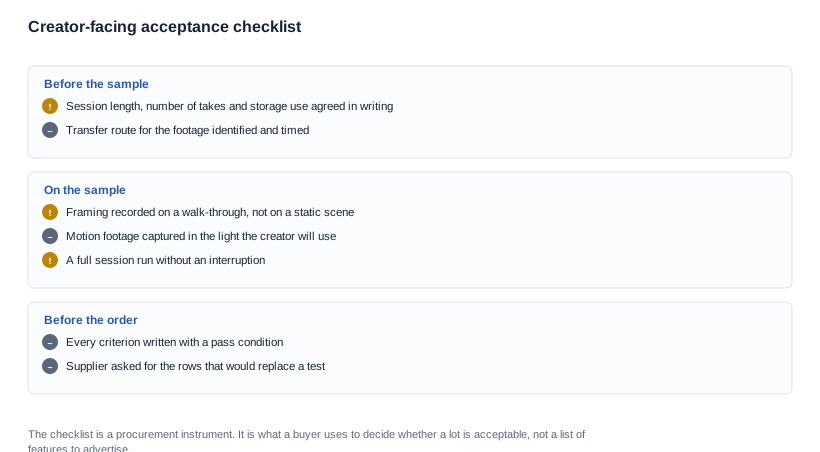
The protocol below is how a buyer handles a product whose decisive specifications are not published. It is deliberately short, because a long protocol will not be run before an order, and a protocol that is run after an order is an inspection rather than an acceptance.
Step one: define the session before the sample. The creator writes the shoot down — its length, its number of takes, its lighting, its environment, and the single shot that has to work. Everything downstream is measured against that description rather than against a general idea of the use case.
Step two: run the session on the sample and record where it fails. Failures cluster, and the clustering is the finding. A failure in power, a failure in framing, a failure in storage and a failure in transfer are four different problems with four different remedies, and a session that produces one of each is worth more than a session that produces four of the same.
Step three: turn each failure into a criterion with a pass condition. This is the step that most programmes skip, and skipping it is why the sample is ordered and then nothing is done with it. A criterion without a pass condition is a preference; a criterion with one can be used to accept or reject a later lot.
Step four: ask the supplier for the one published row that would settle a failure without a test. Sometimes the answer exists — the frame weight, the case capacity, the charge time — and the question takes one email. Sometimes it does not, and the test is the only route.
Step five: write the remaining criteria into the purchase order as acceptance conditions. The purchase order is the document that carries the commitment, and a criterion with a protocol, a pass condition and a rejection consequence attached becomes something an inspector can apply rather than something two people can argue about.
Step six: release the balance of the order only after the sample passes the written protocol. This is the step that converts a sample from a demonstration into an acceptance test, and it is also the step most often left implicit.
One point about the protocol is worth making before it is used, because it is where procurement and production tend to disagree. The criteria are not there to catch a supplier out; they are there to make the shipment inspectable. A criterion with a protocol and a pass condition is what turns a later lot from a matter of opinion into a matter of comparison, and it also gives the factory something to build its own inspection against. A supplier who receives a written protocol before the order is producing against a specification rather than against a sample, and a supplier who receives one after the order is producing against a dispute. The AI camera glasses quality checks piece covers the inspection side, and the OEM ready platforms sample before bulk notes cover the stage where the sample programme is set up.
The commercial terms follow the protocol rather than preceding it. MOQ, unit price, lead time, payment terms, packaging and warranty are quotation items and our catalogue publishes none of them for any camera model, but they are much easier to negotiate once the sample has established which model is in the programme. A buyer who goes to the quotation with a written acceptance protocol attached is negotiating a different conversation from one who goes with a specification request.
We publish the electrical rows and the resolution tier for every camera model, the charging method for seven of the eleven, the case position in all four of its states, the ingress marking on the V06 and the S7, and one unit weight in the range — 158 g for the MT6 glasses unit excluding its foldable case. We publish no sensor model, no field of view, no video specification, no frame rate, no weight for the other ten models and no certification number for any of them, and we will not present a resolution tier as an image quality claim, a runtime figure as a production day, or a company-level export certification page as a model-level certificate.
If you are building a creator-facing programme in this category, send us the session description, the models you are weighing and the destination markets. We will tell you which published rows bear on the capture stage, which criteria will have to be settled on a sample, and what to ask the factory before the sample order is placed. The range is at AI camera glasses.
Related reading
- The imaging background — camera imaging
- The feature list — AI features
- Runtime without a condition — battery life
Send us the session description and the models, and we will tell you which rows bear on the capture stage and which criteria need a sample.


