

Asked the way procurement teams actually ask it — does the AI feature need internet, and can that promise survive a customer in a basement or on a vessel — the question cannot be answered from anything published about this range. What the catalogue publishes is a hardware sheet: rated runtime, charge time, cell capacity, charging method, a Bluetooth version for part of the range, camera resolution, ingress marking on two models and colour on two models. What the catalogue does not publish is a single row describing where an AI feature is processed, which models carry it, whether a subscription applies, or where captured data goes.
The published part is short and specific. An AI voice assistant is named as a key technology for the camera tier, and AI translation is noted for the K01 with the evidence recorded as observed from the independent site rather than as a published specification. Beyond that, the catalogue does not publish the supported model list, the processing location, the subscription position or the data location, and it publishes no firmware version and no update policy either. A buyer who wants the answer is therefore not short of a place to ask; what is missing is a documented position to ask from.
For a procurement team running due diligence, a request schedule is worth more than a guess, and the work below converts the gap into exactly that. It sets out what the catalogue actually names, explains why no datasheet closes the hole, separates the three architectures a buyer has to be able to tell apart, and ends with the answer in the three-part form this question deserves. The evaluation criteria are simple: what is published, what is not, and which question closes each gap.
What the catalogue names about the AI features
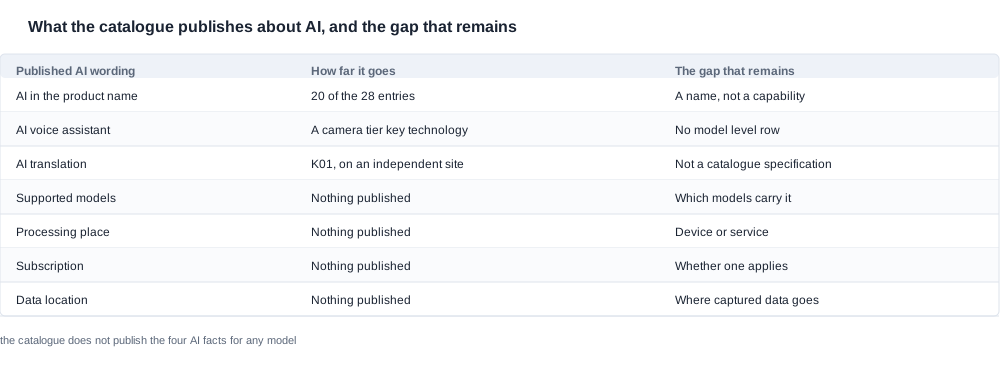
The naming that does exist is broader than most buyers expect, and it is also thinner than the word AI suggests. Twenty of the twenty-eight published entries carry AI in the product name: the eleven camera models — MT6 and V03, MT5 and CY03, KY06 and L1 Pro, V06 and CY05, S7 and L2 Utral, and V03 Pro — the eight audio models, and the electrochromic entry published without a model number. The eight entries without AI in the name are the three sport models, the three kids models, the AR entry and the bone-conduction entry.
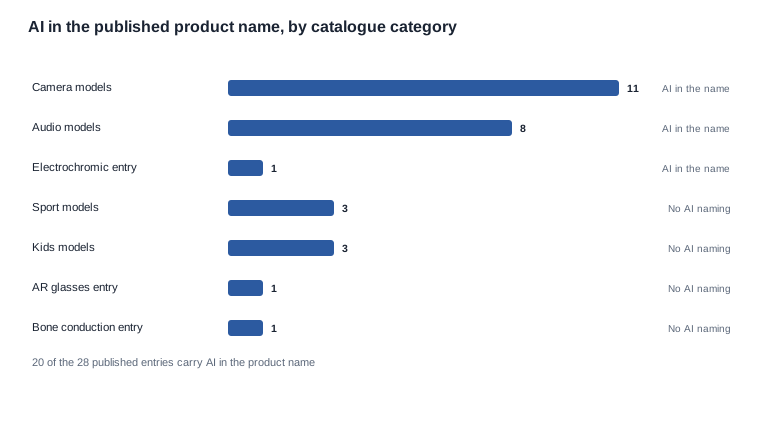
That distribution is worth reading carefully, because it is the only systematic statement about AI in the range and it is a statement about labels rather than about behaviour. A buyer cannot treat AI in the name as a feature row, a compatibility row or a processing row. It tells a reader which side of the catalogue page the entry sits on. It does not tell a procurement team which of the twenty named entries will accept a voice command, which language set it recognises, or whether it will do anything at all without a wide-area connection. A shortlist built on the naming rather than on the published rows is a shortlist built on the label, and a buyer who verifies nothing else will still not know which behaviour it describes.
Two statements about AI sit above the product-name level, and they need to be kept apart. An AI voice assistant is named as a key technology for the camera tier, which is a family-level statement about the direction of the range rather than a per-model specification. AI translation is noted for the K01 with the evidence recorded as observed from the independent site rather than as a published specification, which means the K01 translation statement rests on a second-hand observation and is not a catalogue row. Reading the two as equivalent is the first avoidable error in this category, because one of them can be quoted in a product brief and the other cannot.
Everything else the question needs is published nowhere. The catalogue does not publish which models are supported by the assistant, whether processing runs on the device or in a service, whether a subscription applies to any feature, or where captured data is retained. The word Not published applies to all four, and the same applies to the firmware version and the update policy that would tell a buyer how a behaviour is even versioned.
By contrast, the hardware rows are quoted constantly and safely. Resolution is published per camera model, with the eight megapixel class across eight models and the thirteen megapixel class on the S7 and the L1 Pro, and the L2 Utral. IP54 is published on the V06 and the S7, and those two are the only models in the range with an ingress mark. Colour is published on two models only: three options on the V03 Pro and four on the V06. Charging method is published for twenty-four entries. Those are rows a procurement file can carry, cite and compare, because each one names a measurable attribute of a specific model. An AI label is not in that category, and treating it as though it were is how an unsupportable claim reaches a product page. The criteria for quoting anything in this range are narrow — a named model, a published row and a value on that row — and AI in a product name fails the third test every time.
Why the connectivity question cannot be answered from a datasheet
A datasheet answers hardware questions, and connectivity is a software question wearing a datasheet's clothes. The published material is dense on electronics and empty on everything that runs. Charge time is published for all twenty-eight entries, with twenty-six at a two-hour-or-less ceiling and only the D17 and the ZH12 at about one hour, so a buyer can reason about the power envelope of a shift. Charging method is published for twenty-four entries: magnetic on seventeen models, Type C on seven, and no charging method at all for the four camera models — the CY03 and the L1 Pro, and the CY05 and the MT6. The catalogue does not publish a single line about where an inference runs, and it is not that the line exists and is hard to read; the row is absent.
The wireless rows make the gap sharper rather than softer, because they sit exactly where the question bites. A Bluetooth version is published for fourteen entries: V5.3 on the K01 and the K02, and V5.4 on the other twelve published entries. It is not published for any of the eleven camera models, nor for the A05, the A06 or the bone-conduction entry. That asymmetry matters twice over. The camera tier is the tier where the assistant is named as a key technology, and it is also the tier with no published radio version at all, so the wireless side of those models cannot be assessed from the catalogue even in principle. And where a radio version does appear, it describes the local link between two devices rather than the wide-area path, so even a complete radio table would not answer the connectivity question.
The software lifecycle compounds this. The catalogue does not publish a firmware version for any model, an update policy, or a release cadence. A connectivity answer is always an answer about a build rather than about a model, because behaviour can change between releases without the hardware changing. Without a published firmware version, a buyer cannot even describe the state in which a feature was demonstrated, which means a claim written on the strength of a sample test has no version attached to it and cannot be re-checked later. Any programme that intends to ship an AI capability needs the firmware version recorded next to every test result, precisely because the catalogue will not supply it, and a claim that cannot be traced to a build cannot be re-checked when the next release lands. A sample programme should verify the build before it records any behaviour against it.
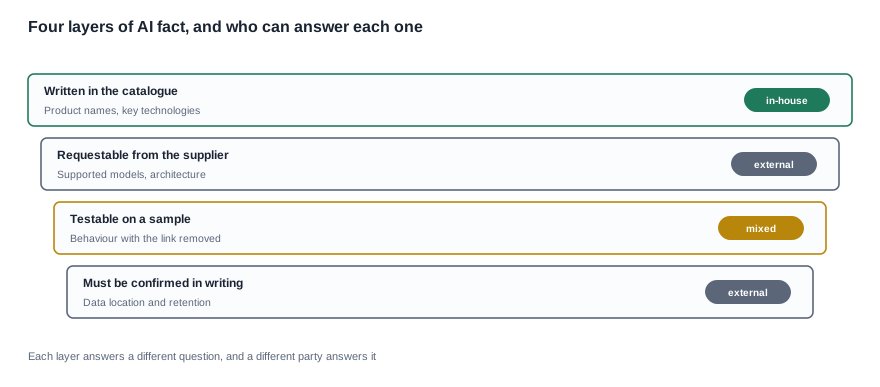
Put the four together and the reason becomes mechanical rather than mysterious. Which models are supported is a compatibility fact. Where processing runs is an architecture fact. Whether a subscription applies is a commercial fact. Where captured data is stored is a data-governance fact. A datasheet cell exists for measured or specified attributes of a device, and none of these four is an attribute of the device; they are attributes of a service relationship. The correct conclusion is not that the answer is unknowable, but that it cannot arrive through the document a buyer already has, and that each of the four facts has a different owner who has to be asked. A buyer who wants to evaluate the requirement against what is published will find the four items in different places: a compatibility question, an architecture question, a commercial question and a data question, and none of the four sits in the specification table where a specifier would expect to find it.

The three architectures a buyer has to be able to tell apart
Buyers who get this wrong tend to treat the question as binary — connected or not connected — and the binary framing is what produces marketing that no published row will support. How to choose between the three cases is a question about where the processing sits, and the trade-offs differ in every case, so a buyer who has not established the architecture cannot yet assess what a listing may claim. There are three architectures, and the point of naming them is not to assign one to a model but to make sure the request and the listing both match whichever one turns out to be true. The catalogue does not publish which of the three applies to any model in this range, and no part of the naming, the hardware rows or the independent-site observation assigns one either.
The first is processing that runs on the device. The model sits on the unit, the audio and the frame data never leave it, and the capability does not depend on reaching a service. A buyer reasoning about this architecture needs to know what happens when the companion application has never been opened, what happens to the battery budget when the model is resident, and whether the behaviour is identical on a unit that has never been paired. None of those rows is published, and each one changes what a listing can claim.
The second is processing that runs in a service. The capture goes out, the service does the work, the result comes back. What a buyer inherits with this architecture is a dependency on reachability, on the service operator's availability, and on a latency that is a property of the network rather than of the device. The commercial consequence is sharper than the technical one, because the failure mode belongs to a third party that the buyer's own agreement with the supplier does not cover, and support load for that failure mode lands on the channel.
The third is processing split across both, which is the case that produces the most expensive misunderstandings. Part of the capability is on the device and part is in a service, so the product can appear to work while the network is fine and fail quietly when it is not. The decisive question in this architecture is not which part runs where; it is what the user sees when the link drops in the middle of a request — an error message, a silent failure, a queued job that completes later, or a fallback to a reduced capability. A defined fallback is a product decision with a cost attached. A silent failure is a support cost that arrives later and cannot be planned for.
The distinction that catches out even careful buyers is between the local radio link and the wide-area connection. A Bluetooth link between two devices in the same room is a local link; it is not the internet, and a capability that runs over it is not thereby a capability that works without a connection. Buyers routinely record "it works over Bluetooth" as though it settled the offline question, and then write copy that says the product needs no network. The published radio version row, where one exists, describes the local link only, and for the eleven camera models there is not even that row to reason from. Two separate questions therefore have to be asked separately: what the device does across the local link, and what the service does across the wide-area path. A review checklist should carry them as two lines rather than one, because a single merged line is what produces the offline claim that no published row supports.
The use-side consequences of all three architectures — what a customer can actually do when there is no coverage — are handled separately in can I use it offline. This article stays on the specification side: what the catalogue publishes, what it leaves out, and which request closes each gap.

What to ask before the answer goes on a listing
Each of the four unpublished facts becomes a request with a named owner, and the questions to ask are the same in every case: a named model, a named feature and a written answer the buyer can verify. A request that names a model produces a different answer from one that asks about the range in general, and the criteria on which to compare two supplier answers should be written before the first request goes out. The order below follows the sequence in which an unanswered request becomes expensive: compatibility first, because it decides which models enter the shortlist; architecture second, because it decides what the listing may say; subscription third, because it changes the commercial model of the product; data location last, because it decides which markets the product may legally be sold into.
- Which models are supported? Published: twenty of the twenty-eight entries carry AI in the product name, and an AI voice assistant is named as a key technology for the camera tier. Not published: the supported model list, and any per-model statement. Ask the supplier: for a named model, whether the capability is present, in which build it appeared, and whether the earlier builds of the same model behaved the same way, so that a buyer can verify the claim against the build that ships.
- Where does the processing run? Published: nothing about processing location for any model. Not published: whether a capability is resolved on the device, in a service, or across both. Ask the supplier: a written architecture statement that names the layer, and the defined behaviour when the wide-area path is unavailable.
- Does a subscription apply? Published: no subscription row appears for any model, and no fee of any kind is published. Not published: whether a subscription applies at all, and what happens to the capability when one lapses. Ask the supplier: the commercial terms of any service attached to the capability, and the behaviour of the product when that service is not available, so that a buyer can assess the total cost of the capability before it is written into a listing.
- Where is captured data stored? Published: nothing about data location, retention or jurisdiction for any model. Not published: the destination of captured audio and footage, how long it is retained, and under whose control it sits. Ask the supplier: the data path in writing, including what leaves the device, in what form and to which destination.
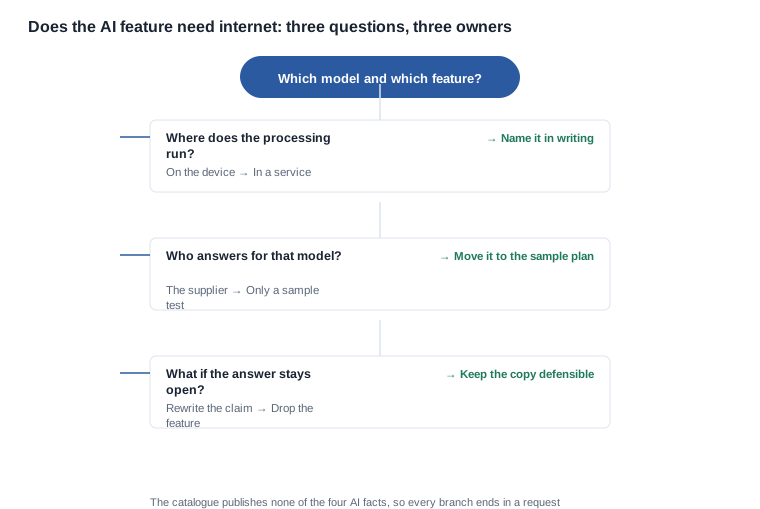
The four requests are easier to answer well than they first appear, because they can be written as one sentence each with the blanks filled in by the buyer rather than by the supplier. The workable form is: for these named models, is this named capability present, does its processing sit on the device or in a service, what does a user see when the wide-area link is unavailable, and what happens to it if any service attached to it is not reachable. A general enquiry about the platform produces a general answer, and a general answer cannot be quoted in a product listing or defended in a contract review. A checklist of the four requests, kept beside the model list, is enough to stop a due diligence file from drifting as the programme moves.
| AI fact | Published today | How a buyer closes it |
|---|---|---|
| Supported models | Not published for any model | A model-by-model list, in writing, against a named model string |
| Processing location | Not published for any model | A written architecture statement plus a demonstration on a sample |
| Subscription | Not published for any model | A written position, and the commercial consequence of each outcome |
| Data location | Not published for any model | A written data path naming destination, retention and jurisdiction |
Partial answers are worth more than they first appear, and they should be recorded rather than discarded. An answer of the form supported on the phone but not on the glasses narrows the claim set precisely: the product still has an AI capability, and the listing now describes the device the capability actually runs on. An answer that arrives as silence is a finding in its own right, and the finding is that the claim cannot be made. Silence is one of the red flags for the programme rather than a delay, and the correct response is to remove the wording from the claim set, not to carry it forward on the expectation that a later order will resolve it.
Two items belong in the same request file because they determine whether any of this stays true after the first shipment. The catalogue does not publish a firmware version or an update policy for any model, so the request should ask how the capability is delivered to a fleet already in the field and what happens to a unit that misses an update. The catalogue also publishes no per-model certification row — the text of the catalogue carries no reference to CE, FCC or RoHS, and the company-level page that carries ten patent certificates, eight appearance designs and two utility models, is not a per-model compliance statement — so the request should ask for the certification position of the exact configuration being ordered. The two frameworks a buyer may name from the published material are the Radio Equipment Directive (EU) 2014/53/EU and the EMC Directive 2014/32/EU, and both bear on the radio link rather than on the AI layer.
The does the ai feature need internet answer
The answer, stated in the three parts that a procurement file can hold, is narrow and complete. Published: an AI voice assistant is named as a key technology for the camera tier; twenty of the twenty-eight published entries carry AI in the product name; the AI translation noted for the K01 rests on an observation from the independent site rather than on a catalogue specification; and the hardware rows for each model — resolution, charge time, rated runtime, charging method, ingress and colour where published — are citable. Not published: which models are supported, whether processing runs on the device or in a service, whether a subscription applies, and where captured data is stored, together with any firmware version, any update policy and any per-model certification row. Ask the supplier: the four written requests above, each against a named model and a named feature, with the data path and the update route in the same file.
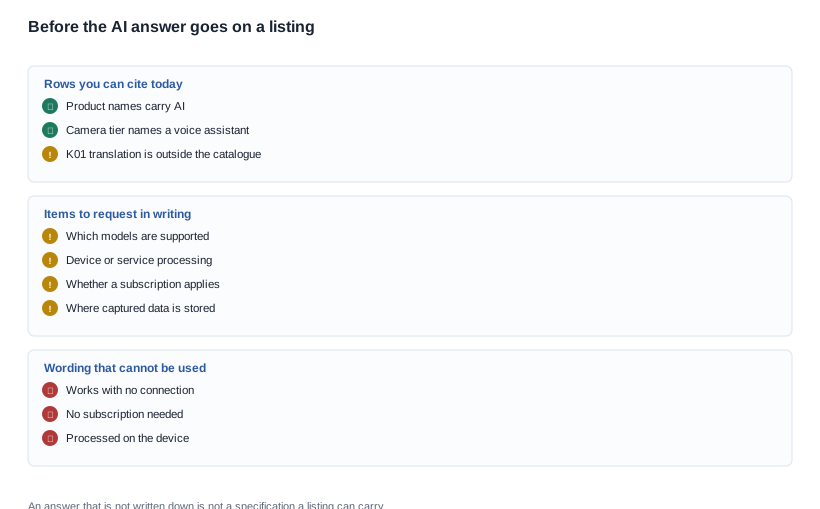
The wording that survives a customer test follows from that, and the most common pitfalls in this category are a capability described from a second-hand observation and a feature named without a model. A listing may cite the published rows, may name the camera-tier assistant as a key technology, and may state the hardware configuration. A listing may not say that the product works without a connection, that no subscription is needed, that processing happens on the device, or that captured data stays in a particular place: none of those four has a published row, and the catalogue does not publish any of them for any model. The trap in that sentence is the direction of the negation. The catalogue does not publish a connectivity requirement; that is not a statement that no connectivity requirement exists, but a statement that nobody has documented one, which is a very different thing for a buyer who intends to defend the claim.
The decision that follows has three steps. Before you order, the four requests go out and the answers are filed against model strings, because an answer that names a model can be compared with an answer that names a different one, and a supplier who answers for the range as a whole has told a buyer nothing it can assess. When a sample arrives, the evaluation records the firmware build, the wide-area link removed and the behaviour of each capability, so that the result is evidence rather than an impression and the total cost of an open question stays visible while it can still be changed. And what to write on the listing follows the evidence: if the architecture is documented, the listing can describe it; if it is not, the listing describes the hardware and the named key technology, and stops there.
We will not attach an on-device or a cloud claim to any model in this range, because no such claim is published for it, and we do not repeat a marketing phrase as though it were a specification. What the published position does give a supplier is narrower: the rows a buyer may cite, the four requests that have to come back in writing, and a way to tell which request settles the question first. The question a buyer arrives with — does the ai feature need internet — is settled for a specific configuration in a written file rather than on a catalogue page.
Related reading
- The use-side of the same question, and what a customer can do with no signal — can I use it offline
- The same gap read from a content-creation programme's side — smart glasses for content creation: AI feature options
- A neighbouring question with the same shape — does the camera record continuously
- How to read an AI feature section of a datasheet without over-reading it — reading an AI feature datasheet
- The per-model rows the claims above are written against — AI camera glasses range
Send the model, the feature and the markets you sell into, and we will say which of the four requests is the one that decides it for your programme.


