
A content programme does not have one buyer and one set of requirements, so a single specification flattens exactly the differences that decide whether the product works. Smart glasses case work is the slower answer to that problem: one decision at a time, each with its own evidence and its own deliverable. It is not a more elegant process. It is the only one that produces a decision a buyer can sign, because a decision nobody can defend is a decision that gets reopened at the first difficult quarter.
This article sets out what a case actually contains, how it gets opened, how it is closed, where cases tend to collide with each other, and what a closed case file should look like by the end of a programme.
Smart glasses cases: one decision, one evidence set, one deliverable
A case is not a customer persona and it is not a product with a label on it. A case is a single pending decision with three attached things.
The situation. Who is wearing the device, what they are producing, where they are producing it, and what is stopping them today. Without the situation there is no way to judge a result, because the same measurement is decisive in one situation and irrelevant in another.
The evidence that would settle it. Not everything that could be measured, but the specific measurement that would decide the case if it came back one way or the other. A case whose evidence is "we should look at the camera quality" is not open, it is vague, and it will be closed by whoever is most confident.
The deliverable. A named artefact at the end: a configuration, a written finding, a sample request, a spec line, or a decision not to pursue. A case that produces no artefact has not been worked, it has been discussed.
Three illustrative cases from a typical content programme, written as shapes rather than as real accounts, show why the split is necessary.
- A talking-head creator selling courses. The situation is a seated subject, controlled light, a static frame. The evidence that settles it is the usable field of view measured on the footage and the capture latency on the control that will ship, because a creator who cannot frame a two-person conversation without turning their head, and who cannot tell whether the shot registered, will not use the device twice.
- A field reporter working outdoors. The situation is movement, daylight and evening light, an extended session. The evidence that settles it is continuous-capture runtime with the case, the shutter behaviour while walking, and the low-light response at a stated illuminance. None of the three is relevant to the seated creator.
- A retail walkthrough seller. The situation is an interior, mixed lighting, a presenter who talks while moving around a product. The evidence is the frame rate at a normal speaking pace, the storage behaviour over a full session, and the weight, because a device that is uncomfortable by the second hour changes how the seller works.
Same catalogue, same supplier, three different sets of evidence and three different configurations at the end. A single specification sheet would have answered none of them properly, and would have made the programme look decided when it was not.
The three cases do not necessarily produce three products. They produce three requirements, and the honest options are usually fewer than they first appear. One platform with three configurations, where the configurations differ on the case and the lens rather than on the electronics, is often the answer, because the differences that the cases surfaced tend to be workflow differences rather than platform differences. The other common outcome is two cases that look separate and turn out to be the same case once the platform and the session length are written down, which is a saving worth hunting for before samples are ordered. What is rarely a good answer is a range where each product exists because a case was opened, without anyone checking whether two of them could be one.
The questions that open a smart glasses case
Seven questions, asked in this order, turn a request into a case. The order matters, because each answer narrows the next.
- What is being produced, and for which platform? The platform decides the format and the format decides what has to be true of the capture. A vertical clip for a social feed, a long-form interview, and a product walkthrough have almost nothing in common beyond the device.
- Who is wearing it, and for how long? A creator, a customer, a field technician and a salesperson wear the same device for different durations. The longest continuous capture is the number that has to survive, not the average session.
- Where does the audio come from? Built-in microphone, an external microphone, or a separate recorder. The catalogue publishes no microphone specification for any camera model, so this is answered on a sample rather than on a sheet.
- What is the wearing situation? Indoors, outdoors, in a vehicle, in wind, in a dusty workshop. The sport tier's IP54 marking sits with the V06 and the S7 only, and there is no third-party report behind it, so it is a catalogue fact rather than a warranty.
- What does the brand need to be able to say? The regulatory framing of the listing is part of the case rather than a follow-up to it, because a claim that cannot be supported stops the programme at the point of publication.
- What would disqualify the configuration? This is the decision criteria question, and asking it early removes most of the ambiguity. "Nothing would disqualify it" is itself an answer, and an unhelpful one.
- Who decides, and on what evidence? A named owner, with a named evidence source, and a date by which the case closes.
Questions one to five describe the case. Questions six and seven make it closable, and they are the two most often skipped.
Two failures are worth naming. The first is the case whose evidence is something the buyer cannot obtain, such as a guaranteed video format or a certification position that only exists on paper. That case is not blocked, it is dependent: it is waiting on a written answer from the supplier, and it should sit on a list with an owner and a date rather than inside a sample request that will come back without it. The second failure is the case that is opened twice under two names, one for the product team and one for the commercial team, each with its own notes and neither aware of the other. A single case register, visible to everyone who owns a piece of the programme, prevents most of that duplication, and it is a one-page document rather than a system.
Running a smart glasses case from request to signed decision
The mechanics of working a case are unglamorous and they are what make the difference between a programme and a series of impressions.
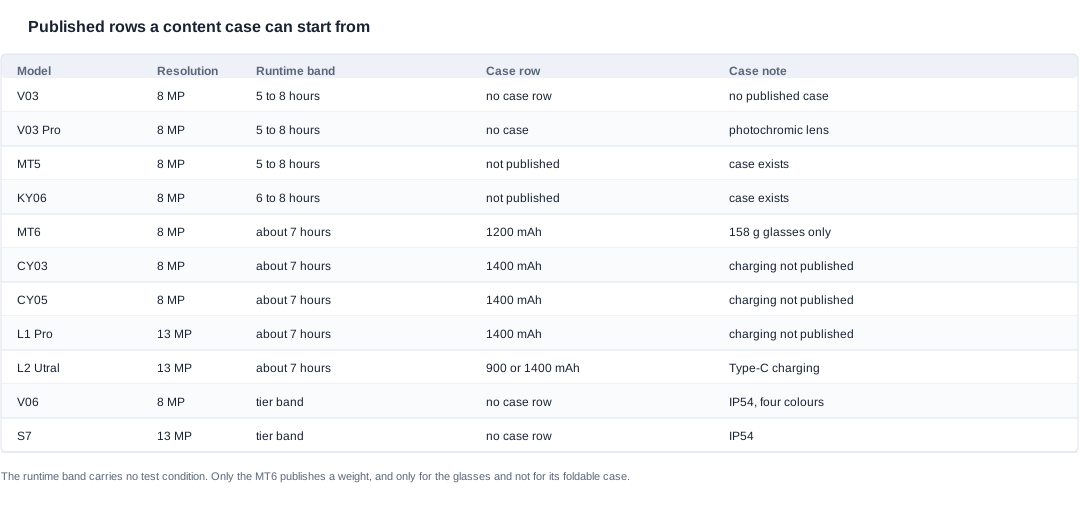
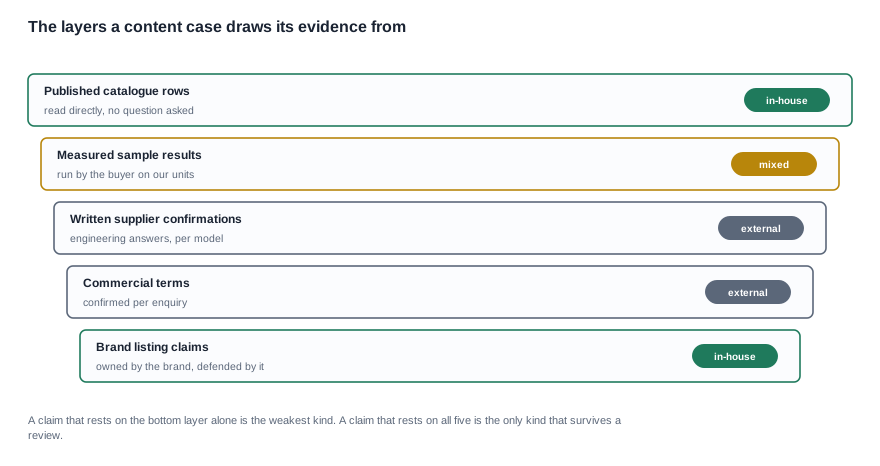
Split the known from the unknown, in writing. The known set in our camera tier is short and solid: resolution tier, cell capacity, rated runtime band, charge time, case capacity where published, charging interface where published, colour and lens options on the V03 Pro and the V06, the IP54 marking on the V06 and the S7, and the 158 g weight on the MT6. The unknown set is long. Keeping them in two columns is what stops a known number from being used to imply an unknown one, and it is a discipline that matters more when the two lists sit in the same document.
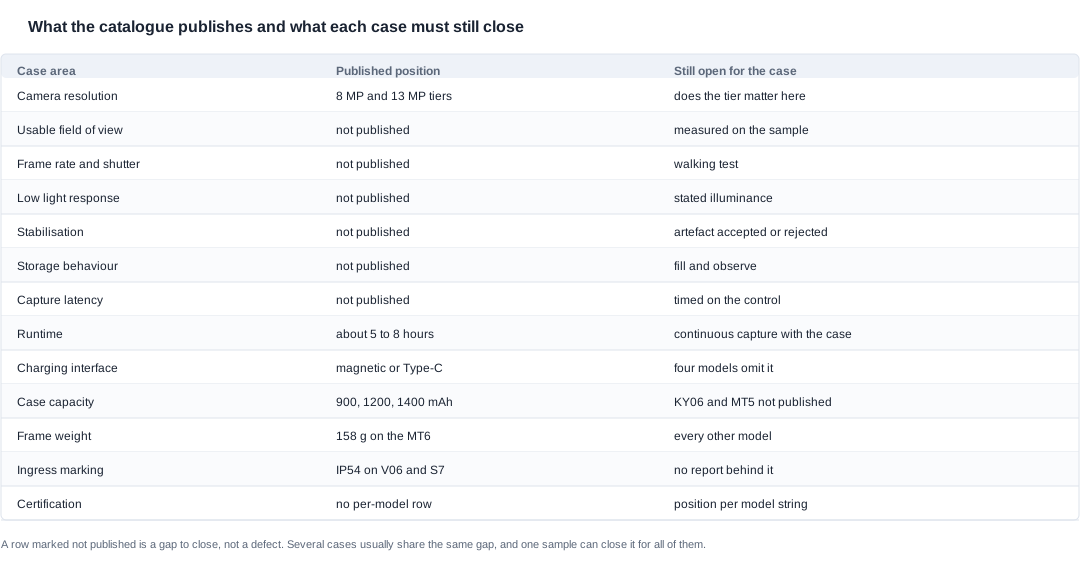
Order samples by open question rather than by case. Several cases usually share the same gap, and one sample that answers three questions is worth more than three samples that each answer one. This is the argument that makes a small sample budget work, and the custom sample discussion covers how to write a sample request that comes back with answers rather than with a box.
Set the acceptance criteria before the sample is opened. For each measurement, write down the result that would confirm the configuration and the result that would disqualify it. Without that written rule the sample becomes an opinion, and the programme continues on momentum rather than on evidence.
Run the case to a finding rather than to a feeling. A finding states what was measured, on what unit, under what conditions, and what follows. It carries the acceptance criteria it was judged against, so a later reader can reconstruct the reasoning rather than trust the conclusion.

Close cases that end in no decision. A programme that has decided not to pursue a use case has produced an answer, and recording it stops the same idea from being reopened in the next planning cycle. The cases worth closing with a negative finding are the ones where the catalogue does not publish what the case needs: a guaranteed video format, a measured microphone specification, an ingress rating with a report behind it, or a certification position for a named model.
Sign the criteria off with the people who will be measured against them. Engineering, product and the commercial owner should be able to see the same acceptance criteria. Where the criteria are not signed off in writing, a failed case tends to be re-argued rather than closed.
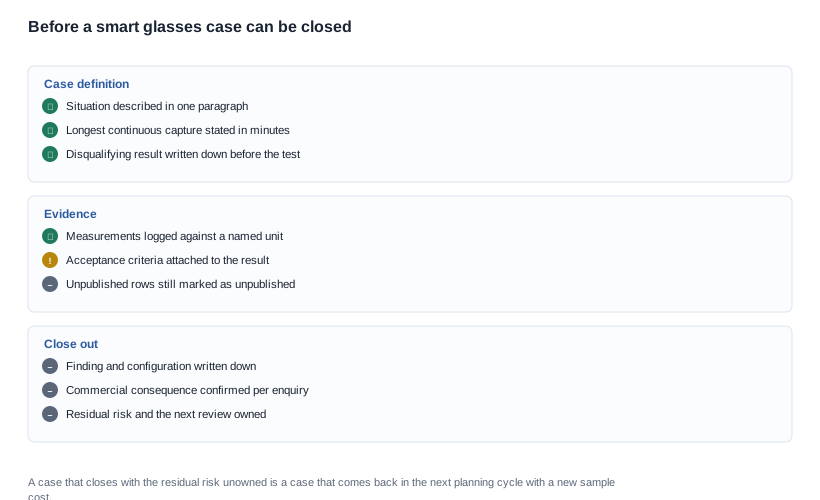
Sample ordering is the part of the work that rewards a little discipline. Build the order from the open questions rather than from the cases, so that the same unit appears once in the order and closes several rows at the same time. Keep the acceptance criteria on the same sheet as the request, so that the receiving team measures against them rather than against whatever it assumes the buyer wanted. Log the result in the case file rather than in an inbox, and log what was not measured as well as what was, because a gap left blank is indistinguishable from a gap that was closed.
The commercial frame follows the cases rather than preceding them. Price, minimum order quantity, lead time, sample cost, warranty scope and tooling charges are all confirmed per enquiry, and each of them depends on the configuration the cases produce. A quotation that arrives before the cases are closed is a quotation for a guess, and the number usually moves once the cases are answered.

Where smart glasses cases collide with each other
The value of working case by case shows up in the conflicts, because a conflict that is invisible in a single specification becomes obvious when two cases are laid next to each other.
Runtime is the one that collides most often. The published figures are mixed-use figures with no stated condition, so two cases can both sit inside the published band and still be mutually exclusive in practice. A creator who needs a six-hour continuous capture and a retailer who needs three hours of intermittent recording are not two rows on the same spreadsheet; the first is a case the published band may not survive, and the second is comfortable. The battery comparison article works through the camera tier's power rows.
Brand customisation and creator requirement are different asks. Logo, colour, packaging and the Bluetooth name are brand-side decisions. A field of view, a runtime, a microphone and a control method are creator-side. A case that mixes them in one request is harder to answer, because the brand answer is a decision and the creator answer is a measurement, and they have different lead times. The customisation options article covers the depth of the brand-side answer.
Certification coverage does not scale with the number of cases. Our catalogue names no certification mark for any model and carries no per-model certification row. The export-certification page is a picture page showing ten patent certificate images, eight design patents and two utility models, which is evidence of design work rather than a per-model regulatory position. A brand that launches in three markets has three regulatory questions attached to each case, and none of them is answered by the catalogue.
Form factor and use case pull in opposite directions. The MT6 is the only model in the entire catalogue with a published weight, at 158 g for the glasses alone, excluding its 1200 mAh foldable case. The remaining models publish no weight, so the argument that decides a long-session case is an argument the catalogue cannot settle for them.
Naming does not follow use case. The V06 and the S7 carry names that read as sport and are camera models; the YKC02 is a sport model with a published 2 × 70 mAh cell configuration and no camera. A case written against the wrong model string produces a finding that cannot be acted on.
Total cost of ownership collides across the range. The camera decision is the cheap half of the programme; the expensive half is the rework when a listing has to be withdrawn or a batch has to be re-shot. Two cases can each be justified on price and still produce a programme whose total cost is worse than one case done properly.
What a closed smart glasses case file contains
A case file that closes properly contains seven things, and a file missing any of them will come back later.
- The situation, in one paragraph. Who, what, where, and what the constraint was.
- The evidence, with the numbers. What was measured, on which unit, under which conditions, with the instrument or method stated.
- The acceptance criteria the evidence was judged against, and where they came from.
- The finding, in one sentence. Confirmed, not confirmed, partially confirmed, or not pursued.
- The configuration, at model string and option level, with any row that is still not published marked as such.
- The commercial consequence. What the configuration does to the quotation, the sample cost, the minimum order quantity, the lead time, the warranty position and the tooling, each confirmed per enquiry.
- The residual risk, stated plainly. What is still unknown, what would trigger a re-test, and who owns the next review.
The last of these is the one most often left out, and it is the one that decides whether a programme keeps its knowledge or rebuilds it every year.
There is a second file, and it is the more valuable of the two. It is the set of cases that were never opened, kept as a list of the questions that were asked and not answered. A content programme that knows what it does not know can schedule the work that would close those questions. A programme that has quietly dropped them will rediscover the same gap in the next planning cycle, with a new sample cost and a new delay.
Smart glasses case economics: what a closed case is worth
Case work is often described as a process cost, which understates it. The useful question is what a closed case is worth, and the honest answer is that it is worth whatever it removes from the total cost of the programme. That total has three parts, and only the first is visible in a quotation.
The visible part is the goods. The unit price, the minimum order quantity, the lead time, the tooling charge for a custom case or a custom mount, and the warranty position. All of these are confirmed per enquiry rather than published, and all of them move with the configuration. Two configurations that differ only by whether a case is in the box can sit in different order bands, and a case that has not been closed leaves that difference unknown.
The less visible part is the evidence cost. Sample units, the shipping to run them, the person-days spent running the measurements, and the delay while the answer comes back. This cost is real and it is usually small, which is precisely why it gets ignored until a programme has opened nine cases and paid for nine samples to answer three gaps.
The largest part is the rework, and it is the part nobody prices. A listing that has to be withdrawn after a customer returns a product, a batch that has to be re-shot, a channel partner who cannot answer a question about the specification and stops selling, a creator who concludes the product does not do what the page says. None of this appears in the quotation, and all of it is downstream of a case that was closed on an opinion rather than on evidence.
There is a practical rule that follows from this. Before you order, check whether the acceptance criteria for the configuration you are about to buy are written down, signed off and attached to the model string. If they are, the delivery can be checked against them. If they are not, the delivery can only be argued about, and an argument at the point of delivery is the most expensive way to buy a product.
The same rule applies to a programme that is buying across several models. Each configuration can have its own minimum order quantity, its own sample cost and its own tooling, and a case that closes one configuration tells you nothing about the others. The cleanest structure is a single platform with a small number of named configurations, each with its own criteria, because that is the structure where the evidence cost stays proportional to the number of cases rather than to the number of products.
If your team wants to work a specific case with us, send it as a list: who is wearing the device, what they are producing, the environment, the longest continuous capture, and the result that would disqualify the configuration. We will tell you which published rows already answer part of it, which gap the case depends on, which other case shares that gap, and what a sample request for it would need to contain.
Related reading
- AI camera glasses battery comparison
- AI camera glasses customization options
- AI camera glasses for content creation
- Requesting smart glasses samples
Send the case as a list — who, what, where, and what would disqualify the configuration — and we will tell you which gap it depends on.


