
An AI camera glasses battery comparison is only useful if you accept that the published endurance figures are not measured on a shared basis. Across the eleven camera models in this range there are four cell capacities, three different endurance shapes and one charge-time ceiling, and no test condition is published for any of them. That makes the comparison below a comparison of what the catalogue states, which is genuinely useful for planning an accessory strategy and genuinely dangerous for writing a product claim. This guide is written for a buyer assembling a range for resale, so it works through the published rows, names the rows nobody publishes, and ends with the question set that has to go to the supplier before a listing goes live.
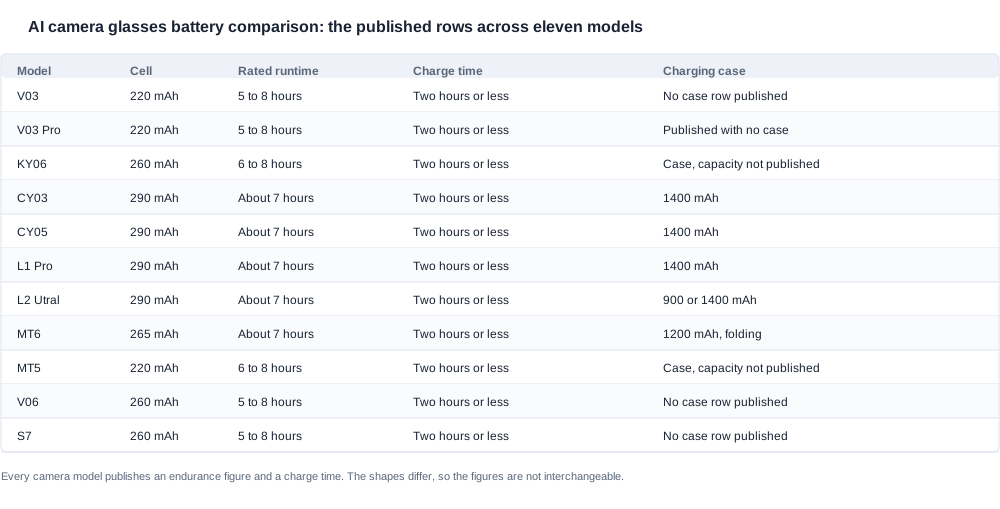
AI camera glasses battery comparison: the eleven published rows
Eleven models carry a camera. Every one of them publishes a cell capacity, a rated runtime and a charge time, and that completeness is unusual in this category — there is no camera model in the range where the endurance row is missing. What differs is the shape of the number and the state of the accessory, and both of those differences carry commercial weight.
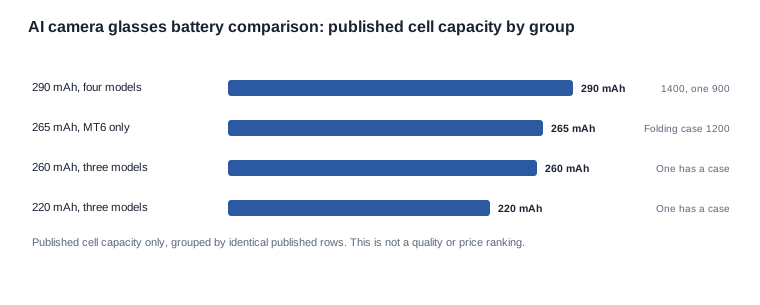
The cell capacities fall into four groups. Two hundred and twenty milliamp hours for the V03 Pro and the V03, and the MT5. Two hundred and sixty for the V06 and the S7, and the KY06. Two hundred and sixty-five for the MT6 alone. And two hundred and ninety for the CY05 and the CY03, and the L1 Pro and the L2 Utral. No camera model publishes a cell below 220 mAh, and none publishes above 290 mAh, so the spread across the whole range is a factor of about one and a third from the smallest cell to the largest.
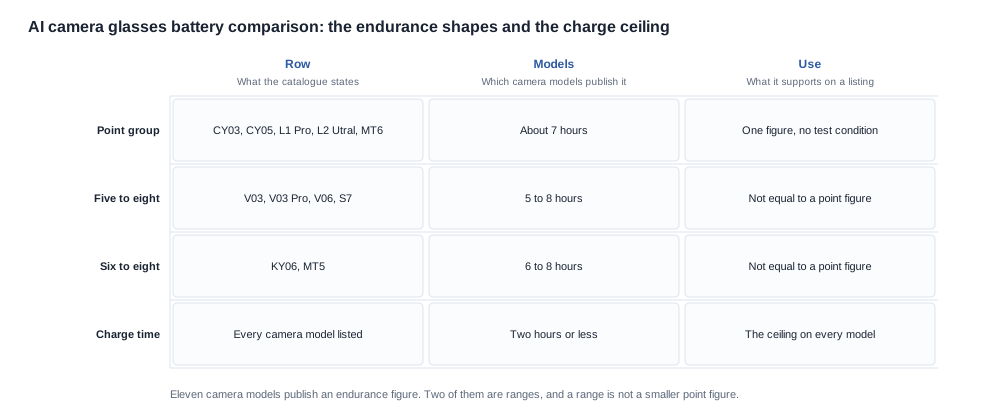
The endurance figures fall into three shapes, and this is the fact that matters most. Five models publish a point figure of about seven hours — the MT6 and the L2 Utral, the CY05 and the CY03, and the L1 Pro. Four models publish a range of five to eight hours: the V03 Pro and the V06, and the V03 and the S7. Two models publish a range of six to eight hours: the KY06 and the MT5. That is the whole published set.
The charge time is identical across all eleven. Every camera model in the range publishes a charge time of two hours or less. That is a ceiling, not a measurement, and it is worth being precise about what a ceiling does and does not let you claim. "Two hours or less" permits a unit that takes exactly two hours; "under two hours" would not. Use the first form. The published figure also carries no starting state of charge, no termination criterion and no cell temperature, which means it cannot be converted into the length of a break in a shift, and it cannot be used as the turnaround time for a charging case, because the catalogue does not describe how a case charges a frame.
The camera resolution split runs across the capacity groups, which is why capacity alone cannot shortlist. Eight models publish 8 MP — CY03 and V03 Pro, V06 and KY06, and MT6 and MT5, and CY05 and V03. Three publish 13 MP — the S7, the L1 Pro and the L2 Utral. Note where the 13 MP models sit: two of them are in the 290 mAh group and one of them, the S7, is in the 260 mAh group with a five-to-eight-hour range. A buyer who concludes that the higher resolution tier is also the longer-running tier is reading a correlation that the catalogue does not support.
The feature rows are distributed in a way that also cuts across the battery groups. The V03 Pro publishes a photochromic lens, a flexible temple and three colourways. The V06 and the S7 publish an ergonomic design, a removable inner frame and an ingress marking of IP54, and those two are the only camera models in the whole catalogue carrying an ingress rating — the V06 in four colours, the S7 in thirteen megapixels. The L2 Utral publishes variant names of Utral and Pro Max. The MT6 publishes a foldable charging case and the only frame weight in the entire catalogue. So the capacity groups tell you about the battery, and the feature rows tell you about everything else, and neither is a substitute for the other in a shortlist.
What no camera model publishes, in one place. The camera models publish no sensor model, no field of view, no video resolution or frame rate, no stabilisation, no low-light performance, no storage capacity and no file format. They publish no Bluetooth version. They publish no frame weight except the MT6, and even that figure — 158 grams for the glasses body, including the cell and the camera and excluding the folding charging case — is not a bare frame weight, and the weight of the case itself is not published. They publish no ingress rating except on the V06 and the S7. And they publish no certification numbers at all. For a buyer, that list is not a complaint about the catalogue; it is the specification request you should have drafted before the first sample arrived.

Why an endurance range and a point figure are different claims
A buyer who puts "5 to 8 hours" in one column of a comparison table and "about 7 hours" in the next has built a page that says something untrue. It says the two products behave the same, because the numbers overlap. It also says something unspecified, because a range and a point figure are not the same kind of measurement, and because a range with a spread of three hours is reporting a much wider variation than a point figure with no spread at all.
The most likely explanation is measurement under different conditions. A point figure of about seven hours and a range of five to eight hours across the same product family suggest at least two different protocols, and possibly a different protocol within a single model if a range is being reported as a worst case in one mode and a best case in another. None of that is stated anywhere. The catalogue publishes a number; it does not publish the number's test condition, and a number without a test condition is a rating, not a measurement.
A camera product makes the missing condition worse than it would be for an audio product. A paired radio with a microphone in a live conversation consumes a different amount of power from a camera that is recording, and a camera that is recording consumes a different amount again from a camera that is idle with the lens capped. A catalogue figure for a camera glasses product therefore carries at least three implicit variables, and the published number does not tell you which of them it represents. This is the single most common way a runtime claim in this category turns out to be unusable, and it is why a runtime figure should never be the load-bearing claim on a product page.
The consequence for a listing is a wording decision, not a number decision. The safe formulation names the figure as a manufacturer-rated value, attaches it to the model, and does not present it as a guaranteed working time. If the channel needs a working-time claim — a proposition built on a full shift of capture — then the number has to come from a sample tested in the condition the customer will actually experience, and the test protocol has to be written down before the test starts, because a protocol decided afterwards is not a protocol.
The consequence for a range plan is that you need a tolerance, not a figure. If the catalogue figures are not on a shared basis, the useful planning artefact is the worst published value for the model you have selected, treated as a floor for capacity planning and a ceiling for a marketing claim, with the two roles kept deliberately separate. A range plan that assumes every unit runs the midpoint of its published range will be wrong in both directions, and the failure mode is asymmetric: a plan that assumed too much runtime arrives with a stock of units that will not complete a shift, and a plan that assumed too little arrives with an accessory programme that costs more than the frames.
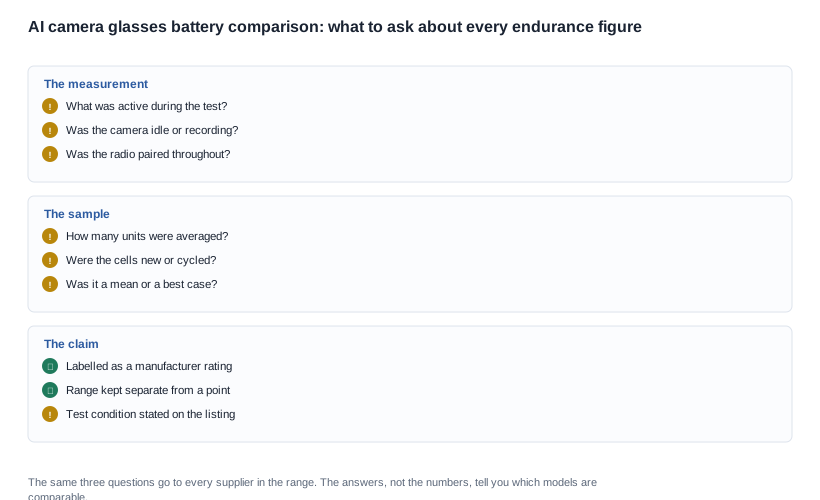
What makes a runtime figure comparable, stated as a procurement rule. Three conditions have to be attached to any endurance number before two products may be compared on it: the load state during the test, the sample size and cell history behind the figure, and whether the number is a mean, a median or a best case. Until all three are attached, the number is a rating, and the comparison you build on it is a comparison of marketing copy. This is the same discipline the battery life note applies to the wider catalogue, and it is why the published CY05 specification list and the L1 Pro specification list are more useful to a procurement file than any single runtime number is.
The one thing that is genuinely comparable across all eleven models is the charge time, and only as a ceiling. Every camera model publishes two hours or less. That consistency is useful: it means the charging accessory programme does not have to be designed per model, and it means you can plan a shared charging kit for a multi-SKU range. What it does not tell you is how long a unit takes in a specific condition, whether it accepts charge while switched off, or whether a case can top the frame up between shifts, and those three questions are worth putting in the enquiry because they are the difference between a charging programme and a charging accessory.

What the case rows make plannable and the runtime rows do not
The charging case is the most commercially useful published column in this range, and the reason is structural rather than incidental. A case is a physical object with a stated capacity, a stated form and a stated place in the box. An endurance figure is a number with no condition. When a range plan has to survive a freight quotation, a channel discussion and a returns analysis, the case column is the one that can carry all three.
The eleven models split into four case states, and the distinction between them is not cosmetic.
- Five publish a case capacity. The CY05, the L1 Pro and the CY03 each state 1400 mAh. The L2 Utral states either 900 mAh or 1400 mAh, which is the only case choice published anywhere in the range and the single most useful lever for serving two configurations from one platform. The MT6 states 1200 mAh in a folding case, which is a packaging and logistics property as much as a capacity one.
- Two publish a case with no capacity. The KY06 and the MT5 have a case, and the catalogue does not state its capacity. This is a materially different position from having no case, and it is also a gap that blocks landed-cost modelling, because a case you cannot size is a parcel weight you cannot calculate.
- Four have no charging-case row at all. The V06 and the S7, and the V03 and the V03 Pro. The catalogue is silent on the accessory, which is not the same as a statement that no case exists.
- None of the four is published as having no case. There is no such line in the catalogue, and a missing row is weaker evidence than a printed figure — which is exactly why it has to be closed in writing.
Why the silent group matters commercially. A buyer who reads the silence on the V03 and the S7, and the V06 and the V03 Pro as "no case" will build a packaging programme and an accessory plan on a reading the catalogue does not support. It is the wrong reading, and it is wrong in both directions: a case assumed to be absent is a case that can be missed in the carton, and a case assumed to be present is a case that has to be paid for. Those four are a question to put to the supplier — "does a case exist for the V03 and the S7, and the V03 Pro and the V06, and if so what is its capacity" — and a question with an answer is worth more than an assumption. The charging case options analysis works through the case rows model by model.
The four models whose charging method is not published are also the four that state a case capacity, and that combination should set your question order. The CY03 and the CY05, and the L1 Pro and the MT6 publish no charging interface row. Every one of them does publish a case capacity of 1400 or 1200 mAh. So on these models you know there is a second cell in the parcel and you do not know how the frame itself is charged. That is a two-part question to a supplier and it is a specification question, not a price question: does the frame charge over its own port, and does the case top it up, and does the case refill from the same port or from a separate one. Getting this wrong changes the bill of materials, the charging instructions in the box, the warranty story and the returns diagnosis, because a customer who plugs the frame into the wrong thing will report a fault.
The case also decides the accessory programme, which is where the margin is. A magnetic-charging product that ships with a case needs a second lithium cell in the parcel, a heavier carton, a different freight class and a battery transport document for that second cell. The freight consequence is quantified in the shipping weight breakdown. A Type-C product needs no charging accessory in the box and no second cell in the parcel. That is a real structural difference between two products in the same catalogue, and it is invisible if you compare only the frame.
And the interface difference is the reason a model shortlist should be built in two passes. First pass: which models have a documented case position, so the accessory and parcel programme can be planned. Second pass: which of those have a published interface, so the charging instructions and the in-box contents can be written. Running the passes in that order means you never build a packaging plan around an accessory that arrives without a way to be charged.

The charging interface split that decides the parcel before the price
The charging interface divides the eleven camera models into three groups, and it is the cleanest structural line in the range. Five models publish magnetic charging: the MT5 and the V03, and the S7 and the KY06, and the V06. Two publish a Type-C port: the V03 Pro and the L2 Utral. Four publish no interface row at all: the CY03 and the L1 Pro, and the MT6 and the CY05. Note that the two Type-C models are the two that publish a photochromic or variant configuration, and that the four unpublished models are precisely the four that state a large case capacity — the catalogue's silences are not random, and the pattern is worth noticing even though the reason is not published.
The interface decides what has to be in the box. A magnetically charging product needs somewhere for the magnet to land: a case, a pad, or a cable and a specific puck. A Type-C product ships with a standard cable and no proprietary accessory. That difference propagates outward — into the carton dimensions, into the master carton quantity, into the number of different packing lines in the warehouse, and into the after-sales spares list. For a brand running a multi-SKU programme, the number of distinct in-box accessory configurations is a cost driver that a buyer who only compared frame prices will not have seen.
The interface also decides the compliance burden. A device with a lithium cell in the frame needs a battery transport document for the frame cell. A device that also ships a case adds a second cell, and a second cell adds a second line to the transport paperwork, the UN38.3 test summary and the packaging and marking requirements. In a multi-market programme, this is where the documentation timeline quietly expands, because the battery test summaries are usually the longest-lead item in the file and they are frequently started late. The battery transport compliance checklist sets out the chain of documents that follow from the cell count.
What this means for a first order rather than a range plan. If you are placing a first order in this category, the interface is the thing to fix first, before the case, before the artwork and before the quotation. It is the only one of the three that changes what physically goes in the box, and it is the one that cannot be changed later without redoing the packaging. A programme that starts with the colour and the logo and reaches the charging interface at the artwork stage is a programme that discovers a packing change at the point where packing changes are most expensive.
The trap in comparing a supplier sheet to this catalogue. Because four models publish no interface row, a supplier sheet that says "magnetic charging" for one of them is not contradicting the catalogue — it is filling a gap. That is fine, and it is a useful thing to receive. But a supplier sheet that says "magnetic charging" is not the same as a catalogue row, and the two should be recorded differently in your file: one is a published specification you can list, the other is a supplier statement you may list only once it appears in a document you have signed off. Buyers who merge the two categories in a spreadsheet end up with a specification that looks complete and is not, and they discover that at the conformity file stage rather than at the sample stage.
Where the endurance question goes when the catalogue stops
On this range, our position is straightforward. The battery rows in this category are marketing-ready and not comparison-ready. We will publish the rating as a rating, attach it to the model, and keep a range and a point figure visually distinct. We will not normalise the numbers by assuming a shared test condition, because that assumption is exactly the thing that would be wrong. We will not present any of these figures as a guaranteed working time for a camera product, because the camera is the dominant load and no source describes the load. And we will not quote a unit price, a minimum order quantity or a lead time for any of these models, because our documentation does not contain them.
On compliance, stated once and plainly. A single export certification page appears in our catalogue with image content rather than text content — ten patent certificates, eight for appearance designs and two for utility models. No CE, FCC or RoHS is mentioned in the catalogue text anywhere, and there is no per-model certification row for any model in the range. A page of patent certificates is not a conformity position, and a company-level page does not tell you which model numbers your file will cover. The per-model certification scope is a document to request from a testing body in your destination market, and the certification checklist covers how to ask for it in a form that can be checked.
The shortlist you can build today, and the one you cannot. You can narrow eleven models to a shortlist on four published rows: cell capacity, rated runtime, charge time and case state, with the interface as a fifth where it is published. You cannot finalise a shortlist on image quality, because the camera rows stop at the resolution class; you cannot finalise on weight, because one model publishes it; you cannot finalise on durability, because two models publish an ingress rating; and you cannot finalise on certification, because no model publishes a certificate number.
The eleven questions to put in the enquiry, in the order that they unblock the most work. What load was active during the endurance test, and was the camera recording or idle? Was the radio paired throughout? How many units were averaged, and were the cells new or cycled? Is the published figure a mean or a best case? Is there a charging case for the models that publish no case row, and what is its capacity? For the four models with no published interface, what is the charging interface and does the case top the frame up? What is the packed unit weight, measured on a real packed unit? Does the frame weigh what the MT6's 158 grams implies for the rest of the range, or is that model unusual? What is the sensor, the field of view and the video format? What is the frame weight with the cell fitted? And which model numbers appear on the certification file?
What we can tell you today, in one paragraph. We can tell you the cell capacity, the rated runtime, the charge time, the charging method where it is published, the case capacity where it is published, and the camera resolution class for all eleven camera models, and we can tell you which four models publish no charging interface row and which three models publish no case row. We cannot tell you what the endurance figures were measured under, we cannot tell you the sensor or the field of view for any model, we cannot tell you the weight of any model other than the MT6, and we cannot tell you a price, a minimum order quantity, a lead time or a certification status. Rather than guess at those, we mark them open and tell you who has to close them.
The next step, in practical terms. Send us the markets you are selling into, the channel, and the two or three models you have narrowed to, and we will tell you which published rows each of them supports, which questions have to go into the supplier enquiry, and which of the four figures in the table above will still be open when the first sample arrives. A range plan that carries a written assumption and a date for replacing it is usable; a range plan that carries a hope is not.
Related reading
- Choosing across the camera range — picking a model across the AI camera range
- The case economics in detail — AI camera glasses charging case options
- The platform structure for brand owners — OEM ready platforms which models are ready
- The category entry point — AI camera glasses buying guide
Send us the models you are shortlisting and the markets, and we will tell you which platform to build the range around and which figures need a sample test.


