
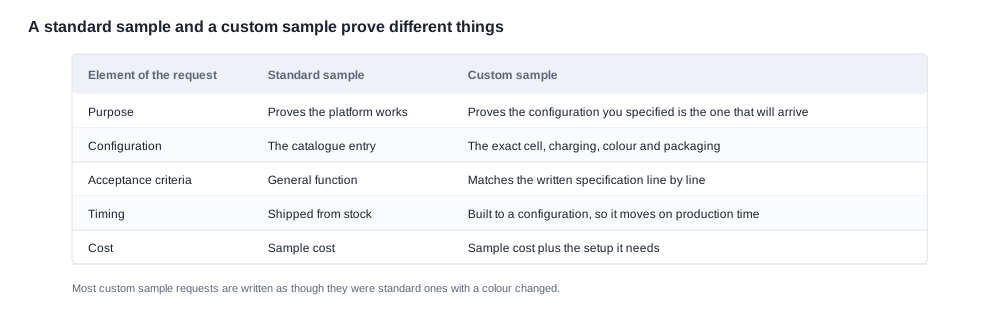
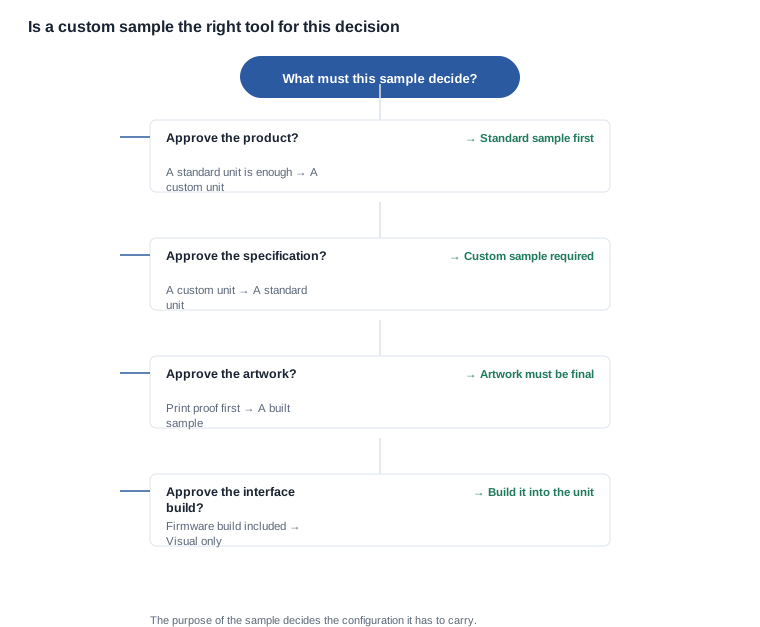
A custom sample is not a standard sample with a colour change, and treating it as one is the single most common way buyers waste the money and the calendar. A standard sample answers a question about the product: does this platform work, does it fit, does it sound right, does the camera do what the listing promises. A custom sample answers a question about a specification: does the exact configuration I have written down arrive, in the exact treatment I have paid for, in the state my production run will be in. The second question is narrower, more technical and considerably more expensive to get wrong, because a wrong answer at the sample stage is discovered after the tooling is cut and the artwork is printed.
The reason a custom sample needs more rigour is structural. Behind every customisation sits a process — a mould, a print cycle, a firmware build, a colour-matching session — and each of those processes has a lead time, a tolerance and a failure mode. A sample built on the wrong version of a process does not tell you the process is wrong; it tells you nothing at all, because you cannot tell whether the unit failed or the specification of the unit was never accurate.
So the work of requesting a custom sample is largely the work of deciding what the sample has to match, and then making sure the request states it in terms the factory can build to. This article sets out what has to match, what it costs to establish, what to check when the unit arrives, and what remains unproven even in the best case.
There is a fourth failure mode that is worth naming because it is invisible at the start: the request is written correctly but the specification behind it is not frozen. A custom sample that is built from a draft logo, a provisional colour and an unreleased firmware build will be approved against a specification that has already moved on, and the sample will be rejected for being out of date — a conclusion that tells the buyer nothing about the factory. Freezing the inputs before the request, even informally, is worth more than any amount of checking after delivery.
Requesting smart glasses samples: what a custom sample must match
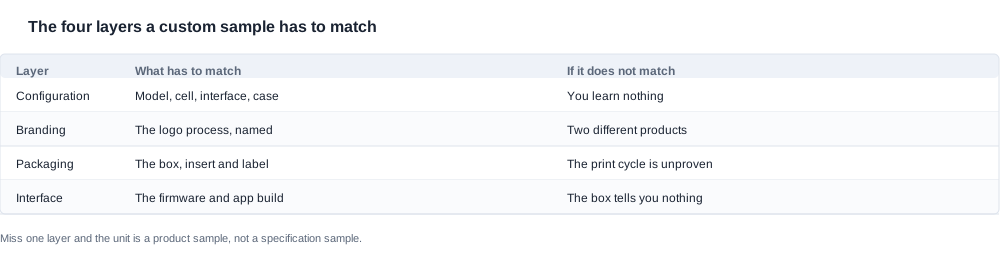
Four things have to match, and a sample that misses any one of them is a unit of the product rather than a unit of your product.
The configuration itself. The model, the charging interface, the cell configuration, the case capacity, the camera resolution, the colour and the firmware build. These are the published rows of the catalogue, and they are not decoration in a request — they are the specification the factory works from. The catalogue publishes the cell range across the range from 40 mAh in the children’s entries up to 290 mAh in the camera entries, the charging method on 24 of 28 entries with four camera entries left unpublished, and case capacities of 900, 1200 and 1400 mAh on the five entries that carry one. Naming the exact rows means the sample and the quotation describe the same object.
The branding treatment. The logo process, applied by the process you intend to buy. The published customisation set covers logo, colour, packaging, temple shape, system and user interface, Bluetooth naming and firmware customisation, and the logo method is where the distinction bites hardest: in-mould marking, laser engraving, pad printing and debossing are four processes with four different appearances, four different unit costs and four different tooling consequences. A pad-printed logo on the sample and an in-mould-marked logo in production are two different products wearing the same name. The tooling implications of each are set out in standard OEM tooling requirements, and they are not equivalent.
The packaging artwork. The actual box, the insert, the manual and the label, with the artwork that will be used. Packaging is a product in its own right — it is what protects the unit, it is what the customer unboxes, and it is where the print cycle sits between the sample and the shipment. Artwork also carries an external lead time, so a sample built before the artwork is final may be built on artwork that is about to change, which makes the sample worthless as an approval of the packaging.
The interface layer, where the customisation includes one. A branded app, a system and user-interface layer, a renamed Bluetooth device, a modified firmware default: these changes are invisible in a box, and they are exactly the changes that a customer notices in the first five minutes. If the customisation includes a firmware or interface change, the sample has to carry it, because no photograph of a carton can tell you what the device did when you opened the box.

Customisation is the real subject when requesting a sample
The published customisation list across the range is the practical starting point for a request, and it is worth reading as a set of independent decisions rather than as a bundle. Logo, colour, packaging, temple shape, system and user interface, Bluetooth naming and firmware customisation. Each is a separate line in the request, each has a different cost behaviour, and each has a different lead time. A request that asks for "our branding" and leaves the method open will come back as a proposal, and the proposal will be priced and scheduled as though every line were the same effort. They are not.
The line that surprises buyers most often is the temple shape, because it is the one customisation on the list that carries physical tooling. A temple profile is a mould; a colour is a process; a logo on an existing surface is a process on top of an existing mould. That difference propagates into everything downstream: the sample takes longer, the sample cost is different, and the conformity consequence changes, because a change to the frame is a change to the product rather than a change to its appearance. The full set of options and their boundaries is in customisation options overview.
Colour is the second line that needs care, because it interacts with the finish. The catalogue publishes colour options on only two camera entries — three for the V03 Pro, which is also the only camera model with photochromic lenses, and four for the V06 — and publishes no colour list at all for the remainder of the range. A request for "our colour" therefore has to be a request for a specific colour against a specific model and a specific finish, and the acceptance has to be against a physical reference rather than a file. The sequence for that is described in customisation options: colour matching, and the underlying reason is physical: a screen cannot reproduce the surface, and a printed proof cannot reproduce the moulding.
There is a version of this that is easy to miss. Some customisations are cheap to specify and expensive to change later, while others are the reverse. The logo treatment is relatively forgiving, because a new print run can be bought. The firmware and interface work is expensive to change later, because it propagates into the app, the documentation and the certification file. The colour is expensive to change later once packaging and artwork have been printed around it. Ordering the customisations by how hard they are to undo — rather than by how much they matter to the marketing — gives a sensible sequence for locking them down, and the engineering customisation checklist is built around that kind of ordering.
It is also worth separating who does the work. Some customisations arrive from you as a finished input: the artwork file, the logo vector, the brand guidelines, the manual copy, the app build. Others are performed by the factory: the marking, the moulding, the colour match, the firmware integration, the packaging print. A request that does not distinguish the two will produce a request for clarification rather than a schedule, because the factory is waiting on an input it assumed the buyer was supplying. Stating explicitly which inputs you will provide, in which format, by which date, is one of the cheapest ways to compress a sample timeline.
Bluetooth naming and firmware customisation deserve a note of their own, because they are the two lines that sound trivial and behave expensively. A renamed device is a small change to a string in a build, but it propagates into the pairing instructions, the manual, the packaging artwork, the support scripts and every piece of training material a distributor will give to a customer. A firmware default is the same: change the behaviour a customer sees when they first open the box and you have changed the onboarding that your whole channel is built on. Neither is hard to specify. Both are hard to change once the packaging is printed, which is why they belong in the first specification even when they look like small print.

The costs to settle before requesting a custom unit
Money is the part buyers are told to expect, and the part they most often discover late. Four questions, asked before the sample is ordered, prevent most of the unpleasant surprises.
Which of the customisations require new tooling, and which are process changes on an existing tool? The answer determines the order of magnitude of the one-off cost and the length of the schedule. A temple profile change and a colour change are not in the same category, and a request that treats them as equivalent produces a quote that cannot be compared with anything.
What is the one-off cost of each customisation, separated from the unit price? The separation matters because the one-off costs amortise over volume while the unit price does not, so a small order is dominated by them and a large order is not. The treatment of that separation, and of the tooling investment generally, is set out in ODM development, NRE and tooling.
What is the effect on the schedule, and does the sample require the tooling to be cut first? This is the question with the biggest practical impact on a launch date. A sample that requires a new mould cannot be built from stock, so the sample arrives after the tooling rather than before it, which means the sample can no longer influence the tooling decision — it can only confirm it. That is a materially different sample, and it is worth knowing which one you have bought.
What is the conformity consequence of each change? A change to the frame, the interface or the firmware is a change to the product, and some changes trigger a review of what was already certified. The conditions that trigger such a review are described in engineering customisation and certification impact. Since the catalogue publishes no per-model certification row and no published UN38.3 test summary, the right question to ask is not which certificate a change affects but whether the change triggers any re-test at all.
A fifth question is worth asking because it is routinely forgotten: what happens to the sample fee and the sample cost if the sample is rejected. A custom sample that has consumed tooling work is not the same commercial object as a stock unit, and a supplier who has a clear answer about that has a clear answer about the programme.
These five questions are also the substance of a negotiation rather than a formality, and the trade-off is worth understanding before the conversation. A buyer who pushes on the sample cost alone is asking for a discount on a line that is often largely fixed, because the tooling work has been done whether the sample is approved or not. A buyer who negotiates the relationship between the sample cost and the production order — whether a rejected sample is rebuilt, whether the tooling investment is carried across to the production volume, whether the sample cost is credited against the first order — is negotiating something that actually moves. The same applies to the schedule: a supplier who can offer a faster sample in exchange for an earlier artwork release or a firmer forecast has made a trade rather than a concession, and that is the trade worth making when the launch date is the constraint.


Arrival checks when requesting a custom unit
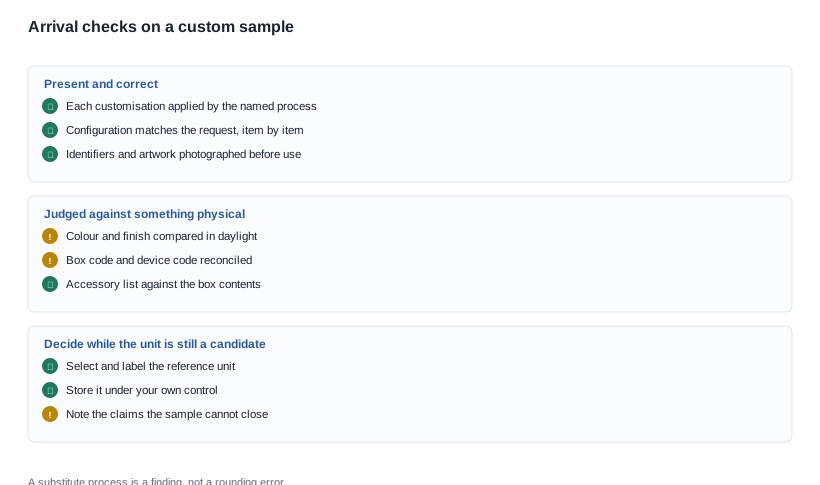
The unit arrives and there is a short window in which it is still a candidate. The checks in that window are worth doing in order, and the first one is the one most often skipped.
Are the customisations actually present, and applied by the specified process? Not by a substitute process that happens to look similar. A pad-printed logo where in-mould marking was specified is a finding, not a rounding error, because it changes the unit cost and the tooling position for the entire run. Photograph each customisation individually, in good light, at a scale where the process can be identified.
Does the configuration match the request, item by item? Check the model designation, the cell configuration, the charging interface, the case or the absence of a case, the colour and the firmware build against the published rows and against your own specification. This is the check that catches a wrong-configuration delivery, and it is much cheaper to do on a sample than on a shipment.
The colour and the finish, against a physical reference, in daylight. A screen is not a reference and a print proof is not a reference. If the request did not include a physical swatch, that is the moment to record that the colour will need to be approved against the production unit rather than the sample, and to plan for it.
The identifiers and the artwork, photographed before anything is used. The serial number, the label, the model code on the box against the code on the device, the accessory list against the box contents, and the artwork itself. These photographs are what a later claim, a later artwork comparison and a later packaging dispute will be settled with. Taking them before the unit is powered on and handled costs two minutes and saves an argument later.
One further step is worth adding to the list, and it is the one that protects the golden sample. Decide at this point which unit becomes the reference, label it, and store it under your own control before it goes anywhere near the marketing team. The wider form of this routine, and the sequence for recording a reference unit properly, sits in the engineering customisation checklist referenced above; the request itself belongs with the wider guidance on what to include when requesting samples.
When a check fails, resist the temptation to treat the unit as damaged goods and send it back. A failed check is a data point about the specification, and the useful response is to record what failed, against which line of the request, and then ask whether the request was wrong or the build was wrong. The two have completely different consequences: a request that was wrong gets corrected before the next unit is built, and a build that was wrong gets investigated before the production run. The difference is worth a day of delay, and it is the difference between a sample programme that improves the specification and one that merely generates a replacement.
What requesting a custom sample still cannot prove
There is a short list of things that no sample closes, and it is worth reading before the sample is ordered rather than after it arrives, because these are the questions where a buyer who has not thought in advance will wrongly assume the sample has answered them.
The certification file. A sample is an object; the file is a set of documents. The published position on this site is that the export certification page carries ten patent certificates — eight design patents and two utility models — as images, with no per-model certification row and no published UN38.3 test summary. So a custom sample cannot confirm that your configuration is certified for your destination market, and a request should ask for the named report, the model family it was issued against, the laboratory and the date.
The physical properties the catalogue does not publish. The frame weight is published for one entry only, at 158 g for the MT6 glasses excluding its case. The sensor, the camera specification, the acoustic performance and the lens performance are not published for any entry. The ingress evidence is thin as well, with only the V06 and the S7 carrying an IP54 marking and no report number behind it. None of these is closed by a sample; they are closed by measurement, on your own units, against a protocol you have written.
The consistency of the production run. A custom sample is one unit of one build. It tells you the specification was achievable on that day; it tells you nothing about whether the thousandth unit will match it, which is a question about the frozen bill of materials, the change control procedure and the incoming comparison routine.
The commercial terms. Sample fee, sample cost, minimum order quantity, lead time, warranty and payment terms are not published anywhere on this site, because each is a property of a live order rather than of a product. They are settled in a quotation, and the route for that is the request a quote page.
The closing position is simple. A custom sample is worth precisely what the specification it carries is worth, and the specification is the output of the request rather than of the factory. Send the configuration, the customisation list with the process named for each, the market, the artwork status and the decision the sample feeds, and we will tell you which parts the sample will establish and which parts remain open regardless of how good the unit is.
There is one more case worth planning for in advance, which is the second custom sample. If the first unit is rejected, the rebuild request is not the first request with two corrections attached to it — it is a much shorter document, because everything that did not fail is already settled. The practical consequence is worth planning for: keep the first specification as a versioned document, keep the arrival record with the photographs, and keep the decision on what failed. When the second unit arrives, the check list is short and the remaining uncertainty is concentrated in the one or two items that were actually open. Buyers who treat the rebuild as a fresh request pay for the whole specification twice, and they lose the evidence trail in the process, which is often more expensive than the unit itself.
Related reading
- The request itself — request a quote
- What to include — what to include when requesting samples
- The customisation set — customisation options overview
- The engineering detail — engineering customisation checklist
Send the customisation list, configuration, market and decision, and we will say what the sample will establish.


