
Smart glasses for content creation: the five mistakes that arrive as reviews
The conclusion a first content launch can act on
Five mistakes account for most content-creation channels that launch, get poor reviews, and relist. None of them is a technology error, and all five are made by people who have been told the product is a good fit. Smart glasses for content creation beginner mistakes are not about picking the wrong model; they are about publishing a claim the documentation does not carry, and then finding out in public.
The reason these five recur is that the claims are all attractive. A resolution tier, a runtime band, an ingress marking, a weight figure and a format description are exactly the five things a buyer wants on a product page, and exactly the five things that are either model-specific, condition-dependent, or absent from the catalogue entirely. A first-time buyer who fills the listing from a competitor's specification sheet gets a page that converts well and cannot survive a customer test.
The conclusion is therefore procedural rather than editorial: build a claim register before the listing copy exists, give every claim one of three statuses, and hold the launch until each claim in the register is either published with its limit attached or removed. That is a half-day of work, and it removes the largest category of content-creation returns — the ones where the customer says the product did not do what the page said.
The second conclusion is about which claims are worth keeping. The camera tier publishes the cell capacity, the resolution class, the charging interface where it is published, the rated runtime, the charge time, the case capacities where they are published and the structural features — and it publishes nothing at all about the video format, the frame rate, the field of view, the storage behaviour, the low-light performance or the recording indicator. A listing built from the first group converts and survives; a listing built from the second group converts and then returns.
Who is buying, and what the claim register has to cover
The reader is a brand-side buyer, a channel buyer or an e-commerce seller preparing a first content-creation listing: a brand owner opening a category, a marketplace seller preparing a product page, or a distributor supplying copy to a retailer. The situation is usually a listing to publish, a review section to fix, or a competitor's listing to beat, and in each case the same question sits underneath: which of these statements can we defend when a customer measures it?
The fear underneath it is not a conversion rate. It is a relist. A channel that publishes "waterproof" on a model whose only ingress marking belongs to a different model, or "eight hours" on a rating with no test condition, will get through launch on the strength of the copy and will get through the first month of reviews on the strength of nobody contradicting it. Then the first customer who measures it writes the review, and the relist costs the channel the keyword positions it spent six months building.
Two things have to arrive before the register can be built. The first is the model mix, because four of the five claims below are model-specific and a register that is not indexed by model will publish one model's marking across a whole category page. The second is the destination market, because the recording and consent question differs by jurisdiction and by platform, and because the market-access rows are per model rather than per company.
Why a claim outruns the documentation it was built on
A claim outruns its documentation for a predictable reason: the claim is written once and then copied. A specification sheet is read once per model; a claim is written once per channel and then replicated across every listing, every marketplace description and every piece of creator copy the channel produces. A claim that was true for one model becomes a description of the range within a quarter, and by then nobody remembers which row it came from.
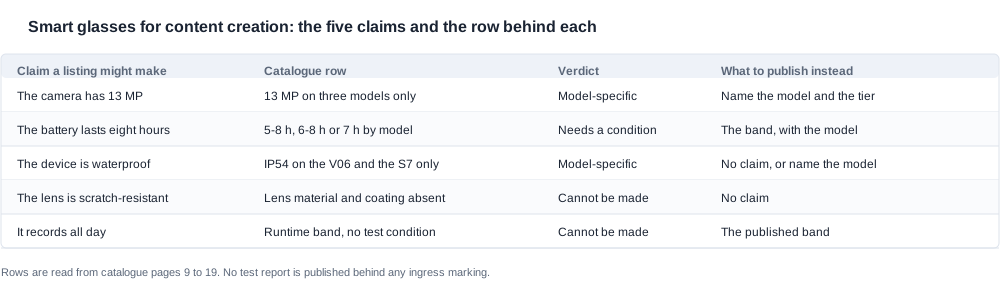
The table above is the register in miniature, and the fourth column is what a channel should publish instead. Note the shape of it: only one of the five claims is publishable as it is normally written. Three have to be narrowed to a model or attached to a condition, and one has to be removed entirely because there is no row behind it at any level.
The review gate that stops the copying is simple and it is not a legal review. It is a check that every sentence in the listing that describes the device can be traced to a row in the register, and that the register is indexed by model. A brand that runs that check on every listing it publishes will catch the copied claim before it reaches a customer, and it will catch it while changing one word rather than while relisting a product.

The claim register a first content launch has to keep
The five claims and the row behind each one
The five claims below are the ones that recur, and each one is presented with the row behind it, what is wrong with the usual version, and the preventive step.
Mistake one: choosing and publishing on the pixel count. The camera range publishes 8 MP on eight models and 13 MP on three — the L2 Utral and the L1 Pro, and the S7 — and the pixel count is the number a first-time buyer leads with and the least informative row available. It says how many pixels the camera can record and nothing about how large they are or how much light they gather. The rows that would describe the file — video resolution, frame rate, field of view, storage behaviour — are all absent from the catalogue. A buyer choosing on pixels has chosen the one row they can see and none of the four they need. Prevention: index the register by model and write the tier as a tier, naming which of the eleven models carries 13 MP.
Mistake two: publishing a rated runtime without its condition. The camera figures are 220 mAh to 290 mAh cells with rated runtimes of five to eight hours on the V03 and the S7, and the V06 and the V03 Pro, six to eight hours on the KY06 and the MT5, and roughly seven hours on the L2 Utral and the L1 Pro, and the CY03 and the CY05, and the MT6 — and the test condition behind every one of them is absent. A creator who buys expecting eight hours and gets five has not been sold a bad product; they have been sold an incomplete page. Prevention: publish the band with the model named, and state that no test condition is published. It costs one sentence and removes an entire category of complaint.
Mistake three: carrying a waterproof claim across the range. The IP54 marking belongs to the V06 and the S7, two sport camera models, and to no other model in the catalogue; no third-party test report is published behind it either. So a listing that says the device is waterproof on a model outside those two is claiming a protection that is not published for that model and not documented for the two where it is. Prevention: either name the model and the marking's limits, or drop the word.
Mistake four: making a lens claim from a catalogue that publishes no lens data. The lens material and the coating are not published for any model, so no listing may call a lens scratch-resistant, anti-glare, impact-resistant or durable. This is the claim that most often arrives from a generic product description template rather than from a supplier document, and it is the one that is hardest to defend because a customer can scratch a lens in a pocket. Prevention: remove the adjectives entirely rather than softening them.
Mistake five: asking about storage only after the listing is live. Storage capacity and overwrite behaviour are absent from the catalogue, and they are the rows that determine whether a two-hour take ends with a complete recording or with the last twenty minutes of one. The symptom is a customer whose footage stops without an error. Prevention: request the rows by name before the launch, and if the answer is that the behaviour is not measured, say so on the listing rather than discovering it in reviews.
The claims that cannot be made at all
Four categories have no published row behind them at any model, and a claim in any of them cannot be written with a caveat because there is no fact to attach the caveat to. They are the file format and frame rate, the field of view, the storage and overwrite behaviour, and the recording indicator. The first three mean a listing cannot describe what the customer will get in the file. The fourth is the one with legal consequences rather than only commercial ones.
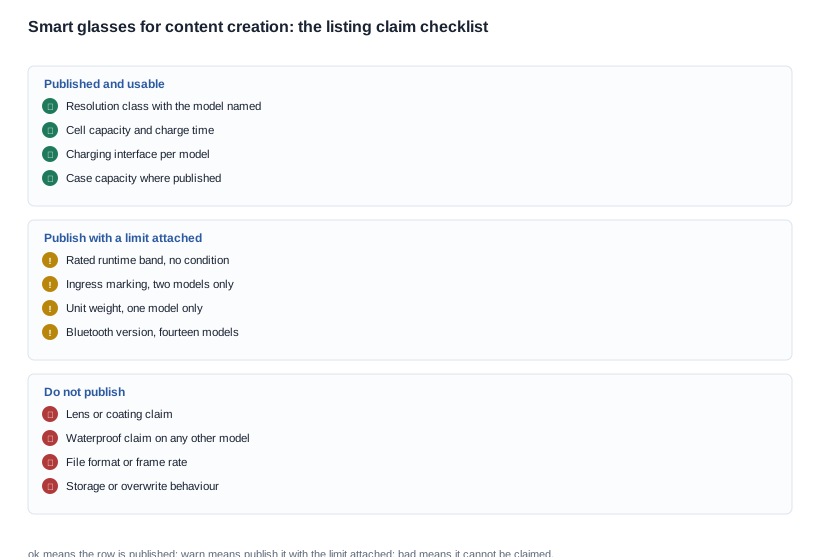
The checklist above is the register turned into a gate, and the three status groups are the three decisions a channel makes about every row. Published and usable means the row can go on the page as it stands. Publish with a limit attached means the row exists but has to travel with its restriction — the runtime band without a condition, the ingress marking on two models only, the 158 g weight on one model, the Bluetooth version that fourteen models do not publish. Do not publish means the row is absent, and no amount of wording rescues it.
Verifying the claims before the listing goes live
The three-column register and the review gate
The register is a document with three columns and it takes an hour to build for a single model family: the claim as it would be written, the catalogue row behind it, and the status. Everything else about it is discipline rather than format.
- Ask for the video resolution, the frame rate and the file format per model, so the format row is either filled or explicitly marked empty.
- Ask for the field of view per model, so the framing description can be written or dropped.
- Ask for the storage capacity and the overwrite behaviour, so the take-length statement is a fact or is absent.
- Ask for the runtime figure with its test condition, so the endurance band can be published as a measured range.
- Ask for the charging method for the four camera models where it is not published — the MT6 and the CY05, and the CY03 and the L1 Pro — so the power description is complete.
- Ask for the per-model unit weight and the hinge specification, so no stability claim is made for a model that has no published weight.
- Ask for the ingress position in writing for the exact model, together with the report identifier behind any marking.
- Ask for the certification scope per model for each destination market, because the catalogue carries no per-model certification row and the catalogue text contains no CE, FCC, RoHS, REACH or UN38.3 marking at all.
The review gate then has one rule: every sentence in the listing that describes the device appears in the register, and every register row has a status. A sentence with no register row is not a stylistic issue; it is an unpublished claim, and the cheapest moment to find it is before the listing is live.
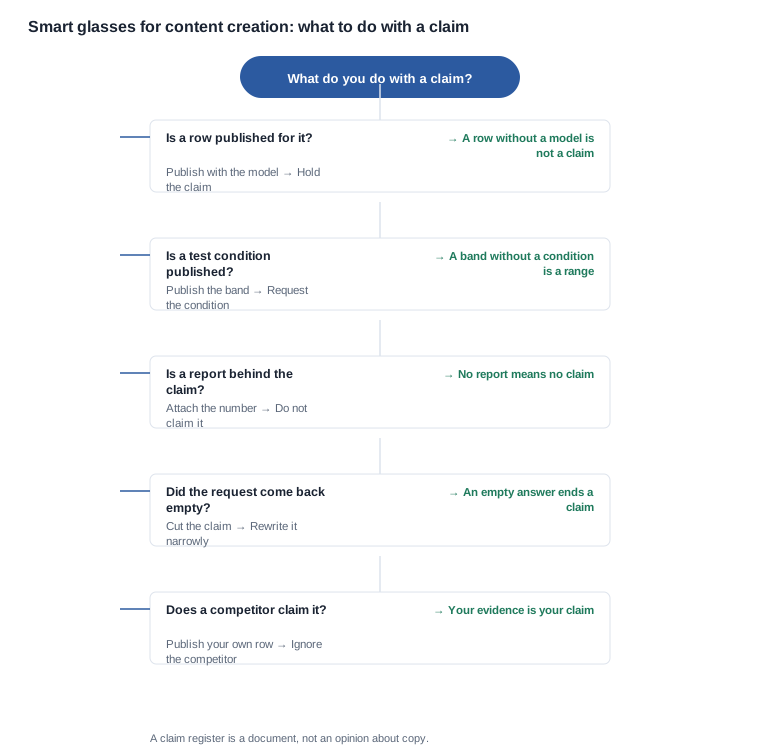
The decision path above is what a reviewer does with a claim that has been proposed, and the fourth branch is the one that saves the most money: an empty answer to a request ends the claim rather than qualifying it. A brand that accepts an empty answer removes the sentence and publishes a smaller claim, and the smaller claim survives.
The recording indicator and the consent question
The one claim with consequences beyond returns is the recording indicator, and it is not published for any model. A first-person camera records whoever is in front of it, and in a public shoot that is a consent and privacy matter before it is a feature, varying by jurisdiction and by platform policy. The question to put to the supplier is specific: where is the indicator implemented — in the hardware, in the firmware or in the app only — and what happens when the app is not running.
If the answer is that the indicator is app-only, then the channel has a decision to make rather than a description to publish. The deployment-specific thread is at content creation legal considerations, and it is worth reading before the listing rather than after the first complaint, because the remedy for a consent complaint is not a copy edit. A brand that cannot answer the indicator question should say in the listing that the recording state is confirmed by an on-device control, or should not publish a recording claim at all.
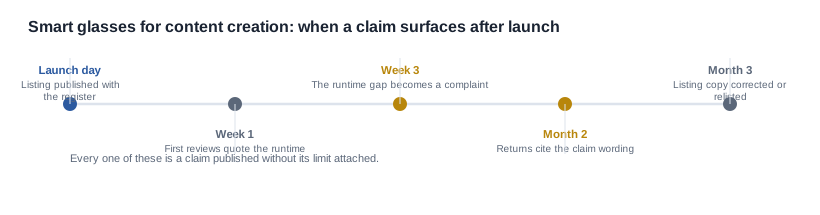
The timeline above shows the ordinary shape of a claim failure, and the reason it matters is the order. Nothing happens for two to three weeks, then a single review converts the claim into a complaint, and by the time the listing is corrected the channel has already spent the marketing budget and lost the keyword position. The register moves the whole sequence forward to launch day, where the cost of removing a sentence is one word.

Where a first content launch goes wrong
The failures below reach a buyer as a surprise, and each is written as a symptom, a root cause and a control.
A listing built from a supplier brochure rather than from a register. Every descriptive sentence traces to marketing copy that nobody checked against a row. Control: the register, and the gate before the listing goes live.
A claim replicated across the range. A marking that belongs to two models appears on eleven listings because it was copied. Control: index the register by model and review every listing whenever the model mix changes.
A statement that arrives empty and is softened instead of removed. "Approximately eight hours under typical conditions" is still a claim about a condition that does not exist. Control: an empty answer ends the sentence.
A warranty that contradicts the listing. The returns description has to match what was published, because a customer citing the published wording is making a warranty claim rather than a review. Control: the warranty terms and the register are reviewed together, and the content creation buying checklist is the right starting point.
An evaluation done at a desk. Sizing, balance over a long session and how the device behaves during movement are unevidenced in our documentation, and the unit weight is published for one model only, the MT6 at 158 g for the glasses body. These are established by using the product for a full session, not by reading a sheet.
No plan for the second listing. A first launch is a test of the copy, and the second launch is where the corrections get applied. Control: schedule the relist, and treat the first month as the measurement period for the register itself.

What a first content launch costs commercially
Three terms a first launch can still move
Three terms in a first content launch carry real room, and all three sit outside the unit price. The first is whether the supplier will supply the register's missing rows as part of the sample order, which is the cheapest way to close the eight requests above and the difference between a launch that survives its first month of reviews and one that does not.
The second is whether the packaging and the listing artwork carry the limits that the register attaches — the model name next to the marking, the band next to the runtime. Artwork that omits the limit reproduces the claim in the one place the customer is certain to see it, so the artwork review is worth a line in the order rather than a note in a meeting.
The third is the warranty and returns structure, which for a content channel is a reason-code problem rather than a policy problem. The reason codes a content channel sees are the ones the listing created: the device did not last as stated, the format did not open, the lens was marked, the storage stopped. A returns policy that maps those four to specific remedies, and an incoming inspection criteria that distinguishes them from a defect, is worth more to a channel than a price concession, because the copy is what generates them.
An opening order that ships in two parts against payment tied to inspection suits a channel that intends to relist with corrected copy once the first month has passed, and the margin is in the volume that sits at the pilot tier rather than the run tier.
The costs a first launch cannot negotiate
Three costs are not negotiation targets. The camera hardware, the cell and the charging interface, and therefore the charge time and the runtime ceiling, are fixed for a given model. The cost of certification and the time it takes are decided by the programme and by whoever runs the test for the destination market, incurred once per product family rather than per unit. And tooling is a one-time cost that should be quoted as a separate line and amortised across the order, because a quotation that folds tooling into the unit price hides both its size and the point at which it stops being payable.
The channel-specific addition to the commercial conversation is the returns reserve. A content launch should be budgeted with a returns reserve sized on the claim risk rather than on the defect rate, because in this category the majority of returns are created by the listing rather than by the device, and a channel that budgets on defect rate will discover its reserve is wrong in the month it relists. The published rows behind the camera models are at AI camera glasses, and the scenario entry point is smart glasses for content creation.
What we publish for content creation, and what we will not claim
It is worth being precise: a content-creation listing built from the published rows plus the marked gaps converts less well than one built from guesses, and returns far less. We will give you the published configuration — the resolution class, the cell capacity, the charge time, the rated runtime, the charging method where it is published and the case capacity where it is published — and we will mark the rows we do not hold.
The sensor, the field of view, the video resolution, the frame rate, the storage behaviour, the overwrite behaviour, the recording indicator, the lens material, the coating, the hinge specification, the per-model unit weight beyond the single 158 g figure for the MT6 body, the operating temperature range, the cycle life rating and the runtime test condition are all absent from our documentation, and we will not fill them with values from the industry or from another supplier's sheet. We will also not extend the IP54 marking beyond the V06 and the S7, and we will not describe a recording quality for a model where the specification is not in front of us.
What we will do is build the register with you. Send us the models you are listing and the markets you are selling into, and we will return the published rows per model, the claims that can be published as they stand, the claims that need their limit attached, and the claims to remove — which is the part of the launch that usually gets skipped and the part that decides whether the channel relists.
Related reading
- The full list — content creation buying checklist
- The recording question — content creation legal considerations
- The published configurations — AI camera glasses
- The opening point of the scenario — smart glasses for content creation
Send the models you are listing and the markets you are selling into, and we will return the register per model rather than a description of the product.


