

Smart glasses for content creation budgets are settled before anyone quotes a unit price, because the cost of this category is not one number but a stack of them: the bill of materials inside the device, the second cell in the box, the documentation route for your own brand name, the gap between a hand-built sample and a production unit, and the returns you are reserving against rows nobody has published yet. A buyer who compares two unit prices is comparing the smallest line in the stack and will discover the other four at the point where they are hardest to change.
What this article gives you is the order in which those lines have to be built, and the published rows that let you predict a cost tier before a number exists. We do not publish a price list, a minimum order quantity, a production lead time or a cost breakdown, and we will not put an industry average in their place. Every figure below is either a catalogue row or an explicit gap.
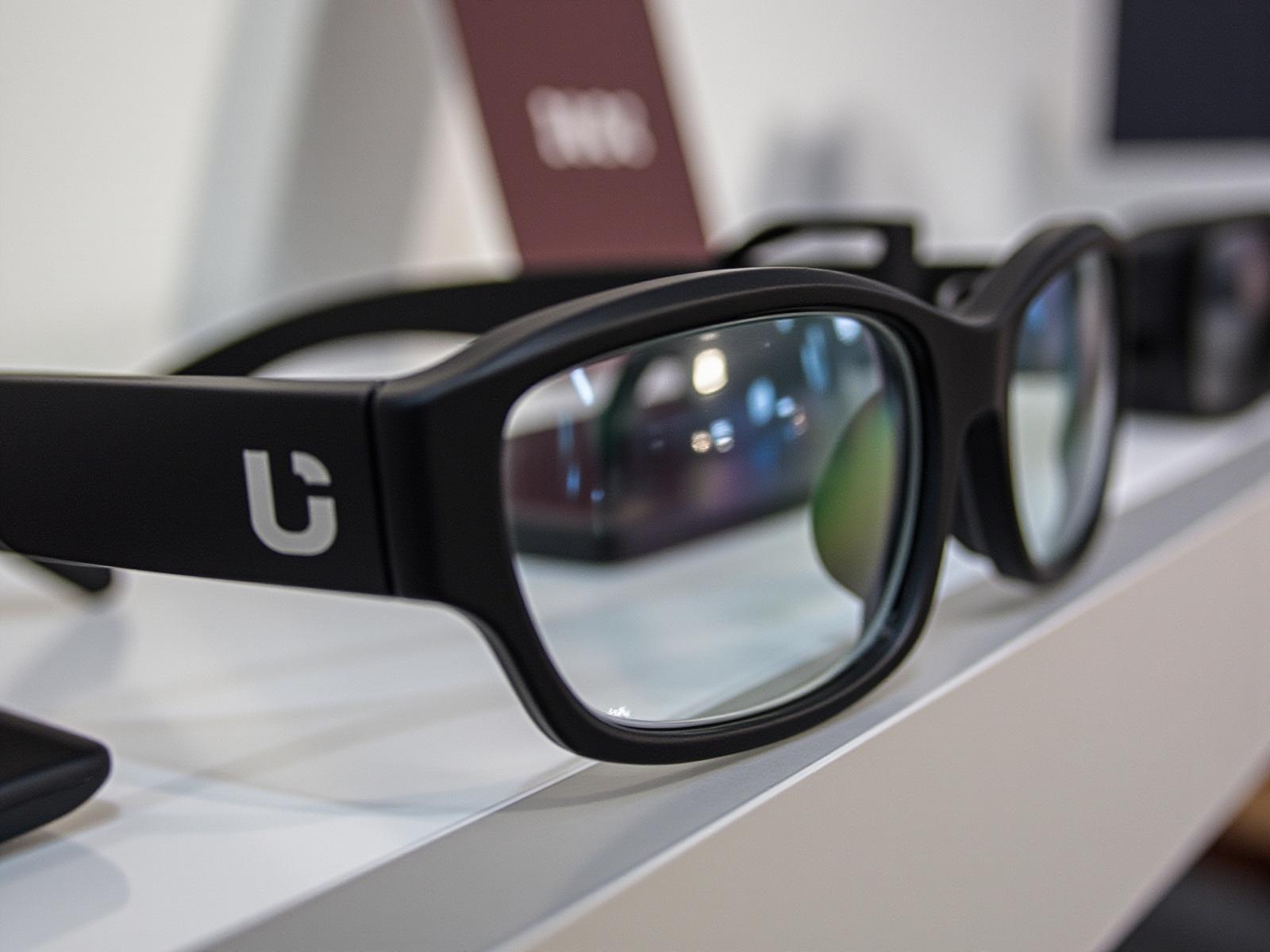
Smart glasses for content creation: what a content budget is actually made of
The short answer. The budget for a content-creation device should be built from the creator profile rather than from a price list, because the profile decides how many units a shoot needs, and the unit count is the only multiplier that matters. A creator who shoots ten short clips a day and a creator who runs a four-hour walk-through need different hardware, different accessories and different amounts of freight, and the published rows in this catalogue let you tell those two cases apart before anyone quotes. Do not ask for a price first. Ask for the six rows that decide the configuration — camera tier, cell capacity, charge time, charging interface, case capacity and rated use — and the price becomes answerable, because the price is a function of the configuration and the quantity, not a number that exists on its own.
Who is holding this budget and what it has to survive. A brand owner is opening a new material number and needs a landed number that survives a finance review, which means the freight, the documentation and the returns reserve all have to be inside it rather than discovered later. A procurement manager is comparing two quotations that use different configurations and different accessories, and needs a way to tell whether the gap between them is a real difference or an artefact of what each supplier chose to include. A channel buyer for an e-commerce listing is buying a single SKU with a minimum order quantity and a per-unit landed cost, and needs the accessory chain priced separately from the device. A private-label programme is running for a year or more, and the number that matters is not the first order at all; it is the total cost of the second and third.
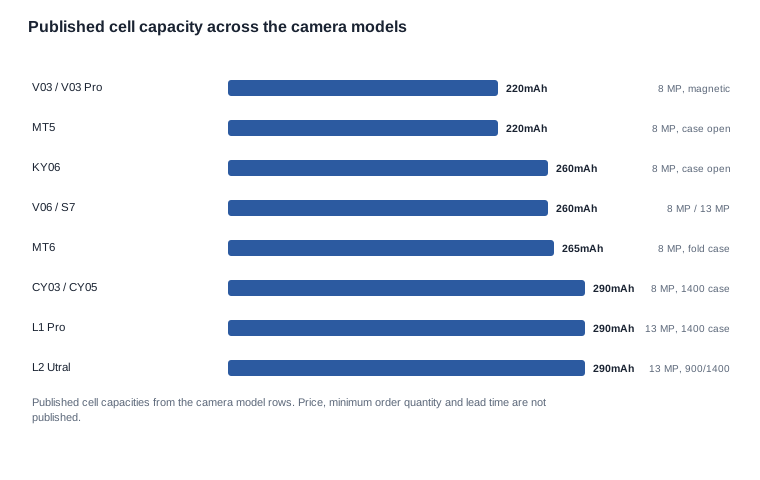
What the catalogue publishes, and what a cost map can be built from. The range lists 28 models. The eleven camera models each carry a published camera tier, a cell capacity, a charge time, a rated-use figure and, for seven of them, a charging method. The tier split is eight models at 8 megapixels and three at 13 megapixels. Cell capacities across the camera group run 220 mAh, 260 mAh, 265 mAh and 290 mAh. Charge time is published for every model in the range at two hours or less, with the exception of two sport models at about an hour. The charging interface is magnetic on seventeen models and Type-C on seven, and for four camera models — the CY05, the CY03 and the MT6, and the L1 Pro — the catalogue publishes no charging-method row at all.
What the catalogue does not publish, and why that is the budget. There is no price, no minimum order quantity, no production lead time, no per-model cost breakdown, no production capacity figure, no yield figure and no defect rate for this range. There is also no per-model conformity record, no certificate number and no test report reference. Any of those figures offered as a "typical" value is an invented value, and it will be wrong in a direction you cannot predict, because the one that moves your landed cost the most is usually the one that was guessed.
The cost lines a unit price never covers
The invoice is the smallest line in the stack. Here are the four others, in the order they usually surface.
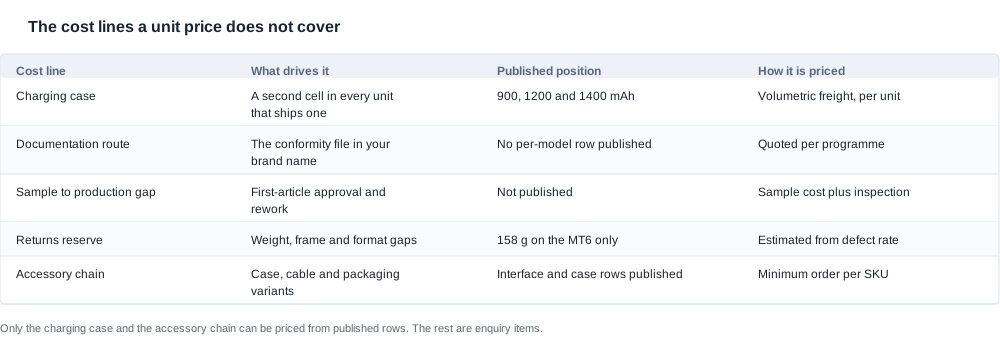
The charging case is a second lithium cell in every unit that ships one. The published case capacities are 900 mAh, 1200 mAh and 1400 mAh, with the L2 Utral offered at either 900 or 1400 mAh and the MT6's 1200 mAh case folding. The L1 Pro and the CY05, and the CY03 publish a 1400 mAh case; the KY06 and the MT5 ship with a case whose capacity is not published; and the catalogue carries no case row at all for the V06 and the V03 Pro, and the S7 and the V03, which is a different thing from being published as having no case and is worth asking about before the accessory budget is set. For the budget, the case matters twice: once as a component cost in every unit, and once as volumetric freight, which on air freight for a consumer electronics parcel is frequently a larger swing than the unit price difference you negotiated. A 1400 mAh case added to the box changes the freight bill by more than most buyers expect, and it is a line that does not appear in a unit price quotation.
**The documentation route is priced per programme, not per unit.The catalogue includes a company-level export certification page made up of ten appearance-design patent certificate images, and it does not carry a per-model certification row. That means the conformity file for a configuration sold under your own brand name is something you request, not something you inherit. When a brand puts its own name on the product, the declaration of conformity has to be reissued in that name, and the underlying test evidence has to be checked for whether it covers the model designation you are actually ordering, including the case configuration and the colourway. Buyers ask about CE, FCC and RoHS here, and the honest position is that our catalogue carries no per-model conformity row for any of them, so the documents are a written request against your exact configuration. The cost of that route is real and it is not a unit price.
The sample-to-production gap is the line buyers forget entirely. A sample that runs from a hand-built unit tells you the design works. It tells you nothing about production yield, first-article approval, rework policy or the consistency of a batch, and none of those are published for this range. The commercial consequence is straightforward: the sample cost, the sample timeline and the inspection terms belong inside the budget as a separate line, because they are money spent before a single saleable unit exists. A buyer who treats a sample as a free evaluation has already spent money and not recorded it.
The returns reserve is set by rows that are not published. The catalogue publishes a unit weight for exactly one model in the whole range: the MT6 at 158 g, which is the glasses body including its cell and camera and excluding the foldable charging case. For every other model the weight is not published, and the video format, frame rate, field of view, storage behaviour, transfer path and thermal behaviour are not published for any model. Weight complaints scale with return rate, and a complaint about footage that is technically correct and unusable is a return that no factory can fix, because the fix is a different sensor or a different frame rate and both are open rows. You cannot reserve against a cost you cannot see, so the reserve is a percentage of the delivered price until the sample tests replace it with a number.
The accessory chain is a separate bill per SKU. A case, a cable, an insert and a box are each a configuration with their own minimum order quantity and their own packaging file. A range with two models and one shared case configuration is cheaper to run than a range with four models and four case configurations, and the difference is invisible in a unit price and visible in the purchase order.
Building the budget in the order that stops rework
The sequence below is not a formality. It is arranged so that each step reduces the number of variables in the one after it.

Step one is the creator profile, written down in numbers. Shoot length, edit chain, delivery format and the number of people on a shoot are the four inputs. Every published row in the catalogue is a filter applied to those four numbers, and a buyer who skips this step ends up comparing two devices that solve different problems. The comparison method in how to compare models for this application runs the filter in a fixed order so the output is a shortlist rather than an impression.
Step two maps the profile onto the published camera rows and shortlist two models. Eleven camera models is too many to price and too many to test. Two is enough to quote against and to sample. The published rows make the first pass mechanical: a V03, a V03 Pro or an MT5 for the shortest sessions at 220 mAh and a five-to-eight-hour band; a KY06, a V06 or an S7 at 260 mAh; the MT6 at 265 mAh with a foldable 1200 mAh case; and the CY03 and the CY05, and the L1 Pro and the L2 Utral — each at 290 mAh and about seven hours, with the L1 Pro and the L2 Utral at 13 megapixels.
Step three is the request for the four rows that are not published. The video format with its frame rate, the field of view with its convention, the storage capacity and overwrite behaviour, and the transfer path with the application version. These four rows decide whether the device is usable for the profile, and none of them is published for any model. A budget built before they arrive is a budget for a category, not for a product.
Step four builds the landed cost rather than the unit cost. Unit price, case freight, the documentation route, packaging and the accessory chain, with the shipping terms and the payment terms attached. The logistics and lead-time page covers how the schedule terms sit against the payment terms, and the pricing and payment terms page covers how a volume band is structured.
Step five adds the accessory chain and the returns reserve per SKU. Not per range. A SKU nobody sells still carries a minimum order quantity, a packaging file and a reserve.
Step six compares two complete budgets. If one quotation includes a case and a cable and the other does not, the gap between them is a difference in scope, not a difference in price, and the second step in this article is the checklist for telling the two apart.

What to put in the enquiry so the price is a price
The request that produces a comparable quotation has three parts: the published rows you have already fixed, the open rows you need answered, and the commercial rows you need confirmed.
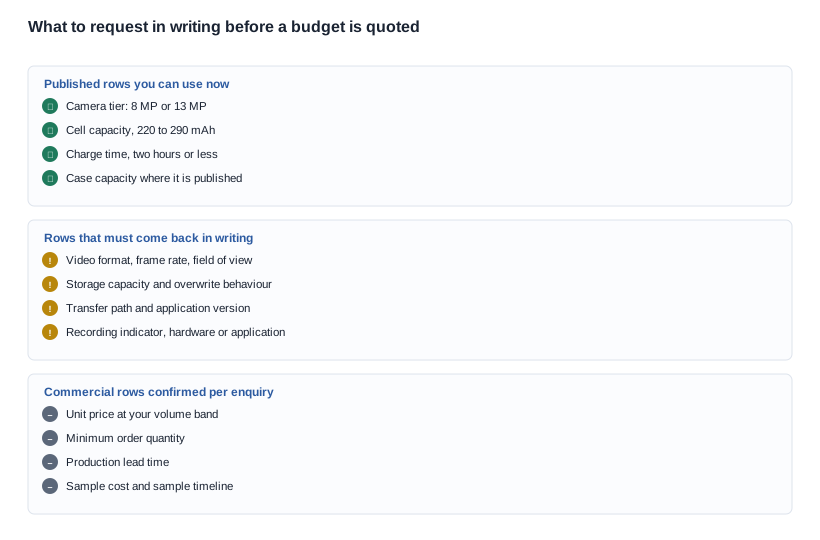
The published rows go in as a configuration string, not as prose. Write the camera tier, the cell capacity, the charging interface, the case configuration and the colourway into one line, because a configuration described in general terms produces a price that cannot be compared with anything. Three pairs in the camera group are effectively the same platform in different casings, and within each pair the differences are the interface and the case rather than the capability, so a buyer who specifies a tier and leaves the interface open will receive a quotation for a configuration they did not choose.
The open rows go in as a single request, with a date attached. Four rows, one message, one format. The reason for one message is comparability: answers that arrive in a month across four emails cannot be set side by side, and the row that comes back last is the row that gets quoted. The reason for the date is the one that matters commercially, which is that an unanswered row becomes a written assumption in the contract, and an assumption in a contract is a liability that arrives with the goods.
The commercial rows go in as a band, not a point. Unit price at your quantity, the minimum order quantity, the production lead time, the sample cost and the sample timeline, the warranty period with a stated response, and the return terms. Ask for the payment terms against inspection rather than against production, and ask whether the order can be split into a first delivery and a balance delivery, because a split delivery turns an all-or-nothing schedule risk into two smaller ones.
Normalising two quotations before you compare them. A buyer comparing a quotation from an original equipment manufacturer against a quotation from a trading company is usually comparing two different scopes, and the difference is frequently larger than the price. Write the two quotations onto the same template before reading either of them: the device configuration string, the case configuration, the accessory list, the packaging, the documentation route, the inspection terms, the delivery split, the payment nodes and the warranty. Any line that appears on one sheet and not the other is not free on the other sheet; it is either excluded or supplied at a price that has not been stated. Only the lines that appear on both sheets, with the same content, are comparable, and the comparison is over the rows that survive that test. The manufacturer and trading company distinction page covers where the two scopes usually diverge.
What is worth negotiating, and what is not worth arguing about. The unit price and the volume band are negotiable because they scale with your order. The minimum order quantity is negotiable in the sense that a pilot order is often available at a lower quantity at a higher unit price, and the question is whether the premium is smaller than the carrying cost of the stock. Packaging, delivery splitting and the payment nodes are negotiable. Tooling is a one-off cost that is usually amortised across the first order, and certification is a per-programme cost that is not, so ask which one you are being quoted whenever the two appear on the same line of a quotation, because they are frequently bundled into a single figure that hides which is which. The contract terms page sets out the clauses that carry these points.
Two budget mistakes that are expensive and easy to make. The first is discounting before the configuration is fixed, which buys a price on a specification nobody has agreed and then pays for it again when the configuration changes. The second is treating the sample cost as a sunk expense rather than as the first instalment of a quality-control programme: a sample tested against written pass lines is the cheapest quality assurance available to you, while a sample admired in a demonstration is a cost with no return. Both mistakes are avoided by the same two actions, which are to freeze the configuration string and to write the pass lines before the sample is shipped.

Where our published data stops on cost
Here, a budget built on an open row is a budget for a category, and the most useful thing a factory can do with a buyer at this stage is close rows rather than discount them. We publish the camera tiers, the charging interfaces, the published the rated runtimes, structural features, the charge times, the published case capacities and the cell capacities exactly as the catalogue states them, and we publish the absence of a price, a minimum order quantity, a production lead time, a cost breakdown, a sensor model, a field of view, a video format, a frame rate, a storage behaviour, a transfer path, a thermal behaviour, a per-model weight and any certificate number with the same prominence.
Two commitments follow from that, and both are worth more to a buyer than a discount. The first is that we will not fill an open row with a typical figure from the industry, because an average substituted for a specification is how a programme ends up with a product that cannot pass its own spec sheet. The second is that we will not present a company-level export certification page as though it were a per-model conformity record, and we will not quote certificate numbers we cannot evidence.
We will also tell you plainly when a model is the wrong choice for the profile. The audio group in this range is eight models with published Bluetooth versions, published cell capacities and published runtimes, and for a channel whose product is narration rather than picture the cost structure sits in a different place entirely, at the Bluetooth audio glasses range. The AI camera glasses range page lists the camera configurations and their published rows.
Sending us the numbers that start the budget
Send the creator profile, the quantity band, the target market and the two models you have shortlisted, and we will tell you which published rows those configurations carry, which four rows have to come back from the factory or from a sample, and what the accessory chain costs at the quantity you actually intend to order.
The decision framework this budget sits inside is at smart glasses for content creation, and the sample programme that closes the open rows is described at sampling before a production run.
Related reading
- What the spec sheet does not tell you — the gaps that decide return rates
- Sampling before you commit to a production run — what a sample can and cannot prove
- Certification checklist for imported consumer electronics — what to request in writing
Tell us the target market, the quantity band and the configuration you need, and we will tell you which published models fit and which figures we cannot commit to.


