

Content creation, where the camera and the audio are the product, puts a specific set of demands on the build, and a buyer who treats it as a general product decision pays for the wrong configuration. The point of this page is the programme rather than the unit: what a content device has to survive across a year of use, which published rows settle that question, which ones do not, and how the answers change the accessory chain, the fleet size and the returns reserve.
Smart glasses for content creation: what a twelve-month programme actually costs
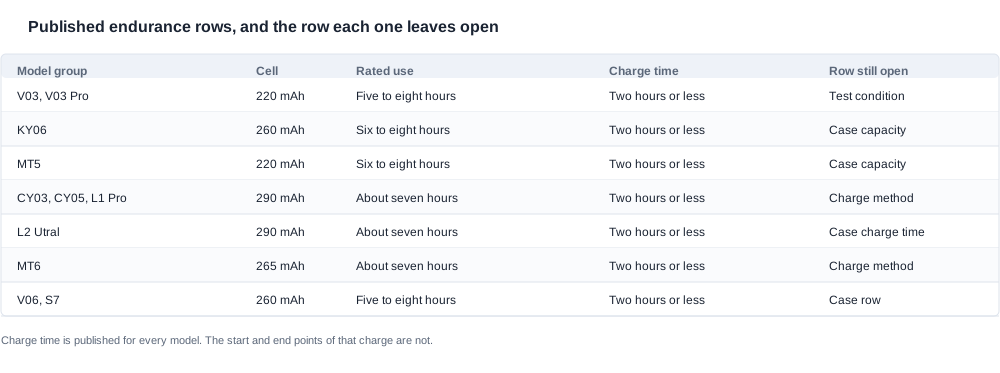
The short answer. A long-running content programme is bought as a duty cycle, not as a runtime figure. The published rated use of five to eight hours on the 220 mAh models and about seven on the 290 mAh models describes one session; a programme describes a month, and a month is made of sessions, gaps, heat, transfers and application updates. Four published rows decide the programme and one published row does not: the endurance figures are published, and the condition they were measured under is not. Everything else that determines whether a unit is still usable in month nine — the thermal behaviour, the storage behaviour, the application version floor, the unit weight for every model except one — is not published for any model, which means the programme has to be managed by measurement rather than by specification.
Who is planning the programme and what they are defending. A brand owner is deciding how many units to place in the field, which is a fleet-sizing question and not a per-unit question. A procurement manager is deciding the accessory chain and the reorder profile, because a device that ships with a case and a device that ships without one produce different orders, different freight bills and different accessory minimums. A channel operator is deciding how many units a creator segment needs and what happens when one of them is retired. A factory is deciding what it can commit to over a year, and the answer to that question is narrower than buyers often expect, because most of the long-term behaviour rows are not published.
What the published rows settle for a programme. Charge time is published for every model in the range at two hours or less, with two sport models at about an hour, and the caveat that no starting state or end point is published — so the figure cannot be turned into a mid-day turnaround. The rated use figures are published per model as five to eight hours, six to eight hours or about seven hours, with no test condition. Case capacities are published at 900 mAh, 1200 mAh and 1400 mAh on five models, present but unquantified on two, absent as a catalogue row on three and explicitly published as not included on one. A unit weight is published for one model only, the MT6 at 158 g, being the glasses body including its cell and camera and excluding the foldable charging case. The ingress marking appears on two camera models and on no others.
The endurance rows, and the condition they are missing
Read the table above as a set of programme inputs rather than as a comparison. Each row gives a cell capacity, a rated-use band, a charge time and the one row that is still open for that group. The open rows are not the same for every model: the case capacity is open for the two models that ship with an unquantified case, the charging method is open for the four camera models that publish no interface row, the case charge time is open where a case is published but its own refill behaviour is not.
Why the missing test condition is the most consequential gap in the set. A rated-use figure without a condition is a maximum under some unknown load, and the difference between a maximum and a working session is the difference between a device that ends a shoot day and a device that ends a shoot. The catalogue does not say whether the camera was running during the measurement, and it does not say what the load was, so the number cannot be converted into a session length for planning purposes. The published band is a useful ceiling for a programme plan and a poor promise for a customer.
The charge time is published for every model, and it is still not a turnaround figure. The catalogue publishes two hours or less across the camera group and about an hour for two sport models, but it publishes no starting state and no termination criterion, so "two hours" cannot be converted into "two hours of usable shooting". A buyer planning a day with a single unit and a mid-session top-up is relying on a number whose endpoint is undefined, and the mitigation is procedural: plan the day in blocks that end before the charge question arises, and treat the case as the buffer rather than the charger.
The thermal row, which is the one that has no number at all. A device held at a high duty cycle for ninety minutes reaches a temperature the specification does not describe, because the thermal behaviour is not published. In practice this is the row that determines whether a unit is still usable at the end of a long session, and it is the row that cannot be planned around without a measurement. Ask what the unit does at its limit — whether it records a partial file, drops frames or shuts down — and record a clip at the start and at the end of a full session. A partial file is recoverable; a shutdown mid-take is not.
The duty cycle decides the fleet, and the duty cycle is not published
The rated use figure is the same for all eleven camera models in the sense that matters: it does not vary with how the device is used. What varies is the duty cycle — the proportion of the working day the camera is actually recording — and the duty cycle is what decides whether one unit, a case or a rotation of units answers the segment.
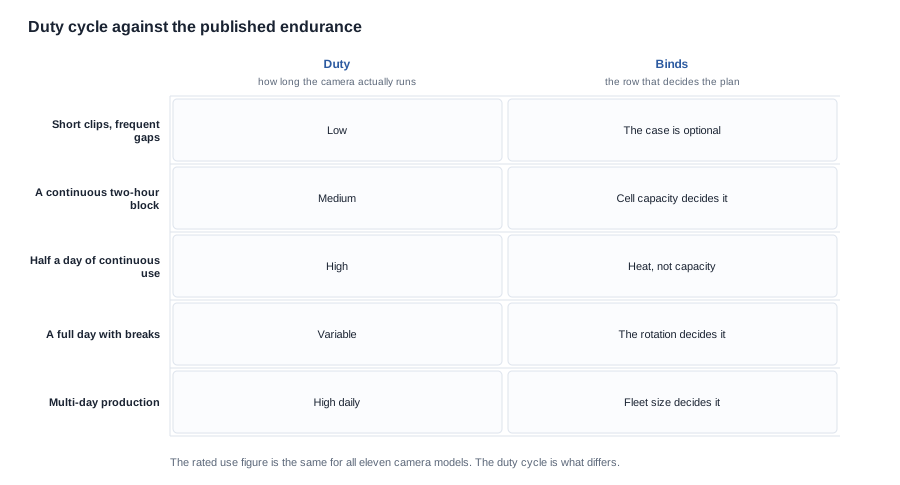
How the matrix changes the fleet decision. Short clips with frequent gaps mean the case is optional, because the device is idle for most of the session. A continuous two-hour block means the cell capacity decides it. Half a day of continuous use means heat decides it, not capacity. A full day with breaks means the rotation decides it. Multi-day production means the fleet size decides it, and a fleet is a different commercial structure entirely, with its own spare-unit ratio, its own accessory chain and its own replacement cadence.
The fleet-sizing arithmetic a buyer should run before ordering. Start from the published cell and the published case capacity and ask how many top-ups a session needs under a conservative assumption about the duty cycle. Then apply the measured recharge count rather than the capacity, because a 1400 mAh case that delivers two full recharges is a different planning object from a 1400 mAh case that delivers one. The recharge count is not published for any model, and it is the number that determines whether one unit per creator is viable or whether the channel is running a rotation. The cases are a second shift, not a spare battery, and the difference matters commercially because a second shift is an accessory line with its own minimum order quantity while a spare battery is an engineering change.
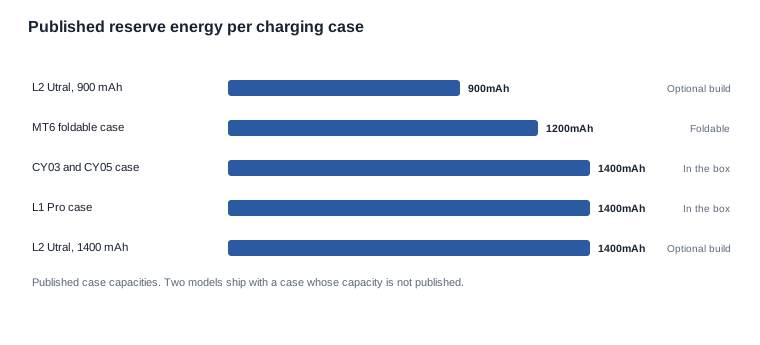
Why the published reserve energy is the last piece of the fleet arithmetic and not the first. The bars above show the published case capacities: 900 mAh and 1400 mAh for the L2 Utral depending on configuration, a foldable 1200 mAh case for the MT6, and 1400 mAh for the CY03 and the CY05, and the L1 Pro. Two camera models ship with a case whose capacity is not published, and four have no case row at all, which is an undocumented box rather than a published answer in either direction. The point for a programme is that the reserve is known for some configurations and not for others, and a fleet plan that assumes a reserve across the range is assuming it for models where it is not published.

The second shift: what a charging case is for
A charging case is not a spare cell. It is a second shift for the creator, and it changes the shape of the shoot day rather than the shape of the device. The published case capacities of 900, 1200 and 1400 mAh are the numbers that decide whether a single unit can carry a session or whether the session has to be interrupted for a recharge.
Three programme questions that the case answers or does not answer. How many times can a unit be topped up from the case in a day, which depends on the measured recharge count and is not published. How long does the case itself take to refill, which is a separate figure from the device's charge time and is not published either. And does the case survive the transport and the storage between sessions, which is a materials and contact question rather than an electrical one and is not addressed by any published row. A programme that plans around the case capacity alone is planning around one of the three.
The accessory decision is therefore a per-model decision, not a range decision. Five models publish a case capacity, two publish a case without a capacity, and four publish no case row at all — the V06 and the S7, and the V03 Pro and the V03. A buyer who puts "with charging case" on a range-wide accessory schedule is writing a promise for eight of the eleven camera models that the catalogue does not support. The action is to hold the accessory schedule per model, exactly as the device configuration is held per model.
The second shift also changes the returns profile. A device that can be recharged mid-session is a device whose creator is not standing in a corridor waiting for it. That is not a comfort argument; it is a schedule argument, and it shows up in the number of sessions a creator completes per day, which is the number the channel's revenue assumption rests on.

Reading the first returns as programme data
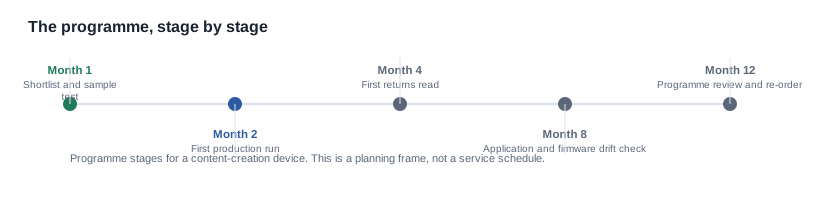
The first four months of a programme produce more programme data than the first four weeks, and most buyers collect it badly. The reads worth taking, in this order. After the first production run, the distribution of the fault reasons: if the volume is concentrated on one model and one symptom, that is a configuration problem rather than a category problem. At month four, the first returns read, which is the first point at which returns are a signal rather than noise. At month eight, the application and firmware drift check, because the application version floor is not published and the application is the component most likely to change between shipments. At month twelve, the programme review, which decides whether the range is re-ordered, narrowed or retired.
The four questions to ask of your own returns data, before asking the factory. What share of returns cite an accessory rather than the device, which tells you whether the accessory schedule is drifting from the device schedule. What share cite footage that was unusable, which is the specification-gap share and the number the next order has to reduce. What share cite a connection or an application problem, which is the drift share and the number the version floor has to prevent. And what the return rate is per unit sold per model rather than per range, because a range-level number hides the model that is actually failing.
What the factory can and cannot contribute to that review. The factory can contribute the defect and rework position for the batches supplied, the configuration history of what was shipped when, and the state of any application or firmware changes. It cannot contribute a yield figure, a defect rate or a failure analysis for a unit that was returned to the channel, because none of those is published for this range. A buyer who asks for a yield number as though it were a documented figure will receive an estimate, and an estimate that is not a fact is the same problem this category has everywhere else.
How to evaluate a programme at the twelve-month review, against criteria rather than against impressions. Four criteria, each one a number the programme has already produced. The first is the share of the fleet still in service, compared against what the accessory plan assumed. The second is the number of sessions a creator completes per week against what the revenue model assumed. The third is the returns rate per model, which is the number that decides whether the range is narrowed. The fourth is the total cost per usable session, which is the figure that makes the programme comparable to the phone and the handheld camera it replaced. When to run that review is a commercial decision rather than a technical one, and the usual trigger is the reorder point rather than the calendar, because the review that happens just before a purchase order is the review that changes something.
The three red flags in a programme review that should stop the reorder. A returns rate concentrated on one symptom rather than spread across models, which points at the specification rather than at the product. A falling number of sessions per creator, which points at the workflow and is the cheapest problem to fix. And an accessory schedule that has drifted from the device configuration, which is invisible until the freight bill and the returns arrive together.
The comparison a programme review should always end with. Compare the total cost per usable session against the two tools the device was bought to replace. That comparison uses the unit price, the accessory schedule, the measured session length and the returns rate, and it is the only figure that compares like with like — a unit price compares a device with a device and tells you nothing about whether the programme worked.
The commercial terms that matter over a programme rather than on an order. The warranty period with a stated response, and whether the period runs from delivery or from the end of the programme. The return terms for units retired from service at the end of a programme, which is a question that only comes up on the second order. The reorder lead time against the season or the campaign calendar. Whether spare units and spare cables are available at a stated price after the first year. And the payment and delivery structure for a rolling order, which is where the schedule risk is actually managed. The lead time, payment terms and contract terms pages cover the structure of those three, and the negotiation space on all of them is wider on a programme than it is on a first order.
What we publish for a long-running programme, and what we will not commit to
It is worth being precise: the published material covers the hardware side of a programme, and the rest is a question for the supplier's own file, and the honest way to present that is to name the rows rather than to fill them. We publish the cell capacities, the rated runtimes, the camera tiers, the charging interfaces, the charge times, the ingress markings, the published structural features and the published case capacities for each configuration, and we publish the absence of a runtime test condition, a thermal behaviour, a storage behaviour, a transfer path, a sensor model, a field of view, a video format, a frame rate, an application version floor and a per-model unit weight with the same prominence. The one published weight in the range is 158 g on the MT6, and that figure is the glasses body including its cell and camera and excluding the foldable case, so it transfers to nothing else.
What we will not do is commit to a programme outcome. We will not publish a defect rate, a yield, a lifespan or a replacement interval, because none of those is published for this range, and a number that is not documented becomes a promise the moment it appears in a quotation. We will also not carry a case capacity across to a model that publishes no case row, or a charge time across to a configuration whose charging method is not published.
What we will do is take the duty cycle, the session length, the number of creators, the markets and the models you have in mind, and tell you which published rows apply, which rows the programme has to establish by measurement, and how the accessory chain and the fleet size change when those measurements come back. The models and their published rows are at the AI camera glasses range, the shipping and documentation side of a programme is at export and shipping, and the scenario entry point is smart glasses for content creation.
Sending the duty cycle and the fleet size
Send the duty cycle, the session length, the number of units in the field and the reorder interval. We will tell you what the published rows already settle for that programme, what has to be measured, and where the accessory schedule has to be held per model rather than per range.
Related reading
- Camera and audio smart glasses range
- Export and shipping for a content-creator product
- How the catalogue's camera tiers compare
Send the configuration, the quantity and the market, and we will say which parts of the programme are settled and which are yours.


