

Content creation is less seasonal than outdoor or cycling and more seasonal than office: demand is steadier through the year, but the peak is sharper, and the peak is where the money and the stock both sit. The checklist below is arranged by what changes with the season rather than by what you buy, because the rows a buyer can reorder against are constant and the rows that create the returns are not. It is written for the procurement manager who owns the calendar and for the channel buyer who has to decide what to order before the season is visible.
The one-paragraph version. Freeze the configuration and the copy before the peak, re-check the destination market's documentation route at the same time, order against the volume tier the season can actually fill, and read three months of returns afterwards as the input to the next season's brief. Everything else on this page is detail on those four actions.
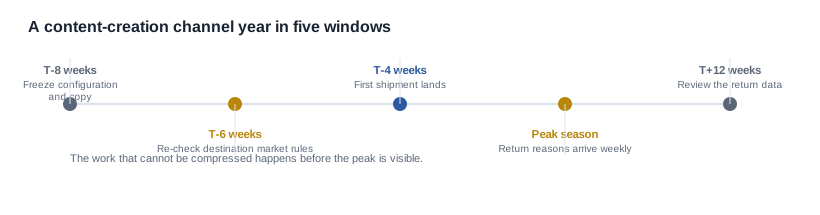
The seasonal checklist in one list. These are the actions in the order they have to happen, and the numbering is the point — each one depends on the one above it.
- Fix the season's volume assumption from the previous season's returns data, not from the previous season's order volume, because the two diverge wherever the return rate was high.
- Shortlist the models against the published rows for the working day the season actually produces, and record the resolution tier, the cell, the charge time, the rated use and the interface for each.
- Settle the case configuration for each shortlisted model, and confirm whether a charging case is part of the order, an accessory, or absent from the published row for that model.
- Re-check the destination market documentation route for the model, the configuration and the market, including the technical file contents the buyer has to hold.
- Freeze the configuration, the artwork and the listing wording against the published rows, including the rows that are explicitly marked as not published.
- Ask for the bill of materials per configuration, with the case specification and the battery transport file for the configuration being shipped.
- Place the order against the volume tier the season can fill, and negotiate a split delivery so the second shipment can be corrected against the first.
- Set the incoming inspection criteria in writing, with the acceptance band and the retained reference unit defined before the shipment lands.
- Publish the expectation rows — the battery band with its caveat, the storage and video rows marked as not published — before the season is visible.
- Review three months of returns by classified reason, and write the findings into the next season's brief before the next freeze window.
Smart glasses for content creation: a year in five windows
A content channel's year has five windows, and the work in each one is different in kind rather than in volume. The first is preparation, six to eight weeks before demand appears. The second is the compression window, where the order is placed and the configuration is frozen. The third is the peak itself, where the returns arrive. The fourth is the review, three months after the peak, when the returns data becomes usable. The fifth is the brief for the following year.
Who is reading this. A procurement manager is planning the order calendar and needs to know which tasks can be pulled later without consequence and which cannot. A channel buyer is placing the seasonal order and needs the volume tiers and the lead times in the same frame. A brand owner is approving the range for the season and needs to know what the configuration freeze actually costs when it is done late. The smart glasses for content creation page covers the channel itself, and the AI camera glasses page lists the configurations and their published rows.

Eight weeks out: the work that cannot be compressed
Three things in this window are bounded by somebody else's calendar rather than by your own, and they are the reason this window exists.
Freeze the configuration and the copy. Peak-season reorders are constrained by whichever stage is binding, and in this category the most common binding stage is artwork approval or a designation change reopening the documentation. A configuration that is still open when the season becomes visible is a configuration that cannot be reordered quickly, and the cost of that shows up as a missed sales window rather than as a price. Freezing means the model, the colour, the logo and the case configuration, and freezing the listing wording against the published rows rather than against last season's wording.
Re-check the destination market position. A market that was open last season may have changed its requirements, and the compliance work is not compressible by anyone. In the European Union that sits under the Radio Equipment Directive, Directive (EU) 2014/53/EU, and the General Product Safety Regulation, Regulation (EU) 2023/988, which has applied since 13 December 2024. Buyers should treat this as an annual re-check rather than a one-off project, because what changes is rarely the regulation itself and usually the technical file that has to accompany it for the model, the configuration and the destination market. Note that our catalogue publishes a company-level export certification page and no per-model certification row, so the scope of any certification for a specific model is a document to request rather than a fact to assume.
Re-check the case decision. Some camera configurations publish a case at 900 mAh or 1400 mAh, some publish a case whose capacity is not published, and four publish no charging-case row at all, which is silence rather than a published statement that the box contains no case. Peak season is when a creator carries the product all day, and the case is what makes that viable, so the case decision is a seasonal decision in a way that the rest of the bill of materials is not. It is also a second lithium cell, so the battery transport file has to cover the configuration that is actually shipped.
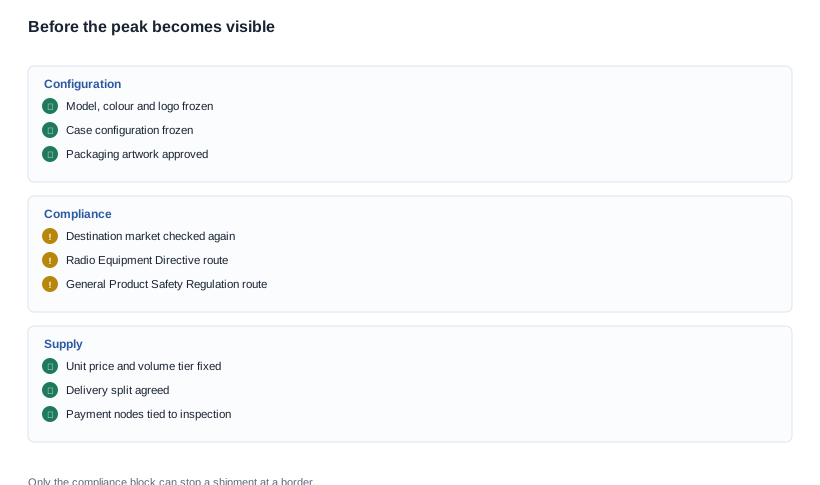
And one thing that is compressible, but only if it is done early. The volume tier. A buyer who waits for the season to be visible before placing the order has already lost the price tier that the visibility would have earned, because the tier is priced on the order, not on the season. The trade-off to negotiate is therefore lead time against price tier, and the honest answer is that the price tier is usually the larger number for a seasonal channel, which is why the order goes in early against a conservative volume, and the balance goes in on a second delivery once the season is measured.
Through the peak: the three return reasons that arrive
Peak season concentrates three return reasons that a quiet month would have spread thinly. Each of them is preventable, and each of them is preventable by something written before the season rather than by something added during it.
The battery expectation. The camera models publish cells from 220 mAh to 290 mAh and rated use between five and eight hours depending on the model, and the test condition behind every one of those bands is not published. A creator filming all day expects the top of the band. Publish the figure with its caveat rather than waiting for the review, and make sure the caveat is on the same page as the figure rather than three lines below.
Storage behaviour. The storage capacity and the behaviour when storage fills are not published in our documentation. A creator who fills the storage mid-shoot will describe the product as broken, and the fix is a sentence on the page saying the row is not specified, plus a line in the guide about checking before the take.
The recording indicator. In a public shoot this is a consent matter before it is a technical one, and it varies by jurisdiction and by platform policy. Say where the indicator is, or say that it is not published. Neither answer costs anything; guessing does.
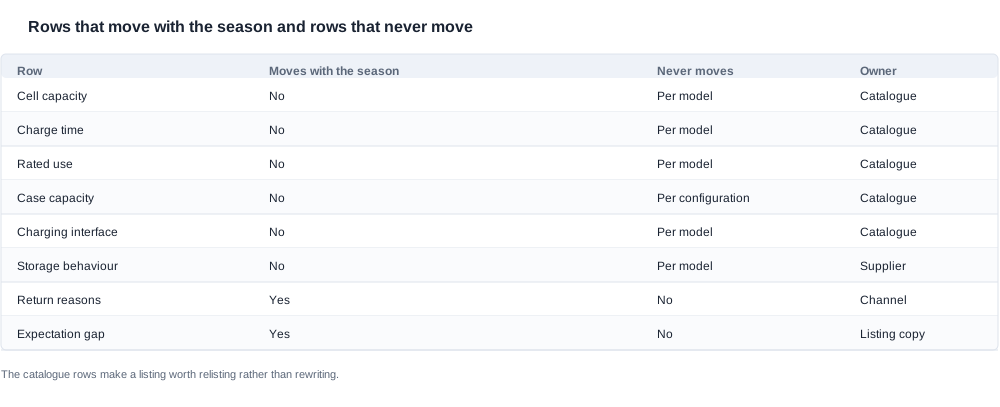
| Row | Moves with the season | Never moves | Who owns it |
|---|---|---|---|
| Cell capacity | No | Per model | Catalogue |
| Charge time | No | Per model | Catalogue |
| Rated use | No | Per model | Catalogue |
| Charging interface | No | Per model | Catalogue |
| Case capacity | No | Per configuration | Catalogue |
| Storage behaviour | No | Per model | Supplier |
| Return reasons | Yes | No | Channel |
| Expectation gap | Yes | No | Listing copy |
| Packaging artwork | Yes, at freeze | No | Brand and supplier |
The commercial treatment of the peak is a working capital question, and it is the one most often left to the purchasing team alone. Stock bought ahead of the season is stock financed at the pre-season landed cost, and if the configuration was not frozen, that stock may also have to be reworked at a cost that nobody budgeted. A buyer who freezes the configuration in the first window and splits the delivery across two shipments turns a single large inventory commitment into two smaller ones that can be corrected. That is worth more than a price negotiation of a percentage point or two, and it is available to every channel that asks.
The lead time question belongs in the same conversation as the price tier, because they are the two variables that determine when the season can be served. A supplier quote that carries a short lead time and a low price tier is usually a supplier quote that has not yet costed the artwork approval and the certification route, and a quote with a long lead time and a good tier is often the more useful one for a channel that can hold stock. The trade-off is genuinely two-sided, and the way to resolve it is to ask for both numbers in writing and to compare the resulting cash position rather than the unit price: a unit that arrives eight weeks late at a lower price does not serve the season at all, while a unit that arrives four weeks early at a slightly higher tier sells at full margin. The mistake to avoid is comparing the two quotations on unit price alone, which is the comparison most buyers make and the one that hides the season entirely.

After the peak: reading three months of returns as data
The review window is the one most often skipped, because the season has ended and the next one is months away, and because the returns data is a queue rather than a report. Three months of returns, classified by stated reason and kept verbatim rather than coded, is the input that makes the next season better rather than merely different.
Two findings usually emerge from the first review. The first is that the expectation gap was larger than expected, which is a copy problem rather than a product problem, and the cheapest place to fix a copy problem is the page. The second is that the fit complaints were about weight, which is a row our documentation does not publish beyond the single published figure of 158 g for the MT6 glasses body, excluding its foldable charging case — so a buyer facing weight complaints is being asked to explain a number the catalogue does not carry.
The classification is the whole value of the exercise. A return reason stated as "did not work" is useless; a return reason classified as a hardware defect, an expectation gap, a documentation shortfall or transit damage is actionable, because each class has a different remedy and a different cost. The fourth of those classes is the one worth watching at volume, because it is the one that points at the packaging rather than at the device, and it is invisible unless somebody counts it.
What to do with the findings is a shortlist, not a report. Each classified reason points at one of four places: the hardware, the documentation, the listing copy, or the process that supports the creator. A hardware finding means a defect conversation with the supplier, and it is the only class where a quality control claim is appropriate. A documentation finding means a row that should have been in the file and was not, and the remedy is to add it to the request list for the next order so that it is contractual rather than courteous. A listing finding means the wording outran the published rows, and the remedy is a copy change that costs nothing and takes effect immediately. A process finding means the guide, the inspection criteria or the spare strategy did not do their job, and it is the class most often left unactioned because nobody owns it. A buyer who assigns each finding to one of those four places before the brief is written has converted a season's returns into a specification for the next one.

The order of the operations matters more than the effort. The review produces the next season's brief, the brief produces the freeze, and the freeze produces the order. A buyer who runs the review late has produced a brief that arrives after the freeze window, which means the next season repeats the same configuration with the same expectations and the same returns. That is the failure this whole page is aimed at, and it is a scheduling problem rather than a product problem.

The rows that never move with the season
The published configuration rows are per model, and they are identical in every season: cell capacity, charge time, rated use, case capacity where published, charging interface, the resolution tier, the structural features and the colour counts. That is what makes a listing worth relisting rather than rewriting, and it is the reason a seasonal channel does not need a seasonal content programme.
The commercial corollary is that the seasonal work is about the order and the paperwork, not about the specification. A buyer who understands this stops looking for seasonal product differences and starts looking for seasonal order differences: which volume tier the season can fill, which lead time the supplier can commit to in this window, whether the case configuration should change for a peak that runs long sessions, whether the packaging artwork needs a seasonal message and what that does to the artwork approval timeline, and whether the accessory minimum order quantity should be bought once or split.
That list is shorter than it feels, and each item on it is negotiable except the certification route. The volume tier, the minimum order quantity for the accessory set, the packaging specification, delivery splitting, the payment nodes against inspection, the warranty period with a stated response and the return terms are all commercial terms a buyer can negotiate. The cost of certification and the time it takes are fixed by the programme and by whoever certifies it, and the tooling cost is frequently amortised across the first order while certification cost is incurred per product family — so the useful question is which of the two has actually been quoted.
The accessory minimum order quantity deserves its own line, because it is the term most likely to be badly misjudged in a seasonal order. The case, the cable and the spare parts are separate lines with their own minimums, and a minimum sized for an annual programme is usually too large for a seasonal one — while a minimum sized for the season is usually too small to be manufactured at a sensible unit price. The way to handle it is to buy the season's quantity in two calls, one covering the committed part of the season and one covering the adjustable part, and to ask the supplier to quote the accessory line against the total programme volume rather than against the shipment. That single question is worth more than any per-unit negotiation on the same line, because it is the difference between an accessory price the supplier can produce and one they cannot.
What a small channel should do first
If only two things get done, they should be these two, and both cost one sentence each on a page. Publish the battery figure with its caveat, and mark the storage and the video rows as not published. Between them they cover the two largest return categories in this application, and they are the two places where a buyer's expectation and the documentation diverge most sharply.
Everything else on this checklist is worth doing before the season is visible rather than during it, because the work that cannot be compressed is the compliance work and the configuration freeze, and both belong to the buyer rather than to the supplier. A channel that has frozen its configuration and confirmed its market documentation route can absorb a bad week. A channel that has not can lose a season.
The related material for the same discipline in a sharper season is at seasonal considerations for outdoor, and the long-term ownership pattern is at long-term use by owners.
One practical note for a channel that has never run a seasonal cycle in this category. The first season is a measurement exercise, and it should be budgeted as one. A small order against a conservative tier, a single split delivery, written acceptance criteria and a full returns review will produce more usable information than a large order that cannot be corrected. The cost of that first measured season is a fraction of a season that fails quietly, and the output is a brief for the second one that contains real numbers rather than assumptions carried over from another category.
The short answer: we do not publish seasonal demand data, sell-through rates or market forecasts, and we will not present an industry estimate as our own. Sensor model, field of view, video resolution, storage behaviour and frame weight remain not published in our documentation in every season, and the published rows above are the same rows in every season, which is what makes them safe to quote.
Send us the season you are planning for, the volume, the models and the destination markets, and we will tell you which configurations exist, which rows apply to each, and which documentation has to be settled before the freeze window closes.


