What a content business should expect from smart glasses for content creation is narrower than the product page suggests, and the difference is where the returns come from. The honest starting point is the published data: the camera models carry either an 8-megapixel sensor class — eight of them, the V03 and the CY05, the MT6 and the MT5, and the CY03 and the V06, and the V03 Pro and the KY06 — or a 13-megapixel class on three, the L2 Utral and the S7, and the L1 Pro. What none of the eleven publishes is the field of view, the video format, the frame rate, the storage capacity, the low-light behaviour, the stabilisation behaviour, the unit weight on all but the MT6, or the ingress rating on any camera model except two. Those gaps are not a reason to avoid the category; they are the reason to buy on a sample and to plan the asset pipeline yourself.
Smart glasses for content creation: the capture chain decides the product
Who this is for. The reader is a brand owner, a channel buyer or a product manager who is not deciding whether to become a creator but whether to put a camera product into a channel that already makes video. The task in front of them is a sourcing decision with an unusual shape: the hardware is a small part of the total cost, while the imagery, the capture workflow and the listing assets are a large part of it. The fear behind it is that the sample is convincing in a supplier meeting room and then produces soft, badly framed, hard-to-transfer footage in the buyer's actual location, which is exactly the condition under which a content product returns.
What a content buyer is really purchasing. Not a camera, but a capture chain: framing, format, runtime under a real shooting load, and a path from the device to a finished file. The catalogue publishes the middle of that chain — the sensor class, the cell capacity, the rated runtime band, the case capacity where it is published — and leaves the ends open, the charging interface where it is published, the charge time. A buyer who reads the published rows correctly will understand that this is a device with a published electrical envelope and an unpublished imaging envelope, and that the second one is where the product identity actually lives.
Why two quotations for the same camera model differ so widely. The published rows sit close together across the camera range: cell capacities from 220 mAh to 290 mAh, rated runtimes clustering between about five and about eight hours, a charge time of two hours or less across the whole range, and a charging interface that is magnetic on most camera models and Type-C on a few of them. None of those rows explains a quotation gap of a wide margin. The gap comes from four configuration decisions a buyer makes without noticing: whether a charging case is in the box, which case capacity is ordered, whether the interface is a magnetic contact or a Type-C socket, and whether the artwork is a standard cavity or a custom one. Each of the four changes the bill of materials, the declared shipping weight, the transit documentation and the artwork cost at the same time, so a supplier quoting a unit with no configuration attached is quoting a placeholder. A buyer who arrives with the configuration decided receives a quotation that can be compared against another supplier's; a buyer who does not receives two numbers that cannot be compared at all.
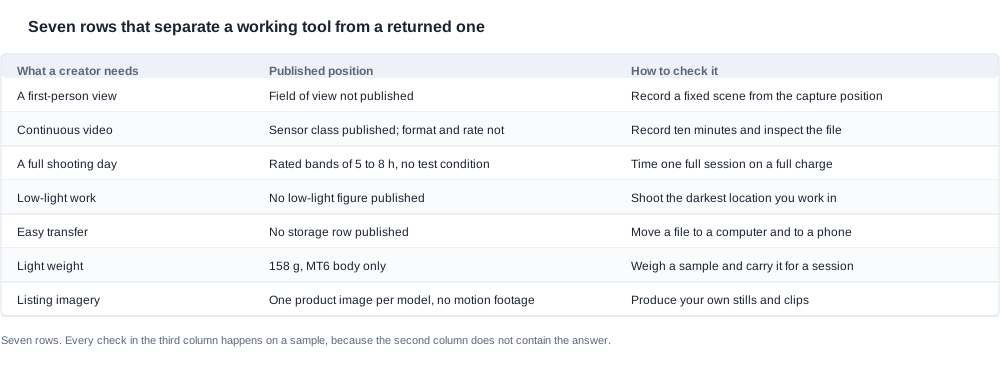
Seven rows that separate a working tool from a returned one
The seven rows below are the ones a content buyer has to settle before an order, and they are the same seven rows the chart beside them uses. Every row states the published position first, because the published position is what a supplier can commit to, and then the check, because the check is what closes the gap.
| What a creator needs | Published position | How to check it |
|---|---|---|
| A first-person view | Field of view not published | Record a fixed scene from the capture position |
| Continuous video | Sensor class published; format and rate not | Record ten minutes and inspect the file |
| A full shooting day | Rated bands of 5 to 8 h, no test condition | Time one full session on a full charge |
| Low-light work | No low-light figure published | Shoot the darkest location you work in |
| Easy transfer | No storage row published | Move a file to a computer and to a phone |
| Light weight | 158 g, MT6 body only | Weigh a sample and carry it for a session |
| Listing imagery | One product image per model, no motion footage | Produce your own stills and clips |
The first-person view is the row that decides whether the product is a camera. A first-person camera and a device that records stills are different products with different buyers, and the difference is entirely a framing question. The catalogue does not publish a field of view for any model, so the buyer has to establish the framing empirically: put a marker at a known distance, record from the capture position, and measure what the frame actually contains. This is a ten-minute test and it is the single highest-value test in the whole evaluation, because a device whose framing does not match the way the buyer shoots will not be used at all, whatever its sensor class.
Continuous video splits into one published row and four unpublished ones. The published row is the sensor class: eight models at 8 megapixels and three at 13 megapixels. The unpublished rows are the video format, the frame rate, the stabilisation behaviour and the file handling. A 13-megapixel sensor that records a compressed, low-frame-rate file is a different commercial proposition from a 13-megapixel sensor that records a high-rate file, and only the first number is published. A content buyer who quotes the megapixel figure in a listing without the format and the rate is describing half a specification.
A full shooting day is a rated band, not a runtime promise. Every one of the eleven camera models publishes a runtime: five to eight hours on the V03 and the S7, and the V06 and the V03 Pro, six to eight hours on the KY06 and the MT5, and about seven hours on the MT6 and the CY05, and the CY03 and the L2 Utral, and the L1 Pro. None of them publishes the test condition behind that figure — no volume level, no signal condition, no recording-versus-idle duty cycle. A content day is a camera workload for most of it, which is a materially different duty cycle from the one a runtime rating usually describes. The prudent plan is to budget on the lower end of the published band and to verify it on a full-charge session rather than to quote the band as a working day.
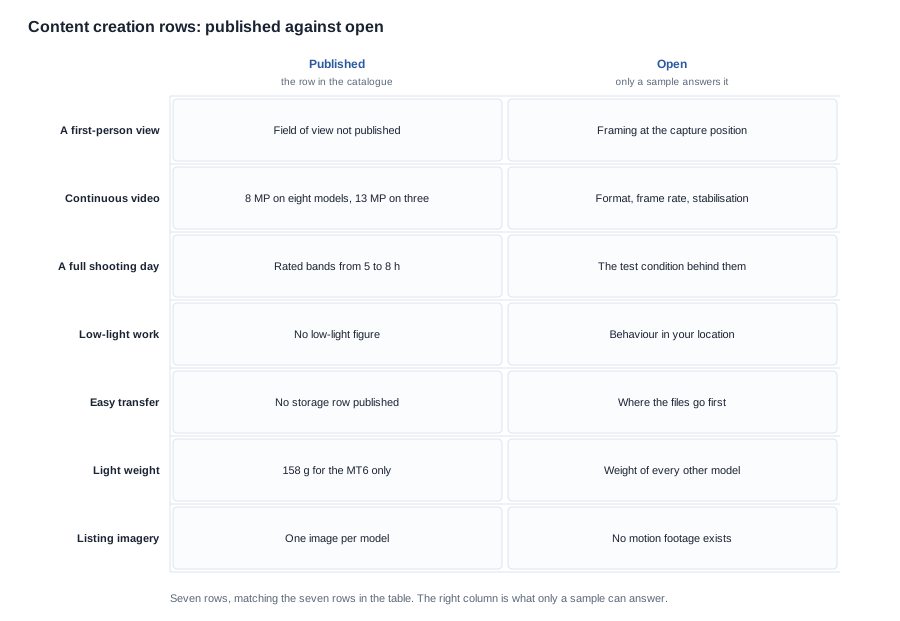
Low-light work and easy transfer are the two rows with no published number at all. There is no low-light figure, no storage capacity, no clip limit and no transfer path published for any camera model. The second one has a direct commercial consequence: storage capacity and clip limits are what decide whether a device can be handed to a person who does not know the limit, and a device that stops recording without warning produces a broken clip rather than a missing clip, which is far harder to diagnose in a support ticket.
Light weight is one published figure for the whole catalogue. The MT6 publishes 158 g, and that is the weight of the MT6 glasses body including the 265 mAh cell and the camera, excluding the 1200 mAh foldable charging case. No other model in the catalogue publishes a weight, and no bare frame weight is published for any model at all, so there is no frame weight to quote for the other ten camera models. For a buyer whose channel is long-session content, that means the sizing decision has to be made on a sample and the listing copy has to avoid a weight it cannot evidence.
Listing imagery is the row buyers forget is a row. The catalogue carries one product image per model and no motion footage, and no product photography has been provided to us. Every asset in a content channel has to be produced by the buyer, on the unit the buyer sells.
The capture test to run before the order is placed
The test below is the one we would run, and it is written so that every step ends in a file somebody can inspect rather than in an opinion somebody can repeat. It takes a single sample, a single afternoon and a single location that matters.
- Record ten minutes in each location the buyer actually works in. Not the supplier's meeting room. One interior location with the lighting the buyer has, one with the lighting the buyer avoids, and one outdoors. Save the files unedited and keep the originals.
- Measure the framing at the capture position, not from a still image. Place a measured object at a known distance, record from the position the unit will actually be carried in, and note what falls inside the frame. Repeat at three distances. This is the step that produces a number the buyer can put in a listing.
- Check the transfer path end to end — device, computer, phone. Move one file along the whole path the buyer's workflow will use. Record how long the transfer takes and what the file is called when it arrives. A device that needs a proprietary application to reach a computer is a support cost, and the buyer should price it before the order.
- Time one full session on a full charge and record where it ends. Not the rated band. The actual minute at which recording stops, with the case present and with it absent, because the presence of the case in the bag changes how often the buyer has to think about power at all.
- Produce your own imagery. The catalogue carries no motion footage, so the assets for the listing and the assets for the channel are yours to make, and they are made on the sample, which means they are made on the unit you will ship or on a unit you have not yet ordered.

The five steps above are the sequence the sample test follows, and each one is chosen so that it ends in a file rather than in an opinion.
Two things to put in writing before the order. The first is the case configuration, because the catalogue publishes three different answers for it among the eleven camera models: a 1400 mAh case on the CY03 and the CY05, and the L1 Pro, a choice of 900 or 1400 mAh on the L2 Utral, and a 1200 mAh foldable case on the MT6; the KY06 and the MT5 ship with a case whose capacity is not published; the S7 and the V03, and the V06 have no charging-case row in the catalogue at all; and the V03 Pro has no charging-case row. Four different answers, and the difference between them is a price point, an artwork cavity and a second lithium cell in the transit file. The second is the charging method, because four of the eleven camera models publish no charging-method row at all — the MT6 and the CY05, and the CY03 and the L1 Pro have cell capacity, charge time, runtime and case capacity published, and no interface line. "The charging method is not published for this model" and "this model has no charging case" are different statements, and only the second one applies to the V03 Pro.
**What the certification position is, and is not.Our product catalogue contains a company-level export certification page whose content is pictures rather than words — ten patent certificates, eight of them appearance-design patents, two utility-model patents — and the catalogue text contains no reference to CE, to FCC or to RoHS anywhere, and no per-model certification row. For a content buyer this matters less than for an industrial buyer, but it still matters for anything shipped into a market with its own radio and chemistry requirements. The point to write down is the same one: this is a document to request from the supplier, not a row to read from the catalogue. The route is at certification checklist, and the radio requirement itself is at the RED directive page.
What a content channel costs in assets, not in units
This is the part of the content-creation scenario that is not visible in a quotation, and it is where the total cost of the decision actually sits.
The catalogue cannot supply your marketing assets. One product image per model, no motion footage, no product photography supplied to us. That is not a gap in the catalogue's usefulness; it is the correct position for a manufacturer who does not hold a studio. But it means the asset cost of putting this product into a content channel is a line item the buyer carries, and it has three parts: the shoot itself, the edit, and the ongoing replacement of assets when the model changes.
A shoot has to happen anyway, so make it a test. The same session that produces the listing assets produces the measurement data from step two, step four and step three of the capture test. Buyers who treat the shoot as marketing spend and the sample as a technical test end up paying for the same information twice, which is how the total cost of a "cheap" camera product ends up higher than a more expensive one with a supplier who supplies assets.
The optical feature that cannot be advertised on a spec sheet. The V03 Pro is published with photochromic lenses, and the catalogue also carries an electrochromic glasses entry with no model designation at all, publishing a 100 mAh cell, a charge time of two hours or less, about seven hours of rated use, magnetic charging and Bluetooth 5.4. No photochromic or electrochromic performance figure is published anywhere: no response time, no depth of change, no light transmission, no operating temperature range. A variable lens is therefore a feature to evaluate on a sample rather than a specification to advertise, and the lens maintenance instruction in your insert has to be restricted rather than permissive, because a lens whose optical behaviour changes should not be treated with a solvent chosen for a fixed lens. The lens guidance is at the lens maintenance guide.
What the accessory bundle means in practice. The case is the accessory that decides whether a shooting day survives, and the catalogue makes it a configuration decision rather than an add-on sale: the 1400 mAh and the 900 mAh cases are two different price points and two different freight weights, the foldable MT6 case is a different industrial design, and the models with no published case row have to be configured with the buyer deciding what happens after the battery runs down. The accessories position for this scenario is at the content creation accessories article.
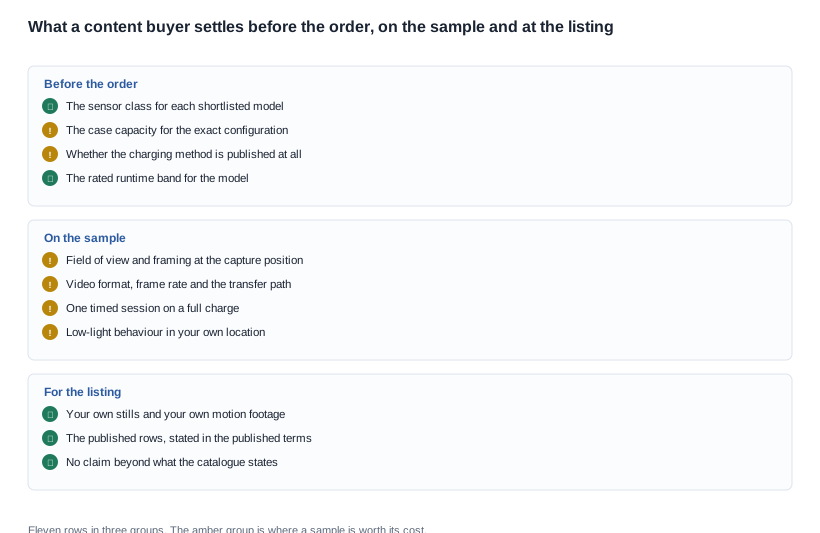
The checklist above splits the work three ways: what has to be settled on paper before the order, what has to be settled on a unit, and what has to be produced by you. Only the middle group justifies the cost of a sample, because it is the group where a specification page cannot help you at all.
The boundary is knowable on a sample and nowhere else
The working rule we apply: the value of these glasses to a content business is real and bounded, and the boundary can be established on a sample even though it cannot be read from a catalogue page. We publish the sensor class, the cell capacities, the rated runtime bands, the charge times, the charging interface where it is published, the case capacities where they are published, and the published structural features — the photochromic lenses and the flexible temple on the V03 Pro, the detachable inner frames on the V06 and the S7. We do not publish the field of view, the video format, the frame rate, the stabilisation behaviour, the storage capacity, the transfer path, the low-light behaviour, the runtime test condition, or the unit weight on any model other than the MT6's published 158 g whole-unit figure. We will also not state that any camera model is tested to IP54: two models, the V06 and the S7, carry an IP54 catalogue marking with no third-party test report published behind it, and no other camera model carries any ingress marking.
What is fixed and what is open. Fixed before the negotiation: the sensor class, the cell capacity, the charge time, the rated runtime band, the charging interface where it is published, the certification cost and lead time, the tooling cost amortised across the first order, and the battery transport documentation for a configuration containing a case. Open: the configuration and the case, the artwork, the colour and logo treatment, the packaging and insert contents, the payment structure, the shipment split, the warranty length and terms, the sample cost against the first order, the minimum order quantity tier, and whether a content asset pack can be commissioned alongside the first order. Total cost is where most of the room is, because the asset spend and the case decision move together.
The case below is illustrative, set out as a scenario rather than a client file. Take a distributor who has decided to add a first-person camera line to an existing channel that already sells audio products. The first decision is the interface, because it settles the kit and therefore the asset workflow: taking the Type-C route, the unit recharges from a cable the buyer's customers already own, and the case becomes an optional accessory rather than a component of the box. The second decision is the case, because the published case answers differ across the camera range and the 1400 mAh option on the L1 Pro and the CY03 is a single price-ladder decision that also determines the transit file. The third decision is the shoot, scheduled before the first order rather than after it, so that the listing imagery and the capture measurements come from the same session on the same unit. The outcome is one configuration with a defensible bill of materials, a claim set the listing can carry, and an asset cost that was budgeted rather than discovered.
What to send us next. Send the models you are comparing, the shooting conditions the product has to work in, whether the case is in the box, and the destination market. We will tell you which published rows cover those models, which case configurations exist, which questions have to be settled in writing before a purchase order, and where the published data stops. The camera range lists the per-model figures, the content creation scenario entry point sets out the wider deployment frame, and the camera imaging article covers what the sensor class does and does not tell you.
Related reading
- How to enter the scenario — smart glasses for content creation
- The published figures — battery life
- The imaging background — camera imaging
- The accessories position — content creation accessories
Tell us what you shoot, how long a session runs and whether you work indoors or out, and we will tell you which configurations in the camera range suit the job.