

Smart glasses for travel are sold on two assumptions that the catalogue does not support: that a lens will survive a week of handling, and that a complaint about a scratched lens can be settled while the customer is still shopping. Neither assumption holds. The lens material, the coating and any abrasion figure are not published for any model in our range, and a traveller reaches for whatever is in the bag when the lens smears, which turns a care note into a scratch liability. The commercial consequence is that the cleaning position for a travel line has to be commissioned, supplied and priced before the artwork is released, not written into the listing after the first batch of returns has already been paid for.
Smart glasses for travel: the claim that arrives three weeks after departure
The buying task behind this article. The reader is a brand-side sourcing buyer, a channel buyer or a product manager specifying a travel or commute line for a consumer channel, a corporate travel programme or a rental operation. The task is not to evaluate a product. It is to build a cleaning position into the unit and into the claim file, and to cost the returns that position prevents. The fear being managed is specific: a listing whose most common complaint is a scratched or hazy lens, where the complaint arrives three weeks after the trip, when the customer is no longer in the market and will not buy again.
What our published position actually settles. For the camera tier we publish a resolution class, a cell capacity, a charge time, a charging interface, a rated runtime and a colour count. On seven of the eleven camera models we publish a charging-case capacity: 1400 mAh on the CY05 and the CY03, and the L1 Pro, 900 mAh or 1400 mAh as a configuration choice on the L2 Utral, and a 1200 mAh foldable case on the MT6. The KY06 and the MT5 are offered with a case whose capacity is not published. The catalogue publishes no charging-case row at all for the V03 Pro and the V06, and the V03 or the S7, and what the carton carries for those four is an item to settle with the supplier rather than assume. That is seven camera models with a case and four with no row at all — which is why "the case" is not a single line in a travel bill of materials.
What is not published, and therefore decides nothing on its own. Not published for any model: the lens material, the coating, the surface treatment, any abrasion or chemical resistance figure, a per-model weight beyond the single 158 g whole-unit figure for the MT6, the field of view, the video specification and the runtime test condition. A travel cleaning instruction that recommends a solvent, a household spray or a dry buff on a sleeve is therefore not a simplification — it is a claim about a surface nobody has characterised, and it is the kind of claim that surfaces later as an argument rather than a review.
Why a travel claim behaves differently from every other channel. In most categories the customer reports within days of delivery, while the unit is still under any return window that a marketplace grants. A travel product inverts that: the purchase is made for a trip, the trip consumes the first weeks of ownership, and the complaint is written after the customer has returned home, tired, looking at a haze on a lens and comparing the experience with what the listing promised. Two commercial consequences follow. First, the unit that generates the claim has usually already left the return deadline, so the dispute is settled on the merits rather than on the policy — which makes the written condition standard the only thing that decides the outcome. Second, the customer has no intent to buy again from that brand, so a single handled claim costs the lifetime value of the relationship rather than one transaction.
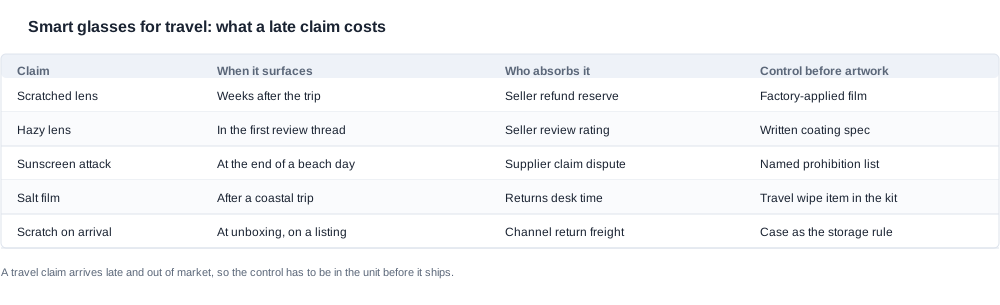
The four claim families a travel line actually produces. The table below is the working version of the travel claim map. Each row states what arrives, when it arrives, who absorbs the cost and which control has to be in place before the packaging is released. The order of the rows matters, because the first two are the ones that a pre-trip checklist can prevent and the last one is a freight cost that no instruction reaches.
| Claim family | When it arrives | Who absorbs it | Control before artwork |
|---|---|---|---|
| Scratch on arrival | At unboxing, on a listing | Channel return freight | A case as the storage rule |
| Haze in the first week | In the first review thread | Seller review rating | A written coating statement |
| Sunscreen or insect repellent attack | At the end of a beach day | Supplier claim dispute | A named prohibited-agent list |
| Salt film and grit | After a coastal or dusty trip | Returns desk time | A supplied cloth item |
| Scratch discovered on return | Weeks after the trip | Seller refund reserve | A factory-applied protective film |

Smart glasses for travel and the trip-specific agents that do the damage
The agents are ordinary and they travel with the customer. Sunscreen, insect repellent, salt spray, road film, dust, and the oils left by a hand that has been on a handlebar or a steering wheel. Each of these is a consumer product the traveller already owns, which is exactly why it ends up on the lens — the item is to hand and the instruction is not. A prohibition list that names sunscreen and insect repellent is worth more in a travel channel than a general warning, because it stops the two substances most likely to be applied while the unit is still in a pocket.
Sunscreen is the hard one, because it is oil-based and it sits. Water will not carry it off, and rubbing a dry cloth across an oily lens is the classic way to grind a particle into a coating. The safe sequence, given an unpublished surface, is the restrictive one: rinse with clean water first, then wipe with the supplied cloth, and never apply a solvent or a spray. Whether a stronger sequence is defensible depends entirely on the coating specification, and that specification has to arrive in writing before the insert is written.
Salt spray and grit invert the usual order. On a dusty lens, the reflex is a dry buff, and a dry buff with grit on the surface is the fastest route to a scratch. The correct sequence is to lift the loose material first and to dampen the cloth, never to rub dry. That sequencing instruction is one sentence and it belongs on the insert; a shop-floor assumption that "more pressure fixes it" is what generates the claim.
Fingerprints and skin oil are the boring case, and they are the common one. They need nothing more than a microfibre cloth with light pressure. The commercial point is that this is the reason a wipe-down becomes habitual at all: the customer has to be given a reason to reach for the supplied item rather than for a sleeve, and the supplied item has to be in the box rather than in a drawer at home.
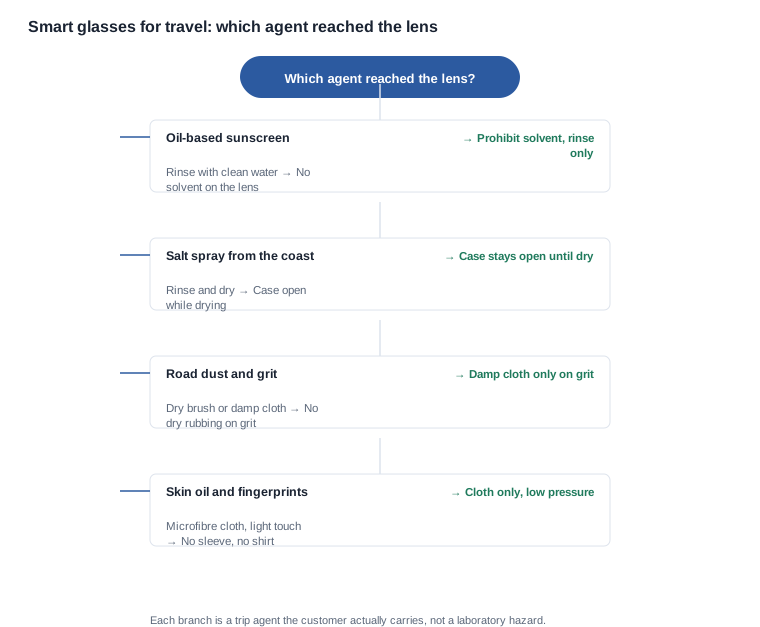
The prohibition list is a deliverable, and it should be priced as one. A generic warning costs nothing and prevents nothing. A named list, mapped to the agents the trip actually carries, has to be drafted, reviewed against the coating statement, translated for the target market and printed on an insert that has to be signed off before the packaging run. That is a documentation cost, it belongs in the first order, and it is the piece of the travel programme most likely to be omitted by a supplier who is quoting on unit price alone.
What the routine has to survive is a deferral. The realistic travel pattern is a three-day gap followed by a hurried wipe in an airport or a hotel room, with the traveller holding the unit in one hand and a bag in the other. A routine with several steps does not survive that moment. One item, one motion, one line on the insert, attached to a moment the traveller already has — the device going back into its case — is the only version with a realistic adoption rate, and adoption is what the per-unit consumable cost is buying.

Smart glasses for travel: storage decides more than any wipe-down
The lens is damaged as often by what it rests against as by what is used on it. A travel unit is put down on a café table, a train seat, a car roof, a hotel desk and a suitcase strap, dozens of times a trip. A lens placed face-down on any of those is abraded by contact alone, with no agent involved and no mistake by the customer. This is why the storage position, not the wipe-down instruction, is the primary control in this category. The wipe-down removes what has been deposited; only storage prevents what gets deposited in the first place.
The case is the mechanism that makes a storage rule enforceable. A rule that depends on the customer remembering not to put a lens face-down on a table fails on a bad day; a case gives the customer a place where the failure mode is impossible. That is a packaging decision with a price, and the price differs by configuration across our range: 1400 mAh on the CY03 and the CY05, and the L1 Pro, 900 mAh or 1400 mAh as a configuration choice on the L2 Utral, 1200 mAh on the MT6's foldable case, a case of unstated capacity on the KY06 and the MT5, and no case at all on the V03 Pro.
The case is also a second lithium cell, and that changes the freight file. Any configuration that ships a case adds a second cell to the declaration and to the transport paperwork, and the requirement has to be settled before the order rather than discovered at the border. The rules are set out at battery transport, and the question to the supplier is narrow: does the file cover the exact configuration being ordered, with the case in it.
Whether the case is mandatory depends on the charging interface, and that is settled before the kit. The range publishes Type-C charging on the D12 and the D11, the D17 and the ZH12, and the L2 Utral and the V03 Pro. A Type-C model recharges from a cable the traveller already owns, so the case remains optional and can be sold as a separate accessory at a price that suits both parties. A magnetic model needs either a dock or the case carried, and once the case is mandatory the spare cable stops being worth anything. The interface decision therefore comes first, the kit comes second, and a quotation that reverses the order will price a case into a configuration that did not need one.
Charge time is published for every model in the range, and it is not the constraint. Twenty-six models publish a charge time of two hours or less, and the D17 and the ZH12 publish about one hour. What the published figure does not carry is a starting state or an end criterion, so it cannot be converted into an interruption window or into a case turnaround time. A buyer who wants to plan a travel day around charging needs those two missing definitions from the supplier, not an interpretation of the published number.

Smart glasses for travel: the documents to settle before artwork release

The travel programme has an unusual order of operations. Most product decisions travel from specification to artwork. In this channel the artwork is the last document in the chain, because the insert carries the prohibition list, the storage rule and the condition standard, and all three have to be settled before it can be printed. Releasing artwork early is how travel programmes end up with an insert that contradicts the coating statement they never obtained.
Seven requests, and each one ends in a document.
- The lens material and coating statement, per model, in writing. Ask for it per model rather than for the range, because the family spans a standard lens and a photochromic lens configuration on the V03 Pro, and the two surfaces do not take the same instruction. The photochromic side of the question is at photochromic lens and the general material background is at materials and ergonomics.
- The travel-specific prohibited-agent list. Ask for sunscreen, insect repellent, salt spray and any household solvent to be named explicitly, and ask which of them the supplier has tested against the coating rather than merely excluded by policy.
- A one-step instruction test on a sample. Follow only the printed insert, in the conditions a traveller creates, and then check whether the image is visibly affected afterwards. A test that a buyer performs with full knowledge of the coating does not reproduce a customer's test, so hand the insert to somebody who has not seen the product.
- The return condition standard, in writing, with a visual reference. A list without pictures becomes a dispute about what "scratched" means. A list with a visual reference and a stated judgement location becomes a decision that a returns desk can apply the same way every time.
- The refurbishment checklist and its price per unit. This is the number that is normally missing, and its absence is why travel programmes carry the refurbishment cost in the margin and discover it in the worst month.
- The model designation table and the certificate register. The catalogue's export page is an image page rather than a written one, and the catalogue publishes no per-model certification row; the document text contains no CE, FCC or RoHS marking either. Every certificate number a buyer relies on therefore has to come from the supplier and be checked in the issuing body's public register, which is at certification checklist.
- The battery transport file for the shipped configuration. Ask for it as a configuration, with the case in it, and ask for it before the deposit.
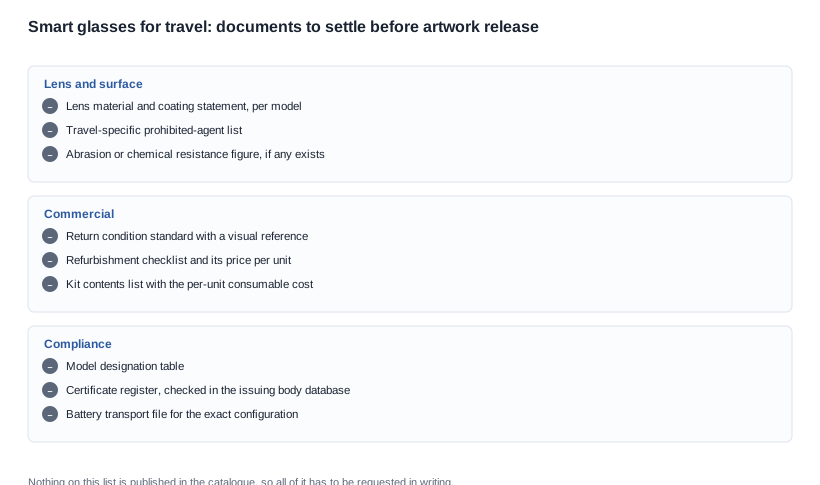
The document set a travel order should carry. The lens material and coating statement per model, the travel-specific prohibited-agent list, the kit contents list with the per-unit consumable cost, the insert artwork, the storage instruction, the return condition standard, the refurbishment checklist with its price, the model designation table, the certificate register and the agreed incoming inspection criteria. The clause language for putting these into the order is at contract terms, and the commercial structure of a first order is at pricing.
Smart glasses for travel: where the money moves inside the order cycle
The travel line's cost has three components, and only one of them is quoted. The unit price, the returns reserve and the documentation route. A quotation that contains only the first one produces a programme whose apparent margin is consumed by the second and third, and the consumption is invisible until the reserve is exhausted. The negotiation is therefore rarely about the unit price; it is about how the returns and the documentation are apportioned.
The parts of the travel cost that move inside the order. The kit contents and their per-unit cost are the cheapest return-rate reduction available in this channel, and the quantity to negotiate is the quantity per device and the resupply interval rather than whether the item is included at all. Whether a protective film ships, and whether it is factory-applied rather than fitted by the customer, is usually the largest single reduction in the scratch share of the returns. Whether the case is in the box or sold as an accessory is the biggest lever in the price ladder, because it is the difference between one price point and two, and it moves the artwork, the freight weight and the transit file together. The wording of the return condition standard is a negotiation between two parties who both prefer to avoid the argument later.
The parts that cannot move inside the order. The lens material and the coating are what they are, and with them the instruction that can safely be printed. The certification cost and lead time are a fixed feature of the configuration and the market. Tooling is a non-recurring cost that is amortised across the first order and quoted as a separate line rather than folded into the unit price, because folding it in hides it from the comparison. The charge time and the runtime ceiling are properties of the published cell configuration.
The illustration below is written as a scenario, not as a client project. Assume a European travel retailer listing two models under one brand for its own store: an audio model and a camera model, at two price points. The first decision is the interface, because it settles the kit. Taking the Type-C route, which the range publishes on the V03 Pro and the D17, the L2 Utral and the D12, and the D11 and the ZH12, the case becomes an optional accessory rather than a box item, and the camera model is configured with the 1400 mAh case sold separately. The second decision is the claim set: the listing describes the storage rule rather than promising a scratch-free lens, and the insert names sunscreen, insect repellent and salt spray as prohibited agents with a rinse-and-drip sequence. The third decision is the documentation, and the transit file is the item that has to be settled before the order rather than after it, because it covers the case configuration. The outcome is two price points from one platform, a per-unit consumable cost that is visible and small, and a returns reserve that is priced rather than discovered.
Our position and the boundary of it. We publish the rows a buyer can order from: the resolution class, the cell capacities from 40 mAh to 290 mAh, the charge times, the rated runtimes between roughly five and eight hours for the camera models, the charging interface per model, the colour counts and the case capacities where the catalogue states them. We publish the absence of lens material, coating specification, abrasion and chemical resistance data, a per-model weight beyond the single 158 g whole-unit figure for the MT6, the field of view and the runtime test condition with the same prominence, because a buyer who finds those gaps late pays for them twice. We will not publish a cleaning recommendation for a lens whose material and coating we have not been given, and we will not state that any model in our range is tested to IP54, because no test report sits behind that marking.
What to send us next. Send the trip profiles, the markets, the channel and the price band, and we will return which published rows apply, what the kit and the storage position should be for each configuration, which claims the listing can support without overreaching, and which documents have to be settled before the artwork is released. The product range is at AI camera glasses, the kit decision is at travel accessories, the broader maintenance procedure is at how to clean smart glasses for travel, and the scenario entry point is smart glasses for travel.
Related reading
- How the scenario opens — smart glasses for travel
- The range we publish — AI camera glasses
- The broader maintenance procedure — how to clean smart glasses for travel
- The kit decision — travel accessories
Tell us the trip profiles and the markets, and we will say what the kit and the storage position should be.


