
Smart glasses for cycling: the questions a channel buyer asks before the first order
Short answer. A cycling channel buyer asks eight questions, and only two of them are about the product: what survives a wet ride, and what the buyer has to promise about it. The other six are about the configuration, the case, the document set, the channel and the sample — and they are the six that decide whether the first order is the right order. The shortlist that falls out of the answers is usually two models, not eight, and the reason is visible in the published rows: the sport family and the camera family publish a charging interface and an ingress marking that the audio family does not, and the camera family publishes a case architecture the audio family does not.
Question one: which model actually survives a ride? The catalogue publishes rated runtime bands rather than a single endurance figure, and the bands differ by family. The eight audio models publish between about six and eight hours, with the G07 and the YK12 at the lower end of that spread and the K01, the K02 and the LC-105 pair at the upper end. The camera models publish five to eight hours on the V03 Pro and the V03, and the V06 and the S7, six to eight hours on the KY06 and the MT5, and about seven hours on the CY03 and the L1 Pro, and the L2 Utral and the MT6, and the CY05. No runtime in the range carries a test condition. That single fact is what makes the question answerable and the listing risky: the figure exists, so you can write it, and the condition is missing, so the moment you write it as a promise instead of a rating you have created a dispute.
Question two: does it survive rain? Exactly two models carry an ingress marking: the V06 and the S7, published as IP54 with a removable inner frame and an ergonomic frame design alongside it. No third-party test report sits behind the marking anywhere in the catalogue, and no ingress rating is published for the audio models, the sport models or the camera models. The second digit in IP54 covers protection against splashing water; it is not immersion and it is not a sustained downpour. The action is to ask for the ingress position in writing for the exact model, and to keep the word "waterproof" out of the copy.
Question three: how long does charging take? Every entry in the catalogue publishes a charge time. Twenty-six of them publish a ceiling of two hours or less; the D17 and the ZH12 publish about one hour. The wording is the substance here: a ceiling of two hours or less permits exactly two hours, so a listing that says "under two hours" asserts something the catalogue does not. The charge time also has no published starting state and no published end criterion, so it cannot be converted into a charge-while-you-ride claim or compared against a competitor's figure.
Question four: what does one weigh? One figure is published in the whole catalogue: 158 grams, for the MT6 glasses body, including the battery and the camera and excluding the 1200 mAh foldable charging case. No bare frame weight is published for any model. A buyer who needs a weight for a size chart should ask for the per-model unit weight in writing, and should not reuse the 158 gram figure as a category statement — it belongs to a single camera model with a foldable case and it says nothing about the audio or sport models.
Question five: what is in the box? Partly published, in a way that is more useful than it first appears. Seven camera models publish a charging case: the CY03 and the CY05, and the L1 Pro — each at 1400 mAh; the L2 Utral at a choice of 900 mAh or 1400 mAh; the MT6 at a 1200 mAh foldable case; and the KY06 and the MT5 with a case whose capacity is not published. The catalogue publishes no charging-case row at all for the V03 Pro and the V06, and the V03 or the S7, so the case question for those four is a question for the supplier. The charging interface is published for twenty-four models — magnetic on seventeen and Type-C on seven — and is not published for the CY05 and the L1 Pro, and the CY03 or the MT6, which publish a case capacity but no interface row. The rest of the bill of materials is not published, so it has to be requested per configuration.
Question six: what documentation do I get for my market? The catalogue carries a company-level export certification page whose content is images rather than text, the catalogue text contains no reference to CE, FCC or RoHS, and there is no per-model certification row anywhere. A per-model conformity position is therefore a document to request in writing against a named model, not something the catalogue settles. For a radio-equipped product sold into the European Union, the Radio Equipment Directive (EU) 2014/53/EU sets the conformity frame, and the general product safety regulation has applied since 13 December 2024, which brings an EU-established responsible party onto the online product page. Both are questions for the document set, and both have to be answered before the artwork is released.
Question seven: which model fits a cycling channel specifically? The three sport models are the ones whose published feature set was written for this use: the D17 and the ZH12 publish remote shutter control, surround sound and a charge time of about one hour on a Type-C port, and the YKC02 publishes surround sound, Bluetooth V5.4, 70 mAh per temple and about eight hours of rated use. The V06 and the S7 are the only models that publish an ingress marking. The camera models publish the resolution class, the case architecture and the folding and endurance features that suit first-person content. The audio models are the eight-model block with the simplest case position of the three, and they are the easiest entry point for a channel that is not selling video.
Question eight: how much does it cost and how fast can you ship? Neither is published. Unit prices, minimum order quantities and lead times are confirmed per enquiry, and the only reliable way to compare two suppliers is to put the same configuration string, the same volume and the same destination market in both enquiries. A quotation for "smart glasses" is not comparable to anything.
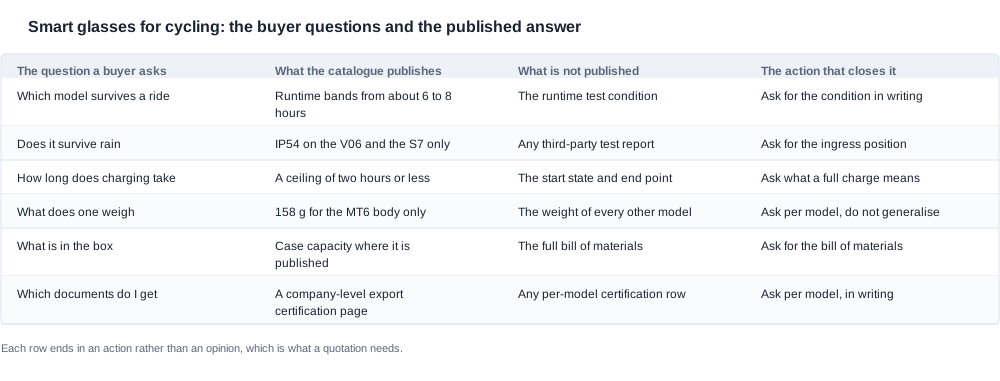
The table above gathers the eight questions with the position the catalogue takes on each and the action that closes it. The third column is the useful one, because it is where a buyer discovers that a question has no published answer and therefore has to be asked as a written request rather than looked up.
The two questions that decide the whole programme
Behind the eight questions there are two that everything else hangs from, and they are worth asking first because they make most of the other answers obvious.
What is the configuration string? In this catalogue the configuration is not a colour and a size. It is the model designation, the charging interface, the case option — where one is published at all — and the destination market. A channel that treats the configuration as a colour choice will receive a quotation it cannot place, and a channel that treats it as a specification will receive one it can. The reason the configuration matters so much here is the case: it is a second lithium cell, it changes the parcel, and on four models it is published as a choice rather than a fixed item.
Which market is the programme for? The document set is per market, the listing copy is per market, and the responsible-party details on the product page are per market. A channel that adds a market after the artwork is printed discovers that the artwork is a per-market cost and not a one-off. This is the question that most often arrives too late, and it is the one that makes a quotation look cheaper than it is.
Smart glasses for cycling: the shortlist that falls out of the answers
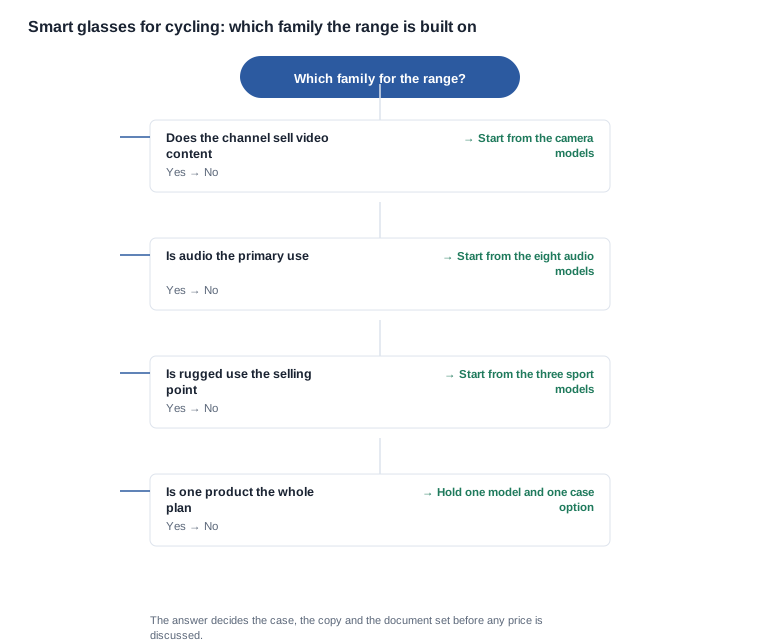
The decision chart above is not a product selection guide — it is a way of choosing which family a cycling range should be built on before any model is named, because the family determines the case, the document set and the copy. If the channel sells video content, the eleven camera models are the range and the case architecture is part of the proposition. If the selling point is rugged use, the two models that carry an ingress marking — the V06 and the S7 — matter more than the resolution class. If audio is the primary use, the eight audio models carry the entry point, and their case position is the simplest of the three families.
What the shortlist usually looks like. In practice a cycling range of two models is one camera model and one sport or audio model, and the second model is chosen for the reason the first model does not cover. If the camera model carries a 1400 mAh case and the audio model carries nothing, the range has one price point and one accessory ladder. If the camera model is chosen without a published case row, the range has one price point and no accessory at all, which is a cleaner launch and a smaller basket.
The criteria behind the shortlist. Four criteria, in this order, and each one is answered by a published row rather than by a preference. First, the runtime band against the use case, because the band is what the listing will be judged against. Second, the case position, because it decides the price ladder, the freight weight and the transit file. Third, the interface, because a Type-C model charges from a cable the customer already owns while a magnetic model requires the case or a dock to be carried — a difference that reaches the customer as a different first-session experience. Fourth, the document set for the destination market, which is settled before the artwork and not after it.
The criteria that cannot be applied from the catalogue. Four questions that every cycling buyer asks cannot be answered from published rows, and a shortlist that pretends otherwise is a shortlist built on a guess. The sensor model and the field of view are not published for any camera model, so image quality cannot be compared from a specification sheet — a sample clip recorded on the shipped unit is the only evidence. The video specification and the frame rate are not published, so a stills resolution figure says nothing about what the camera records in motion. The lens material and the coating are not published, so the cleaning instruction in the box has to be restrictive. And the per-model certification position is not published at all, so it has to be requested in writing for each model in the shortlist.
Smart glasses for cycling: the order of questions that makes two quotations comparable
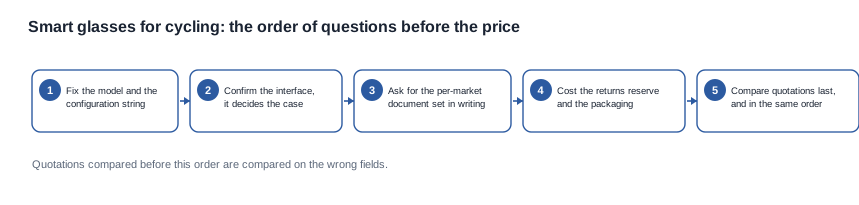
Most cycling quotations fail to be comparable for one reason: they were compared before the configuration was fixed. The flow above is the sequence that prevents it, and each step removes one variable that would otherwise have been compared by impression.
Step one: fix the model and the configuration string. Not the family — the model and the configuration. A family-level enquiry produces a family-level price, and a family-level price is a starting point for a conversation rather than an answer to one.
Step two: confirm the interface, because it decides everything downstream. The interface decides whether the case is optional or structural, whether a cable is in the box, how much the parcel weighs and what the transit file has to cover. Seventeen models publish magnetic charging and seven publish Type-C, and the four camera models that publish a case capacity but no interface row are the ones where the question has to be asked directly.
Step three: get the per-market document set in writing, before the artwork. Not before the order — before the packaging artwork is released. Artwork is where a market becomes expensive, because a responsible-party line, a market label and a language set all go into printed material.
Step four: cost the returns reserve and the packaging before the margin is agreed. The reserve is the line that is never quoted and the line that determines whether the channel survives a bad month. The packaging is the line that changes the freight band and the parcel. Both belong in the comparison, not after it.
Step five: compare the quotations last, and compare them in the same order. Line by line, in the same sequence, with the same fields present on both sides. A quotation that omits a field has not answered that field; it has removed it from the comparison, which is how a cheaper-looking quotation wins.
What the answer changes in the commercial conversation
The value of answering these questions in this order is that the commercial conversation gets shorter and sharper. Instead of "what is your best price", the enquiry becomes "the V06 or the S7, magnetic charging, the destination market, this volume, with the document set for that market". That enquiry gets a comparable answer. The other one gets a negotiation about something nobody has defined.
It also changes what gets negotiated. With the configuration fixed, the negotiation moves to the commercial terms that are actually worth the time: minimum order quantity tiers, whether two models can share a purchase order, the split of a first run across two deliveries, the share of units taken at the pilot tier, and the payment milestones. Those are the terms with real value, and they are invisible in a unit-price comparison.
Smart glasses for cycling: what has to be on the table before a quotation is worth anything
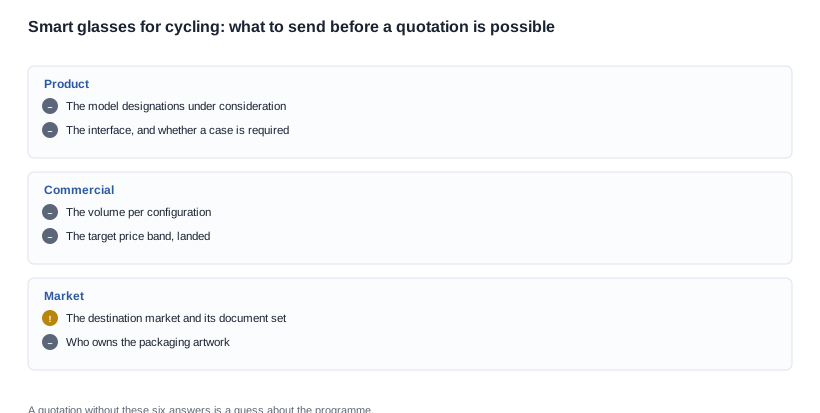
The checklist above is short on purpose, and every line on it changes the answer. Two questions arrive before the specification does: what is being ordered in enough detail to be quoted, and what the programme has to survive. A configuration described in general terms produces a price that cannot be compared with anything, and the second question is the one that decides whether the specification exercise is worth doing now or whether it is a lesson in finding out later which supplier was right.
The product block. The model designations under consideration, written exactly as the catalogue prints them — the same string that has to appear on the label, the invoice and the conformity documents. The interface, and whether a case is required. If the answer to the case question is "the catalogue publishes no case row for this model", that answer belongs in the enquiry, because it is the answer.
The commercial block. The volume per configuration, not the total. The target price band, landed, because a band quoted before freight and duty is a different band. And the split between a pilot quantity and the run quantity, because the share taken at the pilot tier is where most of the room in a first order sits, since it is the supplier's own risk exposure.
The market block. The destination market and the document set it requires, and the ownership of the packaging artwork. The second one is worth asking explicitly because artwork ownership sits with the brand, and a supplier who has produced artwork for another brand will otherwise assume the same arrangement.
A pilot run, and why it is worth the two weeks
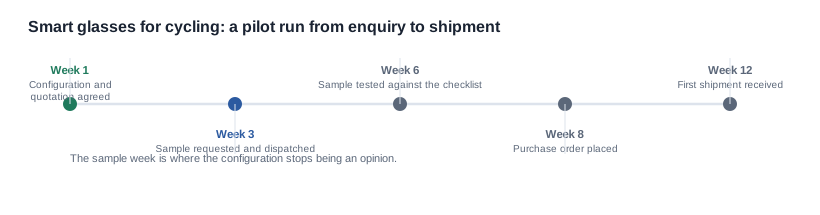
The timeline above is the shape of a pilot run in this category, and the week that matters is the sample week. A sample is the only instrument that answers the four questions the catalogue cannot: what the camera actually records, how the unit behaves after a wet ride, how long the charging case takes in the configuration being ordered, and how the unit presents in the packaging a customer will receive.
Two things make the sample week worth scheduling rather than skipping. The first is that the sample converts the open rows into observations, and observations are what the listing and the reserve are built from. The second is that the sample is the last point at which the configuration is cheap to change; after the first production run, a change is a new minimum order quantity, a new carton and a new artwork approval.
The pilot run also produces the two figures that make a returns reserve real rather than assumed: the actual return rate under a real listing, and the distribution of return reasons. Both are worth more than any percentage a supplier suggests, because both come from the channel's own listing rather than from an average across listings nobody in the room has read.
Smart glasses for cycling: what we answer directly, and what we answer as a document request
Stated plainly: a buyer question deserves one of two answers, and we will not blur them. Either the catalogue publishes the row and we will quote it, with the model it belongs to; or the catalogue is silent and the answer is a document request, with a named owner and a date.
The rows we will quote directly, for any model in the range. The cell capacity, in catalogue form, including the doubled cells where the model publishes them. The charge time, as published: a ceiling of two hours or less for every entry except the D17 and the ZH12, which publish about one hour. The runtime band per model. The charging interface where it is published — magnetic or Type-C — and its absence for the four camera models that publish no interface row. The Bluetooth version where it is published, which is V5.3 on the K01 and the K02 and V5.4 across the audio and sport models. The camera resolution class, which is 8 MP on eight camera models and 13 MP on three, with the S7 in the second group. The ingress marking and the two models that carry it. The structural features the catalogue records, including the detachable temples on the G07 and the YK12, the remote shutter control on the D17 and the ZH12, and the colour counts the catalogue lists. No touch row is published for any model, so the temple control is not a row this programme can quote. The case position in all four of its published forms. And the single published weight, 158 grams for the MT6 glasses body, with the foldable case excluded and the caveat that no other model's weight is published.
The rows we will not quote, and will request as documents. The sensor model, the field of view, the video specification, the frame rate, the storage capacity and the overwrite behaviour. The lens material and the coating. The microphone pickup distance, the noise-reduction implementation and the wind performance. The runtime test condition, the standby draw, the cycle-life rating and the operating temperature range. The per-model unit weight for every model except the MT6. The per-model certification position — because the catalogue text contains no reference to CE, FCC or RoHS and carries no per-model certification row, and a company-level export certification page is not evidence about a specific model. And the warranty terms themselves, which we do not publish and would rather negotiate than quote from memory.
What we will do with a real question. Take the model, the configuration, the market and the volume, and return the published rows that cover them, the shortlist criteria those rows support, the questions that have to be answered in the agreement, and the document list for the market. Where a question has no published answer, we will tell you the question cannot be answered from the catalogue and name what has to be requested in writing instead. The product families are at sport smart glasses, Bluetooth audio glasses and AI camera glasses. The scenario entry point is smart glasses for cycling, the published endurance rows are at battery life, the ingress marking is at IP ratings, and the document side is at certification checklist.
What to send us. Send the model designations, the configuration including the case option, the destination market and the volume, and the eight questions above with your current answers. We will tell you which of them the catalogue settles, which ones are document requests, and which answers will change the shortlist.
Related reading
- The scenario's opening — smart glasses for cycling
- Choosing between the families — how to choose smart glasses for cycling
- The kit decisions — what to bring on the ride
- Commercial blocks — MOQ, lead time, samples
Send the models, the configuration, the market and the volume, and we will tell you which of the eight questions the catalogue settles and which ones have to be answered in writing.


