

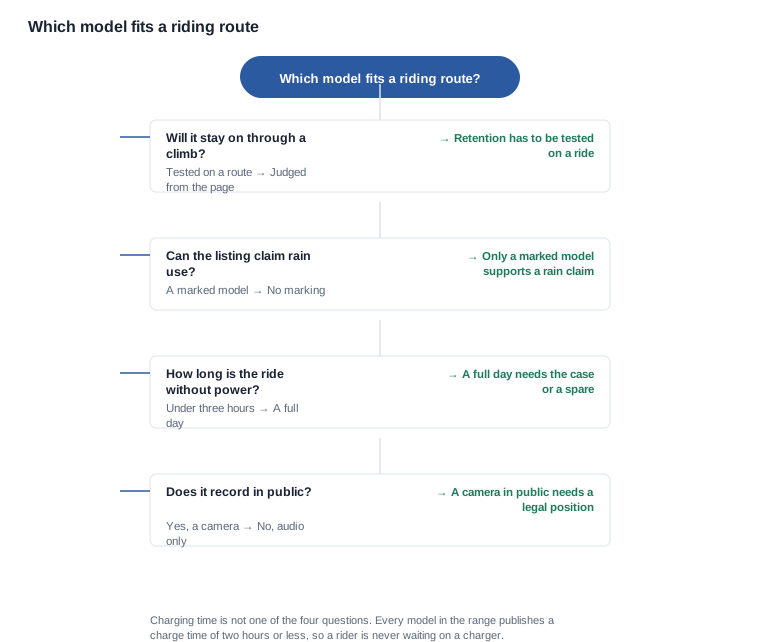
Smart glasses for cycling have to answer four questions before the specification table is opened, and none of them is a specification question. Will it stay on through a climb. Can the listing claim rain use. How long is the ride without power. And is it a camera recording in public. The catalogue answers the third one directly — every model in the range publishes a charge time of two hours or less, and the camera models publish runtime bands of 5 to 8 hours and around 7 hours — and it answers the other three with silence: there is no retention figure for any model, no unit weight for any audio or sport model, and no ingress marking outside the V06 and the S7. So a cycling selection is built by writing down the route, converting it into the claim the listing needs, and then closing each claim with either a test on a real ride or a request to the factory. This page is written for the brand manager and channel buyer building a cycling line, and it treats the route as the specification.
Smart glasses for cycling: start with the route, not the spec sheet
Who is buying, and what they are defending
A brand product manager is launching a cycling line and has to decide what the product is allowed to say. A cycling listing is unusually exposed, because the buyer is comparing against the promise of the product's category rather than against a specification sheet — and the claims that fail first are the ones with nothing behind them. Their exposure is a return rate that arrives months after launch, when a customer reports that the device moved on a descent.
A channel buyer supplying cycling retailers and clubs is buying the documentation that a shop will be asked for, and in this segment the question is asked about the same three things: does it come off, does it survive rain, and how long does it run. Their exposure is a channel that cannot answer those three and therefore cannot sell confidently at full price.
A procurement manager buying units for a shared cycle fleet or a rental operation is buying against a damage rate rather than against a defect rate. A cycling device is dropped, scraped and rained on, and the replacement terms are a line on the purchase order that determines the total cost of the fleet over a season. Their exposure is a fleet whose running cost is set by the terms nobody negotiated.
The reason all three are stuck is the same: the catalogue describes the device at rest, and a cycling product is used in motion. The adjacent test route is at testing smart glasses for cycling.
What the catalogue publishes, and where it goes quiet
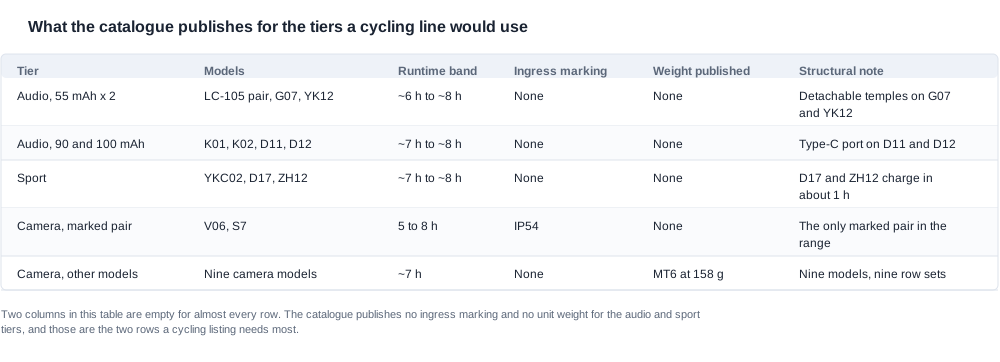
The range is arranged into tiers and the tiers behave differently in a way that matters here. The audio tier contains eight models: the D11 and the K02, the YK12 and the G07, the LC-105-2 and the D12, and the K01 and the LC-105-1. The sport tier contains three: the YKC02, the D17 and the ZH12. The camera tier contains eleven.
The runtime bands are published for all of them. The four models on the 55 mAh per side configuration — the G07 and the YK12, and the LC-105-2 and the LC-105-1 — publish either about eight hours or about six, and the two at the short end are the G07 and the YK12, which are the two with the ultra-slim detachable temple and the slim detachable temple. The K01 and the K02 publish about eight hours on 90 mAh per side, and the D11 and the D12 publish about seven hours on 100 mAh per side. The sport models publish about seven hours on the D17 and about eight hours on the ZH12, with the YKC02 at about eight hours.
Then the table goes quiet in two columns that a cycling listing needs filled. The IP54 ingress marking appears on the V06 and the S7 and on no other model, so the audio and sport tiers carry no ingress position at all. And the range publishes exactly one unit weight — 158 g for the MT6 glasses themselves, including the cell and the camera and excluding the folding case — which belongs to a camera model and not to any audio or sport model. The marking is explained at IP ratings and at what the second digit means.
The first question: will it stay on through a climb
Retention is the failure nobody can read on a page
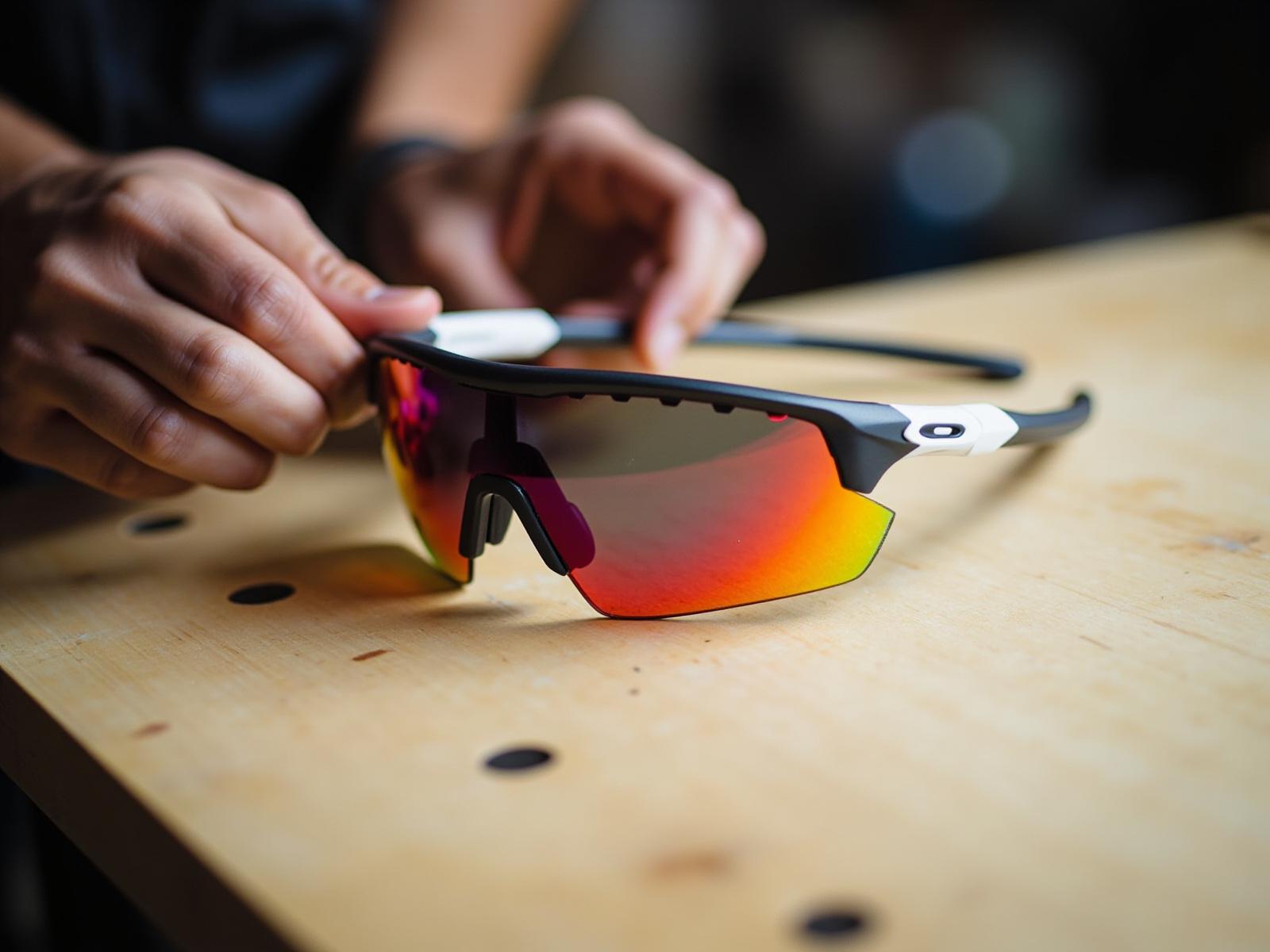
The catalogue publishes no retention figure for any model: no temple tension, no adjustable range, no statement about how a device behaves under repeated vertical movement or a sustained vibration. That silence is not unusual for the category, and it is the reason the first question has to be answered with a ride rather than with a specification.
The consequence for a buyer is that the structural features in the catalogue are the only material available, and they point in two directions at once. The G07 publishes an ultra-slim temple and detachable temples, and the YK12 publishes a slim temple with detachable temples and surround sound. A detachable temple is a retention benefit, because a temple that can be repositioned can be set for the rider. It is also a failure mode, because a pivot that moves under vibration introduces a variable that the catalogue does not describe.
The tiers without a detachable temple are the K01 and the K02 at about eight hours on 90 mAh per side, and the D11 and the D12 at about seven hours on 100 mAh per side. So the buyer who wants the longest published runtime on the audio tier is choosing between the slim-temple models at about six hours and the fixed-temple models at about seven or eight. That is a real trade-off and it is a genuine selection criterion, because the catalogue publishes it.
The other half of the first question is weight, and here the catalogue cannot help at all on the tiers that fit cycling. The 158 g figure belongs to the MT6, a camera model with a 265 mAh cell and a folding 1200 mAh case. For every audio and sport model the weight has to be requested in writing. A buyer building a cycling line should ask for the weights in the same message as everything else, because a line that is launched with a weight claim and then has to retract it is a line that has burned a packaging cycle. The runtime rows are at battery life and the product families at bluetooth audio glasses and sport smart glasses.
The second and third questions: the rain claim and the ride length
Why the ingress marking decides the listing
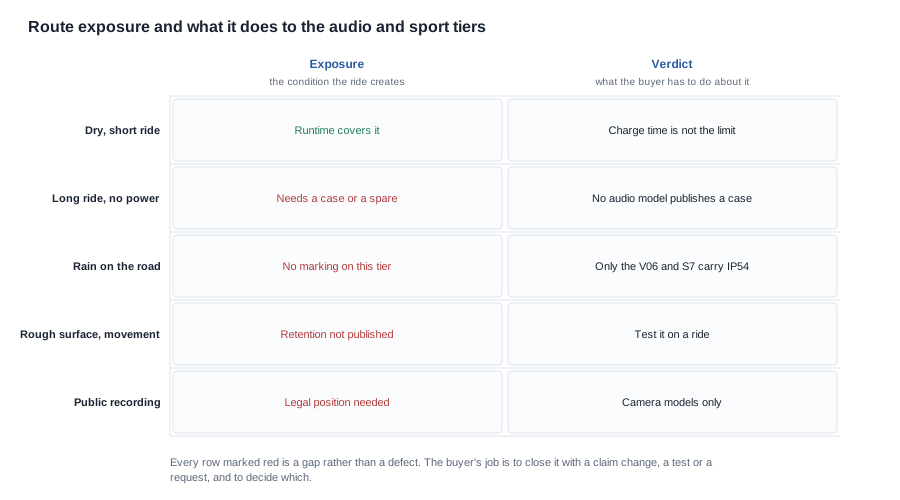
Two camera models in the whole range carry an IP54 marking, the V06 and the S7. That marking covers splashing water and a dust protection level; it does not cover immersion, and no test report behind it is published. For a cycling line the consequence is sharp and it is a commercial one rather than a technical one: the tiers a cyclist would actually choose — the audio models and the sport models — carry no ingress position, so the listing cannot carry a wet-weather claim, while the two models that do carry a marking are camera models with their own decision attached.
That leaves three honest options, and picking one is a decision rather than a technicality. Sell the audio or sport tier without a rain claim and design the packaging around sweat and spray rather than weather. Sell the marked camera pair and accept the camera questions that come with it. Or write a conditional claim, such as a statement that the device resists splashing and that the marking appears on the V06 and the S7 only, which is defensible but not as strong as a rating on the listing.
The third question, the ride length, is the one the catalogue answers properly. The camera models publish 5 to 8 hours on the S7 and the V06, and the V03 and the V03 Pro, 6 to 8 hours on the KY06 and the MT5, and around 7 hours on the CY03 and the L2 Utral, and the MT6 and the L1 Pro, and the CY05. A ride or a stage of up to about five hours is covered by the short end of the band on any camera model. A full day is not covered on any camera model, and no audio or sport model publishes a charging case at all, so the reserve power for a long ride has to be a spare unit or a power bank rather than a case.
The reserve question that sits behind the third
A route profile also produces a reserve requirement, and it is worth naming separately from the ride length because the reserve is not a charging decision. For a ride of up to about five hours, the published camera bands and the audio and sport bands cover the ride on one charge, and the reserve is a spare unit held at the start. For a day that includes a second stage, the reserve has to be a charged unit, and the question becomes how many spare units the fleet carries and who recharges them between stages. That is a pool-sizing question with a docking point, not a cable question, and it belongs in the operating cost rather than in the accessory schedule.
Because no audio or sport model publishes a charging case, the spare-unit route is the only case-free reserve available on those tiers. On the camera tiers the case is available on seven of the eleven models — the L1 Pro and the CY05, and the CY03 — each at 1400 mAh, the L2 Utral at 900 mAh or 1400 mAh, a folding 1200 mAh case on the MT6 and the KY06, and the MT5 with a case row whose capacity is not published — which means the reserve on a camera model can be a case rather than a second unit. Choosing the tier first and the reserve second is what keeps that decision honest.
The fourth question: a camera recording in public
Eleven models in the range publish a camera, and the classes are eight models at eight megapixels and three at thirteen megapixels: the L1 Pro and the L2 Utral, and the S7. For a cycling product this is the question that changes the buyer rather than the model, because recording in public places on a public road raises a data-protection and privacy position that the product page cannot answer.
The catalogue publishes no row that speaks to it, because the rows are electrical and physical: the resolution class, the cell, the charge time, the runtime band, the charging method, the case and the ingress marking. The camera models also publish no Bluetooth version, so a live or paired workflow adds another unpublished row on top. The legal framing for a product that records in public is set out at livestreaming legal considerations, and the comparison between the sport and running routes is at running.
How to close a cycling selection
Five steps, each with a completion standard
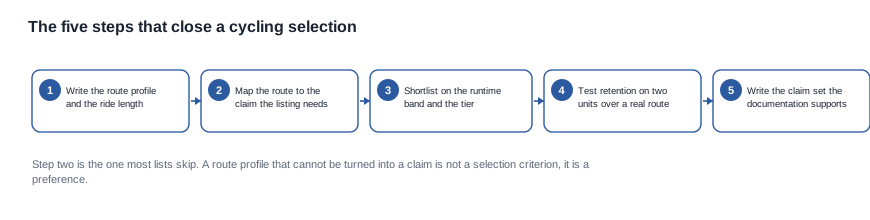
- Write the route. Distance, duration, surface, gradient, weather exposure and the number of stops. The completion standard is a route profile with each of those six named, because a route that cannot be written down cannot be turned into a criterion.
- Map the route to the claim. Turn the profile into the statements the listing intends to make — secure fit, rain resistance, all-day use, hands-free capture. The completion standard is a claim list with the documentation each claim would need.
- Shortlist. Use the runtime band against the ride length and the tier against the claim list. The completion standard is a shortlist in which every model has a written reason tied to a claim.
- Test. Run two units from the same batch over a real route with a gradient and a rough surface, and record what happened to each one. Two units are needed to separate a design characteristic from a manufacturing inconsistency, because the two have different remedies. The completion standard is a signed sheet with the route and the conditions attached.
- Write the claim set. Keep only the claims the documentation and the test support, and put the rest into the request list for the next revision. The completion standard is a claim list where every line has a source.
The rows to request, and the commercial lines to settle
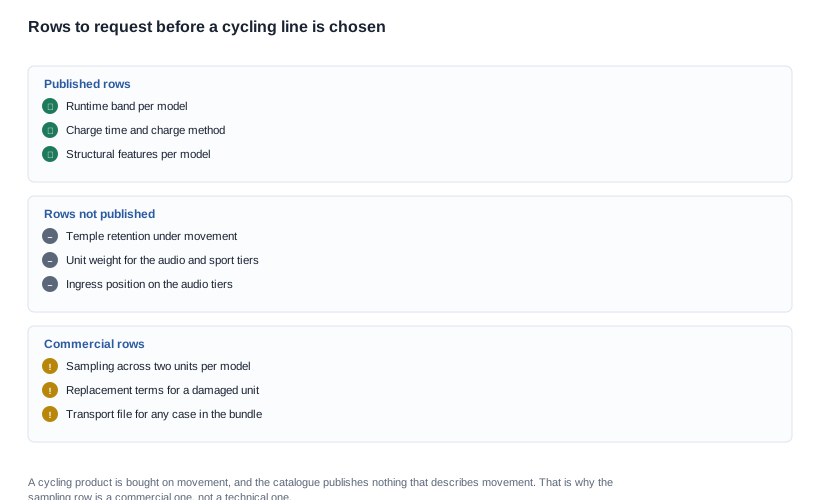
The published rows — runtime band, charge time, charge method, structural features — should be confirmed against the catalogue rather than taken from a reseller sheet, because the tier boundaries are exactly the kind of thing a summary sheet gets wrong. The unpublished rows are the three that decide the listing: temple retention under movement, the unit weight for the audio and sport tiers, and the ingress position on the audio tiers.
The commercial rows are where a cycling line differs from an ordinary one. Sampling has to cover at least two units per shortlisted model, because the failure mode is a retention failure rather than a functional one and it is invisible on a single unit. The replacement terms for a damaged unit matter more than the warranty period in a sport line, since the drop rate is higher than the defect rate. And if the bundle includes a charging case — and only camera models publish one — the transport documentation has to cover the case cells as well, which is set out at battery transport. The commercial framework is at pricing, samples, contract terms and certification checklist.
Where cycling selections fail
The model was chosen from the runtime figure alone. The symptom is a product that runs out of power two hours before the end of a long ride, with the cause being a band that starts at five hours. The root cause is that the runtime band was read as a guaranteed duration. Prevention is to size the ride against the short end of the band and to plan the reserve.
A rain claim was written on an unmarked tier. The symptom is a listing that promises weather performance the documentation does not carry, and a return that turns into a compliance argument. The root cause is that the IP54 marking on two camera models was generalised to the range. Prevention is to check the marking on the exact model and write only what it covers.
A weight claim was published from an inference. The symptom is a specification conflict between the listing and the factory sheet. The root cause is that the catalogue publishes one weight in the range and a buyer extrapolated from it. Prevention is to request the weight per model and publish only a returned figure.
Retention was judged on a desk. The symptom is a return rate that rises with the number of steep rides a customer takes. The root cause is that a stationary test cannot reproduce vibration and the catalogue publishes no retention figure. Prevention is the two-unit route test, with the route written down.
The camera question was deferred. The symptom is a launch delay in a market where recording in public is regulated differently from where the product was designed. The root cause is that the product was chosen on imaging rows and the legal position was never part of the shortlist. Prevention is to put the question at the front of the selection rather than the end.
The case was bundled without a transport file. The symptom is a shipment held at a freight check. The root cause is that the case was added to the bundle after the paperwork. Prevention is to count cells, not devices, before the first shipment.
| Cycling selection failure | Root cause | Preventive action |
|---|---|---|
| Power ends two hours early | Band read as a guaranteed duration | Size the ride on the short end |
| Rain claim on an unmarked tier | Two marked models generalised | Check the marking per model |
| Weight claim conflicts with the sheet | Weight extrapolated from one model | Request the weight per model |
| Returns rise with steeper rides | Retention judged on a desk | Two units over a real route |
| Launch delayed on a legal question | Camera question deferred | Put it at the front of the shortlist |
| Freight check holds a shipment | Case added after the paperwork | Count cells before shipping |
What we publish about cycling selection, and what we will not estimate
Stated plainly: a cycling product is specified by its route, and the catalogue can only support that specification through the runtime bands, the charge times, the charging methods, the structural features and the single ingress marking it publishes. We publish the runtime band for every model, the charge time for every model, the charging method where the catalogue carries one, the cell configuration exactly as it is published, the tier boundaries — eight audio models, three sport models, eleven camera models — and the IP54 marking on the V06 and the S7 stated as a catalogue attribute.
What we will not do is publish a retention figure, a temple tension, an adjustable range, a unit weight for any model beyond the single 158 g whole-unit figure for the MT6 glasses, an ingress position for any model that does not carry one, a Bluetooth version for any camera model, or a frame weight for any model in the range. We will not present the IP54 marking as waterproof or as tested, because no test report behind it is published, and we will not state that a model is certified where the catalogue carries no certification row.
What we will do is take the route profile, the ride length, the tier you intend to sell into, the markets you are shipping to and the claim set you have in mind, and tell you which models the published rows support, which claims the documentation carries, which rows still have to be closed, and what the route test has to cover. The product families are at bluetooth audio glasses and sport smart glasses, the adjacent route is at cycling, and the sample-stage route is at testing smart glasses for cycling.
What to send us next. Send the route profile, the ride length, the tier, the claim set and the target market. We will return the claim-to-row map, the shortlist with its runtime bands, the list of rows still open, and the route test criteria worth writing into the purchase order.
Related reading
- The product lines — bluetooth audio glasses and sport smart glasses
- The sample-stage route — testing smart glasses for cycling
- The ingress marking — IP ratings and what the second digit means
- The camera question — livestreaming legal considerations
- The scenario's starting point — cycling
Tell us the route profile and the tier you plan to sell into, and we will tell you which claims the published rows support and which rows still have to be closed.


