
Advanced practice in smart glasses for cycling is not about adding features to a device; it is about deciding which judgements belong to the factory, which belong to the buyer, and which have to stay with the rider because nobody else can make them safely. Almost every specification in this range is published well enough to support that decision — the interface, the cell capacity, the case capacity, the rated runtime, the resolution class, the remote control feature — and almost none of the published rows say anything about who is expected to act on them. A buyer who resolves that gap at the specification stage gets a product that asks less of the rider on the road. A buyer who leaves it open gets a support desk instead of a product.
The reader, and the decision in front of them. This is written for a buyer at the brand, a channel buyer or a product manager who is putting cycling smart glasses into a club, a rental operation, a dealer network or a store, where the device is used by someone other than the person who paid for it. The task is to write a handover standard: what the device does by itself, what the rider is told to do, and what the buyer commits to when something stops working. The fear is specific and unglamorous — a fleet that works perfectly for the first month and then generates a stream of tickets that nobody can classify, because nobody wrote down which decisions had already been taken.
Smart glasses for cycling: advanced practice is about who owns the decision
The published rows support a handover standard, not a feature list
Twenty-eight models sit in this catalogue, split across eight audio models, three sport models and eleven camera models. The electrical rows are consistent enough to build from: seventeen models charge magnetically, seven use Type-C, and four camera models publish no charging method at all. Runtimes are published for every model, charge times are published for every model, and case capacities are published where a case exists. The V06 and the S7 carry an IP54 marking and a detachable inner frame. The D17 and the ZH12 publish a remote control photo feature. Those are enough rows to write a configuration sheet from.
What the catalogue does not publish is the layer above: how a file is stored, what language the voice prompts use, what happens when a unit will not charge, and what the rider is supposed to do about a smeared lens when the lens material is not published. The twenty models in the range that carry an AI function entry are listed as capable; how that capability is configured, in which language, and under what conditions, is not stated. A handover standard is built in that gap, and it has to be built by the buyer, because nobody else is going to build it for them.

The decisions a factory can take off the rider's hands
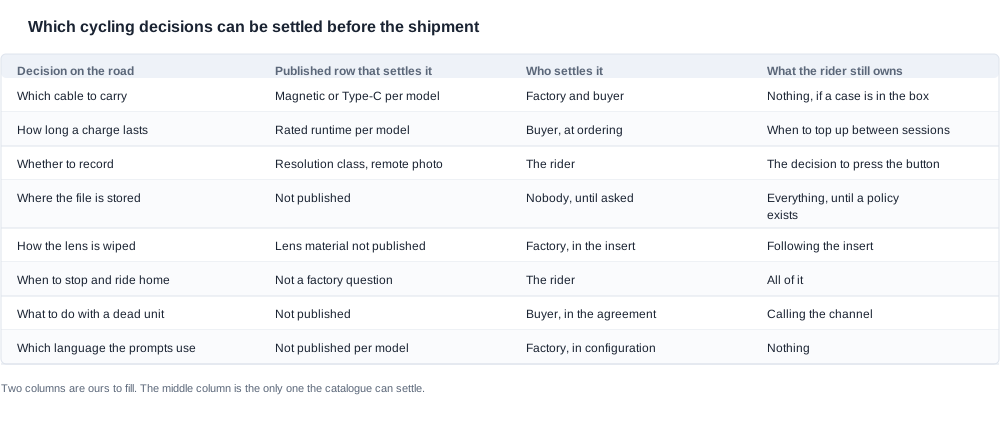
Four decisions belong entirely upstream, and a buyer who moves them out of the rider's lap gets a measurably calmer product.
The charging interface. This is the clearest example in the whole range. A Type-C model on the D17, the ZH12, the V03 Pro or the L2 Utral recharges from a cable the rider already owns, so there is nothing to decide and nothing to lose. A magnetic model on the V06, the S7 or the YKC02 needs either a lead or a dock to be carried, which is a decision the rider should not be making halfway through a route. The four camera models whose charging method is not published — the CY05 and the MT6, and the CY03 and the L1 Pro — are the ones where a rider could be handed a device they cannot recharge with anything they own, and that is why the published row has to be obtained in writing rather than assumed. The charging decisions for this range are set out at charging solutions.
The case in the box. Where a case is included, the rider's charging decision mostly disappears. The catalogue publishes 1400 mAh cases for the CY03 and the CY05, and the L1 Pro, 900 or 1400 mAh for the L2 Utral as a configuration choice, and a 1200 mAh foldable case for the MT6. The V03 Pro and the V06, and the V03 and the S7 have no case row published at all, so what a rider finds in the box is an open item to settle with the supplier. A rider with a case in the box and a rider without one are living with different questions, and only the buyer knows which of them they have sold.
The recording trigger. The D17 and the ZH12 publish a remote control photo feature, which means a camera rider can take the picture without touching the frame. On a model without that feature, the camera is operated from the frame, and a rider taking a photograph at speed is making a decision that a remote removes. Publishing the remote as part of the configuration, rather than as an optional extra, is the kind of advanced practice that costs nothing and removes a whole class of incident.
The prompt language and the configuration state. The catalogue lists twenty of the twenty-eight models as carrying an AI function entry, but it does not publish the language, the trigger conditions or the default state. Those are configurable, and a buyer who specifies them at the factory removes the need for the rider to explore a settings screen on a roadside. The capability overview is at AI features.
The decisions that stay with the rider, and why
The rest of the list is not a failure of preparation. Some of it cannot be moved, and a handover standard that pretends otherwise is a document nobody will follow.
When to stop and ride home. No factory can pre-set that, and any product copy that appears to is making a safety claim it cannot support. The rider owns it, and the buyer's contribution is to make the consequence legible — what a flat battery means at the far end of a route, and who to call.
Whether to record at all. Resolution is published — eight models at 8 MP, three at 13 MP, with the S7 among the latter — but whether a specific moment gets recorded is a judgement about the rider's own ride. What the buyer can do is set the boundary that recording stays inside a legal and privacy frame, and can do that in the agreement rather than in the rider's head.
How to deal with a smeared lens. The lens material and coating are not published for any model, so the instruction has to be conservative: a supplied wipe, no solvent, no sleeve. The decision the buyer removes here is not the wipe itself, it is the temptation to improvise. The surface handling guidance for this family is at outdoor care.
What to do with a unit that stops working. Whether that is a swap, a repair, a refund or a return to the channel is a commercial term, and it has to be in the agreement rather than in a rider's expectation. The warranty and returns language belongs at contract terms, and the channel structure that sits behind it is at samples for the first unit and after-sales for the long tail.
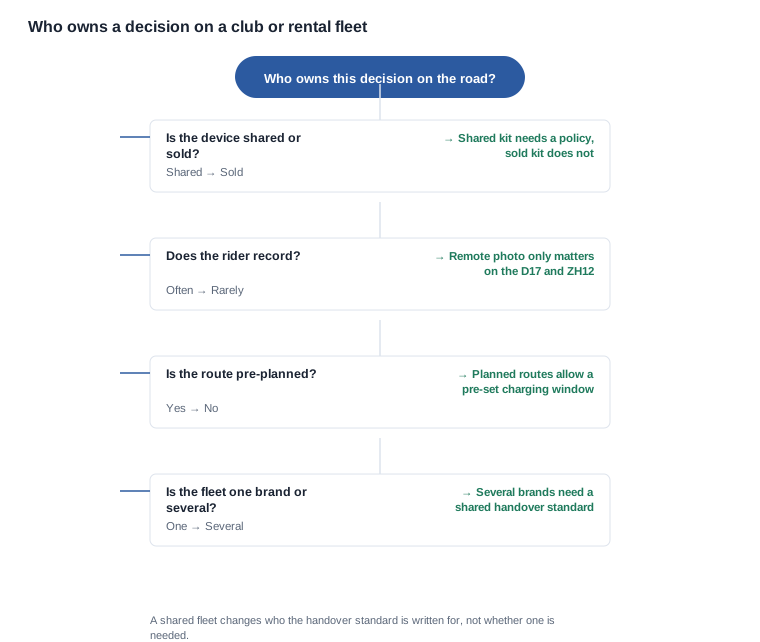
The practical test for whether a handover standard is written correctly is simple: read each line and ask who acts on it at the roadside. If the answer is "the rider, and nothing in the product can change that", the line belongs in the rider instruction. If the answer is "nobody, because it was never configured", the line belongs in the pre-set list. If the answer is "the channel, once a claim is filed", the line belongs in the agreement. Three destinations, three documents, and no line that appears in two of them.
The decisions the channel owns
A third destination exists in the handover standard, and it is the one that is easiest to forget because it involves nobody who touches the device. The channel owns the decisions that only become visible after a unit has left the rider: what happens to a unit that comes back without a fault being identified, how a defect is distinguished from a configuration error, who pays for the replacement, and how the reason reaches the factory. None of these are published rows, and all of them are negotiable.
The distinction between a defect and a configuration error is the sharpest one. A unit shipped with the wrong interface is not a defect; it is a specification error, and the cost of it belongs to the party that signed the pre-set list. A unit that fails to charge after three weeks of correct use is a different category, and it belongs in the warranty. Blurring the two is the standard way a fleet programme turns into a returns problem, because every configuration error gets logged as a device fault and the supplier ends up absorbing a problem they did not create.
The practical version is a reason code on the return form. A small set of codes — no charge, will not pair, lens damage, unit missing, configuration mismatch, other — costs nothing to agree and turns a channel's return reporting from a count into a diagnostic. A buyer who wants to improve the handover standard has to be able to see the reasons, and the reasons have to be recorded in a form that separates the two categories.

How to check that the pre-set state shipped correctly
A pre-set decision that was never audited is a decision the rider still has to make, because the rider is the one who discovers that it was not set. The red flags to watch for are simple: a pre-set list that arrives after the production run, a configuration described as the factory default, and a reason code set that cannot tell a defect from a specification error. The audit does not need a laboratory. It needs a production unit, a written pre-set list, and a person willing to spend an hour with both.

- Write the pre-set list as a numbered document before the production order. One line per decision, each with the value, the reason and the published row it rests on. A list written after the units arrive is a list of what happened.
- State the charging interface per model and confirm it on the unit. If the model charges magnetically, confirm the contact geometry; if it uses Type-C, confirm the port. A unit with the wrong interface in a fleet is a rider's problem on a route, and it is entirely a specification error.
- Confirm the case configuration physically. A 1400 mAh case and a 900 mAh case look different and weigh differently, and the L2 Utral exists in both. Check the case that actually shipped against the case that was ordered.
- Confirm the remote control pairing where the model publishes one. The D17 and the ZH12 publish a remote control photo feature; the pairing has to work on a unit that came out of a production run, not only on a sample.
- Confirm the prompt configuration and the language. This is the item most often left to a factory default, and it is the one a rider is most likely to discover in public.
- Confirm the instruction insert is in the right language and matches the pre-set list. An insert that describes a wipe the box does not contain is a ticket waiting to happen.
- Confirm the model designation on the unit and on the paperwork. The designation is what makes a loss traceable, and it is the number the channel will quote when a unit comes back.
- Keep the audit record. One page, dated, signed, with the batch or lot reference. It is the only artefact that lets a buyer argue a defect is not a configuration error.
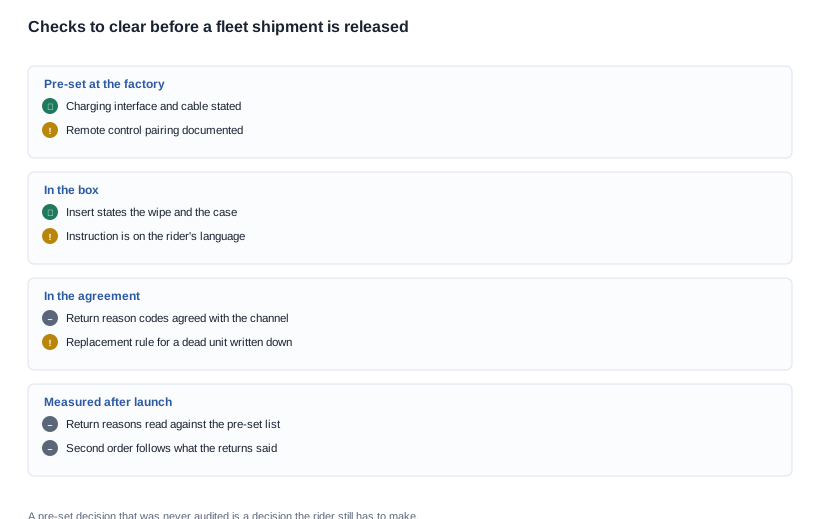
The completion standard for each step is the same: a written record, not a verbal assurance. A verbal assurance from a factory is not a pre-set decision, it is a memory. The buyer who wants the decision removed from the rider's hands has to be willing to hold the factory to a document, which is uncomfortable and is also the whole point of the exercise.
Sample units are not evidence for this particular check. A sample is assembled to demonstrate a feature, configured to look its best, and typically arrives before the production specification is frozen. A pre-set list audited against a sample proves that a device can be configured, not that the units the channel will receive are configured. The audit therefore has to run against a unit drawn from the production run, and the pre-set list has to be frozen before that run starts rather than issued alongside it. Buyers who run the audit late discover the mismatch at the worst possible moment, because by then the artwork is printed and the insert is in the box.
One more row belongs on the list even though the catalogue cannot help with it. The date and the batch reference of the production run, written onto the list, gives the returns analysis something to cut against. When a reason cluster appears in one lot and not in another, the cause is almost always a configuration difference rather than a component difference, and without a lot reference nobody can prove which it was.

What a decision-removal standard costs to agree
Nothing in the published rows makes a handover standard expensive, and almost everything about it is a negotiation rather than a purchase. The cost sits in four places: the pre-set list itself, the audit, the insert, and the agreement.
The pre-set list is a one-time configuration cost that scales to nothing. It is a document, and it becomes a reference for every subsequent order. The criteria for calling the list complete are that every line is traceable to a published row, a written configuration instruction, or an explicit unconfirmed marker. The risk is that it is written once and never revisited, which is why the return analysis at the end of the first season is not optional.
The audit is a small recurring cost with a large effect. A production unit, a written list and an hour is the whole requirement. Buyers who skip it discover configuration errors at the same time as their channel does, and by then the units are in riders' hands. The quality process that normally covers this is at quality control, and the incoming criteria are at quality consistency.
The insert is where the decision actually lands. It is the cheapest lever in the whole programme, and it is the one most often left to the factory's default artwork. The parts of the range that a rider must be told about — the interface, the case, the wipe, the remote, the prompt language, the dead-unit rule — fit on a single printed side.
The agreement is where the remaining risk sits, and it is the last thing to settle before you order. The replacement rule for a failed unit, the definition of a defect against a configuration error, the return reason codes, and the channel's obligation to report reasons rather than counts. A channel that reports counts only cannot tell you whether a handover standard worked, and a buyer who cannot tell cannot improve. The commercial structure of a first order is at pricing, the order terms at MOQ, and the payment structure at payment terms.
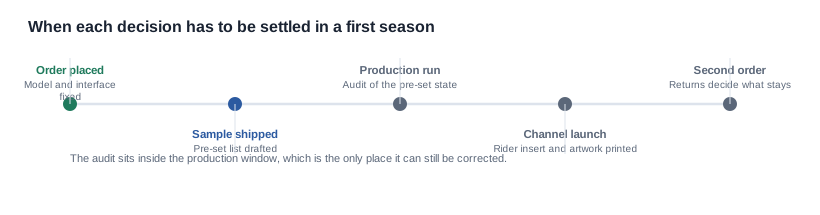
A worked example. Assume a European club operator that has decided to run a shared fleet rather than sell to members, with one brand across two models, on routes that are planned in advance. The first decision is the interface, and the operator takes the Type-C route because the D17 and the ZH12 publish Type-C alongside a remote control photo and roughly one hour of charging, which fits the window between a session and the next. The second decision is the case: with a planned route and a short charge time, the operator takes the models without a case, which means the cable is the only carried item and the lost-object risk collapses. The third decision is the recording boundary, which goes in the agreement because it is a legal question rather than a product one. The fourth is the insert, which states the wipe, the cable and the dead-unit rule. The pre-set list has four lines by the end of it, and every one of them is traceable to a published row. What the operator has not solved is the file-storage and prompt-language question, and the honest outcome is that those two lines are marked as unconfirmed on the pre-set list and chased with the factory rather than assumed.
Where our own reading of the published rows stops
The working rule we apply: advanced practice for smart glasses for cycling is a handover discipline, and the discipline is only as good as the published rows underneath it. We publish the charge times, the rated runtimes, the cell capacities and the resolution classes, the charging interface per model, the case capacities where they exist, the detachable inner frame on the V06 and the S7, the ultra-slim detachable temple on the G07, the slim temple on the YK12, the flexible temples on the V03 Pro, the remote control photo feature on the D17 and the ZH12, the photochromic lens on the V03 Pro and on the AI photochromic model, and the IP54 marking on the V06 and the S7.
What we do not publish, and will not estimate: the lens material or coating, the per-model frame weight beyond the single 158 g figure for the MT6 glasses body, the adjustment range of any frame, the storage behaviour of a recorded file, the prompt languages, the AI feature configuration, or any per-model certification scope. We will also not say that any model in our range is tested to IP54, because no test report is published behind that marking.
What we will do is take a model list, a rider profile and a channel model, and tell you which decisions the published rows already settle, which ones have to be pre-set by the factory, which ones belong in the insert, and which ones belong in the agreement. The scenario entry point is smart glasses for cycling, the device families are at sport smart glasses and ai camera glasses, the runtime measurement background is at battery life, and the selection logic that sits upstream is at how to choose smart glasses for cycling.
What to send us next. Send the models, the channel model, the route pattern and the way the fleet is replenished, and we will return a pre-set list skeleton with each line marked as published, configurable or unconfirmed, plus the documentation that has to be in place before a production run is released.
Related reading
- The opening point of the scenario — smart glasses for cycling
- The selection logic — how to choose smart glasses for cycling
- The accessory programme — smart glasses for cycling accessories
Send the models and the channel model, and we will return a pre-set list with every line marked as published, configurable or unconfirmed.


