

A smart glasses for cycling order is a radio product, a battery product, a camera product and a software product at the same time, and the published specification only settles the first three of those. The regulatory file a brand or a channel buyer needs before the goods move is not in our catalogue, and it is not in anybody else's — it sits in a supplier's own document set, one model and one market at a time. The practical consequence is that compliance for a cycling programme has to be bought deliberately, as a named deliverable with an owner and a date, or it turns up at the border on a shipment that is already paid for. Below is the six-regime map of that file, how to assemble it, what a genuine document looks like as opposed to a plausible one, and where the commercial room sits once the cost of the file is on the table.
Smart glasses for cycling: the compliance file to check, not a formality
The short version of the decision. Before a purchase order for smart glasses for cycling is released, the buyer needs to know three things: which regulatory regimes apply to the specific model and the specific markets, which document in the supplier's file covers that model and that market, and what the listing is allowed to claim once that document exists. The first two are requests. The third is a decision the brand makes and the supplier supports. Nothing in a product catalogue can supply any of the three, because a catalogue row describes a product and a regulatory file describes a compliance route for a specific configuration.
Who is holding this decision. The reader is a brand-side product or regulatory lead, a channel buyer who is putting a cycling line into a marketplace, and an e-commerce seller who has a listing to publish and a stock position to protect. In each case the working position is the same: a quotation is on the table, a sample has been approved or is about to be, and the question is which documentation will travel with the goods and which will be asked for after they arrive. The thing people fear in this category is rarely a fine. It is a held consignment, a re-test, a listing that has to be withdrawn, and a launch date that moves because a piece of paper was never in the plan.
What the product actually is, in regulatory terms. Our catalogue describes twenty-eight models, and the description splits into three families that a compliance file treats very differently. The eight audio models — the K01, the K02, the D11, the D12, the LC-105 pair, the G07 and the YK12 — publish a Bluetooth version, which makes the radio route explicit and the technical file the shortest of the three. The three sport models — the YKC02, the D17 and the ZH12 — publish a Bluetooth version as well. The eleven camera models — the V03 Pro and the MT6, the V06 and the V03, the KY06 and the L2 Utral, the L1 Pro and the S7, the CY03 and the CY05, and the MT5 — publish a resolution class, a cell capacity, a charge time and a rated runtime, but the catalogue text for those eleven rows carries no Bluetooth version row at all. That absence is not a detail of the file; it is the reason a camera model can cost more to file than an audio model, because the radio configuration has to be established from the sub-supplier before a test plan can even be priced.
Why two quotations for the same specification can differ in compliance cost. The unit price in a cycling quotation usually covers the hardware, the packaging and the assembly. It does not necessarily cover the route to market, and three things move that cost independently of the specification. The first is the radio variant: a supplier who has already filed a module can often extend an existing file across several models, while a supplier using an unfiled module has to pay for a new test campaign. The second is the cell: the range runs from 40 mAh on the A05 and the A06, through 70 mAh on the A07, 100 mAh on the D11 and the D12, 115 mAh on the D17, 220 mAh on the V03, 260 mAh on the V06 and the S7, to 290 mAh on the L2 Utral and the CY05, and the CY03 and the L1 Pro, and every one of those values needs its own transport documentation if the file is to cover the exact configuration. The third is the case: a configuration that includes the 1400 mAh case published for the L1 Pro and the CY03, and the CY05, or the 1200 mAh folding case published for the MT6, is a second lithium article inside the same box, and a file that was built for the glasses alone does not cover it.
**The limit of our own published material, stated plainly.The catalogue includes a company-level export certification page near the front, and the text layer of the whole document contains no CE, no FCC, no RoHS and no REACH string anywhere. There is no per-model certification row. The IP54 marking on the V06 and the S7 is a catalogue attribute with no published third-party test report behind it. None of that means the products are uncertified; it means the evidence is not in the document we publish, and a buyer who treats a catalogue as a compliance source has already made a mistake that surfaces at the worst possible moment.

What our catalogue settles about compliance, and the six regimes it leaves open
The published rows are genuinely useful, and they are the right starting point, because a file can only be requested for a configuration that has been named precisely. The catalogue publishes cell capacities, charge times, rated runtimes, charging interfaces, Bluetooth versions for the audio and sport families, colour counts, case capacities where they are published, and the structural features that change the assembly — the removable inner frame on the V06 and the S7, the ultra-slim detachable temples on the G07, the slim detachable temples on the YK12, and the remote capture control on the D17 and the ZH12. It publishes the IP54 marking on exactly two models, the V06 and the S7. It publishes the charging interface for twenty-four of the twenty-eight models: magnetic on seventeen, Type-C on seven, and unpublished on the CY03 and the L1 Pro, and the CY05 and the MT6, which the catalogue describes by case capacity only.
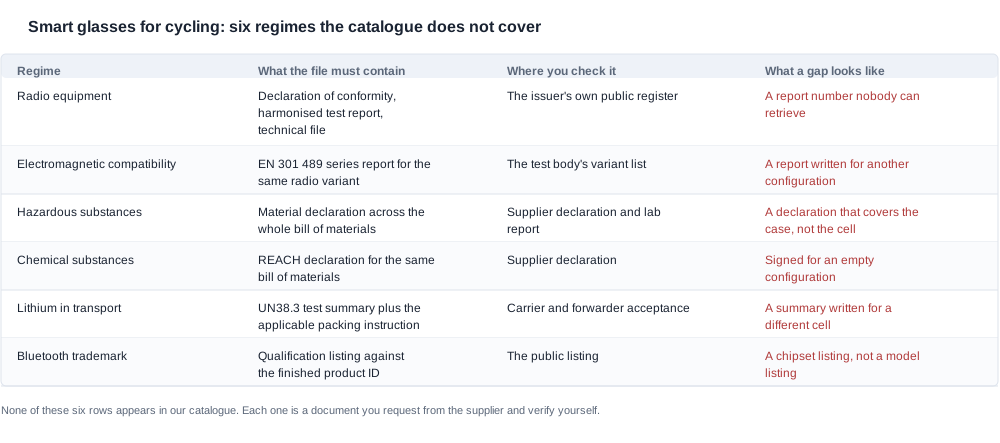
Against that, six regimes have to be covered from outside the catalogue, and each one is verified differently.
The radio regime. A product that transmits is radio equipment, and in the European Union the applicable instrument is the Radio Equipment Directive (EU) 2014/53/EU, which sits alongside the EMC directive as a separate piece of legislation — a distinction worth keeping straight in a purchase order, because the two have different test reports and the numbering is easy to muddle. What the file needs is a declaration of conformity, the harmonised test report behind it, and a technical file that the declaration references. What you check is the issuer's own public register: the certificate number has to resolve to the same legal entity that signed the declaration, and the model list on the report has to include your configuration and not only the chipset.
The electromagnetic compatibility regime. This is where the EN 301 489 series belongs. Those are the coordinated standards that support the EMC directive, and they are not the directive itself; a supplier who quotes an EN 301 489 series report is meeting the EMC obligation, not the radio one, and both have to be present. The check here is the variant list: a report written against one radio variant does not cover a second variant of the same housing, which is exactly where a multi-model programme gets into trouble.
The materials regime. RoHS restricts hazardous substances in electrical equipment; REACH governs chemical substances more broadly. Both work by declaration over the bill of materials rather than by testing the finished device, which means the declaration is only as good as the bill of materials it was written against. The failure mode is precise and common: a declaration written for the glasses, offered as evidence for a package that also contains a case, a cable and a battery. Ask for the declaration to name the whole bill of materials, and ask what happens to it when a case is added to the configuration.
The transport regime. Every lithium cell in the box needs a test summary in the form the transport rules recognise, and the UN38.3 test summary is the document most freight forwarders ask for first. The rule that catches people is that the summary must match the cell in the configuration: a summary for a 100 mAh cell does not cover a 55 mAh by two assembly, and a summary for the glasses does not cover a 1400 mAh case. Ask the supplier to confirm the cell list, and ask the forwarder to confirm acceptance before the goods are produced rather than after.
The trademark regime. If the product uses the Bluetooth mark, the Bluetooth SIG qualification listing has to exist against the finished product, not against the chipset. The check is a public listing. A chipset listing is common, and it is not evidence that the model you are buying has been qualified.
The claims regime, which is not a regime but behaves like one. What the listing says is a separate obligation from what the file contains, and it is the one buyers most often get wrong when they assume the file covers the copy. The line to hold is simple: a certificate supports a claim about a model, and it does not support a claim about a capability the certificate says nothing about.
One reading of the IP54 marking, because it is the row that is most often over-read. The V06 and the S7 are the two models in our range that publish an IP54 marking. The first digit is a dust protection level and the second covers splashing water; the marking does not cover immersion, and it does not cover a sustained downpour. No third-party test report for that marking is published. A listing that says "waterproof" is making a claim the documentation cannot carry, and the customer who makes the claim on your behalf will be the one testing it in a storm.
Building the file: seven steps between the enquiry and the signed technical file
The difference between a supplier who has done the compliance work and one who has described it is a document trail that the buyer can follow without asking a question. The seven steps below are in the order they should happen, because each one either produces the input the next one needs or is the point at which the project can stop cheaply.

- Name the markets and the configuration first. A file is market-specific and configuration-specific. Decide the destination countries, decide whether one configuration ships everywhere or whether the radio marking differs, and write the configuration string down before asking anyone for documents. Completion test: a single page that names the models, the quantities, the markets and the configuration.
- Request the file per model, in writing. A request for "the certificates" gets a bundle of unrelated documents. A request that names one model and asks for the file covering that model gets an answerable question. Completion test: an email thread in which each model has its own answer.
- Verify every certificate number in the issuing body's own register. Do this before reading anything else in the document; a number that does not resolve is the fastest possible way to find out that the file is not what it says. Completion test: a register entry per number, with the date you checked it.
- Match the battery documentation to the exact cell and case in the order. The catalogue publishes cell values per model, and the configuration you ordered may add a case that was not in the model as published. Completion test: the cell list in the test summary matches the cell list in the configuration string, including the case where one is included.
- Compare the model list on the technical file with the configuration string. This is where an inherited file shows up: the file names a model that shares a housing with yours but not a radio module or a cell. Completion test: a line-by-line comparison, with any difference recorded rather than absorbed.
- Fix the claim boundary in writing before any listing copy is written. Write down what the listing may say about water, about certification, about what the product does, and what it may not say. This is cheap now and expensive later, because every marketplace listing, every dealer sheet and every instruction insert inherits the wording you approved first. Completion test: a signed one-page claims sheet.
- Re-check the file at every production revision. A new cell supplier, a new radio module, a firmware change that alters the radio profile, or a change of factory can each invalidate a document without anybody noticing. Completion test: a change-control line in the purchase order that requires re-verification before any change is accepted.
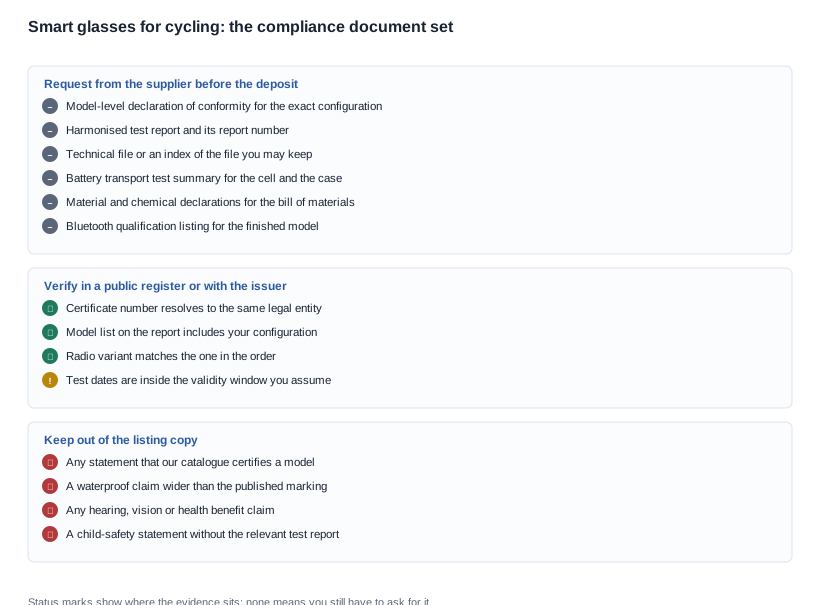
The document set itself is short enough to hold in one page, and a buyer who has it in front of them can tell in a few minutes whether a supplier's file is complete or not. What matters is that each item has a home: the declaration of conformity and its harmonised test report, the technical file or an index of the parts the buyer is allowed to keep, the material and chemical declarations tied to the bill of materials, the battery transport test summary, and the Bluetooth qualification listing for the finished model. The status marks in the checklist above show where the evidence normally sits. Most of the items start in the first column because they are requests, not documents you already hold, and the second column is where the buyer's own quality assurance does the work of checking them.
Who does the checking, and what it costs. The verification in step three is not the supplier's job, and this is the point where buyers most often under-resource a programme. The supplier can produce documents; the supplier cannot be the party that confirms a register entry, because the register is public and the check is free but has to be done by somebody with the consequence in front of them. Budget it as a half-day of quality assurance per model family in the first order and as a re-check at every revision. That is a small line item compared with a held consignment.
The six questions to ask before you order. Put these in the first round of the enquiry, in this order: which regimes apply to this model and these markets; which document in your file covers this model; which certificate numbers can I look up myself; which cell and case are inside this configuration; which radio variant is in this build; and what may I write in the listing. Asking them in the first round is what separates a quotation you can plan around from one you cannot.

Where a cycling compliance file fails after the goods have shipped
These are the failures that reach a buyer as a surprise, and each one has a control that can be written into the order rather than discovered later. The red flags are ordinary-looking documents with one detail wrong, which is why a buyer needs to know how to evaluate a file rather than simply count the papers in it.
The file covers the module, not the model. The report lists a chipset or a radio module, and the model on the purchase order is a housing assembled around it. The symptom is a registration or listing enquiry that comes back with a name nobody recognises. The control is step five: compare the model list on the file with the configuration string, line by line, and record the difference.
The battery documentation covers the glasses but not the case. The configuration added a 1400 mAh case or the 1200 mAh folding case, and the transport file was assembled before that decision was made. The symptom is a forwarder who accepts the original documentation and then queries the packed goods. The control is to fix the case decision before the file is requested, because the case changes the cell list, the packaging artwork and the transport paperwork together.
The listing claims more than the file supports. A marking on the catalogue page, a phrase in a showroom script and a certification claim in a marketplace copy are three different things, and only the third needs a document. The symptom is usually a review that says the product is not as described. The control is the claims sheet from step six, reviewed by whoever signs off the copy, not only by the person who signed the order.
The copy drifts into health or hearing language. Words like hearing aid, hearing protection, vision therapy or myopia prevention turn a consumer accessory into a regulated claim, and they do it by accident, in a translation, or in a marketing sentence written by somebody who was not told the boundary. The symptom is a listing taken down, and in some markets a recall of the printed insert. The control is a banned-phrase list attached to the claims sheet, and a rule that no one outside the compliance owner writes listing copy.
The file was handed over and not held. The supplier supplied the documents for the approval, and the buyer was never given a copy that it is permitted to keep, or was given only the declaration with no technical file index. The symptom is that the second order starts the compliance conversation from zero, with a new supplier representative who has never heard of it. The control is a clause that says the technical file, or at minimum an index of it, is a deliverable that transfers to the buyer with the first shipment.
The configuration changed after the file was made. The cell supplier changed, the radio module changed, the firmware radio profile changed, or a second factory was introduced to shorten the lead time. None of these changes is visible on the product, and all of them can affect the document. The symptom is a distributor in a second market asking why the file does not match the unit in the box. The control is change control in the purchase order, with re-verification as a condition of accepting any change.
None of these failures is exotic, and none of them is a reason to change supplier. Each is a line in an order, a clause in an agreement, or a date in a plan.

The compliance calendar and where the money sits
The cost of a file for a named model and a named variant is close to fixed, and so is the time it takes. What is negotiable is how much of that cost you pay once, how much you amortise across a programme, and what happens to the schedule if the file is the thing that slips. When to start the request, and when to insist on a copy of the technical file rather than a summary of it, are the two timing decisions that matter most.
Three costs are quoted as fixed, and the buyer should expect them to be quoted as fixed. The certification cost and its lead time for a specific model and variant, since a new radio variant is a new campaign. The test report cost itself, which belongs to the model and not to the order. And the tooling and non-recurring engineering, which the B2B_WRITING_SPEC for our own programme describes as amortised across the first order and quoted as a separate line rather than folded into the unit price. A supplier who folds compliance into the unit price is not being generous; they are hiding a fixed cost in a variable line, and the effect surfaces the moment the second order lands at a different volume.
Four things do move. The first is how many models carry the file. If several SKUs in the range share a radio module and a cell, one file may be extended across them, and the model list on that file becomes a commercial lever worth more than a unit price discount. The second is the variant question for colour, logo and packaging: those normally do not need a new file, and a supplier who quotes a new test campaign for a logo change is charging for administrative volume. The third is the claim boundary, which is genuinely yours to set and which the supplier will support with copy if you give them one. The fourth is the payment and delivery structure, where a milestone tied to the file being handed over is worth more than a discount on the unit price, because it moves the risk to the party that controls the document.
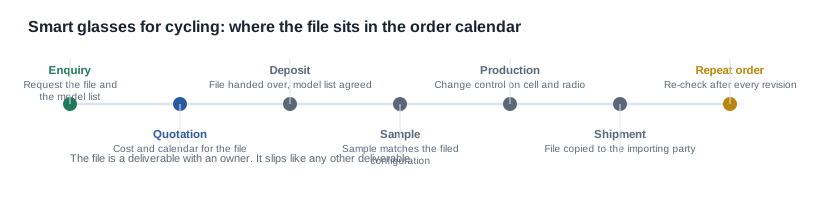
The clauses worth writing. Five lines do most of the work. First, the identity of the filed model, stated precisely enough that a different radio variant or a different cell is not covered by it. Second, the right to keep a copy of the technical file, or an index of it, with the first shipment. Third, change control: any change to the cell, the radio module, the firmware radio profile or the production site requires re-verification before it is accepted. Fourth, a remedy if the file does not cover the configuration that ships — in practice a re-test at the supplier's cost, with a stated process and not a vague commitment. Fifth, an audit right that lets your own quality assurance check the register entries rather than trusting a summary.
The total cost view, because the compliance line is usually the smallest line and the most expensive to get wrong. The programme cost is the unit price, plus the compliance cost, plus the returns reserve, plus the carrying cost of a delay. When two quotations are compared, the comparison should be made on all four, because a quotation that is four per cent higher on the unit and holds the file in three weeks can be the cheaper programme, and the reverse is equally true. That is the trade-off to negotiate hardest, and it depends on where your own programme is weakest rather than on a rule that applies to everybody.
What the catalogue claims about certification, and what it does not
On this, narrow and deliberate. We publish the rows a buyer can order from — the charging interface, the cell capacities, the charge times, the resolution class, the rated runtimes, the Bluetooth version where the catalogue publishes it, the colour counts, the case capacities where they are published, and the IP54 marking on the V06 and the S7 as a catalogue attribute. We publish the company-level export certification page that sits at the front of the catalogue. That is the whole of what we can stand behind.
What we will not do is state that a model in our range is certified to CE, FCC, RoHS or REACH, because our catalogue carries no such statement and we are not going to manufacture one from a general capability. We will not quote a certificate number, a report number or a test date that we have not been given for a specific model in writing. We will not extend the IP54 marking to the camera models where no rating is published, or beyond what the digits mean, and we will not use the word waterproof. We will not make or allow any hearing, vision or health claim, and we will not make a child-safety statement on the basis of a company-level page.
What we will do is take the models, the markets, the volumes and the configuration, and tell you which configurations exist, which published rows cover them, which cells and cases are involved, and exactly which documents have to come from us or from a sub-supplier before a purchase order is released. The scenario entry point is smart glasses for cycling, the compliance set is at market compliance centre, the product families are at sport smart glasses, and the safety side of the same scenario is at is it safe to record while cycling.
What to send us next. Send the model list, the destination markets, the volumes and the configuration string, and we will return the published rows that apply to each model, the cells and cases each configuration involves, and the document list that has to be closed out before the first shipment. If a specific item on that list is something we cannot supply ourselves, we will say so and name it as a sub-supplier item rather than let it appear as a checkbox.
Related reading
- The safety side of the same scenario — is it safe to record while cycling
- The channel considerations — smart glasses for cycling
- The compliance set — market compliance centre
- sport smart glasses
Send the models, the markets and the configuration, and we will tell you which published rows apply and which documents you still have to close.


