

A recommendation that is only a model name is a catalogue entry. A recommendation a buyer can act on names the band, names the models in it, names the published row that decides between them, and names what the buyer gives up in exchange. That is the standard this article applies to smart glasses for cycling: four bands, the models inside each one, the row that settles the choice, and the trade-off stated in a sentence a salesperson can repeat. Where a model should not go on a cycling list, it is named here rather than left out, because an exclusion a buyer cannot see is an exclusion a buyer will discover on a return rate.
Smart glasses for cycling: the named trade-off each band has to match
The recommendation, stated up front. For an entry audio band, take the two-cell magnetic group — the LC-105 pair at 55 mAh by two, the G07 and the YK12 on the same cells, the K01 and the K02 at 90 mAh by two — and accept that the two models with slim temples publish about six hours rather than eight. For a single-cell band where the packaging must stay light and the case must not become a second lithium article, take the D11 and the D12: one 100 mAh cell, Type-C charging, about seven hours. For capture that has to work without a hand leaving the bar, take the D17 or the ZH12, both Type-C with a remote capture control published, and accept that they are sport models rather than camera models. For a camera programme, the choice is between the eleven camera models, and the decision is not the resolution class — it is whether the configuration carries a case.
Who this is for. The reader is a brand owner filling a cycling range, a channel buyer with a price band and a volume to hit, and a product manager who has to justify the shortlist to somebody who was not in the specification meeting. All three need the same thing: a shortlist that survives a challenge from a colleague who asks why the more expensive model is not in it.
The four bands, and why the band comes first. The band is a commercial decision — what the channel sells, at what price, in what volume — and the model is a technical decision inside it. Running them the other way round is how programmes end up with a technically interesting model and no channel for it. Once the band is fixed, the published rows do most of the remaining work, because our catalogue describes the range in terms a buyer can order from: cell capacities, rated runtimes, charging interfaces, charge times, Bluetooth versions, resolution classes, colour counts and case capacities.
Why the recommendation carries its exclusions. A shortlist that only contains what to buy is half a document. The other half is what should not be on the list and why, because the most common failure in this category is not buying the wrong model — it is buying a model whose unanswered rows were supposed to be answered before the order. Every exclusion below is a published fact about our own catalogue, which is the only kind of exclusion a buyer can act on without a phone call.
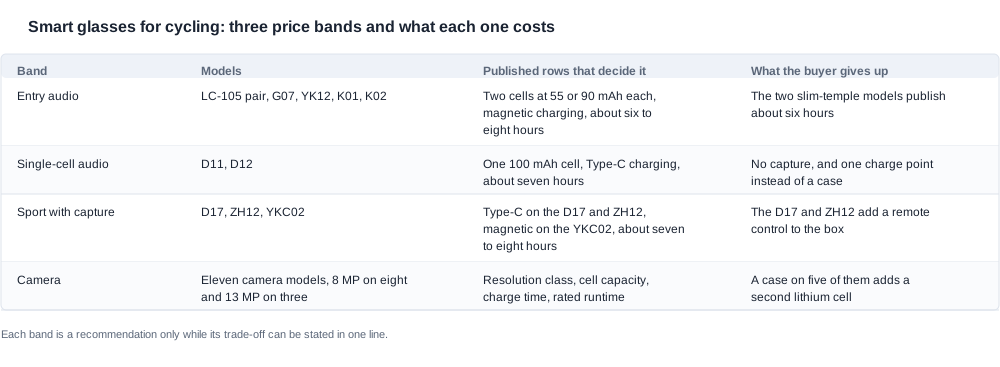
The four bands and the published rows that decide them
The entry audio band: two cells, magnetic charging, about six to eight hours. The LC-105 pair, the G07 and the YK12 all publish two 55 mAh cells, Bluetooth V5.4, magnetic charging and a charge time of two hours or less; the K01 and the K02 publish two 90 mAh cells, Bluetooth V5.3, magnetic charging and the same charge time. The published runtimes separate this band into two groups, and the separation is easy to miss: the LC-105 pair publishes about eight hours, while the G07 and the YK12 publish about six. That is not a rounding difference, and a buyer who quotes eight hours across the band is quoting a figure the catalogue does not support for two of the five models. The structural feature that separates the G07 is published and useful: ultra-slim detachable temples, which make the temple a replaceable component. The YK12 publishes a slim temple with surround sound, which is a different statement — the catalogue does not call the YK12 temple detachable, and the distinction decides whether the temple is a part or a write-off.
The single-cell band: one 100 mAh cell, Type-C, about seven hours. The D11 and the D12 publish one 100 mAh cell each, Type-C charging and a rated runtime of about seven hours. For a channel that does not want to manage a case, this is the most straightforward band in the range, and the reason is not the cell count. It is that a Type-C model recharges from a cable the customer already owns, so the charging accessory stops being a configuration decision and becomes a consumable. A magnetic model needs the case carried, and the case is a second lithium cell that has to be declared for transport, which is a document and a cost rather than a feature.
The capture band: the D17 and the ZH12, and the YKC02 beside them. The D17 publishes one 115 mAh cell, Type-C charging, about seven hours and a remote capture control; the ZH12 publishes one 100 mAh cell, Type-C charging, about eight hours, a remote capture control and surround sound. Both also publish the fastest charge time in the catalogue, at about one hour, which is what makes them fit the window between a ride and the next commitment. The YKC02 belongs in the sport family rather than the audio family — it publishes two 70 mAh cells, Bluetooth V5.4, magnetic charging and about eight hours, with surround sound and a long battery life listed as features. It is not an audio-class model and it should not be counted in an audio shortlist, which is the kind of mistake that produces a quantity plan built on the wrong number of models.
The camera band: eleven models, and the case is the decision. The eleven camera models publish either an 8 MP resolution class, which eight of them carry, or a 13 MP class, which three of them carry — the S7 and the L1 Pro, and the L2 Utral. Resolution is not what should decide the band, because the field of view is not published for any model and the difference between 8 MP and 13 MP is a sample-footage question, not a specification question. What does decide the band is the case. The CY05 and the L1 Pro, and the CY03 publish a 1400 mAh case; the L2 Utral publishes 900 or 1400 mAh as a configuration choice; the MT6 publishes a 1200 mAh folding case. The KY06 and the MT5 ship with a case whose capacity is not published, and the catalogue carries no charging case row at all for the V03 and the V03 Pro, and the V06 and the S7. So "the camera model with a case" is three different answers, and a camera programme that does not settle the case question before the order has a transport file to assemble afterwards.
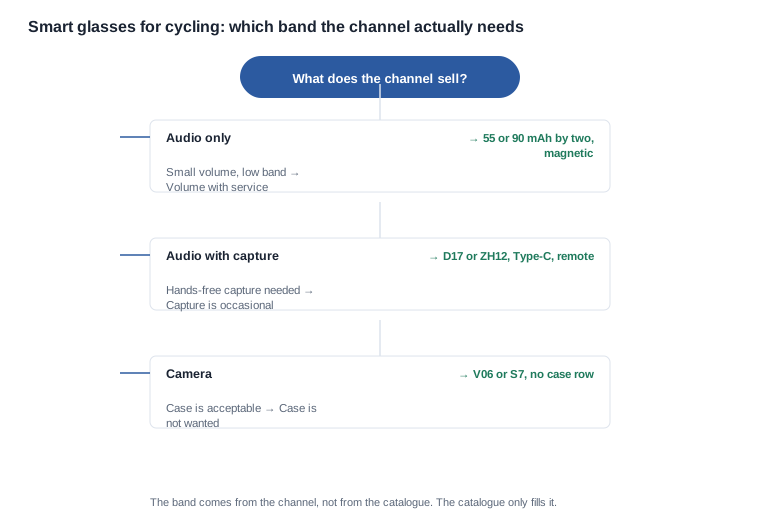
The decision chart above is the shortest version of the recommendation. It asks what the channel actually sells, and it produces a band rather than a model. The two models inside the band are then separated by published rows, not by preference, and a buyer who cannot state the separation in one sentence has not yet chosen.
What we would keep off a cycling list, and what has to be closed
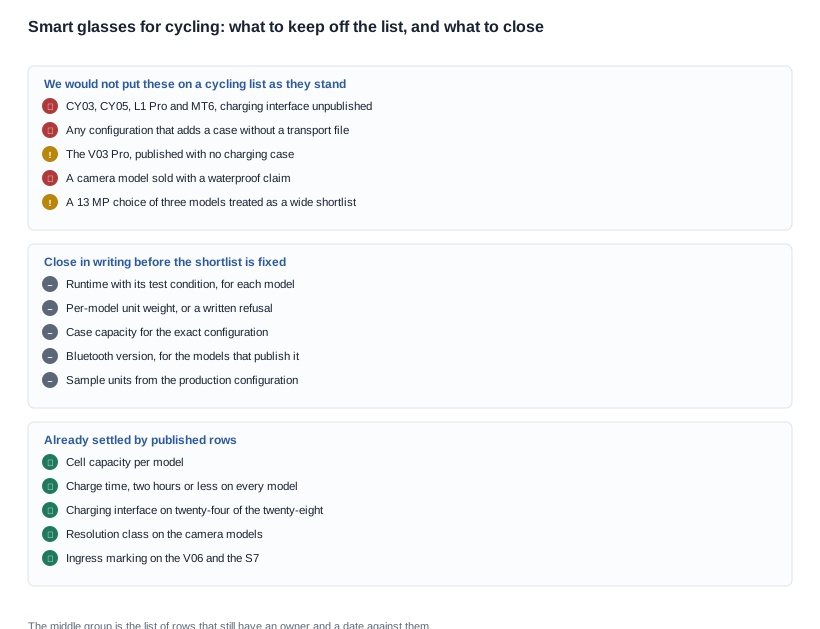
The four camera models whose charging interface is not published. The CY05 and the L1 Pro, and the MT6 and the CY03 have pages that carry pixel class, cell capacity, charge time, runtime and a case capacity, and no charging interface row at all. That is a published fact about the catalogue, and it has two consequences. The first is commercial: a model whose interface is unknown cannot be quoted with a cable and a dock in the bill of materials without a written answer. The second is legal: the transport file for the configuration cannot be scoped until the interface is known. These four models are excellent products in a configuration where the interface is settled, and they are not candidates for a shortlist that is being put together in one pass.
The V03 Pro, one of four camera models with no charging-case row. The catalogue prints nothing about the case position for it, which makes it an easy fact to miss precisely because it is not a gap. A buyer who assumes a camera model comes with a case has assumed something the catalogue never settled, and the assumption shows up as a customer expectation rather than as a specification error. The S7 and the V03, and the V06 sit in the same group: unpublished is not the same as absent, and what the carton carries for all four is a question to put to the supplier.
Any camera model sold with a waterproof claim. The V06 and the S7 are the only models in the range that publish an ingress marking, at IP54, and no third-party test report behind that marking is published. Every other camera model has no rating at all. A recommendation that puts a camera model in a wet-weather band without a corresponding claim sheet is asking a supplier to carry a claim it cannot support.
A 13 MP shortlist treated as a wide choice. Three models is a narrow shortlist, and a narrow shortlist changes the negotiating position: the buyer has less room to move on price and more need to move on terms. That is worth knowing before the order, not after the first quotation comes back with a single source in it.
The rows that still need an owner and a date. The runtime with its test condition, the per-model unit weight, the case capacity for the exact configuration, the Bluetooth version where the catalogue publishes it, and a sample unit from the production configuration. Each of these is a question to a supplier with a date attached, and each of them is cheaper to close before the shortlist is fixed than after it is printed in a price list.

Turning a recommendation into an orderable shortlist
A recommendation becomes orderable through six steps, and the value of the exercise is in the third one.

- Fix the band from the channel. What does the channel sell, at what price point, in what volume, and with what accessory expectation? The answer gives you a band, and the band is what narrows twenty-eight models to two or three.
- Read the published rows for every model inside the band. Write them side by side. The rows that separate the models are usually two or three — runtime, interface, cell count, case — and they are the rows the shortlist should be built on.
- Delete any model whose trade-off you cannot state in one line. This is the step that saves money, and it is the one that gets skipped, because deleting a model feels like narrowing the programme. What it actually does is remove the model that will generate the most argument later: the one where nobody can say what you gave up to get it.
- Ask the supplier to close the open rows in writing. Per model, per configuration, with a date. A row closed verbally is a row that will be reopened in the pre-launch review.
- Sample the two models that survived, not the whole list. A sample order of two or three units per model, against a written acceptance list, costs a fraction of a sample order across the whole band and produces the evidence that the surviving models are the right ones.
- Issue the order with the documentation attached. The file, the transport documentation for the configuration and the claims sheet travel with the purchase order rather than with a later email.
What a sample has to settle, and what it cannot. A sample settles the things a specification cannot: whether the capture is usable at riding speed, whether the controls can be operated without a hand, whether the sizing suits a real head, whether the software installs on a real network in the launch market. It cannot settle the population question from a single unit, and it cannot settle a runtime figure for a volume of use. Write both of those limits into the sample order, because a sample that passes is read by everyone involved as a general approval.
The questions that turn a shortlist into an order. Five, and they are worth more than any additional model on the list: what is the per-model unit weight, or a written statement that it is not published; what is the runtime with its test condition; what is the case capacity for the exact configuration ordered; what is the minimum order quantity per model and whether the band can be split across two purchase orders; and what is the lead time for the first shipment against the launch date. A supplier who answers all five precisely is telling you they run the programme the way you are asking you to run it.
What a recommendation has to be worth commercially
A shortlist that cannot be built commercially is not a shortlist. Four lines decide whether a recommended band works, and none of them is the unit price.
The price tier and the volume split. Each model in the range has its own tier, and the tier is where the volume actually sits — the pilot quantity that proves the programme and the run quantity that carries it. A recommendation that names one model per band is usually a recommendation that leaves the split undecided, and the split is decided later, by whoever is closest to the cash.
Landed cost, not unit price. The unit price is the cost of the device. The landed cost adds the freight, the duty treatment, the packaging, the accessory set and the compliance and testing cost of the configuration. In this category the accessory set and the second lithium cell are the two items that move landed cost most, and both are visible in the published rows: magnetic versus Type-C decides whether the case is in the box, and the case is a second cell that has to be declared and shipped.
The margin question behind the band. The band exists because the channel has a price point it has to hit. A recommendation that cannot be built at that price point is a recommendation the channel will not take, however good the model is. So the band is a commercial constraint expressed in technical language, and the right way to challenge a recommendation is to ask what happens to the margin at the band, not to ask which model is better.
The returns reserve, which belongs in the recommendation. A recommendation that only prices the unit has left out the returns reserve, and the reserve is where the unresolved rows land. A model with an unpublished charging interface, or one with a case that is not covered by a transport file, or one whose runtime has no test condition, carries a different reserve from a model whose rows are settled. The reserve is a commercial consequence of an open row, which is the clearest possible argument for closing the rows before the shortlist is fixed.
The commercial clauses that follow from the recommendation. Four lines belong in the order. The configuration string, precise enough that a different interface or a different cell is not covered by it. The minimum order quantity per model and whether the band can be split across two purchase orders. The lead time for the first shipment, stated against the launch date rather than as a range. And the remedy if the delivered configuration differs from the approved sample, written as a process rather than a principle.
Smart glasses for cycling: the band and the model we name, and the figures we will not lean on
On recommendations, that we will name a band and a model and the published row that separates them, and we will name the trade-off in the same sentence. We will not recommend a model for a use case it does not serve, and we will not recommend a camera model for a cycling programme without settling the case question first, because the case is a second lithium cell and a transport obligation before it is a convenience.
What we will not do is recommend on figures we do not publish. The lens material, the coating, the field of view, the video specification, the runtime test condition, the per-model frame weight beyond the single 158 g whole-unit figure for the MT6, and the spare part availability for the detachable temples on the G07 or the removable inner frame on the V06 and the S7 are all outside what we can substantiate, and a recommendation that leaned on any of them would be leaning on our estimate rather than on our data.
What we will do is take the band, the volume, the price point, the launch market and the accessory expectation, and return the shortlist with the published rows behind it, the trade-offs named, the exclusions named, and the questions that still need a supplier's answer before the order. The product families are at sport smart glasses, the scenario background is at smart glasses for cycling, the configuration sheet that carries the shortlist is at the configuration template, and the fault-handling side is at troubleshooting.
What to send us next. Send the channel, the price point, the volume and the launch market, and we will return the band, the two or three models inside it, the published row that separates them, and the four or five questions that have to be closed before the shortlist is printed.
Related reading
- The families of models — sport smart glasses
- The scenario background — smart glasses for cycling
- The configuration sheet — the configuration template
- Fault handling — troubleshooting
Send the channel, the price point and the volume, and we will return the band, the models and the row that separates them.


